


Master the world’s most celebrated poetic forms — from haiku to sestina — one form at a time, with guided practice and timeless examples. Write a real poem in every form you study.
What you’ll be able to do
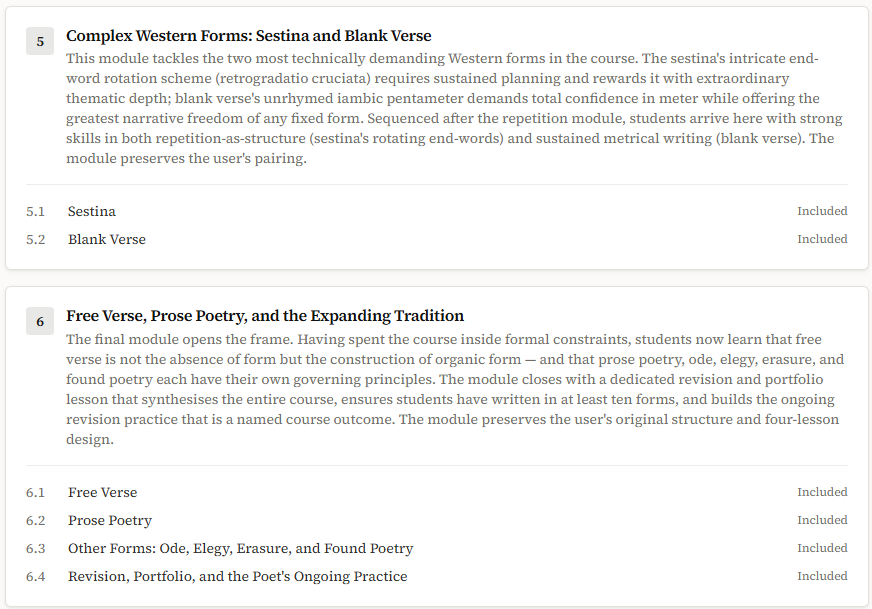
- Write a correctly structured poem in at least 10 distinct forms, from haiku to sestina
- Identify the defining rules, origins, and emotional register of each major poetic form
- Analyse canonical public-domain poems to understand how master poets work within — and bend — formal constraints
- Use meter, repetition, and refrain as deliberate creative tools rather than obstacles
- Develop a personal revision practice to refine drafts of formal and free verse poems
- Build a portfolio of original poems spanning Eastern, Western, and contemporary traditions
f you’ve ever read a poem that made you put the book down and stare at the ceiling, you already know something important: that effect wasn’t an accident. Someone made a choice — about where a line ended, about which word came back, about how many syllables to carry before the breath released. I made this course because I want you to be able to make those choices too, deliberately and with confidence.
I know what it’s like to stand at the edge of a form and feel slightly fraudulent. The sonnet, in particular, has a way of doing that — fourteen lines, iambic pentameter, a rhyme scheme you keep misremembering — until it stops feeling like a living thing and starts feeling like an exam you haven’t revised for. What I’ve learned, and what this course is built to show you, is that the rules of formal poetry are not walls. They’re more like the banks of a river: they’re what makes the water move.
What’s Included in Your Course
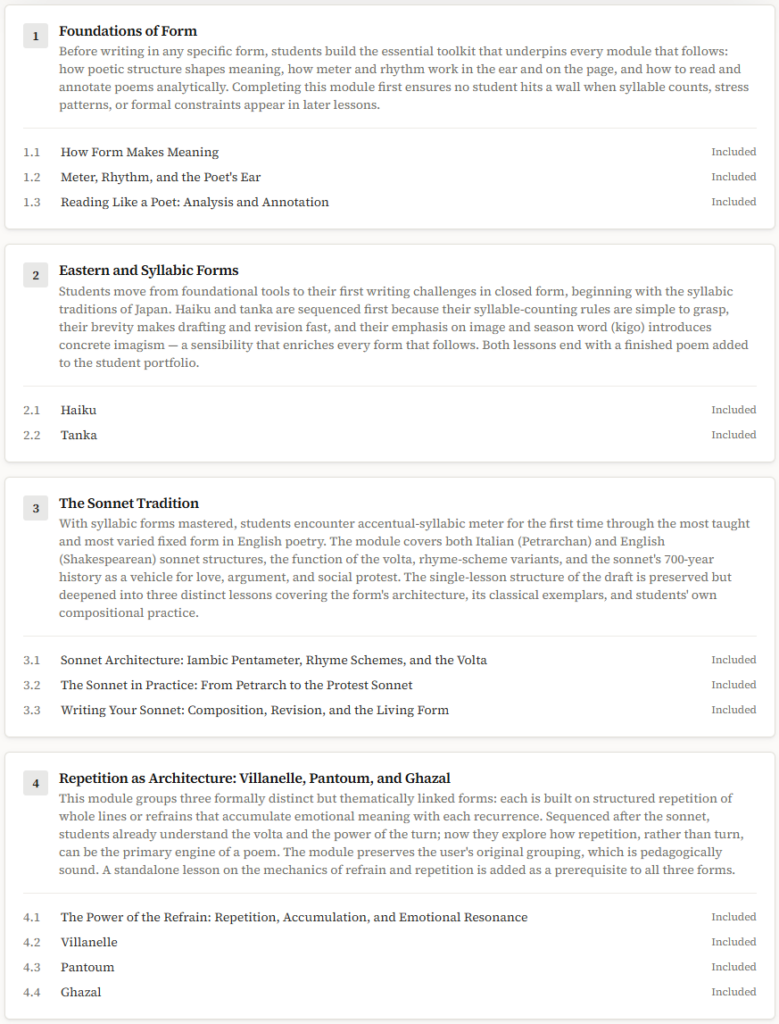
Every unit in Poetry Forms Masterclass follows the same honest sequence. First, we look at what the form actually is — its architecture, its history, the emotional logic that makes it the right container for certain kinds of feeling and not others. Then we read it, closely, in the hands of poets who knew exactly what they were doing. Then you write. Not a worksheet. A poem. Your own. I believe deeply that the only way to understand a villanelle’s refrain, or the turn of a ghazal, or the way a sestina’s end-words accumulate weight over six stanzas, is to feel those things working under your own hands.
I also want to be honest about what this course is not: it is not a shortcut to genius, and I won’t pretend that writing in form is always easy. There will be drafts that resist you. There will be a sestina that fights back. What I can promise is that you will never be alone with the blank page — every form comes with models, with craft discussion, with a clear framework that turns “I don’t know where to start” into “I know exactly what this poem needs next.”
By the time you reach the final module, you’ll have a portfolio of original poems and a revision practice that’s yours to keep. More than that, you’ll read poetry differently for the rest of your life — as a practitioner, not just an admirer. That, to me, is the real transformation. Welcome to the studio.
https://teachclub.com/@poetry_forms_masterclass


Get the Free Close Reading Worksheet Pack
Join my email list and receive the printable worksheet pack you can use with any novel or poem.
No spam. Just helpful guides for reading literature well.












