


Brave New World Character Analysis: Key People, Motivations, and Conflicts

Brave New World

Brave New World character analysis helps readers see how Aldous Huxley builds a world where comfort costs people their freedom. Each major character shows a different response to control, pleasure, and pain.

This guide breaks down the main characters, their motives, and the conflicts that shape the novel.

In this Guide

  • Why character analysis matters in the novel
  • Bernard Marx and the need to feel special
  • John the Savage and the search for meaning
  • Lenina Crowne and social conditioning
  • Mustapha Mond and the price of stability
  • How to use this analysis in essays
  • FAQ
Brave New World

Brave New World character analysis: why characters matter

The novel uses characters to test the values of the World State.

In Brave New World, people are trained to avoid deep love, strong grief, and private thought. The main characters matter because they reveal cracks in that system.

A strong Brave New World character analysis should not only ask what each person does. It should ask why they act, what they fear, and what their choices show about the society around them.

If you want a simple method for studying motives and conflicts, see our guide on how to analyze characters in literature.

Brave New World character analysis of Bernard Marx

Bernard wants to be different, but he also wants the approval of the world he criticizes.

Bernard Marx is an Alpha, so he has high status. Yet he feels insecure because he does not fit the ideal Alpha image. People mock his body, and that shame shapes much of his behavior.

At first, Bernard seems brave because he questions soma, casual relationships, and public life. He wants private feeling in a society that fears privacy.

But Bernard’s rebellion is shaky. Once he gains fame through John, he enjoys attention. He becomes proud, rude, and eager to use the same social system that once hurt him.

His main conflict is between the desire for truth and the desire for status. This makes him a flawed but useful character for essays.

Bernard is similar to some uneasy figures in modern literature who dislike society but still crave its rewards. Like Winston in 1984, he feels trapped by a system that controls human desire. Unlike Winston, Bernard’s courage fades fast.

Brave New World character analysis of John the Savage

John is the novel’s clearest outsider, and his pain exposes the World State’s emptiness.

John grows up on the Savage Reservation, where he learns pain, shame, religion, and longing. He also reads Shakespeare, which gives him a rich language for love and suffering.

When John enters the World State, he hopes to find wonder. Instead, he finds a clean, safe world that avoids deep human feeling.

John’s main motive is to live with meaning. He wants love to be sacred, not casual. He wants suffering to count, not vanish through soma.

His conflict with the World State is moral and emotional. He cannot accept a life built on comfort without truth.

John’s tragedy comes from his extreme idealism. He sees clearly that this world is false, but he cannot find a healthy way to live outside it.

For background on Huxley and the novel’s place in literature, Britannica offers a helpful overview of Brave New World.

Brave New World character analysis of Lenina Crowne

Lenina is not a villain. She shows how deeply the World State shapes normal people.

Lenina Crowne follows the rules of her society. She takes soma, repeats slogans, and believes that desire should be simple.

Still, Lenina is not flat. She has real feelings for John, even if she cannot understand his values. Her attraction to him proves that human longing still exists beneath social training.

Her main conflict is between conditioning and emotion. She feels drawn to John, but she can only express love in the terms her culture has taught her.

This makes Lenina a strong character for quote-based analysis. Her words often sound shallow, but they reveal a world where language itself has been shaped by power.

She is very different from a character like Elizabeth Bennet in Pride and Prejudice, who studies people and questions social pressure. Lenina has been taught not to question much at all.

Brave New World character analysis of Mustapha Mond

Mustapha Mond understands the truth, yet he chooses control.

Mond is one of the World Controllers. He knows about science, history, art, and religion. He is not fooled by the system, and he helps run it.

This makes him one of the most important characters in the novel. He can explain why the World State removed old forms of freedom.

Mond’s main motive is stability. He believes art, faith, and deep love create conflict. To him, peace is worth the loss of truth.

His conflict with John is the heart of the novel’s argument. John says people need the right to suffer, choose, and believe. Mond says most people are happier without those burdens.

A useful Brave New World character analysis should treat Mond with care. He is not simple. He is frightening because his logic can sound calm and reasonable.

Helmholtz Watson and the need for real expression

Helmholtz shows what happens when talent outgrows a controlled culture.

He has success, charm, and intelligence. Unlike Bernard, he is not driven by social shame. His problem is deeper.

He feels that his words should matter more. As a writer, he wants language to carry real feeling, but his world gives him shallow topics and easy slogans.

Helmholtz connects with John because both care about powerful language. Yet Helmholtz is more balanced than John. He can face exile with a sense of purpose.

His conflict is between creative force and social limits. He proves that even high-status people can feel trapped by a world that fears depth.

Linda and the pain of not belonging

Linda shows the human cost of a society that cannot deal with age, grief, or shame.

She was raised in the World State, then left behind on the Reservation. She cannot fully belong to either place.

On the Reservation, people judge her behavior. In the World State, people reject her body because she looks old and worn.

Her motive is simple. She wants comfort and escape. Soma gives her that escape, but it also removes her from real life.

Linda’s story helps students see that the World State’s promise of happiness is cruel. It only works for people who stay useful, young, and controlled.

Major character conflicts in the novel

The strongest conflicts in the novel are not only between people. They are between values.

John vs. Mond is the key debate. John defends truth and suffering. Mond defends peace and pleasure.

Bernard vs. society shows the weak side of rebellion. Bernard wants freedom, but he also wants fame.

Lenina vs. John shows two different ideas of love. Lenina sees desire as normal and easy. John sees love as sacred and full of duty.

Helmholtz vs. the World State shows the need for art. He wants language that can hold real emotion.

How to Use This Brave New World character analysis in essays

A good essay should connect character choices to the novel’s larger ideas.

Start with a clear claim. For example: Bernard Marx is not a true rebel because his desire for status is stronger than his desire for freedom.

Then use short quotes and explain them. Do not drop a quote and move on. Show how the words reveal motive, conflict, or change.

For more support, try our character analysis strategy guide before you draft your response.

You can also use our literature study resources to plan discussion posts, essays, and quote notes.

Suggested books for deeper study

These books can help you compare Huxley’s ideas with other works about control and freedom.

  • Brave New World by Aldous Huxley
  • 1984 by George Orwell
  • Fahrenheit 451 by Ray Bradbury

For more on Huxley’s life and ideas, see Britannica’s page on Aldous Huxley.

FAQ: Brave New World character analysis

Who is the most important character in Brave New World?

John is often the most important because he directly challenges the World State. His clash with Mond reveals the novel’s main debate.

Is Bernard Marx a hero?

Bernard is not a clear hero. He questions society, but he also enjoys power when it benefits him.

What does Lenina Crowne represent?

Lenina represents social conditioning. She has real feelings, but she can only express them through the values she has been taught.

Why is Mustapha Mond important?

Mond explains the World State’s logic. He shows why comfort can become dangerous when it replaces freedom.

What is the best focus for a Brave New World character analysis essay?

Focus on one character’s main conflict. Then connect that conflict to a larger theme, such as freedom, stability, or truth.

Key Takeaway

A strong Brave New World character analysis shows that each major character tests the cost of comfort. Huxley’s novel asks whether a painless life is worth it if people must give up truth, art, and real love.
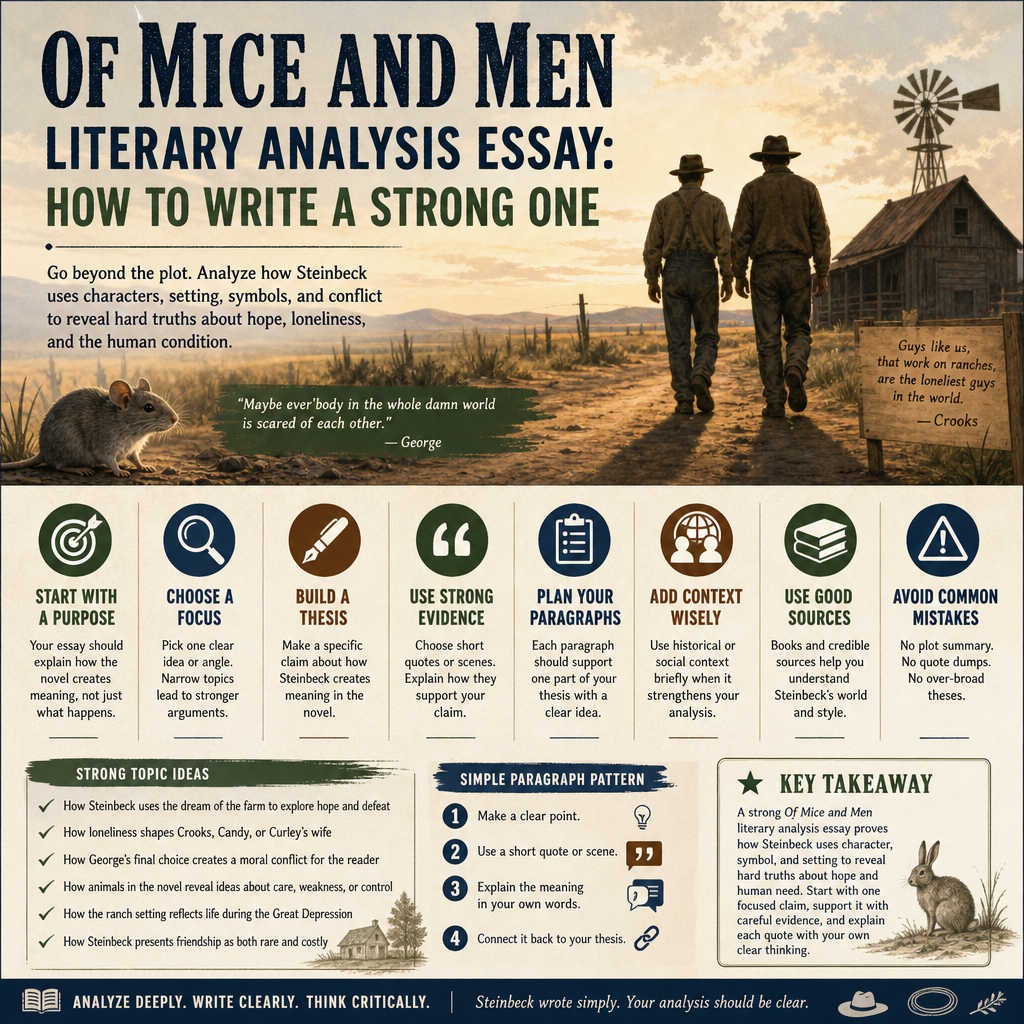

Of Mice and Men Literary Analysis Essay: How to Write a Strong One

Mice and Men

Writing an Of Mice and Men literary analysis essay can feel tough because the book is short but full of meaning. This guide will help you move from topic idea to thesis, then from evidence to a clear final draft.

You will learn how to build an argument about Steinbeck’s novel without just retelling the plot.

Mice and Men

In this Guide

Use this guide as a quick map before you write.

  • What a literary analysis essay should do
  • How to choose a strong focus
  • Thesis statement examples
  • Topic ideas for Of Mice and Men
  • Evidence suggestions from the novel
  • Helpful books and sources
  • FAQ and final takeaway

Start Your Of Mice and Men Literary Analysis Essay with a Clear Purpose

A strong essay should explain how a text creates meaning, not just what happens in the story.

In Of Mice and Men, John Steinbeck tells a simple story about George and Lennie, two workers who hope for a better life. Your job is to look deeper. Ask how Steinbeck uses character, setting, symbols, conflict, or tone to shape the reader’s view.

A plot summary says, ‘George and Lennie want a farm.’ A literary analysis says, ‘Steinbeck uses the dream of the farm to show how hope can both comfort and mislead people who live with little power.’

If you need a wider overview of essay structure, read our guide to writing a literary analysis essay. It pairs well with this Of Mice and Men literary analysis essay plan.

Choose a Focus for Your Of Mice and Men Literary Analysis Essay

Your essay becomes stronger when it studies one clear idea instead of many broad themes.

Many students start with a theme like loneliness or the American Dream. That is a good start, but it is not enough yet. You need an angle that shows what Steinbeck says about that theme.

For example, ‘loneliness’ is too broad. A sharper focus would be: ‘Steinbeck shows that loneliness can make people both cruel and desperate for connection.’

This focus keeps your Of Mice and Men literary analysis essay from drift. It also helps each body paragraph serve one main claim.

Think of how this works in other well-known books. In The Great Gatsby, a student should not just write about wealth. A stronger essay asks how wealth changes how people treat others.

Build a Thesis for an Of Mice and Men Literary Analysis Essay

Your thesis is the main argument your whole essay must prove.

A good thesis names the text, gives a clear claim, and points to how the author creates meaning. It should not sound like a fact from the plot.

Weak thesis: In Of Mice and Men, George and Lennie have a dream.

Stronger thesis: In Of Mice and Men, Steinbeck uses George and Lennie’s dream of owning land to show how hope can help people survive hardship, even when that hope is fragile.

Here are more thesis statement examples you can adapt:

  • Theme thesis: Steinbeck presents loneliness as a force that damages people’s sense of worth and pushes them to seek control over others.
  • Character thesis: Through George’s care for Lennie, Steinbeck shows that love can become a heavy moral burden in an unfair world.
  • Symbol thesis: The rabbits in Of Mice and Men symbolize Lennie’s dream of safety, but they also reveal how far that dream is from reality.
  • Setting thesis: Steinbeck uses the ranch as a harsh social world where workers compete for status because they lack real security.

Your Of Mice and Men literary analysis essay will feel much more focused if every paragraph connects back to one of these kinds of claims.

If thesis writing slows you down, the Literary Analysis Essay Toolkit gives you thesis frames, paragraph planners, and revision checklists made for student essays.

Use Evidence in Your Of Mice and Men Literary Analysis Essay

Good evidence does not speak for itself, so you must explain how it supports your claim.

Choose short quotes or moments that reveal a pattern. You do not need the longest quote. You need the most useful one.

For a theme essay on loneliness, you might study Crooks’s room and his talk with Lennie. Crooks lives apart from the other men, and his bitterness grows from that forced isolation.

For an essay on dreams, you might use the repeated description of the farm. The dream returns at key moments, which shows how much George and Lennie need it.

For an essay on power, you might study Curley’s behavior or the way the ranch workers treat Candy after his dog grows old. These scenes reveal a world where weakness can make a person unsafe.

Use this simple pattern in each body paragraph:

  • Make a clear point.
  • Use a short quote or scene.
  • Explain the meaning in your own words.
  • Connect it back to the thesis.

This pattern works for an Of Mice and Men literary analysis essay, but it also works for novels like To Kill a Mockingbird or Lord of the Flies.

Of Mice and Men Literary Analysis Essay Topic Ideas

The best topic gives you room to argue, not just describe.

Here are strong topic angles for your essay:

  • How Steinbeck uses the dream of the farm to explore hope and defeat
  • How loneliness shapes Crooks, Candy, or Curley’s wife
  • How George’s final choice creates a moral conflict for the reader
  • How animals in the novel reveal ideas about care, weakness, or control
  • How the ranch setting reflects life during the Great Depression
  • How Steinbeck presents friendship as both rare and costly

Once you pick a topic, turn it into a question. For example: ‘How does Steinbeck use Candy’s dog to prepare the reader for the ending?’ Your answer can become your thesis.

This step will help your Of Mice and Men literary analysis essay sound more original and less like a report.

Plan Body Paragraphs Before You Draft

A simple plan can save you from a messy essay.

Each body paragraph should cover one part of your thesis. If your thesis is about hope, loneliness, or moral choice, each paragraph should show a different piece of that idea.

Here is a sample plan for a thesis about the dream of the farm:

  • Body paragraph 1: The farm gives George and Lennie comfort in a hard world.
  • Body paragraph 2: The dream attracts others because many characters feel trapped.
  • Body paragraph 3: The collapse of the dream shows the limits of hope in an unfair society.

Be careful with your topic sentences. Do not start every paragraph with plot. Start with an idea.

Plot-based: Lennie talks about rabbits again.

Analysis-based: Lennie’s repeated focus on rabbits shows his need for a safe future he can understand.

For more help with paragraph shape, our literary analysis essay guide breaks down claims, evidence, and commentary in a clear way.

Add Context Without Letting It Take Over

Context can help, but the novel must stay at the center of your essay.

Of Mice and Men connects to the Great Depression, migrant labor, and the struggle for economic security. These facts can support your analysis, but they should not replace close reading.

A useful sentence might say: ‘The ranch reflects the unstable lives of workers during the Great Depression, which makes George and Lennie’s dream feel urgent.’

For quick background, you can use Britannica’s biography of John Steinbeck. You can also read the Nobel Prize profile on Steinbeck for a short view of his literary importance.

Helpful Books to Consider

These books can help you understand Steinbeck’s world and style.

If you shop on Amazon or use your school library, look for these titles:

  • Of Mice and Men by John Steinbeck
  • The Grapes of Wrath by John Steinbeck
  • Steinbeck: A Life in Letters edited by Elaine Steinbeck and Robert Wallsten

The first title is the main text. The other books can help you see Steinbeck’s wider concerns with work, poverty, and human dignity.

Common Mistakes to Avoid in an Of Mice and Men Literary Analysis Essay

Small choices can weaken your essay even when your idea is strong.

Do not write a full plot summary. Your teacher already knows the story. Focus on what Steinbeck does and why it matters.

Do not use quotes without commentary. After each quote, explain the word choice, symbol, contrast, or character action that supports your claim.

Do not make your thesis too broad. A claim like ‘Steinbeck shows life is hard’ is true, but it is not specific enough for a strong essay.

Do not ignore the ending. Even if your essay is not only about the final scene, the ending often changes how readers understand earlier dreams and choices.

FAQ: Of Mice and Men Literary Analysis Essay

Here are quick answers to common student questions.

What is a good thesis for an Of Mice and Men literary analysis essay?

A good thesis makes a clear claim about how Steinbeck creates meaning. For example: ‘Steinbeck uses George and Lennie’s dream to show how hope can comfort people who live with fear and uncertainty.’

What themes can I write about?

You can write about loneliness, dreams, friendship, power, mercy, or social inequality. Pick one theme and make a specific claim about it.

How many quotes should I use?

Use enough quotes to prove your points, but do not overload the essay. One strong quote or scene per body paragraph often works well.

Should I include historical context?

Yes, but keep it brief. Use context only when it helps explain the novel’s setting, conflict, or characters.

Can I write about George’s final choice?

Yes. That topic works well because it lets you analyze love, responsibility, and moral conflict in one focused argument.

Key Takeaway

A strong ending should remind you what matters most.

A strong Of Mice and Men literary analysis essay does not just explain the story. It proves how Steinbeck uses character, symbol, and setting to reveal hard truths about hope and human need.

Start with one focused claim, support it with careful evidence, and explain each quote with your own clear thinking. That is the heart of literary analysis. ✍️

Hamlet Summary and Analysis for Students

Rapid Reads Press

Shakespeare’s Hamlet can feel complex at first, but the story becomes clearer when you track the choices behind each scene. This Hamlet summary and analysis gives students a simple path through the plot, major conflicts, structure, and meaning.

In this Guide

Use these sections to find the part of the play you need most.

  • Quick overview
  • Act-by-act plot guide
  • Main characters
  • Key conflicts
  • Themes and symbols
  • Study tips
  • FAQ

Hamlet Summary and Analysis: Quick Overview

Hamlet is a revenge tragedy about grief, doubt, and the danger of delay.

The play takes place in Denmark. Prince Hamlet returns home after his father, King Hamlet, dies. His mother, Gertrude, has quickly married Claudius, the dead king’s brother.

Hamlet soon meets the ghost of his father. The ghost says Claudius murdered him and tells Hamlet to seek revenge.

This news traps Hamlet between action and thought. He wants justice, but he also wants proof. That inner struggle drives the whole play.

Hamlet Summary and Analysis by Act

Each act moves Hamlet closer to a final choice he cannot avoid.

A useful Hamlet summary and analysis often starts with the ghost because it gives the play its central problem. Hamlet must decide if the ghost tells the truth or if it tempts him toward sin.

Act 1

The guards at Elsinore Castle see a ghost that looks like the dead king. Hamlet later meets it, and the ghost claims Claudius poured poison into his ear.

Hamlet swears to remember his father. He also says he may act strange so he can watch others without clear blame.

Act 2

Claudius and Gertrude worry about Hamlet’s behavior. They ask Rosencrantz and Guildenstern, Hamlet’s old friends, to spy on him.

Polonius thinks Hamlet has gone mad because Ophelia rejected him. Hamlet, though, seems more aware than others know.

A group of actors arrives. Hamlet plans to use a play to test Claudius’s guilt.

Act 3

Hamlet gives his famous “To be, or not to be” speech. He weighs life, death, pain, and fear.

The court watches the play Hamlet has arranged. When the actors show a murder like the one described by the ghost, Claudius reacts with guilt.

Later, Hamlet visits Gertrude. He kills Polonius by mistake, thinking Claudius hides behind a curtain.

Act 4

Claudius sends Hamlet to England with secret orders for his death. Hamlet escapes and returns to Denmark.

Ophelia loses her grip on reason after her father dies. She later drowns, and her death deepens the tragedy.

Laertes comes home angry and ready to avenge Polonius. Claudius uses that anger to plan Hamlet’s death.

Act 5

Hamlet returns wiser but still marked by loss. In the graveyard, he sees the skull of Yorick and faces the truth that all people die.

The final duel begins between Hamlet and Laertes. Poisoned weapons and a poisoned cup lead to the deaths of Gertrude, Laertes, Claudius, and Hamlet.

Main Characters and Their Roles

The characters in Hamlet often reveal truth through what they hide.

  • Hamlet: The prince of Denmark. He is thoughtful, angry, and trapped by doubt.
  • Claudius: Hamlet’s uncle and the new king. He is clever, guilty, and hungry for power.
  • Gertrude: Hamlet’s mother. Her quick marriage makes Hamlet feel betrayed.
  • Ophelia: Polonius’s daughter. She is caught between family duty and love for Hamlet.
  • Polonius: A court adviser who loves control but often misreads people.
  • Laertes: Ophelia’s brother. He acts fast, which makes him a sharp contrast to Hamlet.

Hamlet Summary and Analysis of Key Conflicts

The play’s conflicts come from revenge, mistrust, and moral fear.

This Hamlet summary and analysis should make one point clear: Hamlet does not delay because he is lazy. He delays because every choice seems dangerous.

Hamlet vs. Claudius is the main outer conflict: Hamlet wants to expose and punish Claudius, but Claudius controls the court.

Hamlet vs. himself is the deeper conflict. He wants action, yet he fears error, sin, and the unknown after death.

Hamlet vs. the court shows how power creates false behavior. Almost everyone watches someone else, which makes honesty rare.

Themes and Symbols in Hamlet

Shakespeare builds meaning through repeated images, hard choices, and sharp contrasts.

Revenge is the most obvious theme. Hamlet, Laertes, and Fortinbras all want to answer a father’s death, but each man responds in a different way.

Madness is harder to judge. Hamlet may act mad by choice, but Ophelia’s pain seems real and tragic.

Death shadows the whole play. The graveyard scene forces Hamlet to see that kings, fools, and princes all end the same way.

Poison works as both a plot device and a symbol. Claudius poisons the old king, but lies also poison the life of Denmark.

If you want to dig into these details, try close reading in literature. It helps you notice how words, images, and patterns shape meaning.

Structure and Soliloquies

The shape of the play lets us hear Hamlet’s private mind while the public world falls apart.

Hamlet follows the pattern of a revenge tragedy, but Shakespeare makes the form more complex. Instead of rushing toward revenge, Hamlet tests, thinks, and doubts.

The soliloquies are key because Hamlet speaks alone to the audience. These speeches show the gap between what he feels inside and what he shows at court.

The play within the play is also important. Hamlet uses art to reveal truth, much like a detective uses evidence.

Why This Hamlet Summary and Analysis Matters for Students

Hamlet still matters because it asks questions students know well.

Use this Hamlet summary and analysis to see that the play is not only about revenge. It is also about grief, trust, family pressure, and the fear of making the wrong choice.

Like Macbeth, the play shows how ambition can destroy a nation. Unlike Macbeth, Hamlet knows too much and acts too late.

That difference makes Hamlet feel modern. He is not a simple hero. He is a person who thinks deeply and suffers because of it.

How to Study Hamlet Without Getting Lost

Read for choices, not just events.

Before each scene, ask what Hamlet wants and what blocks him. This keeps the plot clear.

Mark moments when characters spy, lie, or perform a role. These patterns help you write stronger essays.

If you want a simple companion for class notes, try this student literature study guide as you review scenes and quotes.

Recommended Books for Deeper Study

These books can help if you want more context after the play.

You can look for these on Amazon or at a library.

  • Hamlet by William Shakespeare, edited by Ann Thompson and Neil Taylor
  • Shakespeare: The World as Stage by Bill Bryson

Further Reading

These trusted sources give more background on Shakespeare and the play.

FAQ

Here are quick answers to common student questions about the play.

What is the main point of a Hamlet summary and analysis?

A Hamlet summary and analysis explains the plot and shows how Shakespeare uses conflict, language, and character choices to create meaning.

Why does Hamlet delay his revenge?

Hamlet delays because he wants proof and fears the moral cost of murder. His mind keeps testing every action.

Is Hamlet really mad?

The play leaves this partly open. Hamlet says he will act strange, but his grief and anger may also push him close to real madness.

What is the main theme of Hamlet?

One main theme is the struggle between thought and action. The play asks what happens when a person knows the truth but cannot act with peace.

Key Takeaway

The best Hamlet summary and analysis shows that the play is more than a revenge story. It is a study of grief, doubt, and the heavy cost of truth.