

Knowing the difference between verbal irony and dramatic irony can make literature feel much less confusing. In this guide, Verbal Irony vs Dramatic Irony Explained, you will learn what each term means, how to spot it, and how to use it in a strong essay.
Both types of irony deal with a gap between what seems true and what is true. The key is knowing where that gap happens.
In this Guide
- The core difference
- What verbal irony means
- What dramatic irony means
- Examples from literature
- How to use irony in analysis
- Books that help
- FAQ
Verbal Irony vs Dramatic Irony Explained: The Core Difference
The simplest way to tell them apart is to ask who knows the truth.
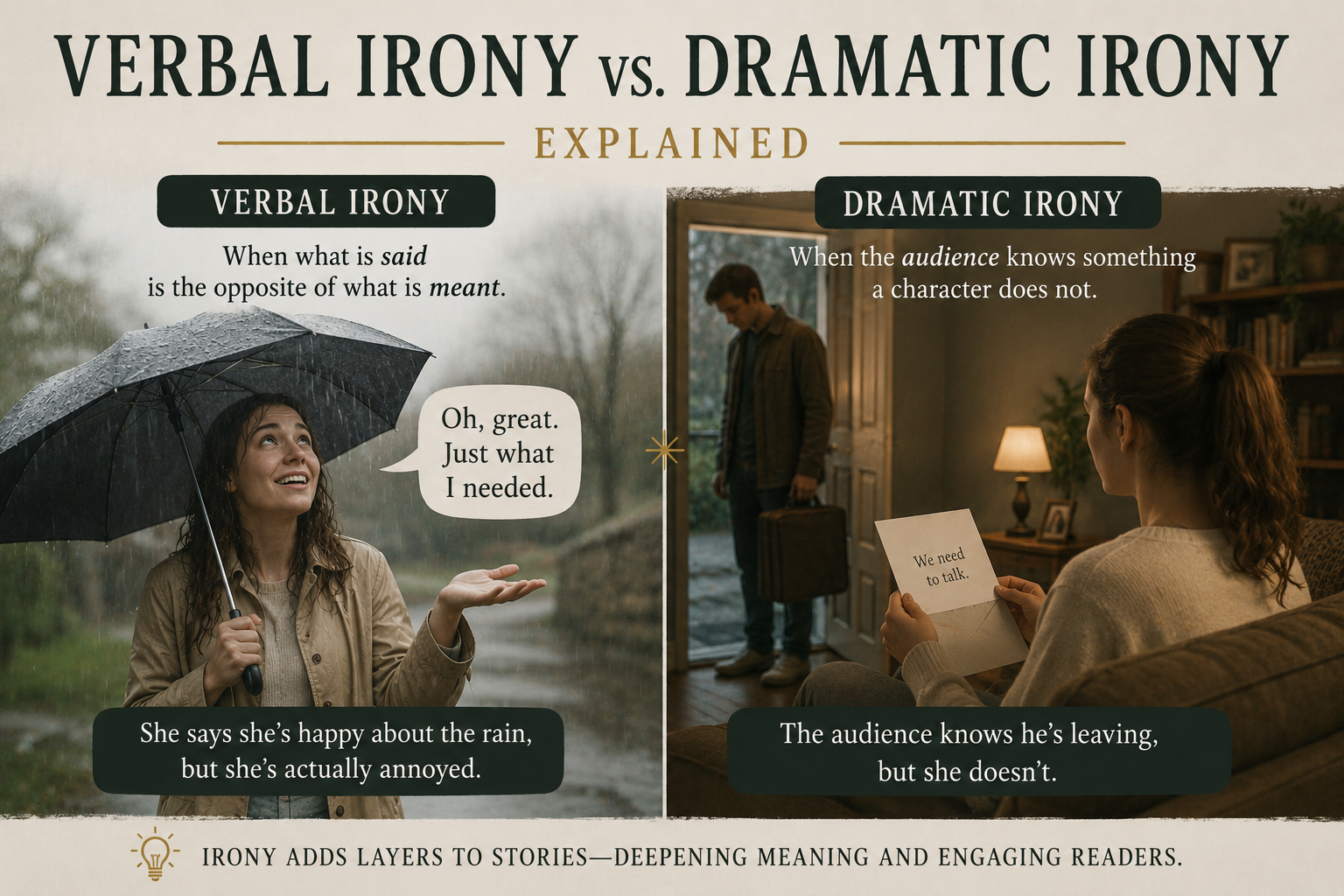
Verbal irony happens when a speaker says one thing but means something different. The meaning often depends on tone, context, or contrast.
Dramatic irony happens when the audience knows something a character does not know. This creates tension because readers can see the danger, mistake, or truth before the character can.
So, Verbal Irony vs Dramatic Irony Explained comes down to this: verbal irony is about what a character says, while dramatic irony is about what the audience knows.
If you want a broader review of related terms, this literary devices list can help you connect irony to satire, foreshadowing, and tone.
Verbal Irony vs Dramatic Irony Explained: What Verbal Irony Means
Verbal irony is a gap between words and meaning.
When a character uses verbal irony, they do not mean the literal words they say. Sometimes the line is funny. Other times, it feels sharp or bitter.
For example, if a student walks out of a hard test and says, “Well, that was easy,” the student likely means the opposite. That is verbal irony.
In literature, verbal irony often helps reveal a character’s attitude. It can show anger, pride, wit, or hidden pain.
Jane Austen uses verbal irony in Pride and Prejudice. The famous opening line says, “It is a truth universally acknowledged, that a single man in possession of a good fortune, must be in want of a wife.”
On the surface, the line sounds serious. But Austen is poking fun at social rules about marriage and money. The words sound grand, but the meaning is satirical.
This is why Verbal Irony vs Dramatic Irony Explained matters for close reading. If you miss the tone, you may miss the real meaning of the line.
Verbal Irony vs Dramatic Irony Explained: What Dramatic Irony Means
Dramatic irony is a gap between the audience’s knowledge and a character’s knowledge.
The character speaks or acts without the full truth. The reader knows more, so the scene feels tense, sad, or darkly funny.
In Romeo and Juliet, the audience knows Juliet is not truly dead. Romeo does not know this. When he finds her and believes she has died, the scene becomes tragic because readers can see the mistake before he can.
This is one of the clearest examples of dramatic irony in English literature. The audience wants Romeo to learn the truth, but he acts too soon.
Sophocles also uses dramatic irony in Oedipus Rex. Oedipus searches for the cause of a plague, but the audience slowly sees that he himself is tied to the crime he wants to solve.
For more background on the term, you can read Britannica’s overview of irony in literature.
Verbal Irony vs Dramatic Irony Explained Through Literature
Examples make the difference easier to see.
In Julius Caesar, Mark Antony calls Brutus an “honourable man” during his funeral speech. He repeats the phrase while proving that Brutus acted with betrayal. The words say one thing, but the meaning points the other way.
That is verbal irony. Antony’s tone and context change the meaning.
In Macbeth, King Duncan trusts Macbeth and praises his castle. The audience already knows Macbeth plans to kill him. Duncan does not know he has entered a place of danger.
That is dramatic irony. The audience’s knowledge makes the scene feel tense.
In The Odyssey, Odysseus hides his identity when he returns home. The audience knows who he is, but many characters do not. Their words and actions carry extra meaning because readers know the truth.
When you compare these examples, Verbal Irony vs Dramatic Irony Explained becomes much clearer. One depends on speech. The other depends on unequal knowledge.
Verbal Irony vs Dramatic Irony Explained for Literary Analysis
To write about irony well, do more than name the device.
Start by explaining the gap. Ask: what is said versus what is meant? Or ask: what does the audience know that the character does not?
For verbal irony, focus on tone. A character may sound polite but mean an insult. A narrator may sound serious but expose a foolish idea.
For dramatic irony, focus on effect. The audience may feel fear, pity, or suspense because they know what the character cannot see.
A strong sentence might look like this:
“Shakespeare uses dramatic irony in Romeo and Juliet because the audience knows Juliet is alive, while Romeo believes she is dead. This makes Romeo’s choice feel more tragic because the reader sees that the disaster could have been avoided.”
For verbal irony, you might write:
“Austen uses verbal irony in the opening of Pride and Prejudice to mock the social belief that wealthy men must be seeking wives. The formal tone makes the idea sound official, but the real meaning is critical and playful.”
That is the heart of Verbal Irony vs Dramatic Irony Explained in essay form. Identify the type, explain the gap, then connect it to the author’s purpose.
Quick Comparison: Verbal Irony vs Dramatic Irony Explained
A quick side-by-side view can help before a quiz or essay.
| Type of Irony | Where the Gap Happens | Simple Example | Common Effect |
|---|---|---|---|
| Verbal irony | Between words and meaning | A character says “Lovely weather” during a storm | Humor or criticism |
| Dramatic irony | Between audience knowledge and character knowledge | The reader knows a secret that the character misses | Suspense or tragedy |
If you are not sure which one you see, ask one question: is the irony in the words, or is it in what the audience knows?
Common Mistakes Students Make
Many students mix up verbal irony and sarcasm.
Sarcasm is a kind of verbal irony, but it is usually harsher. Verbal irony can be funny, polite, or subtle. Sarcasm tends to mock.
Another common mistake is calling every surprise “dramatic irony.” A plot twist is not always dramatic irony. The audience must know something important before the character does.
It also helps to avoid vague phrases like “this makes the story interesting.” Instead, explain the exact effect. Does the irony create suspense? Does it reveal a flaw? Does it help the author criticize society?
For more help with terms that often appear in essays, see this guide to literary devices.
Books That Help You Study Irony
These books include strong examples of verbal irony, dramatic irony, or both.
- Pride and Prejudice by Jane Austen
- Romeo and Juliet by William Shakespeare
- Oedipus Rex by Sophocles
You can also explore the Folger Shakespeare Library’s resources on Romeo and Juliet for more context on Shakespeare’s tragedy.
FAQ: Verbal Irony vs Dramatic Irony Explained
What is the main difference between verbal irony and dramatic irony?
Verbal irony happens when someone says one thing but means another. Dramatic irony happens when the audience knows something a character does not.
Is sarcasm the same as verbal irony?
Not exactly. Sarcasm is a sharper form of verbal irony. It often aims to mock or criticize.
Can dramatic irony happen in a novel?
Yes. Dramatic irony can happen in novels, plays, short stories, and films. It only needs a gap between what the audience knows and what a character knows.
Why do authors use irony?
Authors use irony to create humor, build tension, reveal character, or criticize a belief.
How do I write about irony in an essay?
Name the type of irony, explain the gap, and connect it to the meaning of the work.
Key Takeaway
Verbal Irony vs Dramatic Irony Explained is simple once you focus on the gap. Verbal irony is about words versus meaning, while dramatic irony is about audience knowledge versus character knowledge.
If you can explain that difference with a clear example, you can use irony with confidence in any literature essay.












