


Books About Parallel Worlds invite readers to step through doors, mirrors, wardrobes, and hidden cracks in reality. These stories ask a powerful question: what if another world existed beside our own?
For students, these books offer more than adventure. They help us study identity, choice, power, and the strange feeling of not quite belonging.
In this Guide
- Why parallel world stories matter
- Classic examples in literature
- Modern books to read
- Major themes and symbols
- How to analyze these stories
- FAQs
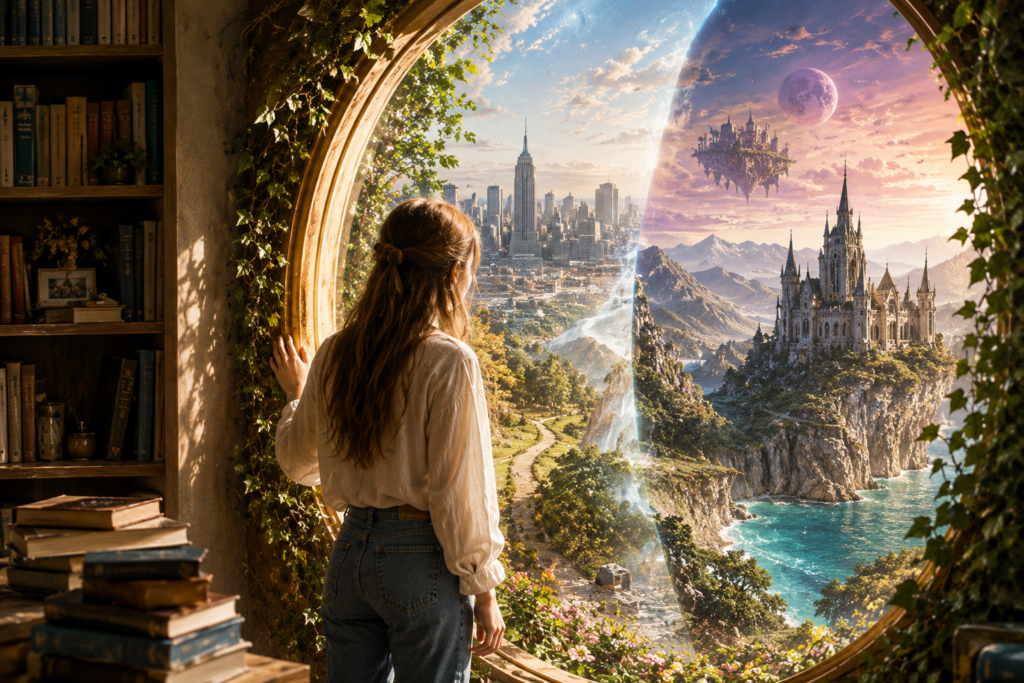
Why Books About Parallel Worlds Still Matter
These stories turn “what if?” into a full literary world.
Books About Parallel Worlds are popular because they make reality feel flexible. A character may leave home and enter a place where the rules are strange, unfair, or magical.
That new world often reflects problems from the real one. A cruel ruler, a broken family, or a hidden danger may appear in a form that feels larger than life.
This is why parallel world fiction works so well for students. It gives readers an exciting plot while also raising serious questions about growing up, truth, and moral choice.
Classic Books About Parallel Worlds in Literature
Many famous stories use other worlds to explore courage and belief.
One of the best-known examples is Alice’s Adventures in Wonderland by Lewis Carroll. Alice falls into a world where logic breaks down. The story feels playful, but it also questions adult rules and language.
The Chronicles of Narnia by C.S. Lewis is another key example. A wardrobe becomes a doorway to Narnia, a world filled with danger, wonder, and moral tests.
These classic Books About Parallel Worlds use fantasy settings to show inner change. The journey into another world becomes a journey into fear, faith, or self-knowledge.
For background on the fantasy genre, Britannica offers a useful overview of fantasy as a literary form.
Modern Books About Parallel Worlds Students Should Know
Recent authors often make parallel worlds darker, stranger, or more personal.
His Dark Materials by Philip Pullman is one of the most important modern examples. The series moves through several worlds and asks deep questions about authority, knowledge, and freedom.
Coraline by Neil Gaiman gives readers a chilling version of the parallel world idea. Coraline finds another home that looks like hers, but everything feels wrong. The “other mother” turns comfort into a threat.
Books About Parallel Worlds like these are useful in class because they mix suspense with meaning. They show how a second world can reveal what a character fears most.
Recommended Books About Parallel Worlds
These titles are strong choices for students, book clubs, and fantasy readers.
- Alice’s Adventures in Wonderland by Lewis Carroll
- Coraline by Neil Gaiman
If you want a longer and more complex read, try Northern Lights by Philip Pullman, published as The Golden Compass in the United States.
Each book uses a different doorway into the impossible. One uses nonsense, one uses horror, and one uses epic fantasy.
Themes in Books About Parallel Worlds
Parallel worlds often reveal hidden truths about the real world.
A major theme is identity. Characters often learn who they are only after they leave the world they know. Alice, Coraline, and Lyra all face versions of fear, power, and choice.
Another key theme is escape. At first, the other world may seem better than ordinary life. Soon, the character learns that escape can come with danger.
Books About Parallel Worlds also explore control. A strange world may have harsh rules, false kindness, or leaders who demand obedience. This helps readers think about freedom in their own lives.
Symbols Commonly Found in Books About Parallel Worlds
These stories often use simple objects with deep meaning.
Doors, mirrors, wardrobes, tunnels, and windows often act as symbols of change. They mark the point where a character leaves one version of life and enters another.
Food can also become symbolic. In many fantasy stories, eating in another world can signal trust, danger, or temptation.
In Coraline, buttons are especially important. They seem small, but they stand for control and the loss of human feeling.
How to Read Books About Parallel Worlds for Class
A strong reading looks at both plot and meaning.
When you study Books About Parallel Worlds, ask why the author created the second world. Is it a dreamlike escape, a warning, or a mirror of real life?
Pay attention to the moment of crossing. The way a character enters the other world often tells you what the story values.
If you need help turning these ideas into a school paper, this guide on how to write a literary analysis essay can help you build a clear argument.
Books About Parallel Worlds and Literary Culture
These stories shape how readers think about imagination.
Books About Parallel Worlds appear in children’s literature, young adult fiction, science fiction, and fantasy. They appeal to many ages because they make the familiar feel strange.
They also connect with real ideas from science and philosophy. The term “multiverse” is often used in science, though fiction uses the idea more freely. Britannica has a helpful entry on the multiverse if you want more context.
In literature, the point is not always science. The second world often helps readers feel the emotional truth of a character’s life.
FAQ: Books About Parallel Worlds
What are Books About Parallel Worlds?
They are stories where characters enter or discover another reality. That world may be magical, futuristic, dreamlike, or strange.
Why do authors use parallel worlds?
Authors use them to explore identity, fear, power, and choice. A second world can make hidden problems easier to see.
Is a parallel world the same as a fantasy world?
Not always. Some fantasy worlds stand alone, while parallel worlds usually exist beside or behind the main world.
What is a good parallel world book for students?
Coraline is a strong choice because it is short, suspenseful, and rich with symbols. Alice’s Adventures in Wonderland is also useful for studying language and logic.
Key Takeaway
Books About Parallel Worlds matter because they make imagination feel meaningful. They show that another world can help us understand this one more clearly.
Whether the doorway is a wardrobe, a mirror, or a hidden hall, the best stories leave readers changed after they return.












