
Their Eyes Were Watching God Quotes Explained: Important Passages for Essays

Their Eyes Were Watching God Quotes

A guide to memorable passages and how students can use them in essays.

Students often remember Zora Neale Hurston’s novel for its rich voice, bold symbols, and deep look at Janie’s self-discovery. This guide to Their Eyes Were Watching God quotes explained will help you connect key passages to theme, character, and essay claims.

In this Guide

  • Why the quotes matter
  • The horizon and Janie’s dreams
  • Voice, silence, and storytelling
  • Love, power, and marriage
  • Nature, the storm, and fate
  • How to use quotes in essays
  • FAQ
Their Eyes Were Watching God Quotes

Their Eyes Were Watching God quotes explained: why the passages matter

Hurston uses short, vivid lines to show Janie’s growth from a young dreamer into a woman who owns her story.

When you study Their Eyes Were Watching God quotes explained, look for two things: what the words say on the surface and what they reveal about Janie’s inner life.

The novel works like a framed story. Janie tells Pheoby what happened, so the quotes often carry both memory and meaning.

Essay tip: Do not drop a quote into your paragraph and move on. Explain how the language proves your point.

Their Eyes Were Watching God quotes explained: the horizon and Janie’s dreams

The horizon is one of the novel’s strongest symbols because it marks the space between what Janie has and what she wants.

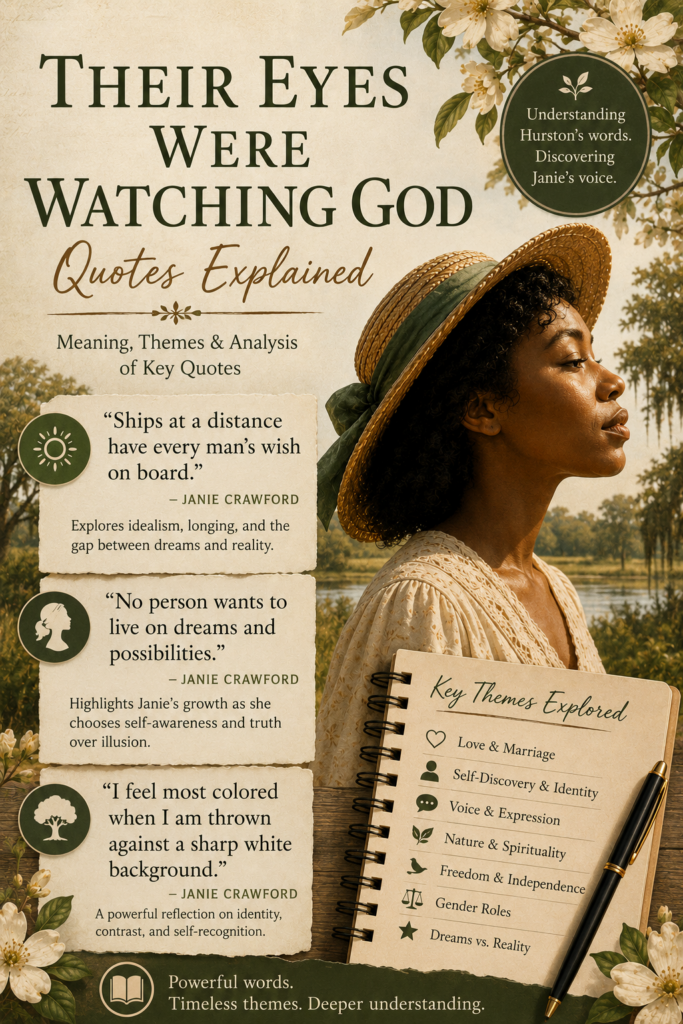
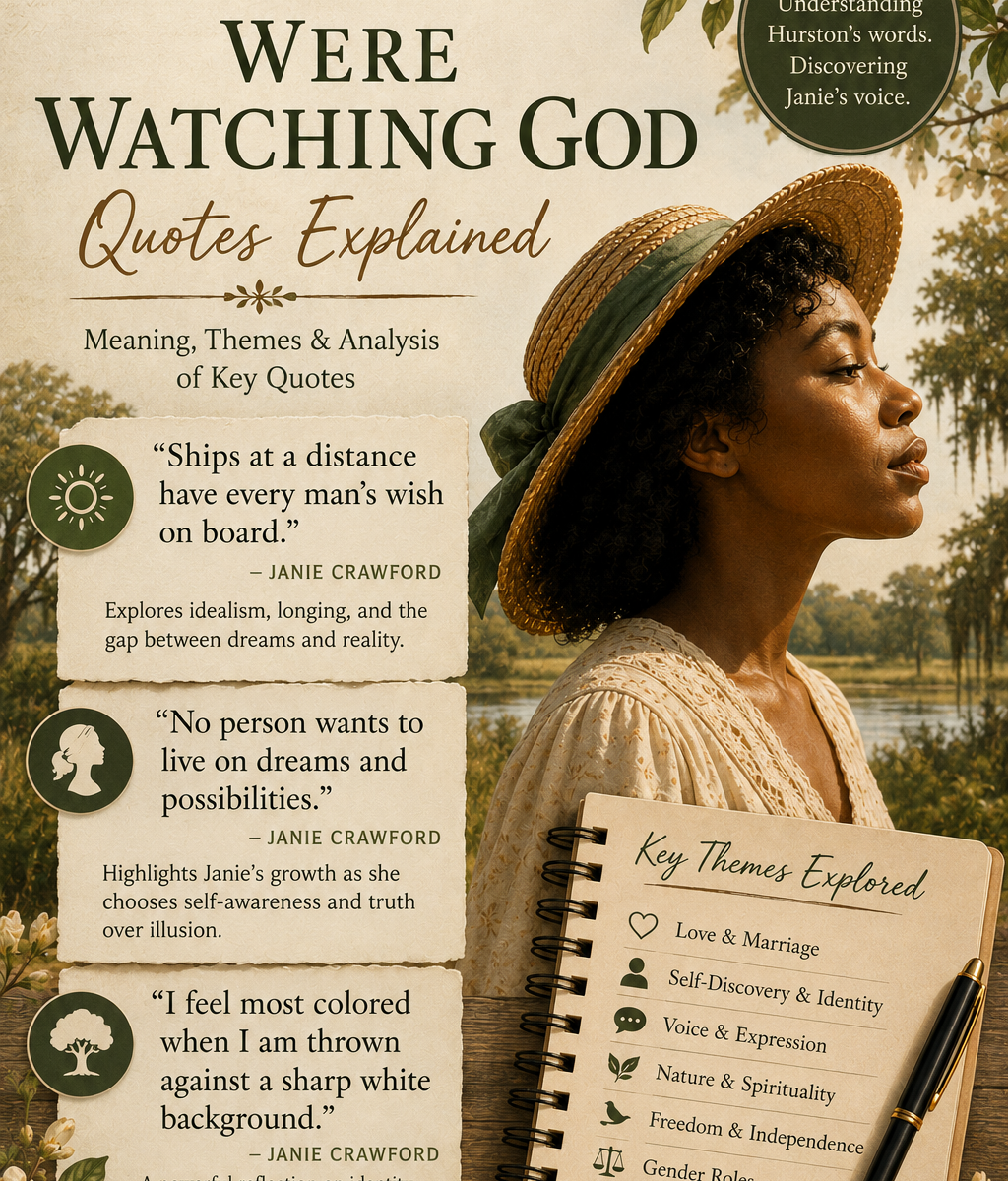
Short quote: “Ships at a distance”

This opening image links dreams to ships far away on the water. It suggests that some people keep waiting for life to bring their hopes closer.

For Janie, the horizon means more than travel. It stands for freedom, desire, and a future she can choose for herself.

This is a key reason Their Eyes Were Watching God quotes explained can help students write about theme. The same symbol returns as Janie learns what love, independence, and self-knowledge mean.

A useful comparison is the green light in The Great Gatsby. Both symbols point toward desire, but Hurston’s horizon becomes more personal because Janie earns a clearer view of herself.

Voice, silence, and Their Eyes Were Watching God quotes explained

Janie’s journey is not only about love. It is also about finding the right to speak.

Short quote: “the horizon”

Near the end, Janie’s return to this image shows that she has not lost her dream. She has changed how she understands it.

At the start, others speak for her or over her. Nanny, Logan, and Joe all try to shape her life through their own ideas of safety, labor, or public image.

Joe Starks is especially important here. He wants Janie to look like a mayor’s wife, but he does not want her to have a public voice.

Use Their Eyes Were Watching God quotes explained to show how Hurston connects speech with power. When Janie speaks at last, her words show that her inner self has survived.

Love, power, and marriage in key quotes

Hurston uses Janie’s relationships to test different ideas of love.

Janie’s first marriage to Logan Killicks is tied to duty and survival. Nanny wants Janie safe, but safety without love feels empty to Janie.

Her marriage to Joe Starks brings status, yet it also brings control. Joe gives Janie a larger house, but he limits her freedom.

Tea Cake offers a different kind of love because he treats Janie more like a person than a symbol. Still, the novel does not present love as perfect or simple.

For Their Eyes Were Watching God quotes explained, focus on how Hurston shows love as both joy and risk. A strong essay can argue that Janie does not just search for romance. She searches for a life that feels true.

Literary connection: Like Jane in Jane Eyre, Janie wants love without losing her self-respect.

Nature, the storm, and fate

The storm scene shows human limits in a world that cannot be fully controlled.

Short quote: “watching God”

This phrase points to fear, awe, and helplessness. During the hurricane, people stop trusting wealth, plans, or social rank.

The storm also changes the novel’s tone. It moves the story from personal choice to survival.

This moment matters because Janie and Tea Cake face a force larger than love. Hurston suggests that nature can test human bonds in ways people cannot predict.

If you know King Lear, you can compare how a storm reveals truth. In both works, nature strips away pride and shows what people are made of.

How to use Their Eyes Were Watching God quotes explained in essays

A good quote paragraph needs a claim, context, evidence, and analysis.

Start with a clear point. Then give only the context your reader needs.

After the quote, explain the words. Ask why Hurston uses that image, symbol, or tone.

For Their Eyes Were Watching God quotes explained, avoid plot summary. Your teacher already knows what happened. Show how the language creates meaning.

Here is a simple model:

Claim: Hurston uses the horizon to show Janie’s desire for a larger life.

Context: The image appears as Janie thinks about dreams and what people hope to reach.

Analysis: The distant horizon suggests that Janie’s dream is not easy to reach, but it remains visible. This makes her growth feel active, not accidental.

If you want more help with structure, read our guide on how to write a literary analysis essay.

For faster review, you can also use our quote analysis study aid as you plan your essay.

Best books to pair with this novel

These books can help students build context and compare themes.

  • Their Eyes Were Watching God by Zora Neale Hurston
  • Passing by Nella Larsen
  • Their Eyes Were Watching God: A Casebook edited by Cheryl A. Wall

You can search these titles on Amazon, at your school library, or through a local bookstore.

Helpful outside resources

For author background, visit the Britannica biography of Zora Neale Hurston.

For more historical context, explore the Library of Congress Zora Neale Hurston collection.

FAQ: Their Eyes Were Watching God quotes explained

What is the most important quote in the novel?

The opening image, “Ships at a distance,” is one of the most important because it introduces dreams, gender, and the horizon symbol.

What does the horizon mean?

The horizon stands for Janie’s dreams, freedom, and search for a life that belongs to her.

Why is voice so important in the novel?

Voice matters because Janie’s growth depends on her ability to speak, remember, and define herself.

Can I use short quote fragments in an essay?

Yes. Short fragments often work well if you explain them closely and connect them to your claim.

How many quotes should I use in a paragraph?

One strong quote is usually enough. Spend more space on analysis than on quoted text.

Key Takeaway

Their Eyes Were Watching God quotes explained show that Janie’s story is about more than romance. It is about voice, freedom, and the courage to claim a life of her own.
Best Books for Obsession and Madness: Dark Reads that Stay with You

Best Books for Obsession and Madness

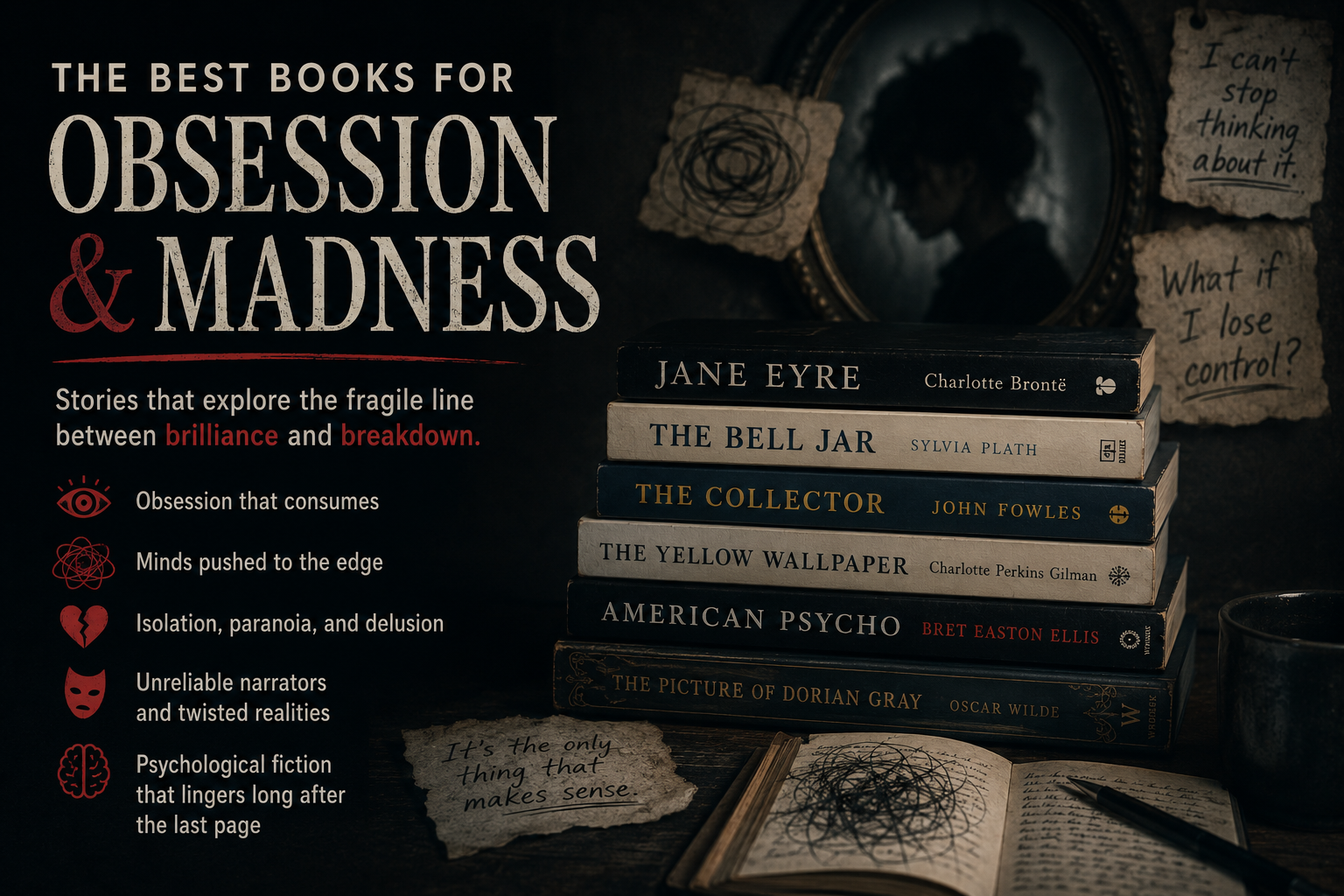
The Best Books for Obsession and Madness show what happens when desire, fear, or guilt takes over a person’s mind. These stories are intense, but they also help readers think about power, love, art, and the fragile line between control and chaos.

In this Guide

Best Books for Obsession and Madness

Why the Best Books for Obsession and Madness Grip Readers

Stories about obsession feel powerful because they show emotions pushed to the edge.

A character may want love, fame, revenge, or truth. At first, the goal may seem normal. Then it grows too large and begins to damage the character’s life.

Madness in literature is not always simple. It can show fear, grief, guilt, or social pressure. In many books, readers must ask if a character is truly losing touch with reality or if the world around them is broken.

The Best Books for Obsession and Madness often make us uneasy because they reflect real human fears. What if we want something too much? What if our thoughts become a trap?

Best Books for Obsession and Madness in Classic Literature

Classic literature gives us some of the most famous examples of minds under pressure.

“The Tell-Tale Heart” by Edgar Allan Poe is one of the clearest stories about guilt and mental collapse. The narrator insists he is sane, but his actions prove the opposite. His obsession with the old man’s eye leads to murder, panic, and confession.

Poe’s work is central to this topic because he often wrote about fear, death, and unstable minds. You can read more about his poetry and legacy at the Poetry Foundation.

Macbeth by William Shakespeare is another key text. Macbeth becomes obsessed with power after he hears a prophecy. His mind fills with fear, blood, and suspicion. Lady Macbeth also breaks under the weight of guilt.

Frankenstein by Mary Shelley shows obsession through science and creation. Victor Frankenstein wants to conquer death, but his dream turns into horror. His refusal to take care of what he creates leads to pain for everyone around him.

These works remain part of the Best Books for Obsession and Madness because they show how one fixed idea can destroy a life.

Modern Best Books for Obsession and Madness

Modern novels often place obsession in daily life, which can make it feel even more real.

The Secret History by Donna Tartt follows a group of college students drawn into beauty, pride, and moral decay. Their obsession with ancient Greek ideas leads them away from normal limits. The novel asks how smart people can justify terrible choices.

Rebecca by Daphne du Maurier is a haunting novel about memory and jealousy. The dead Rebecca controls the house of Manderley even after death. The new Mrs. de Winter feels trapped by a woman she never met.

Gone Girl by Gillian Flynn gives a modern view of obsession inside marriage, media, and image. The novel shows how control can hide behind charm. It also asks how much of a public story is true.

The Best Books for Obsession and Madness do not always need ghosts or castles. Sometimes the most frightening place is a home, a classroom, or a relationship.

How the Best Books for Obsession and Madness Use Symbols

Symbols help readers see what a character cannot say out loud.

In “The Tell-Tale Heart,” the old man’s eye becomes a symbol of fear and fixation. The beating heart becomes a symbol of guilt. The narrator hears it because his mind will not let him escape what he has done.

In Macbeth, blood is the most famous symbol. At first, it shows violence. Later, it shows guilt that cannot be washed away. Lady Macbeth’s hand-washing scene makes this idea clear.

In Rebecca, Manderley is more than a house. It is a symbol of memory, class, and control. The setting keeps Rebecca’s power alive.

If you want help with this skill, read our guide on how to find symbolism in a story. It can help you spot patterns in objects, colors, places, and repeated images.

The Best Books for Obsession and Madness often use symbols that grow darker as the story moves forward.

Major Themes in Books About Obsession and Madness

These stories often return to a few deep questions about human nature.

Guilt is one of the most common themes. Characters may try to hide what they have done, but their minds bring the truth back.

Power also plays a major role. Macbeth wants a crown. Victor Frankenstein wants power over life. Their need for control leads to loss.

Identity is another key theme. Characters may not know who they are once obsession takes hold. They may lie so much that the lie becomes part of them.

Some of these books also connect to Gothic literature, a genre full of mystery, fear, strange settings, and dark emotion. For background, see Britannica’s guide to the Gothic novel.

These titles are strong choices if you want to read more in this dark literary area.

  • Frankenstein by Mary Shelley: A classic novel about ambition, science, and moral responsibility.
  • The Secret History by Donna Tartt: A literary mystery about beauty, pride, and obsession in a college setting.

Both books fit well with the Best Books for Obsession and Madness because they show smart characters who lose control of their choices.

Why Students Should Study the Best Books for Obsession and Madness

These books are useful for essays because they give clear conflicts and strong symbols.

For AP Literature or college classes, they also offer rich character studies. You can write about point of view, unreliable narration, setting, theme, or moral choice.

The Best Books for Obsession and Madness also help students build close reading skills. A small detail, like a sound or object, may reveal a character’s hidden fear.

When you read, ask simple questions. What does the character want? What line do they cross? What symbol shows that their mind has changed?

FAQs About the Best Books for Obsession and Madness

What are the Best Books for Obsession and Madness for beginners?

Start with “The Tell-Tale Heart,” Macbeth, or Frankenstein. These works are famous, short enough to study closely, and full of strong symbols.

Why do authors write about madness?

Authors use madness to explore fear, guilt, grief, and pressure. It can show how a person breaks when they can no longer face the truth.

Is obsession always shown as evil in literature?

No. Obsession can begin as love, ambition, or curiosity. It becomes dangerous when it harms others or destroys the character’s sense of right and wrong.

What symbols often appear in stories about obsession?

Common symbols include eyes, blood, mirrors, houses, letters, and repeated sounds. These details often point to guilt, control, or fear.

Key Takeaway: Why These Dark Stories Matter

The Best Books for Obsession and Madness stay with us because they show how fragile the human mind can be. They remind us that one desire, one fear, or one secret can change everything.

For students, these books are more than dark stories. They are powerful tools for close reading, theme analysis, and deeper thought about human nature.

The Outsiders Summary and Analysis for Students

The Outsiders Summary

This guide gives you a clear The Outsiders summary and analysis without making the novel harder than it needs to be. You will review the plot, structure, conflicts, characters, and deeper meaning of S. E. Hinton’s famous coming-of-age story.

The Outsiders is short, but it has big ideas about class, loyalty, violence, and identity. That is why students often study it in middle school, high school, and college intro courses.

In this Guide

Use this guide as a quick map before class, homework, or essay prep.

The Outsiders summary and analysis: Quick Plot Overview

The novel follows Ponyboy Curtis as he learns that people are more complex than their labels.

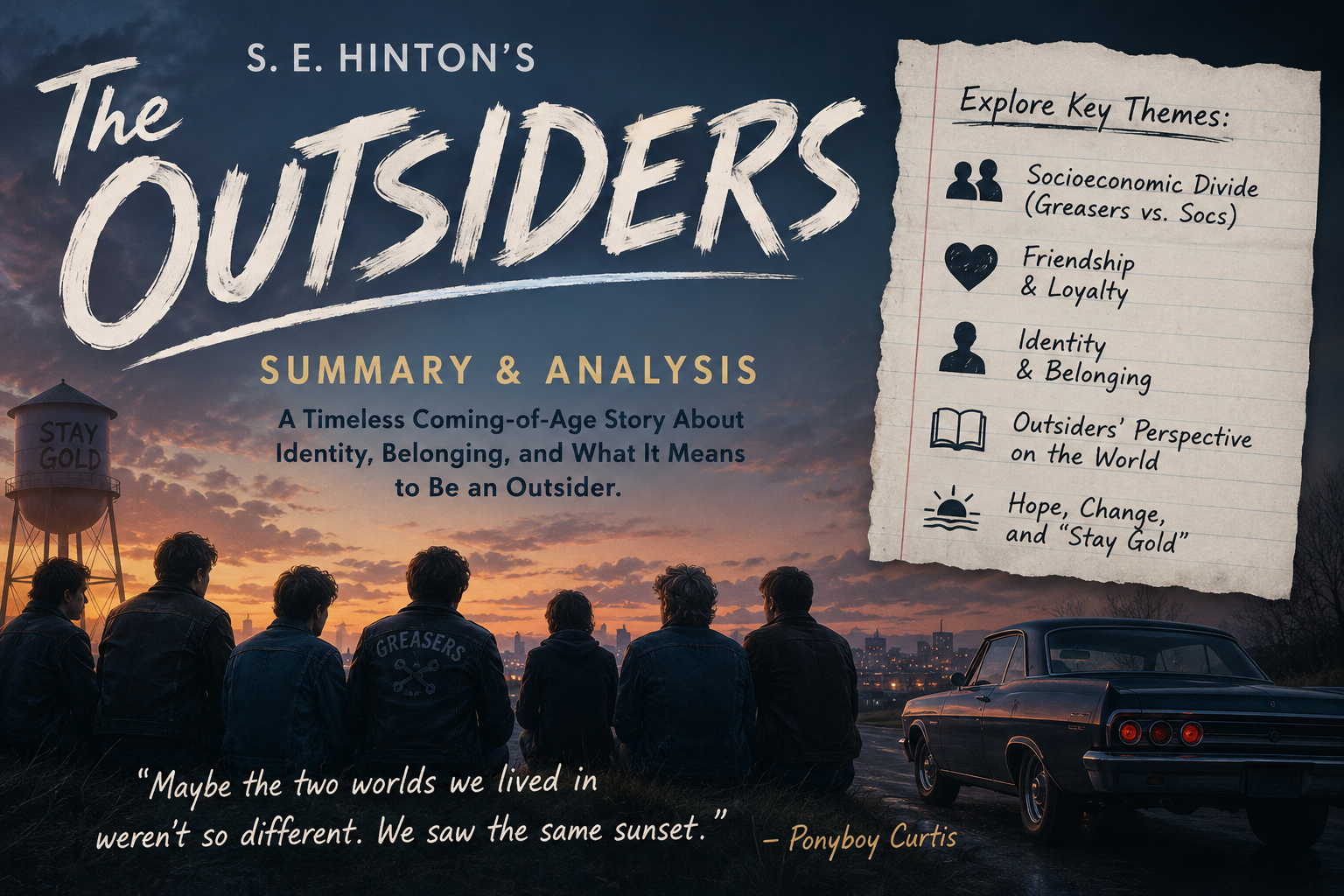
The Outsiders takes place in Oklahoma during the 1960s. Ponyboy belongs to the Greasers, a poor group of boys who face constant judgment from richer teens called the Socs.

A strong The Outsiders summary and analysis starts with the fight between these two groups. The Greasers and Socs do not just dislike each other. They live in different worlds, even though they share the same town.

Ponyboy lives with his older brothers, Darry and Sodapop, after their parents die. Darry acts strict because he wants to keep the family together. Ponyboy often mistakes that pressure for a lack of love.

The plot turns after Ponyboy and Johnny are attacked by Socs. Johnny kills Bob, a Soc, to save Ponyboy. The boys run away and hide in an abandoned church.

At the church, Ponyboy and Johnny grow closer. They read Gone with the Wind, talk about beauty, and try to make sense of what happened. Johnny tells Ponyboy to “stay gold,” a phrase tied to innocence and goodness.

When the church catches fire, Ponyboy, Johnny, and Dally rescue children trapped inside. Johnny is badly hurt. The boys become heroes, but the world around them does not become simple.

The novel ends after Johnny dies from his injuries and Dally dies after a police chase. Ponyboy struggles with grief, then begins to write the story we have just read.

Plot Structure and Point of View

The story feels personal because Ponyboy tells it in his own voice.

The novel uses first-person narration. That means readers see events through Ponyboy’s thoughts, fears, and memories.

This choice matters. Ponyboy is smart and sensitive, but he is also young. He does not always understand Darry, the Socs, or even himself at first.

The book has a circular shape. It begins with Ponyboy leaving a movie theater, and it ends with Ponyboy writing that same opening scene for a school assignment. This structure shows that the novel is also his attempt to understand trauma.

If you want to build stronger notes on narration, try this guide to close reading in literature. It can help you slow down and study small details in key scenes.

The structure also moves from street conflict to moral reflection. Like To Kill a Mockingbird, the novel asks readers to see beyond social labels and judge people with more care.

The Outsiders summary and analysis: Main Conflicts

The main conflicts come from class division, family stress, and moral choice.

The biggest outside conflict is Greasers versus Socs. The Socs have money, status, and protection. The Greasers have each other, but they face danger and blame more often.

This part of The Outsiders summary and analysis is important because Hinton does not show either group as fully good or fully bad. Cherry Valance, a Soc, helps Ponyboy see that pain exists on both sides.

There is also a family conflict between Ponyboy and Darry. Ponyboy thinks Darry is too hard on him. Darry fears that one wrong move could send Ponyboy and Sodapop into foster care.

Johnny faces an inner conflict. He is gentle, but he has lived with fear for years. When he kills Bob, the act is violent, yet it comes from a desperate need to protect Ponyboy.

Dally has a deep conflict too. He acts tough because he believes care makes people weak. Johnny’s death breaks him because Johnny is the one person he still lets himself love.

Characters and What They Reveal

Each major character shows a different way to live with pain.

Ponyboy Curtis is the narrator. He likes books, sunsets, and movies. He feels pulled between the rough world of the Greasers and his own thoughtful nature.

Johnny Cade is quiet and scared, but he is also brave. His final message to Ponyboy tells us that goodness matters, even in a harsh world.

Dally Winston is tough and reckless. He has learned to survive by shutting down his feelings. His end shows the cost of a life without hope.

Darry Curtis is strict because he carries adult weight too soon. He gave up school and sports to care for his brothers.

Sodapop Curtis tries to keep peace at home. He is warm, but he is not free from stress. His pain reminds readers that cheerful people can still suffer.

Cherry Valance helps challenge Ponyboy’s view of the Socs. She proves that class does not erase human feeling.

Major Themes in The Outsiders summary and analysis

The novel’s themes help explain why the story still speaks to young readers.

A good The Outsiders summary and analysis should focus on class conflict. The Greasers and Socs are divided by money, clothes, cars, and public image. The novel asks whether society gives some people more chances than others.

Another key theme is identity. Ponyboy must decide who he is beyond the word Greaser. He learns that a label can describe part of a person, but it cannot explain the whole person.

The theme of loyalty shapes the group. The Greasers protect one another because they often feel ignored by the wider world. Yet loyalty can also lead to fights that cause more harm.

The theme of loss of innocence appears through Johnny and Ponyboy. The poem “Nothing Gold Can Stay” by Robert Frost helps explain this idea. Beauty and youth can fade, but Ponyboy learns that people can still choose kindness.

For more context on the author, Britannica has a helpful overview of S. E. Hinton and her place in young adult fiction.

Symbols and Motifs in the Novel

Hinton uses simple images to carry deep meaning.

In The Outsiders summary and analysis, the sunset is one of the most important symbols. Ponyboy notices that both Greasers and Socs can see the same sunset. This image shows common humanity across class lines.

The poem “Nothing Gold Can Stay” stands for innocence, beauty, and change. Johnny’s advice to “stay gold” means Ponyboy should protect the gentle part of himself.

Hair is another symbol. For the Greasers, long hair is part of their identity. When Ponyboy and Johnny cut and bleach their hair, they feel as if they have lost part of who they are.

The abandoned church works as a place of escape and change. It is away from the city’s violence, but it also becomes the place where the boys must prove who they really are.

Why the Ending Matters

The ending turns the novel from a sad story into an act of witness.

The final chapters are a key part of The Outsiders summary and analysis because they show Ponyboy in denial. He struggles to accept Johnny’s death and Dally’s collapse.

Ponyboy’s school essay becomes the novel itself. This means the act of writing helps him face what happened. He tells the story so other people can understand boys like Johnny before it is too late.

The ending does not solve poverty or violence. It gives Ponyboy a voice. That voice is his first step toward healing.

If you need help turning these ideas into an essay, pair this post with our student literature guides for more support.

How to Use This Guide for Class

This The Outsiders summary and analysis works best when you connect plot events to meaning.

Do not stop at what happens. Ask why each event matters. For example, Johnny’s death is not only sad. It shows how violence can destroy the most vulnerable people first.

For essays, choose one clear claim. You might argue that Ponyboy’s growth comes from learning to see both Greasers and Socs as human. Then use scenes, symbols, and quotes to support that claim.

You can also practice close reading skills by studying the sunset scenes or Johnny’s final letter.

Amazon Books to Read Next

These books pair well with The Outsiders because they also explore youth, class, and moral growth.

  • That Was Then, This Is Now by S. E. Hinton
  • To Kill a Mockingbird by Harper Lee

FAQ: The Outsiders summary and analysis

These quick answers can help with review before a quiz or essay.

What is the main point of The Outsiders?

The main point is that people are more than their social group. The novel asks readers to look past labels like Greaser and Soc.

Why does Johnny tell Ponyboy to “stay gold”?

Johnny means that Ponyboy should protect his innocence, kindness, and ability to see beauty in the world.

What is the main conflict in the novel?

The main conflict is between the Greasers and the Socs, but Ponyboy also faces inner conflict as he tries to understand himself and others.

Why is the ending important?

The ending shows Ponyboy turning pain into a story. His writing gives meaning to what he has survived.

Key Takeaway

The best The Outsiders summary and analysis shows that the novel is not just about rival groups. It is about young people who want safety, love, and a chance to be seen clearly.

Flash Memoir Prompt: First Time You Were Paid for Something You Made or Did

flash memoir

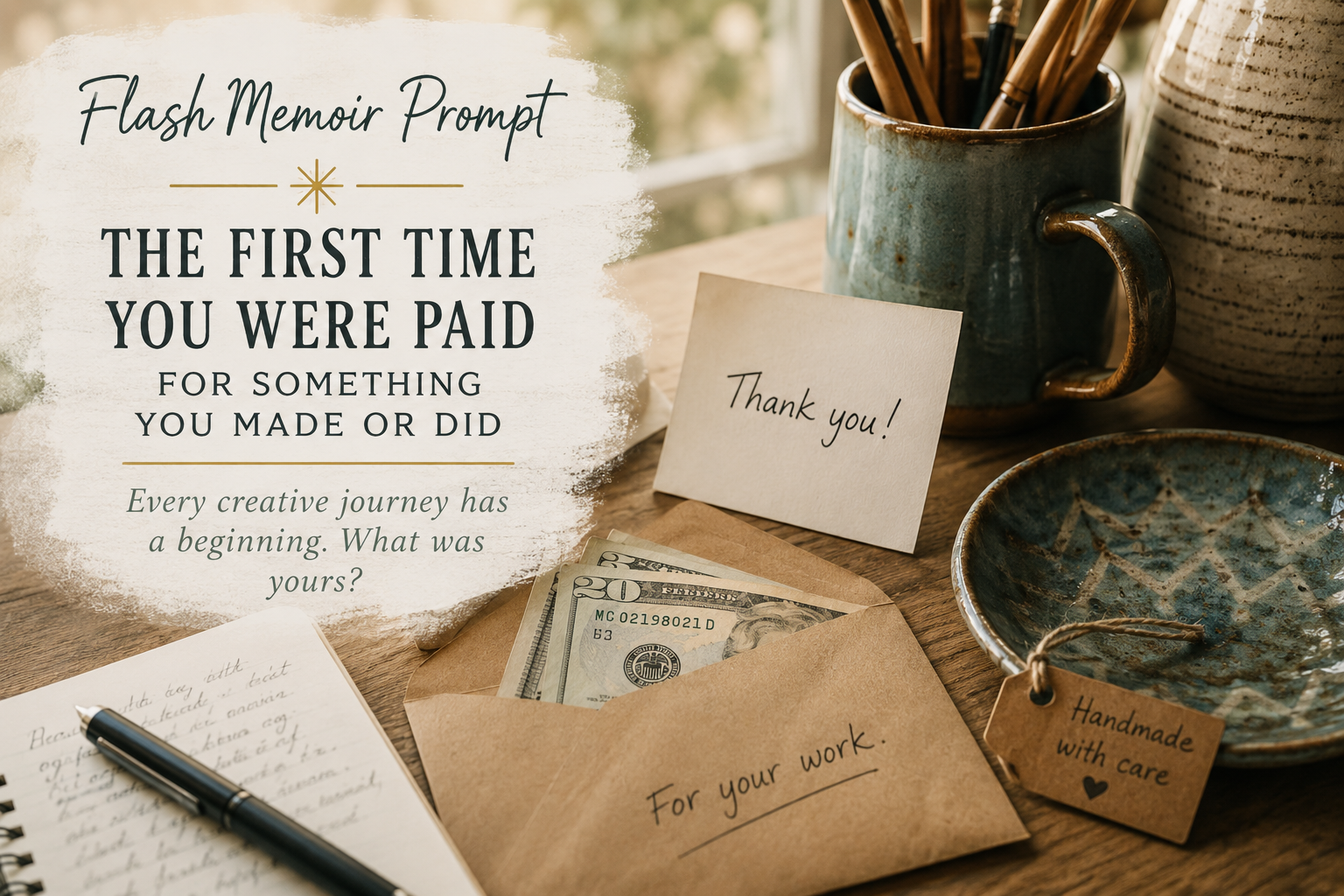
A warm flash memoir prompt for remembering the first dollar, check, tip, or thank-you envelope that made your effort feel real. Maybe you can still picture the way the money arrived: folded into your palm, tucked inside a card, sent through an app, or handed over with a casual “thanks” that did not feel casual to you at all.

The first time someone pays you for something you made or did can be strangely powerful. It might be a few coins for mowing a lawn, babysitting money stuffed into your pocket, a craft fair sale, a paycheck from a summer job, or five dollars from a neighbor who loved the brownies you baked. The amount may have been small. The feeling may have been huge.

This flash memoir prompt first time paid something made invites you to return to that moment before it became part of your life story. Before you had a resume. Before you knew what your work was worth. Before you learned to act calm when someone gave you money for your time, skill, care, or courage.

flash memoir

The Prompt

Write about the first time you were paid for something you made or did.

This prompt can unlock a memory because payment is rarely just payment. It can carry pride, surprise, pressure, embarrassment, or a sudden sense of being seen. In memoir, money often points to something deeper: independence, value, effort, family expectations, or the first tiny feeling of adulthood.

You do not have to write about a major job or a big success. In fact, this prompt works best when you stay close to one small exchange. Focus on the hand, the envelope, the register, the kitchen table, or the moment you counted the money later when no one was watching.

Why This Memory Matters

The first paid moment often marks a quiet shift. Someone outside yourself decided your work had value. That can feel thrilling, awkward, or even confusing.

Maybe you were a child selling lemonade, and you suddenly understood that warm coins could come from your own idea. Maybe you were a teenager with tired feet after a long shift, holding a paycheck that looked official and disappointing at the same time. Maybe you created something personal, like art, music, writing, or food, and payment made you feel proud and exposed.

This kind of memory may also reveal how you learned about work. Did your family celebrate the moment? Did someone tell you to save it? Did you spend it right away? Did you feel guilty taking money for something that had felt easy, fun, or natural?

Those questions matter because memoir is built from meaning hiding inside ordinary scenes. If you need help seeing that deeper layer, you might enjoy this guide on how to identify theme in literature. The same skill can help you notice the theme inside your own memory.

How to Approach This Prompt

Begin with a physical detail. Do not start by explaining your whole relationship with money or work. Start with the exact thing you remember seeing or touching.

For example, write about the paper route bag rubbing your shoulder. Write about the smell of wet grass after you finished mowing. Write about the purple ink on the check. Write about the sticky table at the bake sale or the way the babysitting cash felt too crisp to spend.

Then narrow the memory to one scene. This is flash memoir, so you do not need to cover every job you ever had. Choose one moment: the making, the doing, the handoff, or the private moment after.

Try to write what you noticed before you explain what it meant. If you jump too quickly to the lesson, the piece may feel flat. Let the reader stand beside you first.

You might begin with a sentence like, “The first money I ever earned smelled like chlorine,” or “Mrs. Alvarez paid me in quarters from a blue ceramic bowl.” A concrete start gives the memory a place to live.

If you are writing for school, this same habit can help with close reading. When you learn how to annotate literature, you practice noticing small details before making big claims. Memoir works in a similar way. Notice first. Explain later.

A Quick Example

The first time I got paid, I was eleven, and Mrs. Gentry gave me three dollars for pulling weeds along her fence. The bills were soft and faded, like they had already passed through every hand in town. I remember the dirt under my fingernails more than the money. I remember trying to act like three dollars was normal, like I was the kind of person who earned cash on Saturday mornings. My knees were green from the grass, and my back hurt in a way I felt proud of. At home, I laid the bills on my dresser and kept checking to see if they were still there. I did not buy anything for a week. I just liked knowing they had come from my own hands.

Try It Yourself

Set a timer for ten minutes and write one scene from the first time you were paid for something you made or did. Keep the focus tight. Where were you? Who gave you the money? What did your body feel like in that instant?

If you get stuck, write about the object connected to the memory. The coins, the check, the craft, the tool, the apron, the lawn mower, the receipt, or the envelope can carry the story for you.

Do not worry about making the memory sound impressive. The best flash memoir prompt first time paid something made pieces often come from small, almost funny moments. A crooked bracelet sold at a school fair can hold as much meaning as a first paycheck.

After you draft, read it once and underline the sentence that feels most honest. That sentence may be the real center of the piece.

Want More Flash Memoir Prompts?

If this prompt helped you remember a small but meaningful first, you may enjoy building a steady memoir practice one scene at a time. Explore all 365 prompts in The Memory Trigger: 365 Flash Memoir Writing Prompts.