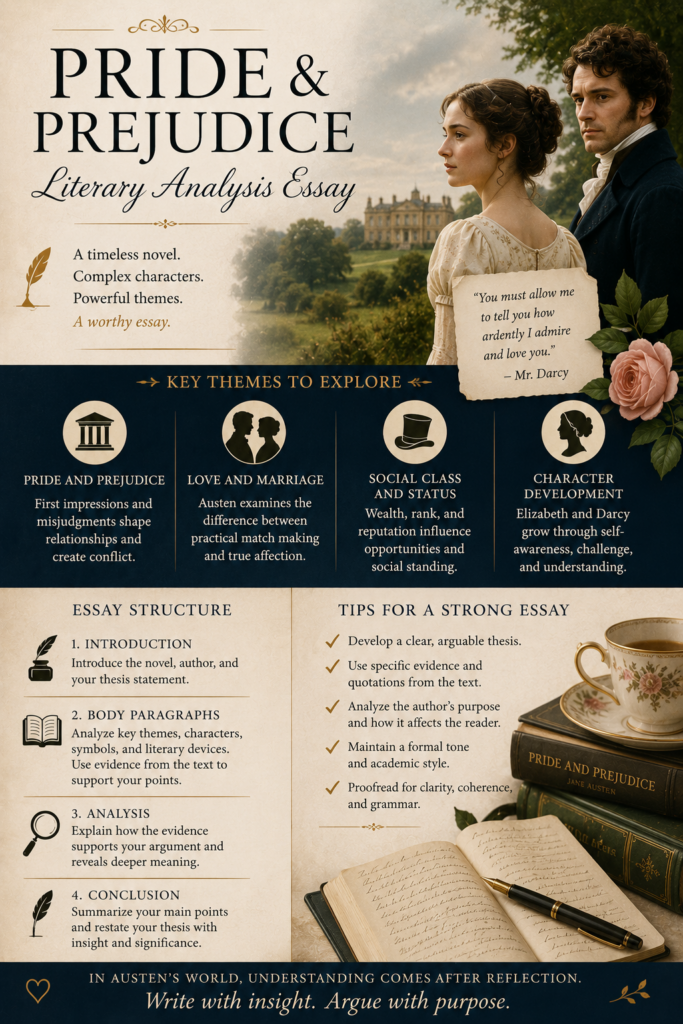
A Pride and Prejudice literary analysis essay asks you to look past the romance and explain how Jane Austen builds meaning. This guide will help you choose a strong topic, write a clear thesis, and support your ideas with useful evidence.
In This Guide
- What your essay should do
- How to choose a focused topic
- How to turn a topic into a question
- Thesis statement examples
- Evidence to use from the novel
- Essay structure tips
- Helpful books and links
- FAQ
What a Pride and Prejudice Literary Analysis Essay Should Do
Your essay should make an argument about how the novel works.
Your Pride and Prejudice literary analysis essay should not retell the plot. And your reader already knows that Elizabeth Bennet and Mr. Darcy misunderstand each other before they change.
Instead, focus on how Austen shapes that change. You might study dialogue, social class, irony, marriage, pride, prejudice, or character growth.
A strong essay answers a question like this: how does Austen use Elizabeth’s changing view of Darcy to explore judgment?
If you need help with the larger essay process, start with this guide on how to write a literary analysis essay.
Step 1: Choose a Focused Pride and Prejudice Literary Analysis Essay Topic
A narrow topic leads to a stronger paper.
A strong Pride and Prejudice literary analysis essay topic should focus on one main idea. Do not try to cover the whole novel in one essay.
For example, a topic like marriage is too broad. A better topic is Austen’s criticism of marriage as a financial choice.
You could also focus on Elizabeth’s wit. That topic works well because her language often shows both intelligence and bias.
Here are focused topic ideas:
- How Elizabeth’s first impressions shape the novel’s conflict
- How Darcy’s letter changes the reader’s view of him
- How Austen uses Mr. Collins to mock social climbing
- How Charlotte Lucas shows the limits placed on women
- How irony reveals the flaws of polite society
Step 2: Turn Your Topic into a Literary Question
A good question helps you move from summary to analysis.
Once you choose a topic, turn it into a question. This step gives your essay a clear job.
Topic: Darcy’s pride.
Question: How does Austen show that Darcy’s pride comes from both class privilege and personal fear?
Topic: Charlotte’s marriage.
Question: How does Charlotte’s choice reveal the pressure women face in a society built around property?
This method also works for other novels. In The Great Gatsby, a student might ask how wealth shapes identity. In Great Expectations, a student might ask how shame changes Pip’s choices.
Step 3: Write a Thesis for Your Pride and Prejudice Literary Analysis Essay
Your thesis is the main claim your essay will prove.
Your thesis should make your Pride and Prejudice literary analysis essay specific. It should name the literary element you plan to study and explain why it matters.
A weak thesis says: Elizabeth and Darcy change in the novel.
A stronger thesis says: Austen uses Elizabeth’s mistaken judgment of Darcy to show that pride and prejudice can hide moral growth until a person learns to read others with care.
That thesis works because it makes an argument. It also gives the essay a clear path.
Thesis Statement Examples
Use these examples as models, not as final answers to copy.
- On Elizabeth: Austen presents Elizabeth Bennet’s wit as both a strength and a flaw, since it helps her see social hypocrisy but also makes her misread Darcy.
- On Darcy: Darcy’s change is not a simple romantic shift; Austen uses his growth to question the pride that comes with rank.
- On marriage: Through Charlotte Lucas and Lydia Bennet, Austen shows that marriage in the novel is shaped by fear as much as love.
- On irony: Austen’s irony exposes the gap between polite manners and true moral character.
If thesis writing feels hard, The Literary Analysis Essay Toolkit can help you build stronger claims, topic sentences, and evidence notes faster.
Evidence to Use in a Pride and Prejudice Literary Analysis Essay
The best evidence comes from moments where a character’s words or choices reveal more than they mean to reveal.
In a Pride and Prejudice literary analysis essay, evidence should support your claim, not replace it. Quote short lines when possible, then explain how the language works.
Useful moments include Darcy’s first insult at the ball, Elizabeth’s reading of Darcy’s letter, Mr. Collins’s proposal, Charlotte’s acceptance of Mr. Collins, and Lady Catherine’s visit to Elizabeth.
Darcy’s first insult gives you evidence for pride and class. Elizabeth’s reaction gives you evidence for wounded pride and quick judgment.
Darcy’s letter is a major turning point. It forces Elizabeth to question her own view of Wickham and Darcy.
Charlotte’s marriage to Mr. Collins helps you discuss gender and security. She does not act like a romantic heroine, but Austen does not treat her choice as foolish.
You can read the novel through a free public-domain edition at Project Gutenberg. For author background, see Britannica’s Jane Austen overview.
How to Structure the Essay
A clear structure helps your reader follow your argument.
Start with an introduction that names the author, the novel, and your main claim. Keep the plot summary brief.
Each body paragraph should focus on one part of your thesis. Begin with a topic sentence that makes a claim, not a fact.
For example, do not write: Darcy gives Elizabeth a letter.
Write: Darcy’s letter changes the novel because it forces Elizabeth to admit that her judgment has been shaped by pride.
After each quote, explain the words. Do not expect the quote to prove the point by itself.
Your conclusion should not repeat the thesis word for word. It should show why your argument matters for the whole novel.
For a deeper breakdown of introductions, body paragraphs, and conclusions, see our literary analysis essay guide.
Sample Mini Outline
A simple outline can keep your draft focused.
Thesis: Austen uses Elizabeth’s changing view of Darcy to show that first impressions can feel certain while still being deeply flawed.
- Introduction: Briefly introduce the novel and present the thesis.
- Body Paragraph 1: Show how Elizabeth trusts her first judgment of Darcy.
- Body Paragraph 2: Analyze how Wickham’s charm strengthens her bias.
- Body Paragraph 3: Explain how Darcy’s letter forces her to revise her view.
- Conclusion: Connect Elizabeth’s growth to Austen’s larger message about judgment.
Common Mistakes to Avoid
Small choices can weaken a strong idea.
Avoid plot summary. A short bit of context is fine, but your own analysis should take up most of the paragraph.
Avoid vague claims like Austen shows society is bad. Name the exact social rule or behavior you mean.
Avoid dumping long quotes into the essay. Choose shorter evidence and explain it in detail.
Avoid writing as if Austen is only telling a love story. The romance matters, but it also helps her study class, money, and self-knowledge.
Helpful Books for Essay Prep
These books can deepen your reading before you write.
- Pride and Prejudice by Jane Austen
- Jane Austen: A Life by Claire Tomalin
If your teacher allows outside sources, use them to support your thinking. Do not let a critic’s view replace your own claim.
FAQ: Pride and Prejudice Literary Analysis Essay
What is the best Pride and Prejudice literary analysis essay topic?
The best Pride and Prejudice literary analysis essay topic is one that is narrow and arguable. Elizabeth’s misjudgment of Darcy, Charlotte’s marriage, or Austen’s irony can all work well.
Can I write about love in Pride and Prejudice?
Yes, but make the topic more specific. Instead of love in the novel, write about how Austen connects love with respect, self-knowledge, or social pressure.
How long should my essay be?
Follow your teacher’s rules first. Many high school essays are 3 to 5 pages, while college essays may be longer.
Do I need quotes from the novel?
Yes. Use short quotes or clear references to key scenes, then explain how they support your thesis.
Key Takeaway
A Pride and Prejudice literary analysis essay works best when it makes a focused claim about how Austen builds meaning. Choose a narrow topic, write a clear thesis, and let each paragraph prove one part of your argument.