Literary Devices in Poetry: A Complete Guide

Literary Devices in Poetry

How to recognize the tools poets use to create meaning, emotion, and beauty

Poetry can sometimes feel confusing when you first read it. The language may seem strange, the lines may be short, and the meaning may not be obvious at first. Many students feel lost because poems do not always tell a clear story the way a novel does. But once you understand literary devices in poetry, poems become much easier to understand and much more enjoyable to read.

Poets use literary devices as tools. These tools help them create images, express emotions, and communicate ideas in powerful ways. When you learn to recognize these tools, you begin to see how a poem works instead of just guessing what it means.

Key idea: Literary devices are the tools poets use to create meaning.

In this guide, we will look at the most important literary devices in poetry, how to recognize them, and how they help you understand a poem more deeply.

In this Guide 📚

What are literary devices in poetry
Why poets use literary devices
Imagery
Metaphor
Simile
Symbolism
Personification
Sound devices
How literary devices create theme
How to analyze literary devices in poetry

Literary Devices in Poetry
Image by Carla Paton

What Are Literary Devices in Poetry?

Literary devices in poetry are techniques that poets use to create meaning, emotion, and imagery. These devices include metaphor, simile, symbolism, imagery, personification, alliteration, and many others.

When poets write, they do not usually explain everything directly. Instead, they show ideas through language. Literary devices help them do this.

For example, instead of saying “I feel sad,” a poet might describe a dark sky, a cold wind, or a dying flower. These images help the reader feel the emotion rather than just read about it.

If you want a deeper introduction to reading literature, you can also read this guide on how to read literature like a scholar:
https://rapidreadspress.com/how-to-read-literature-like-a-scholar/

Why Do Poets Use Literary Devices?

Poets use literary devices because poetry is meant to be felt as well as understood. Literary devices help poets compress meaning into a small number of words.

A poem is usually short, so every word matters. Literary devices allow poets to say more with fewer words.

For example, in Emily Dickinson’s poem:
“Hope is the thing with feathers
That perches in the soul”

Dickinson does not define hope in a dictionary way. Instead, she uses a metaphor. She compares hope to a bird. This image helps the reader understand that hope is alive, gentle, and always present.

This is why literary devices in poetry are not decorations. They are the meaning.

For a step-by-step guide to poetry analysis, see:
https://rapidreadspress.com/how-to-analyze-poetry-step-by-step/

Imagery in Poetry

Imagery is one of the most important literary devices in poetry. Imagery is language that appeals to the senses. It helps the reader see, hear, feel, smell, or taste what is happening in the poem.

Consider these lines from William Wordsworth:
“I wandered lonely as a cloud
That floats on high o’er vales and hills”

This image helps us see the speaker floating above the landscape. The image also creates a feeling of calm and quiet.

When you look for imagery, ask yourself:
What do I see?
What do I hear?
What do I feel?

Imagery often helps reveal the tone and mood of a poem. If you want to better understand tone and mood, this guide will help:
https://rapidreadspress.com/tone-vs-mood-in-literature-whats-the-difference/

Metaphor and Simile

Metaphor and simile are comparisons. They show how two different things are similar.

A simile uses the words “like” or “as.”
A metaphor does not.

Example of simile from Robert Burns:
“O my Luve’s like a red, red rose”

Example of metaphor from Langston Hughes:
“Life is a broken-winged bird
That cannot fly”

These comparisons help readers understand ideas through images. Instead of explaining life in abstract terms, Hughes compares life to a bird that cannot fly. This creates a strong emotional image.

When you find a metaphor or simile, ask what the comparison is trying to show you.

Symbolism in Poetry

Symbolism is when an object represents a larger idea.

In Robert Frost’s poem “The Road Not Taken,” the road is not just a road. It represents life choices.

Symbols often represent ideas like:
Life
Death
Hope
Freedom
Time
Innocence

If you want to learn more about symbolism, you can read this guide:
https://rapidreadspress.com/how-to-find-symbolism-in-a-story/

Personification

Personification is when human qualities are given to animals, objects, or ideas.

Example from Emily Dickinson:
“Because I could not stop for Death –
He kindly stopped for me”

Death is described as a polite person. This changes how we think about death. Instead of something frightening, it becomes something calm and inevitable.

Personification helps poets turn abstract ideas into characters.

Sound Devices in Poetry

Poetry is meant to be heard as well as read. Sound devices are very important literary devices in poetry.

Common sound devices include:
Alliteration – repetition of beginning sounds
Assonance – repetition of vowel sounds
Consonance – repetition of consonant sounds
Rhyme – repetition of end sounds

Example of alliteration from Edgar Allan Poe:
“While I nodded, nearly napping”

The repetition of the “n” sound creates rhythm and mood.

Sound devices help create music in poetry, which affects how the poem feels.

Literary Devices in Poetry
Image by Carla Paton

How Literary Devices Create Theme

Literary devices are not just small techniques. They help create the theme of the poem.

Theme is the main idea or message of a poem. Poets develop theme through imagery, symbolism, metaphor, and other literary devices.

For example, in many poems, night may symbolize death or loneliness, while morning may symbolize hope or new beginnings.

If you want to learn more about theme, read:
https://rapidreadspress.com/how-to-identify-theme-in-literature/

How to Analyze Literary Devices in Poetry

When analyzing literary devices in poetry, follow this simple process:

First, read the poem slowly.
Second, look for imagery and comparisons.
Third, look for symbols.
Fourth, think about how these devices connect to the theme.

You can also use close reading strategies here:
https://rapidreadspress.com/what-is-close-reading-in-literature/

The meaning of a poem is often hidden inside its literary devices.

If you are writing about poetry in an essay, these resources may help:
https://rapidreadspress.com/product/literary-analysis-essay-examples/
https://rapidreadspress.com/product/the-literary-analysis-essay-toolkit/

Recommended Books on Poetry and Literary Devices 📚

How to Read a Poem by Terry Eagleton
Poetry Handbook by Mary Oliver
Perrine’s Literature: Structure, Sound, and Sense

AffiliateThese are excellent resources for understanding literary devices in poetry and learning how to analyze poems more confidently. (Affilate links)

More resources:
Poetry Foundation: https://www.poetryfoundation.org/learn/glossary-terms

Key Takeaway

Literary devices in poetry are the tools poets use to create meaning, emotion, and theme. When you learn to recognize imagery, metaphor, symbolism, personification, and sound devices, poetry becomes clearer and more meaningful. Instead of feeling confusing, poems begin to feel like puzzles that you know how to solve.

FAQ – Literary Devices in Poetry

What are literary devices in poetry?

Literary devices in poetry are techniques such as metaphor, simile, imagery, symbolism, and sound devices that poets use to create meaning and emotion.

What are the most common literary devices in poetry?

The most common literary devices in poetry include imagery, metaphor, simile, symbolism, personification, alliteration, and rhyme.

Why are literary devices important in poetry?

Literary devices are important because they help poets express complex ideas and emotions in a small number of words.

How do you identify literary devices in poetry?

Look for descriptive language, comparisons, repeated sounds, and objects that may represent larger ideas.

32 Literary Devices With Examples From Classic Literature

literary devices list

A clear guide to the most important literary devices students encounter when analyzing novels, poetry, and classic literature.

When readers begin studying literature more closely, they quickly encounter the term literary devices. These are the techniques writers use to shape language, structure narratives, and guide how readers interpret a story.

Authors rely on literary devices such as metaphor, symbolism, irony, and foreshadowing to communicate ideas beneath the surface of the plot. Once readers begin recognizing these techniques, patterns and meanings that once seemed hidden become easier to interpret.

Understanding literary devices is an important step for anyone who wants to learn literary analysis. Instead of only asking what happens in a story, readers begin asking how a writer’s language creates meaning.

This guide provides a complete literary devices list with examples from well-known works of literature, including Frankenstein, Pride and Prejudice, Emma, Dracula, and Wuthering Heights, Romeo and Juliet (affiliate links).

Key Takeaway

Understanding literary devices helps readers interpret literature more thoughtfully. By recognizing patterns in language, imagery, symbolism, and narrative structure, readers move beyond simple plot summaries and begin discovering the deeper ideas within a text.

In This Guide

In this article you will learn:

• what literary devices are and why authors use them
• a literary devices list with 32 important techniques
• examples of literary devices from famous works of literature
• how recognizing literary devices improves literary analysis

literary devices list
Image by Carla Paton

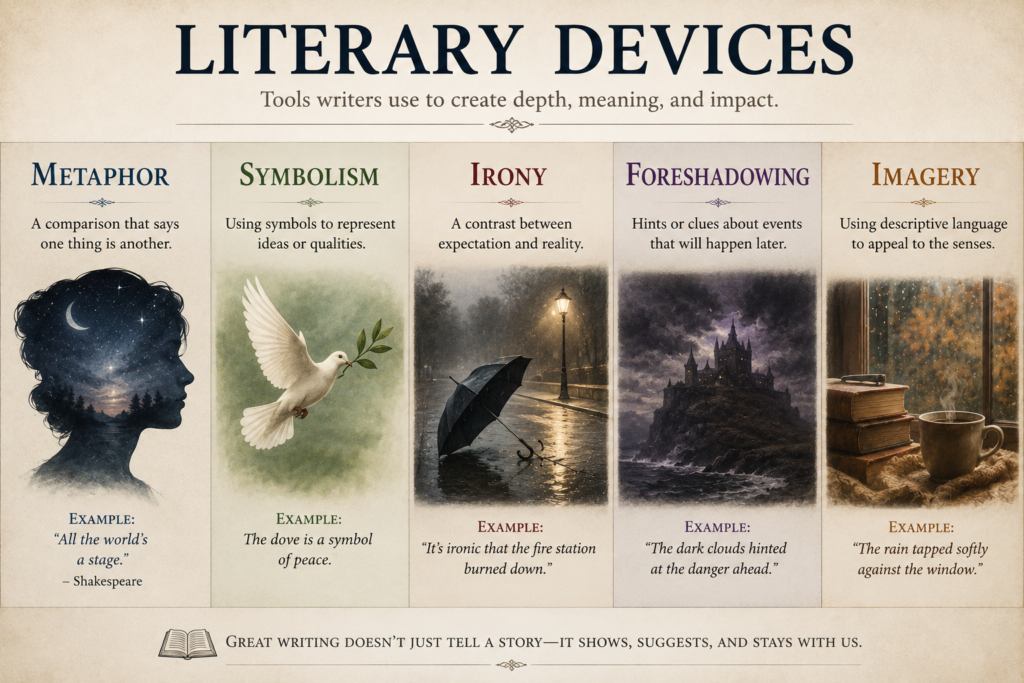
Quick Literary Devices List

This guide explains the following literary devices:

metaphor
simile
symbolism
foreshadowing
imagery
irony
allusion
personification
hyperbole
motif
theme
tone
mood
juxtaposition
flashback
allegory
parallelism
repetition
rhetorical question
suspense
conflict
diction
narrative voice
dialogue
setting
satire
climax
resolution
characterization
symbol
oxymoron
dramatic irony

Literary Devices Definitions at a Glance

Below is a quick reference table summarizing some of the most common literary devices. Each device is explained in more detail later in this guide.
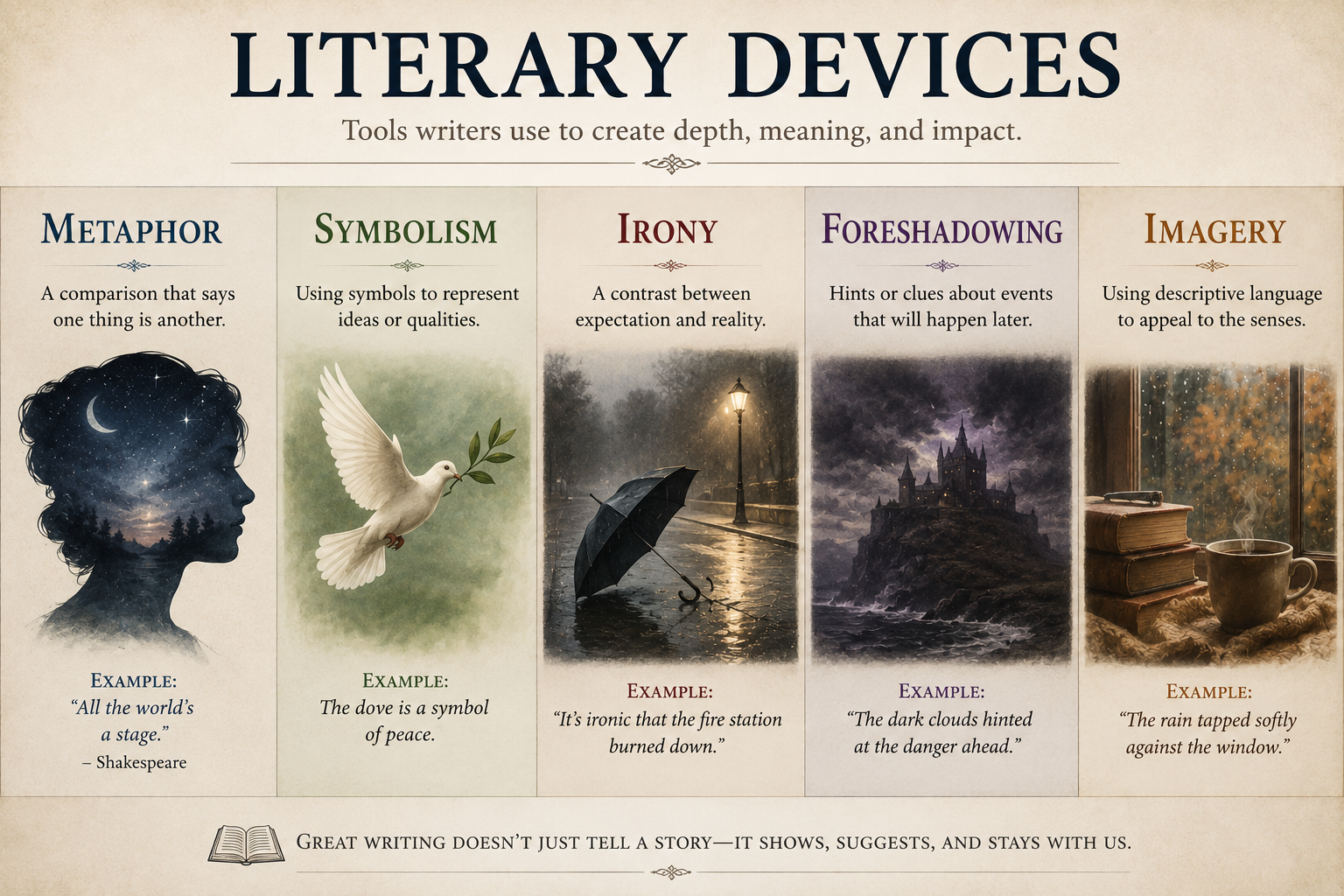
Metaphor: a direct comparison between two unlike things.
Simile: a comparison using the words like or as.
Symbolism: using an object to represent a deeper meaning.
Foreshadowing: hints that suggest future events in a story.
Imagery: descriptive language that appeals to the senses.
Irony: a contrast between expectation and reality.
Allusion: a reference to another text, event, or myth.
Personification: giving human qualities to nonhuman things.
Hyperbole: exaggerated language used for emphasis.
Motif: a recurring image or idea in a text.
Theme: the central idea explored in a literary work.
Tone: the author’s attitude toward the subject.
Mood: the emotional atmosphere experienced by readers.
Juxtaposition: placing contrasting ideas side by side.
Flashback: a narrative shift to an earlier time in the story.

What Are Literary Devices?

Literary devices are techniques writers use to communicate meaning, shape narrative structure, and influence how readers interpret a text.

Some literary devices focus on language, such as metaphor or imagery. Others affect narrative structure, such as flashback or foreshadowing. Still others influence how readers interpret themes, characters, and symbolism.

Recognizing literary devices helps readers move beyond simple summaries and begin interpreting how literature communicates deeper ideas.

If you are new to these techniques, these guides may also help:

How to Read Literature Like a Scholar
How to Identify Theme in Literature
How to Find Symbolism in a Story

📘 Tip for Students

When reading literature, look for patterns. If an image, phrase, or idea appears repeatedly, it may signal an important literary device such as symbolism or motif.

32 Literary Devices Explained With Examples

Below is a literary devices list explaining 32 common techniques used in literature.

1. Metaphor Example

A metaphor compares two unlike things directly to suggest a deeper similarity.

Example from Wuthering Heights by Emily Brontë:

“I am Heathcliff.”

This metaphor suggests that their identities and emotional lives are inseparable. Catherine’s statement is a metaphor expressing the profound emotional and psychological bond she feels with Heathcliff.

2. Simile Example

A simile compares two things using the words like or as.

Example:
Descriptions in Gothic novels such as Dracula often compare darkness or fear to death itself, reinforcing the story’s atmosphere.

Example from Dracula by Bram Stoker:

“The castle is a veritable prison, and I am a prisoner.”

Although not a formal “like/as” comparison, Stoker repeatedly uses simile-like comparisons to emphasize Jonathan Harker’s sense of confinement.

3. Symbolism Example

Symbolism occurs when an object represents a deeper meaning.

Example from Frankenstein by Mary Shelley:

“Learn from me… how dangerous is the acquirement of knowledge.”

Here, the creature and Victor’s experiment symbolize the dangers of uncontrolled scientific ambition.

You can learn more about this technique in How to Find Symbolism in a Story.

4. Foreshadowing Example

Foreshadowing hints at events that will occur later in the narrative.

Example from Frankenstein:

“I had worked hard for nearly two years… for the sole purpose of infusing life into an inanimate body.”

This early description foreshadows the catastrophic consequences of Victor’s experiment.

5. Imagery Example

Imagery uses descriptive language that appeals to the senses.

Example:
In Frankenstein, Shelley frequently describes dramatic mountain landscapes and other details that reflect Victor’s emotional turmoil.

“The rain pattered dismally against the panes.”

The sensory detail creates a gloomy and unsettling atmosphere.

6. Irony Example

Irony occurs when expectations contrast with reality.

Example from Frankenstein:

“I seemed to have lost all soul or sensation but for this one pursuit.”

Victor seeks knowledge to benefit humanity but ultimately causes destruction.

7. Allusion Example

An allusion references another literary work, myth, or historical event.

Example from Frankenstein:

“I ought to be thy Adam.”

The creature references the Biblical story of Adam, highlighting his desire for companionship.

8. Personification Example

Personification gives human qualities to nonhuman things.

Example from Frankenstein:

“The wind whistled round the house.”

The wind is described as if it can whistle like a person.

Want a Printable Version of This Guide?

If you’re studying literary devices for essays or exams, you may find it helpful to have a quick reference sheet.

📘 Download the Free Literary Devices Cheat Sheet

This printable guide summarizes 32 literary devices with simple definitions and examples from classic literature so you can keep them handy while reading or writing literary analysis essays.

9. Hyperbole Example

Hyperbole is intentional exaggeration used for emphasis.

Example from Wuthering Heights:

“I cannot live without my soul!”

Heathcliff exaggerates his emotional dependence on Catherine.

10. Motif Example

A motif is a recurring element that reinforces themes.

Example from Frankenstein:

“A flash of lightning illuminated the object.”

Light and fire repeatedly appear throughout the novel, symbolizing knowledge.

11. Theme Example

A theme is the central idea explored in a literary work.

Example from Pride and Prejudice by Jane Austen:

“Happiness in marriage is entirely a matter of chance.”

This line introduces themes of marriage, social expectations, and compatibility.

You can learn more in How to Identify Theme in Literature.

12. Tone Example

Tone reflects the author’s attitude.

Example from Pride and Prejudice:

“She is tolerable; but not handsome enough to tempt me.”

Mr. Darcy’s remark shows the ironic and critical tone Austen uses to portray social pride.

13. Mood Example

Mood describes the emotional atmosphere.

Example from Wuthering Heights:

“The intense horror of nightmare came over me.”

The language creates a mood of fear and unease.

14. Juxtaposition Example

Juxtaposition places contrasting ideas together.

Example from Pride and Prejudice:

Elizabeth’s lively wit contrasts sharply with Mr. Collins’s formal, rigid speech.

“My reasons for marrying are, first…”

His speech highlights the contrast between practicality and romance.

15. Flashback Example

A flashback shifts the narrative to an earlier time.

Example from Frankenstein:

Much of the story is told through Victor recounting past events to Walton.

“I am by birth a Genevese…”

Victor begins narrating his history.

16. Allegory Example

An allegory tells a story that represents broader ideas.

Example from Frankenstein:

Victor’s scientific ambition can be interpreted as an allegory about humanity’s pursuit of knowledge without responsibility.

“How dangerous is the acquirement of knowledge.”

17. Parallelism Example

Parallelism repeats grammatical structures.

Example from Pride and Prejudice:

“She is tolerable; but not handsome enough…”

The balanced structure emphasizes Darcy’s dismissive tone.

18. Repetition Example

Repetition reinforces ideas through repeated language.

Example from Dracula:

Jonathan repeatedly notes strange details about the Count’s behavior, reinforcing growing suspicion.

“The Count smiled…”

19. Rhetorical Question Example

A rhetorical question is asked for effect.

Example from Frankenstein:

“Why did I not die?”

Victor asks this question to express despair rather than seek an answer.

20. Suspense Example

Suspense builds anticipation.

Example from Dracula:

“Listen to them — the children of the night.”

This mysterious statement builds tension and fear.

21. Conflict Example

Conflict is the central struggle in a story.

Example from Frankenstein:

“I will be with you on your wedding-night.”

The creature threatens Victor, intensifying the conflict between creator and creation.

22. Diction Example

Diction refers to word choice.

Example from Emma by Jane Austen (affiliate link):

“Emma Woodhouse, handsome, clever, and rich…”

Austen’s precise word choice establishes Emma’s character immediately.

23. Narrative Voice Example

The narrative voice determines how a story is told.

Example from Frankenstein:

The novel includes multiple narrators, including Walton and Victor.

“You will rejoice to hear that no disaster has accompanied the commencement of an enterprise…”

24. Dialogue Example

Dialogue is conversation between characters.

Example from Pride and Prejudice:

“She is tolerable…”

This brief dialogue reveals Darcy’s pride and sets up Elizabeth’s later prejudice.

25. Setting Example

Setting describes the time and place of a story.

Example from Wuthering Heights:

“Wuthering Heights is the name of Mr. Heathcliff’s dwelling.”

The isolated moorland setting shapes the novel’s emotional atmosphere.

26. Satire Example

Satire criticizes social behavior.

Example from Pride and Prejudice:

“It is a truth universally acknowledged…”

Austen humorously critiques society’s obsession with marriage.

27. Climax Example

The climax is the turning point of the narrative.

Example from Frankenstein:

The confrontation between Victor and the creature marks the peak of tension.

28. Resolution Example

The resolution concludes the story’s conflicts.

Example from Frankenstein:

“He was soon borne away by the waves.”

The creature disappears after Victor’s death.

29. Characterization Example

Characterization reveals personality traits.

Example from Pride and Prejudice:

Elizabeth’s wit appears in her response to Darcy:

“I could easily forgive his pride, if he had not mortified mine.”

30. Symbol Example

A symbol represents a larger idea.

Example from Frankenstein:

“A spark of being.”

Fire symbolizes knowledge and discovery throughout the novel.

31. Oxymoron Example

Oxymoron: a figure of speech that combines two contradictory terms to create a striking expression.

Example from Romeo and Juliet by William Shakespeare:

“O brawling love! O loving hate!”

In this line, Shakespeare pairs opposite ideas—love and hate—to emphasize Romeo’s emotional confusion.

Oxymorons highlight emotional tension and can make language more dramatic or memorable.

32. Dramatic Irony Example

Dramatic irony: a literary device in which the audience knows something that the characters in the story do not.

Example from Romeo and Juliet:

“O happy dagger!”

Juliet believes Romeo is dead and takes her own life, but the audience knows that his death resulted from tragic misunderstanding. This gap in knowledge creates intense emotional tension.

Dramatic irony is especially common in tragedies and plays, where audiences are aware of information that characters lack.

How to Identify Literary Devices When Reading

Recognizing literary devices becomes easier with practice. When reading literature, look for patterns that signal deeper meaning.

Notice repeated language or imagery. Writers often repeat symbols or motifs to emphasize themes. Pay attention to unusual comparisons such as metaphors or similes. Shifts in tone or mood can also reveal important narrative moments.

If you want to practice these skills, you may find these guides helpful:

How to Annotate Literature
What Is Close Reading in Literature

Practice Identifying Literary Devices

Understanding literary devices becomes much easier when you practice noticing them in real texts. As you read novels, poems, and plays, try marking passages where authors use techniques such as imagery, symbolism, metaphor, or foreshadowing. Over time, these patterns become easier to recognize.

If you would like structured practice, you can sign up below to download the free Close Reading Worksheet Pack, which includes guided exercises designed to help students identify literary devices, themes, and patterns while reading literature.

The worksheets are designed for use with classic texts and can help you apply the techniques discussed in this guide.

Download the Literary Devices Cheat Sheet

If you want a quick reference for studying or writing essays, download the free Literary Devices Cheat Sheet. It includes a printable one-page summary of the 32 literary devices explained in this guide.

📘 Get the Free Cheat Sheet

FAQ – Literary Devices

What are literary devices?

Literary devices are techniques writers use to shape language, structure narratives, and communicate deeper meaning in literature.

Why are literary devices important?

They help readers understand themes, symbolism, character development, and the author’s intentions.

Do all works of literature use literary devices?

Yes. Nearly every novel, poem, or play relies on literary devices to guide how readers interpret the story.

Recommended Books (affiliate links)

How to Read Literature Like a Professor — Thomas C. Foster

The Elements of Style — William Strunk Jr. and E.B. White

A Handbook to Literature — William Harmon

More Resources

Purdue OWL Literary Terms
https://owl.purdue.edu

Poetry Foundation Glossary
https://www.poetryfoundation.org