
Flash Memoir Prompt: Last Time You Lived in a Place that Felt Like Home

Flash Memoir home

A tender flash memoir prompt for remembering the last time you lived in a place that felt like home, starting with the small signs your body trusted before your mind had words for it.

Flash Memoir home

The Prompt

Write about the last time you lived in a place that felt like home.

This flash memoir prompt last time lived place felt like home invites you to look at home as more than a building. It may have been a bedroom with bad carpet, a rented apartment above a loud street, a dorm room with one decent lamp, or a house you later had to leave.

The word “home” can carry a lot. It can mean safety. It can mean routine. It can mean the person who always left the porch light on. This prompt works best when you do not try to explain the whole past at once. Instead, choose one moment when the place felt unmistakably yours.

Why This Memory Matters

The last place that felt like home often holds a quiet turning point. You may not have known it was the last time while you were there. You may have packed the boxes, washed the dishes, locked the door, and believed some version of it would come back.

That is what gives this prompt its ache. It asks you to remember home before it became memory. Maybe you were sitting on the kitchen floor after everyone else went to bed. Maybe you heard the same dog bark every morning. Maybe the hallway smelled like laundry soap and rain.

A strong flash memoir piece does not need to prove that the place mattered. It lets the reader feel it through one clear scene. The cup with the crack in it. The heat vent under your feet. The window you checked before sleep. Those details become emotional evidence.

Place can also work like a symbol in memoir. A door, a table, or a patch of sunlight can stand for comfort without needing a long explanation. If you want to think more about how objects carry meaning, this guide on how to find symbolism in a story can help you notice what your memory may already contain.

How to Approach This Prompt

Begin with a physical detail. Do not start with “I felt at home because…” Start with the thing you can still see, smell, hear, or touch.

Maybe it is the scratch on the front door where the key missed the lock. Maybe it is the way the floorboard dipped near the couch. Maybe it is the sound of someone opening a drawer in the kitchen while you pretended to still be asleep.

Once you have one detail, narrow the memory to one scene. A flash memoir prompt last time lived place felt story can become too large if you try to cover every room, every year, and every reason you left. Choose one short moment and stay there.

You might write about your final morning in the place. You might write about an ordinary night weeks before you moved, when nothing special happened except that you felt safe. Ordinary can be powerful because it shows what you lost or what you still carry.

Try writing what you noticed before explaining what it meant. Let the meaning arrive slowly. Readers often trust the scene more when they are allowed to stand inside it first.

If you are a student or new to personal writing, you can treat your own memory the way you might mark up a short story. Circle the objects that repeat in your mind. Notice the mood. Ask what changes between the start and end of the scene. This method is similar to close reading, and this guide on how to annotate literature can give you a simple way to pay closer attention.

A Quick Example

The last place that felt like home had a green kitchen with one drawer that never closed right. Every morning, my mother shoved it with her hip while the kettle began to whistle. I was twenty-three and back in my childhood room after a job fell apart, which should have made me feel ashamed. Instead, I liked the old ceiling crack above my bed. I liked knowing which stair would creak. One November night, I stood in the kitchen eating toast over the sink, and my father came in for water. He did not ask if I had a plan. He just opened the stuck drawer, found a butter knife, and said, “Leave the porch light on for your brother.” I remember thinking I belonged to that sentence.

Try It Yourself

Set a timer for ten minutes and write from the prompt: Write about the last time you lived in a place that felt like home.

Start with one physical detail from that place. Then place yourself inside one moment. You do not have to explain why you left. You do not have to write the full history of your family, your lease, your school, or your move. Let the scene hold the feeling.

If the memory feels tender, write gently. You can keep the piece private. You can change names. You can stop before the hard part and return later. Flash memoir is small on purpose. It gives one memory enough room to breathe.

Before you finish, ask yourself one question: What did that place let me be? The answer may show you the heart of the piece.

Want More Flash Memoir Prompts?

Explore all 365 prompts in The Memory Trigger: 365 Flash Memoir Writing Prompts.
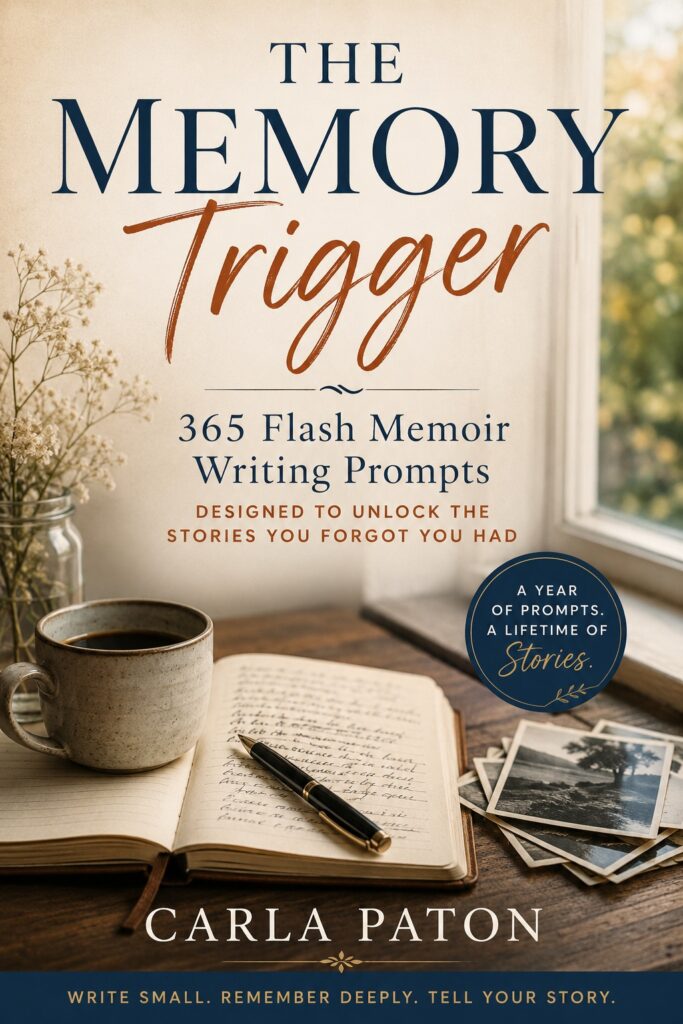
The Memory Trigger

Flash Memoir Prompt: Last Time You Were in a Place You Loved

flash memoir place

A warm, specific writing invitation for remembering the last time you stood in a place you loved before you understood it would become part of your past.

You may remember the room before you remember the goodbye. The way the afternoon light hit the floor. The chipped mug near the sink. The smell of dust, laundry soap, rain, or old wood. At the time, it may have felt ordinary. You were just leaving for the day, closing a door, walking across grass, turning off a lamp.

Only later did you realize it was the last time.

This flash memoir prompt last time place loved before asks you to return to that strange kind of memory: the goodbye you did not know you were having. It is tender because the scene carries two versions of you at once. One version is inside the moment, unaware. The other is looking back, able to see what was already ending.

flash memoir place

The Prompt

Write about the last time you were in a place you loved, before you knew you were leaving it for good.

This prompt can unlock a powerful memory because it does not begin with a dramatic farewell. It begins with ordinary details. A porch step. A classroom desk. A childhood bedroom. A library table. A backyard gate that squeaked every time you opened it.

The place does not need to be beautiful to matter. It only needs to have held part of your life. When you write from this flash memoir prompt last time place loved before, you are not trying to explain everything that happened there. You are choosing one final visit and letting the details carry the feeling.

Why This Memory Matters

Places can hold memory in a way people sometimes cannot. They keep the shape of old routines. They remind us who we were when we still belonged there.

The place in your story might be your grandmother’s kitchen, where the radio was always too loud. It might be an apartment you were ready to leave until you actually had to. It might be a school hallway, a church basement, a summer cabin, or the corner store that closed without warning.

What makes this memory rich is the gap between what you knew then and what you know now. In the moment, you may have been distracted. You may have been annoyed, rushed, hungry, or thinking about something small. Looking back, those small things become charged with meaning.

That is often where memoir comes alive. The lesson does not have to be stated in a grand way. A single object can do quiet work. If you want to think more about how objects carry emotional meaning, you might enjoy this guide on how to find symbolism in a story. The same skill can help you notice symbols in your own life.

A place you loved can also reveal change. Maybe you left because of choice. Maybe someone else made the choice for you. Maybe the place changed first. In any case, the story is less about real estate and more about attachment. It asks: What did this place give you, and what did you lose when you could no longer return?

How to Approach This Prompt

Start with one physical detail. Do not begin by explaining why the place mattered. Begin with what your hand touched, what your eye noticed, or what sound filled the room.

For example, write about the dent in the screen door, the cold tile under your feet, the poster peeling near the ceiling, or the smell of pencil shavings in a classroom. Let the place become real before you name the emotion.

Next, narrow the memory to one scene. Stay in the last visit. Resist the urge to summarize every year you spent there. You can mention the larger story later, but the flash memoir will feel stronger if the reader can stand beside you in that final moment.

You might use a sentence like, “I did not know this was the last time I would…” Then complete it with a simple action. Sit on that porch. Open that locker. Sleep in that room. Walk down that driveway.

Write what you noticed before you write what it meant. This helps the memory feel honest instead of forced. If you are the kind of writer who likes to mark up details before drafting, the habits in how to annotate literature can also help you study your own memories. Circle the images that seem to glow. Those may be the ones your piece needs.

For this flash memoir prompt last time place loved before, try writing for ten minutes without stopping. If you get stuck, return to the room, the ground, the air, or the door. The body often remembers what the mind has filed away.

A Quick Example

I did not know it was the last time I would sit on the back steps of my father’s house. I was seventeen, eating cereal from a plastic bowl because all the real bowls were packed or missing. The yard looked tired. The dog had dug a hole under the fence again, and someone had left a blue tarp folded near the garage. I remember being annoyed that the milk was warm. I remember slapping a mosquito on my ankle. Nothing felt important enough to save. A week later, the house was sold, and my father moved two states away. Now, when I think of that place, I do not picture my bedroom or the living room. I picture those steps, the bowl balanced on my knee, and the morning acting like it would happen again.

Try It Yourself

Set a timer and write the scene as if you are walking back into it. Do not worry about making it polished. Your first job is to notice.

Where were you standing? What was close to your body? What did you hear? What were you thinking about instead of the goodbye?

If the memory feels sad, let it be sad without pressing too hard. If it feels funny or strange, trust that too. Sometimes the truest memories arrive crooked. You might write about losing a place and still remember a ridiculous argument, a bad sandwich, or the way the floor creaked in one exact spot.

This flash memoir prompt last time place loved before works best when you let the ordinary moment stay ordinary for a while. The meaning can enter slowly. It can arrive in the final sentence, or it can stay under the surface.

Want More Flash Memoir Prompts?

If this prompt opened a memory you want to keep exploring, you can build a steady writing habit one small scene at a time. Explore all 365 prompts in The Memory Trigger: 365 Flash Memoir Writing Prompts.

The Memory Trigger