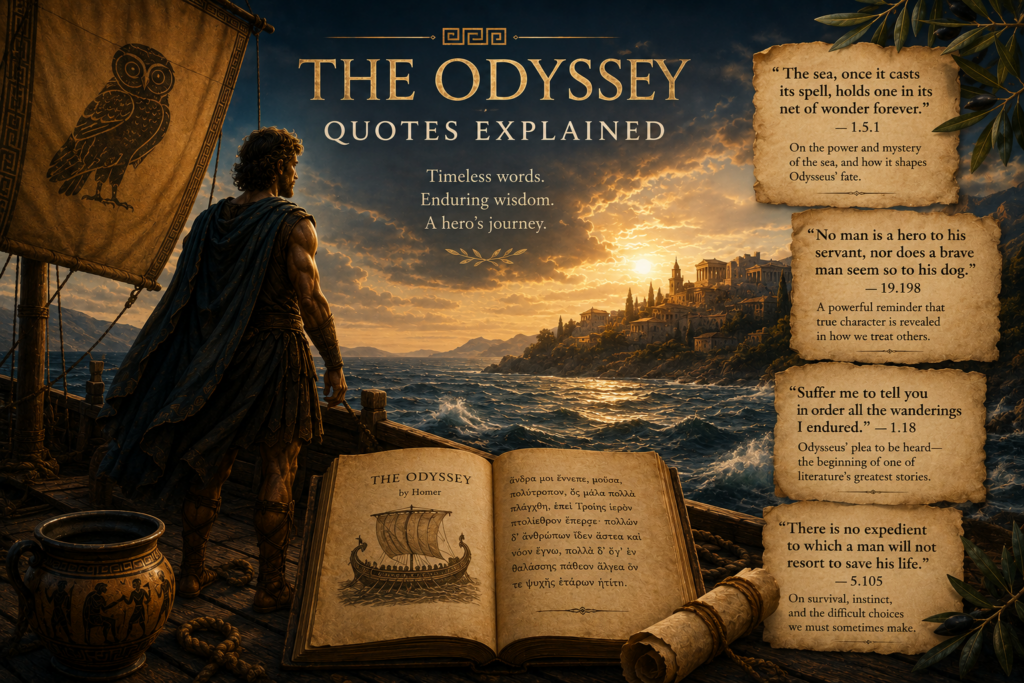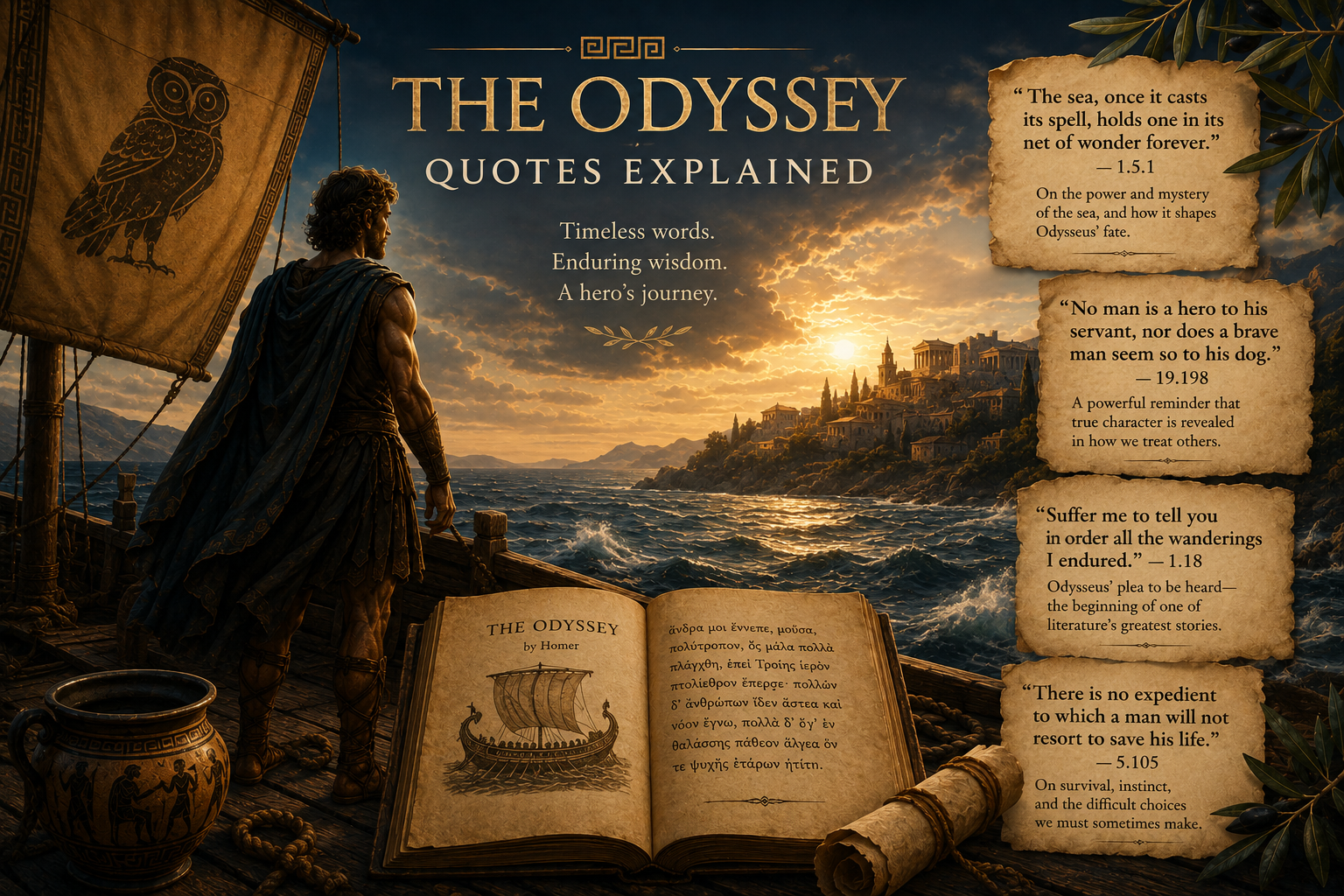
Important The Odyssey Quotes Explained: A Student Guide

Odyssey Quotes

A guide to memorable passages and how students can use them in essays.

The Odyssey quotes explained can help students see how Homer builds a story about home, honor, loss, and wisdom. This guide uses short public-domain phrases when useful, then explains how each passage can support a strong essay claim.

In this Guide

Use this quick map to find the quote or skill you need.

  • Why the quotes matter
  • Identity and home
  • Pride and consequences
  • Loyalty and endurance
  • Essay tips for quote analysis
  • Books and resources
  • FAQ
Odyssey Quotes

Why The Odyssey quotes explained matter in essays

Great quotes do more than sound important. They reveal how a text thinks.

A useful set of The Odyssey quotes explained should connect each passage to a theme, a character choice, or a major conflict. In The Odyssey, those conflicts often come from temptation, pride, and the hard pull of home.

Homer also uses repeated ideas, such as storytelling and disguise. When you explain a quote, look for what changes in the character or what the line shows about the ancient Greek world.

The Odyssey quotes explained: identity and home

Odysseus spends much of the poem away from Ithaca, yet the idea of home shapes nearly every choice he makes.

“Tell me, O Muse…”

This short opening phrase comes from older public-domain translations of the poem. It shows that the epic begins with an invocation, which is a call for divine help in telling the story.

The line matters because it frames Odysseus as more than one man with a problem. His journey becomes a story about human weakness, clever thought, and survival.

When students search for The Odyssey quotes explained, this opening is one of the best places to start. You can use it to discuss the epic tradition and the role of fate.

“that ingenious hero”

Some public-domain translations describe Odysseus with this phrase. It points to his intelligence, which is often his greatest strength.

Odysseus wins many battles with words before he uses force. This is like Hamlet in Shakespeare’s Hamlet, where thought and speech shape action, even when the results turn painful.

In an essay, this quote can support a claim about Odysseus as a hero of the mind. He is not just brave. He survives because he studies people and adapts.

The Odyssey quotes explained: pride and consequences

Homer often shows that a hero’s strength can turn into a weakness.

“My name is Noman”

In the Cyclops episode, Odysseus uses a false name to escape danger. Older translations often give the name as “Noman,” while many modern classes use “Nobody.”

This moment shows his quick wit. He knows that language can become a weapon.

The quote also sets up a warning. Odysseus escapes through cleverness, but he later reveals too much and brings Poseidon’s anger on himself.

“I am Ulysses son of Laertes”

Older public-domain translations often use Ulysses for Odysseus. This line matters because he announces his true name after the Cyclops episode.

The moment feels heroic, but it also exposes his pride. Odysseus wants glory, and that desire costs him years of suffering.

This is a strong quote for an essay about heroic flaws. Like Achilles in The Iliad, Odysseus is great because of his passion, yet that same passion can harm him.

The Odyssey quotes explained: loyalty and endurance

The poem values cleverness, but it also honors patience and faithfulness.

Argus recognizes his master

Many students remember the scene with Argus, Odysseus’s old dog. The exact wording changes by translation, but the point is clear: Argus knows Odysseus when many people do not.

This scene is short, but it has deep emotional power. It shows that loyalty can outlast time, poverty, and disguise.

The Odyssey quotes explained often focus on Odysseus, but Argus can support a strong paragraph about recognition. Home is not only a place. It is also the bonds that still know you.

Penelope and the bed

Penelope tests Odysseus with the secret of their marriage bed. The scene proves that she is not passive or easily fooled.

Her test mirrors Odysseus’s own cleverness. Both of them use intelligence to protect what matters.

This moment works well in essays about marriage, trust, and identity. It also shows that the return home must be earned, not simply claimed.

How to use The Odyssey quotes explained in an essay

A quote should not sit in your paragraph like decoration. It should help prove your point.

The best The Odyssey quotes explained will follow a simple pattern: claim, quote, explanation, and link back to the thesis. If you need help with that structure, read our guide on how to write a literary analysis essay.

Here is a simple example:

Claim: Odysseus’s cleverness saves him, but his pride delays his return.

Quote: His false name, “Noman,” helps him escape the Cyclops.

Explanation: The name shows his gift for strategy. Yet after he escapes, he reveals his identity, which turns his success into a new danger.

Try to avoid a summary-only paragraph. Teachers want analysis, which means you explain why the words matter.

If you want a ready-to-use reference while you study, try our Odyssey quote study guide and pair it with your class notes.

The Odyssey quotes explained through major themes

The strongest quotes connect to themes that appear across the whole epic.

Home: Odysseus wants Ithaca, but he must learn restraint before he can fully return.

Pride: His desire for fame creates real danger, especially after the Cyclops episode.

Disguise: Odysseus’s hidden identity lets him test others before he acts.

Loyalty: Penelope, Telemachus, and Argus show that faithfulness has its own kind of courage.

Storytelling: Odysseus often survives by shaping how others see him. His words become part of his power.

Books and resources for The Odyssey quotes explained

Good background sources can help you understand the epic without replacing your own reading.

For a clear overview of the poem, visit Britannica’s article on The Odyssey. For the ancient Greek text and older translations, see the Perseus Digital Library.

Relevant books to search for

  • The Odyssey by Homer, translated by Emily Wilson
  • The Odyssey by Homer, translated by Robert Fagles
  • The World of Odysseus by M. I. Finley

Different translations use different wording, so always cite the version your class uses.

FAQ: The Odyssey quotes explained

Quick answers can help you choose the right passage for your essay.

What is the most important quote in The Odyssey?

The opening invocation is one of the most important because it sets up the epic style and introduces Odysseus as a complex hero.

Can I use a paraphrase instead of a quote?

Yes, but use direct quotes for key words or major moments. A short quote often gives stronger proof.

Why do translations of The Odyssey sound different?

Each translator makes choices about tone, rhythm, and word meaning. That is why your essay should name the translation you use.

What themes work best with Odysseus quotes?

Strong themes include home, pride, disguise, loyalty, and identity. Choose the one that fits your thesis.

Key takeaway

The best way to use The Odyssey quotes explained is to connect each phrase to a choice, a consequence, or a theme. A short quote with a clear explanation can make your essay sharper and more convincing.
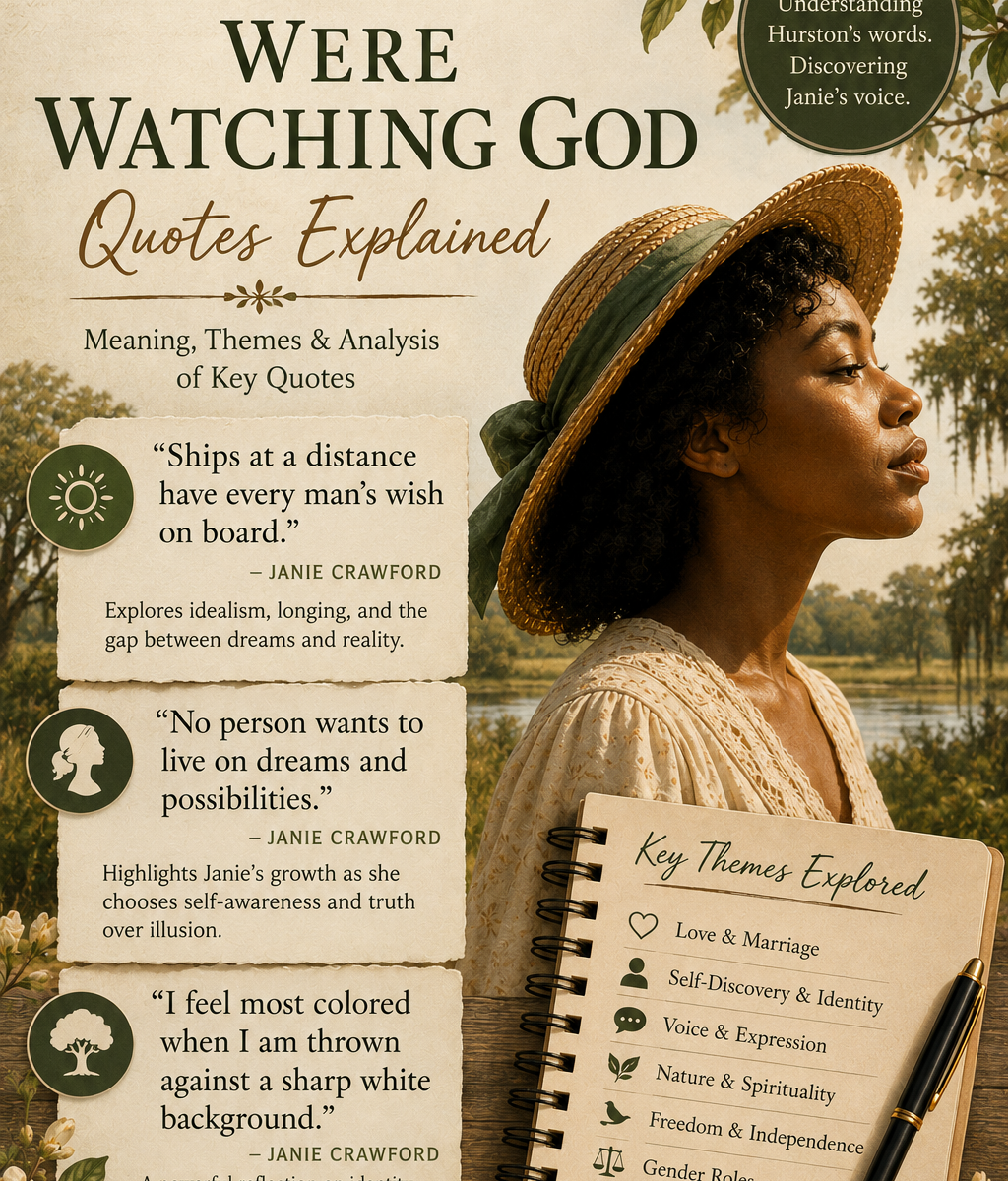
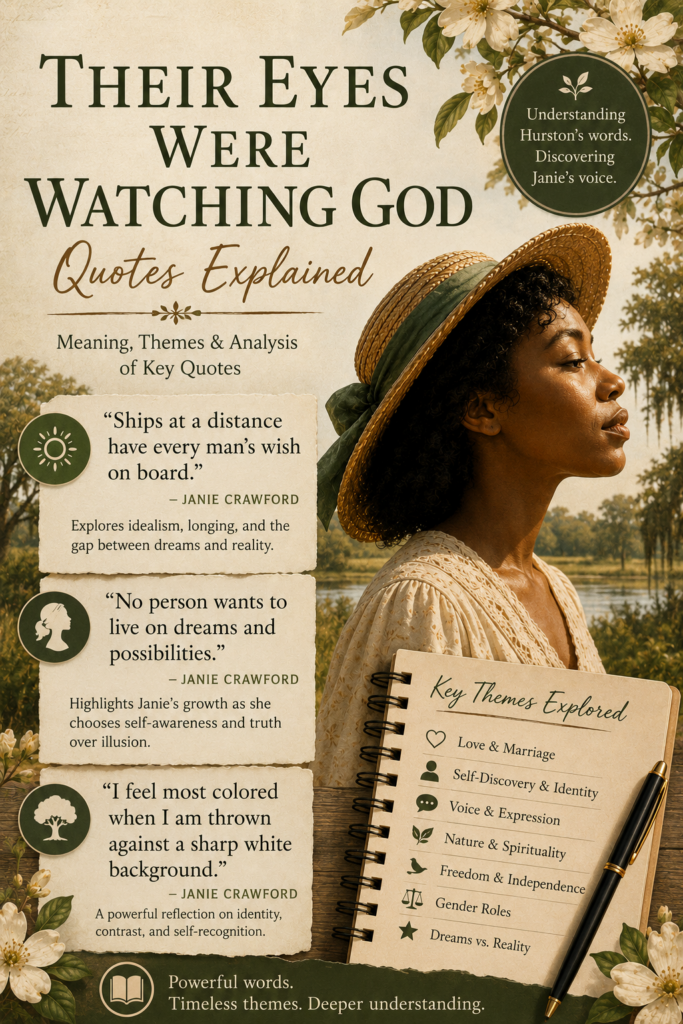
Their Eyes Were Watching God Quotes Explained: Important Passages for Essays

Their Eyes Were Watching God Quotes

A guide to memorable passages and how students can use them in essays.

Students often remember Zora Neale Hurston’s novel for its rich voice, bold symbols, and deep look at Janie’s self-discovery. This guide to Their Eyes Were Watching God quotes explained will help you connect key passages to theme, character, and essay claims.

In this Guide

  • Why the quotes matter
  • The horizon and Janie’s dreams
  • Voice, silence, and storytelling
  • Love, power, and marriage
  • Nature, the storm, and fate
  • How to use quotes in essays
  • FAQ
Their Eyes Were Watching God Quotes

Their Eyes Were Watching God quotes explained: why the passages matter

Hurston uses short, vivid lines to show Janie’s growth from a young dreamer into a woman who owns her story.

When you study Their Eyes Were Watching God quotes explained, look for two things: what the words say on the surface and what they reveal about Janie’s inner life.

The novel works like a framed story. Janie tells Pheoby what happened, so the quotes often carry both memory and meaning.

Essay tip: Do not drop a quote into your paragraph and move on. Explain how the language proves your point.

Their Eyes Were Watching God quotes explained: the horizon and Janie’s dreams

The horizon is one of the novel’s strongest symbols because it marks the space between what Janie has and what she wants.

Short quote: “Ships at a distance”

This opening image links dreams to ships far away on the water. It suggests that some people keep waiting for life to bring their hopes closer.

For Janie, the horizon means more than travel. It stands for freedom, desire, and a future she can choose for herself.

This is a key reason Their Eyes Were Watching God quotes explained can help students write about theme. The same symbol returns as Janie learns what love, independence, and self-knowledge mean.

A useful comparison is the green light in The Great Gatsby. Both symbols point toward desire, but Hurston’s horizon becomes more personal because Janie earns a clearer view of herself.

Voice, silence, and Their Eyes Were Watching God quotes explained

Janie’s journey is not only about love. It is also about finding the right to speak.

Short quote: “the horizon”

Near the end, Janie’s return to this image shows that she has not lost her dream. She has changed how she understands it.

At the start, others speak for her or over her. Nanny, Logan, and Joe all try to shape her life through their own ideas of safety, labor, or public image.

Joe Starks is especially important here. He wants Janie to look like a mayor’s wife, but he does not want her to have a public voice.

Use Their Eyes Were Watching God quotes explained to show how Hurston connects speech with power. When Janie speaks at last, her words show that her inner self has survived.

Love, power, and marriage in key quotes

Hurston uses Janie’s relationships to test different ideas of love.

Janie’s first marriage to Logan Killicks is tied to duty and survival. Nanny wants Janie safe, but safety without love feels empty to Janie.

Her marriage to Joe Starks brings status, yet it also brings control. Joe gives Janie a larger house, but he limits her freedom.

Tea Cake offers a different kind of love because he treats Janie more like a person than a symbol. Still, the novel does not present love as perfect or simple.

For Their Eyes Were Watching God quotes explained, focus on how Hurston shows love as both joy and risk. A strong essay can argue that Janie does not just search for romance. She searches for a life that feels true.

Literary connection: Like Jane in Jane Eyre, Janie wants love without losing her self-respect.

Nature, the storm, and fate

The storm scene shows human limits in a world that cannot be fully controlled.

Short quote: “watching God”

This phrase points to fear, awe, and helplessness. During the hurricane, people stop trusting wealth, plans, or social rank.

The storm also changes the novel’s tone. It moves the story from personal choice to survival.

This moment matters because Janie and Tea Cake face a force larger than love. Hurston suggests that nature can test human bonds in ways people cannot predict.

If you know King Lear, you can compare how a storm reveals truth. In both works, nature strips away pride and shows what people are made of.

How to use Their Eyes Were Watching God quotes explained in essays

A good quote paragraph needs a claim, context, evidence, and analysis.

Start with a clear point. Then give only the context your reader needs.

After the quote, explain the words. Ask why Hurston uses that image, symbol, or tone.

For Their Eyes Were Watching God quotes explained, avoid plot summary. Your teacher already knows what happened. Show how the language creates meaning.

Here is a simple model:

Claim: Hurston uses the horizon to show Janie’s desire for a larger life.

Context: The image appears as Janie thinks about dreams and what people hope to reach.

Analysis: The distant horizon suggests that Janie’s dream is not easy to reach, but it remains visible. This makes her growth feel active, not accidental.

If you want more help with structure, read our guide on how to write a literary analysis essay.

For faster review, you can also use our quote analysis study aid as you plan your essay.

Best books to pair with this novel

These books can help students build context and compare themes.

  • Their Eyes Were Watching God by Zora Neale Hurston
  • Passing by Nella Larsen
  • Their Eyes Were Watching God: A Casebook edited by Cheryl A. Wall

You can search these titles on Amazon, at your school library, or through a local bookstore.

Helpful outside resources

For author background, visit the Britannica biography of Zora Neale Hurston.

For more historical context, explore the Library of Congress Zora Neale Hurston collection.

FAQ: Their Eyes Were Watching God quotes explained

What is the most important quote in the novel?

The opening image, “Ships at a distance,” is one of the most important because it introduces dreams, gender, and the horizon symbol.

What does the horizon mean?

The horizon stands for Janie’s dreams, freedom, and search for a life that belongs to her.

Why is voice so important in the novel?

Voice matters because Janie’s growth depends on her ability to speak, remember, and define herself.

Can I use short quote fragments in an essay?

Yes. Short fragments often work well if you explain them closely and connect them to your claim.

How many quotes should I use in a paragraph?

One strong quote is usually enough. Spend more space on analysis than on quoted text.

Key Takeaway

Their Eyes Were Watching God quotes explained show that Janie’s story is about more than romance. It is about voice, freedom, and the courage to claim a life of her own.

Macbeth Quotes Explained: Important Passages for Students

Macbeth quotes

Macbeth is full of short lines that carry huge meaning. This guide offers Macbeth quotes explained in clear language so you can connect famous passages to theme and character change. Each quote below shows what the words mean and how to use them in an essay.

In this Guide

Use this quick map to find the passages that fit your class notes or essay topic.

  • How to read important quotes
  • Ambition and temptation
  • Guilt and fear
  • Appearance and reality
  • Fate and choice
  • Essay tips and study tools
Macbeth quotes

Macbeth quotes explained: how to read the play

A strong quote is not just a famous line. It is proof of how the play builds meaning.

Start with context. Ask who speaks and what has just happened. Then explain how the line reveals a conflict, fear, or desire.

Do not drop a quote into a paragraph and move on. Your job is to show why the words matter. If you need help with that skill, read our guide on how to write a literary analysis essay.

Macbeth quotes explained for ambition and temptation

Macbeth’s rise begins with a promise, but his choices turn that promise into a trap.

“Stars, hide your fires”

Macbeth says this after he starts to imagine himself as king. He wants the stars to hide their light because he knows his thoughts are dark.

This line shows **secret ambition**. Macbeth does not act yet, but his mind has already crossed a moral line.

“Vaulting ambition”

Macbeth admits that ambition is the main force pushing him toward murder. The image suggests a rider who leaps too far and falls.

This is useful for essays about self-destruction. Like Victor Frankenstein, Macbeth wants power before he has the wisdom to handle it.

These Macbeth quotes work well when your claim focuses on how desire can overpower conscience.

Macbeth quotes explained for guilt and fear

After the murder of Duncan, guilt does not fade. It grows until it shapes how Macbeth and Lady Macbeth see the world.

“Sleep no more!”

Macbeth hears this cry after he kills Duncan. Sleep usually means peace, but Macbeth has destroyed that peace for himself.

The line suggests that guilt becomes a punishment. No guard has caught Macbeth yet, but his mind is already attacking him.

“Out, damned spot!”

Lady Macbeth imagines blood on her hands. The spot is not real, but her guilt is.

Earlier, she seemed cold and strong. By this point, Shakespeare shows that denial cannot protect her forever.

For a comparison, think of Raskolnikov in Crime and Punishment. In both works, the crime happens once, but the guilt keeps returning.

Macbeth quotes explained for appearance and reality

Many characters in the play hide what they want. Shakespeare uses false faces, strange language, and broken trust to show that appearances can mislead.

“Fair is foul, and foul is fair”

The witches speak this line near the start of the play. It means that good and evil will seem mixed up.

The line prepares us for a world where truth is hard to read. Macbeth looks loyal, but he plans betrayal.

“False face must hide what the false heart doth know”

Macbeth says he must hide his plan behind a false expression. His face becomes a mask.

This quote is strong evidence for essays about deception. It shows that Macbeth understands the evil of his choice, yet he chooses to act anyway.

Macbeth quotes explained for fate and choice

The witches predict Macbeth’s future, but they do not force his hand. That tension makes the play feel tragic.

“If chance will have me king”

At first, Macbeth wonders if fate will make him king without action. This shows hesitation.

Soon, he stops waiting. His shift matters because tragedy often grows from a person’s own decisions.

“I am in blood”

Macbeth feels trapped by the violence he has caused. He thinks he has gone too far to turn back.

This line shows how one crime leads to another. Macbeth quotes explained in this way help students argue that fate may tempt him, but choice destroys him.

How to use Macbeth quotes in essays

Good quote analysis connects words on the page to a clear claim. Keep your explanation focused and direct.

When you use Macbeth quotes in an essay, follow a simple pattern:

  1. Make a claim about the character or theme.
  2. Give brief context for the quote.
  3. Use a short quotation.
  4. Explain the words that prove your point.

For example, you might write: Macbeth’s line “Stars, hide your fires” shows that he knows his ambition is morally wrong. He wants darkness to cover his thoughts, which proves that guilt begins before the murder.

For quick review before a quiz, pair this post with our Macbeth quote study notes.

Helpful books for Macbeth students

These editions and study books can help you read the play with stronger notes.

  • Macbeth by William Shakespeare, Folger Shakespeare Library edition
  • Shakespeare After All by Marjorie Garber

Choose an edition with footnotes if the language feels hard. The notes can explain old words without replacing your own thinking.

Trusted online resources

Use reliable sources when you need background on Shakespeare or the play’s history.

For a clear overview, see Britannica’s article on Macbeth. For the full public-domain text with helpful tools, visit the Folger Shakespeare Library text of Macbeth.

FAQ: Macbeth quotes explained

Here are quick answers to common student questions about choosing and analyzing quotes.

What is the best Macbeth quote for ambition?

“Vaulting ambition” is one of the clearest choices. It shows that Macbeth understands the motive behind his crime.

What quote shows Macbeth’s guilt?

“Sleep no more!” is a strong guilt quote. It shows that Macbeth loses inner peace after killing Duncan.

What quote shows Lady Macbeth’s guilt?

“Out, damned spot!” shows her guilt in a vivid way. She imagines blood that cannot be washed away.

How many quotes should I use in a Macbeth essay?

Use enough to support your claim, not to fill space. Two well-explained quotes are often stronger than many rushed ones.

Key Takeaway

Macbeth quotes explained well do more than define old words. They show how ambition, guilt, and choice push Macbeth from brave soldier to tragic tyrant.