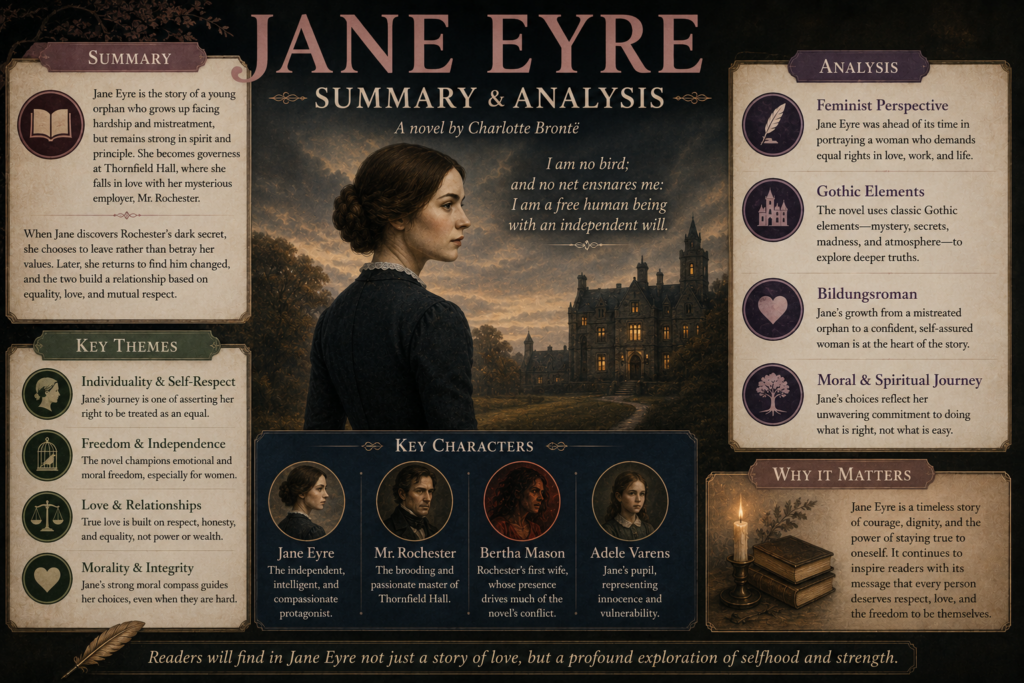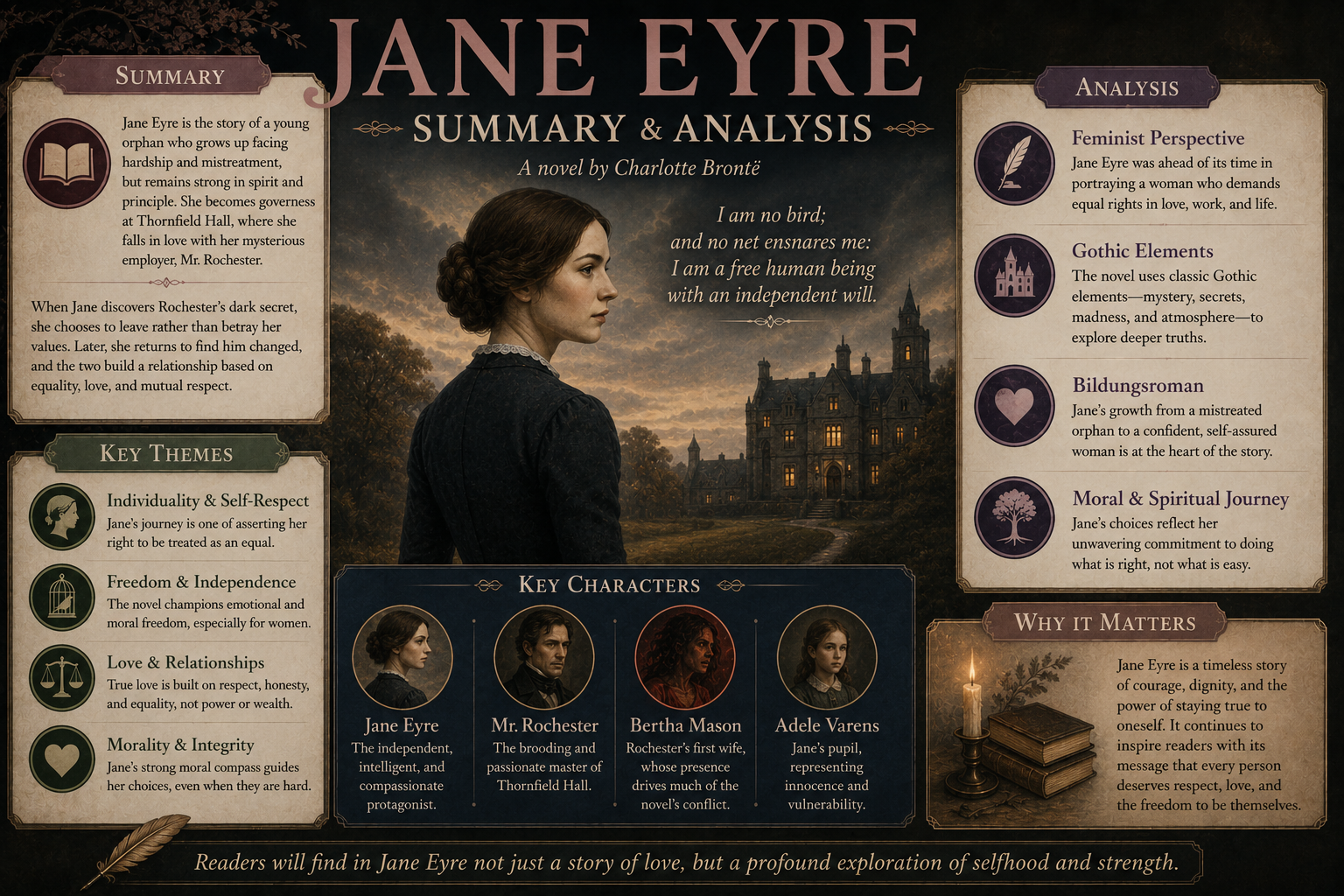
Jane Eyre Summary and Analysis for Students

Jane Eyre Summary

Jane Eyre is one of the most important novels of the Victorian age. This Jane Eyre summary and analysis gives students a clear path through the plot, structure, conflicts, and deeper meaning.

Charlotte Brontë tells a story about a young woman who wants love, faith, and freedom without losing herself.

In this Guide

Use this guide as a map before class, essays, or exams.

  • Quick overview
  • Plot summary by major stage
  • Structure and point of view
  • Main conflicts
  • Themes, symbols, and meaning
  • Helpful books and FAQ
Jane Eyre Summary

Jane Eyre summary and analysis: quick overview

The novel follows Jane from a harsh childhood to a hard-won adult life.

Jane is an orphan raised by cruel relatives at Gateshead. She later goes to Lowood School, becomes a governess at Thornfield Hall, and falls in love with Mr. Rochester.

This Jane Eyre summary and analysis matters because the novel is not just a romance. It is also a story about self-respect, moral choice, and the right to speak.

For a short reference overview, see Britannica on Jane Eyre.

Jane Eyre summary and analysis: plot by major stages

Brontë builds Jane’s life in clear stages, and each place tests her in a new way.

Gateshead: Jane learns she is unwanted

Jane lives with her aunt, Mrs. Reed, and her cousins. They treat her as a burden, not a child with feelings.

The red-room scene is one of the novel’s key moments. Jane is locked in the room where her uncle died, and her fear shows how trapped she feels.

Lowood: Jane learns discipline and loss

At Lowood School, Jane meets Helen Burns, a gentle girl with deep faith. Helen teaches Jane patience, but her death also shows the cruelty of neglect.

Mr. Brocklehurst uses religion to control the girls. Brontë criticizes this false form of faith.

Thornfield: Jane finds love and danger

Jane becomes a governess at Thornfield Hall. She meets Mr. Rochester, who treats her as an equal in conversation.

They fall in love, but the wedding stops when Jane learns Rochester already has a wife, Bertha Mason, hidden in the attic. Jane leaves because she will not become his mistress.

Moor House: Jane faces a different kind of trap

Jane is rescued by the Rivers family, who later turn out to be her cousins. St. John Rivers asks Jane to marry him and serve as a missionary wife.

His offer is respectable, but it has no love. Jane refuses because it would crush her spirit.

Ferndean: Jane returns by choice

Jane later returns to Rochester after a fire destroys Thornfield. Bertha dies in the fire, and Rochester loses his sight and one hand.

Jane marries him only after they can meet on more equal ground. Use this Jane Eyre summary and analysis to notice that Jane’s happy ending depends on freedom, not surrender.

How Jane Eyre is structured

The novel has a life-story shape that helps readers track Jane’s growth.

Jane Eyre is a first-person novel. Jane tells her own story as an adult, so we see both her childhood feelings and her mature judgment.

A Jane Eyre summary and analysis should also note that the book is a Bildungsroman, or coming-of-age novel. Like Great Expectations by Charles Dickens, it follows a young person through pain, mistakes, and self-knowledge.

The setting changes as Jane changes. Gateshead shows rejection, Lowood shows discipline, Thornfield shows desire, and Ferndean shows chosen love.

If you want to study Brontë’s word choices more closely, this guide to close reading in literature can help.

Main conflicts in Jane Eyre

The novel’s conflicts are personal, social, and moral.

Jane versus society is one major conflict. Jane is poor, female, and often powerless, but she refuses to accept shame as her proper place.

Jane versus herself is just as important. She wants love, but she also knows that love without respect can destroy her.

Jane versus Rochester creates the central romantic tension. Rochester loves Jane, but he tries to hide the truth about Bertha, which makes their first union morally wrong.

Jane versus St. John tests her in another way. St. John offers duty without passion, while Rochester offers passion that must be purified by honesty.

Themes in Jane Eyre summary and analysis

Brontë uses Jane’s story to ask what a person needs in order to live with dignity.

Independence and self-respect

Jane’s strongest trait is her sense of inner worth. She has little money or status, but she believes her soul is equal to anyone else’s.

For students, Jane Eyre summary and analysis often begins with this point. Jane does not reject love. She rejects love that demands the loss of self.

Love and equality

Jane and Rochester’s best moments come when they speak honestly. Their worst moments come when power is uneven.

Like Elizabeth Bennet in Pride and Prejudice, Jane must judge whether a man’s love respects her mind as well as her heart.

Religion and moral choice

The novel offers different forms of faith. Helen Burns shows patient faith, Mr. Brocklehurst shows cruel hypocrisy, and St. John shows duty without warmth.

Jane’s faith is tied to conscience. She leaves Rochester because she believes love must answer to moral truth.

Class and gender

Jane lives in a world where class shapes every chance she has. As a governess, she is educated but not rich, so she stands between social groups.

Brontë also shows how women had narrow choices. Jane wants work, love, and respect, not a life chosen for her by others.

Symbols and Gothic elements

The novel uses dark, strange, and intense images to reveal hidden fears.

The red-room stands for childhood trauma and social punishment. Jane is treated as if her anger is a crime.

Thornfield Hall stands for mystery and buried truth. The house looks grand, but it hides pain in its upper rooms.

Fire often marks passion, danger, and change. It destroys Thornfield, but it also clears the way for a more honest life.

These Gothic touches connect Jane Eyre to novels like Wuthering Heights, where setting and emotion feel closely linked.

Literary meaning and why Jane Eyre still matters

Jane’s story still feels modern because she fights for a voice.

This Jane Eyre summary and analysis also shows why the novel is more than a love story. Jane’s final happiness comes because she chooses it from a place of strength.

The famous line about Jane being no bird captures the heart of the book. She refuses to be caged by gender, class, fear, or romance.

To learn more about Charlotte Brontë as a writer, see the Poetry Foundation biography of Charlotte Brontë.

For more study support, our student literature guides can help you review major novels with clearer notes.

Helpful books for Jane Eyre study

These books are useful for students who want more context or a reliable edition.

  • Jane Eyre by Charlotte Brontë, Penguin Classics edition
  • The Madwoman in the Attic by Sandra M. Gilbert and Susan Gubar

You can look for these through a school library, local bookstore, or Amazon Books.

FAQ: Jane Eyre summary and analysis

Here are quick answers to common student questions.

What should a Jane Eyre summary and analysis include?

It should cover Jane’s life stages, her conflicts, major themes, key symbols, and the meaning of her final choice.

What is the main message of Jane Eyre?

The novel argues that love must include equality, honesty, and self-respect.

Why does Jane leave Rochester?

Jane leaves because Rochester is already married. She loves him, but she will not betray her conscience.

Is Jane Eyre a feminist novel?

Many readers see it that way because Jane demands dignity, work, and moral freedom in a world that limits women.

Key Takeaway

A strong Jane Eyre summary and analysis should show how Jane moves from isolation to self-command. The novel’s power comes from one clear idea: Jane wants love, but never at the cost of her soul.
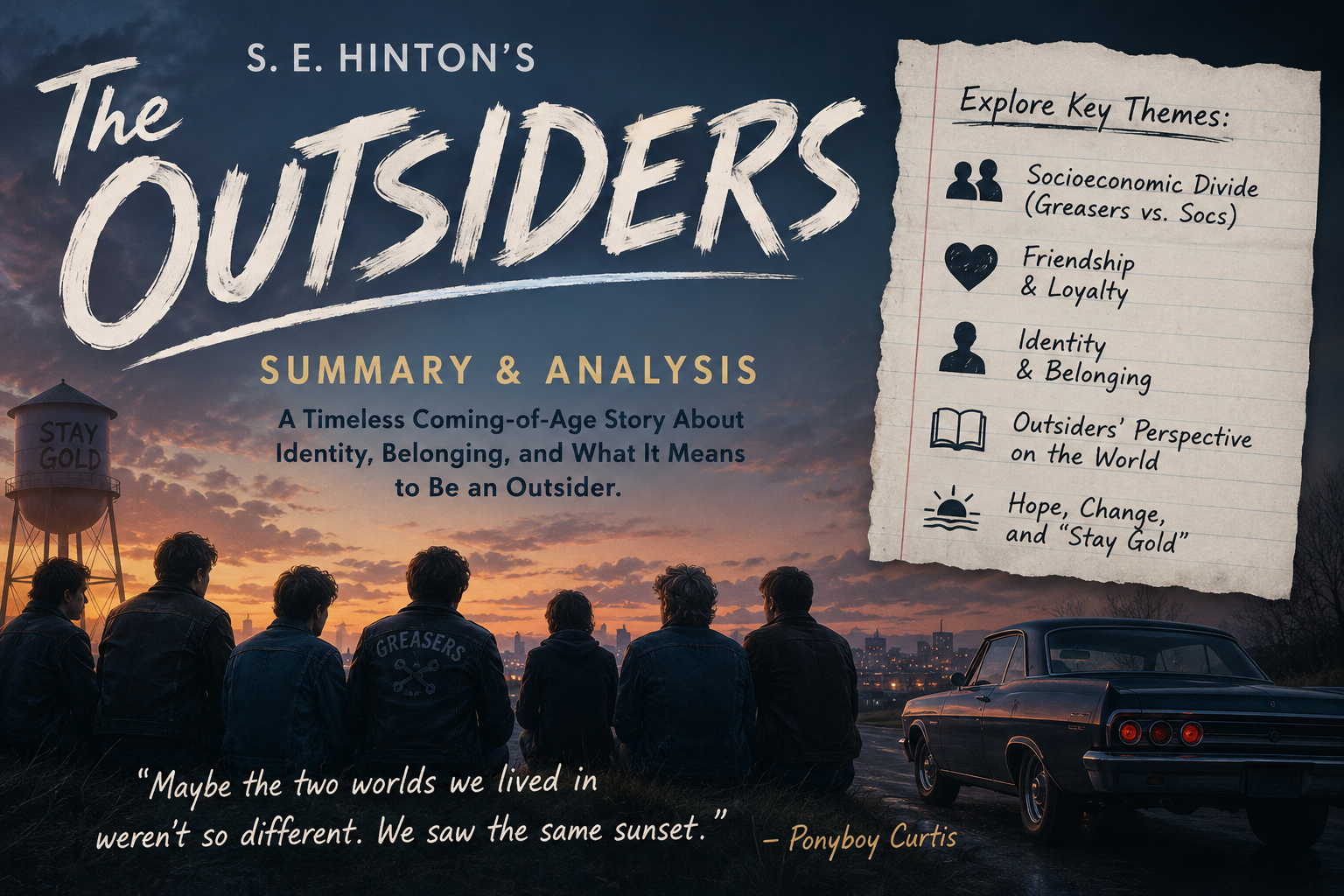
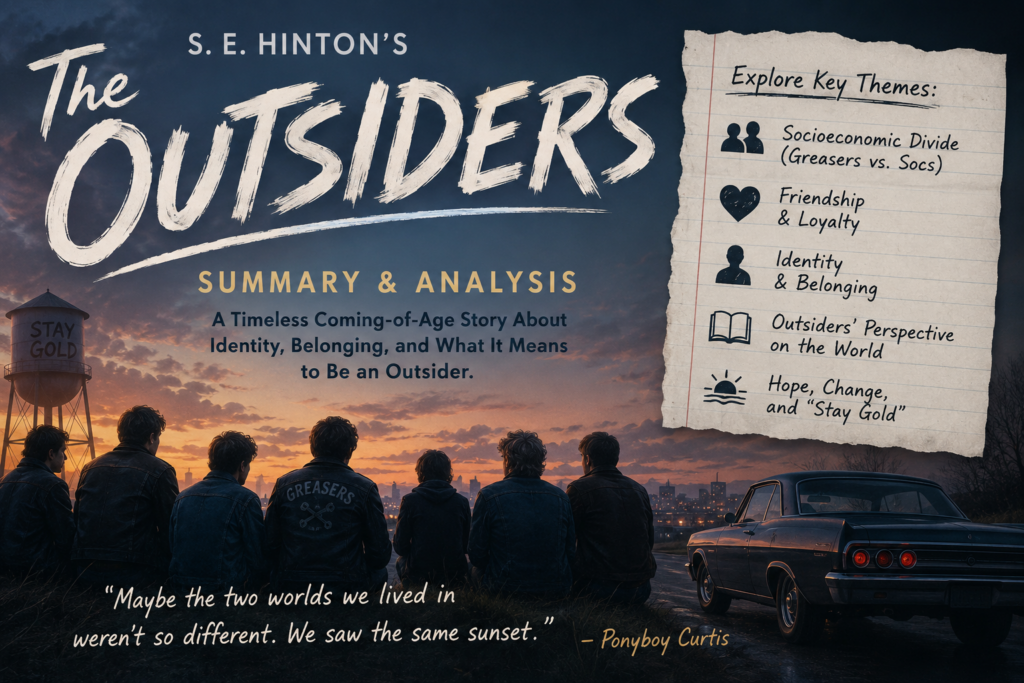
The Outsiders Summary and Analysis for Students

The Outsiders Summary

This guide gives you a clear The Outsiders summary and analysis without making the novel harder than it needs to be. You will review the plot, structure, conflicts, characters, and deeper meaning of S. E. Hinton’s famous coming-of-age story.

The Outsiders is short, but it has big ideas about class, loyalty, violence, and identity. That is why students often study it in middle school, high school, and college intro courses.

In this Guide

Use this guide as a quick map before class, homework, or essay prep.

The Outsiders summary and analysis: Quick Plot Overview

The novel follows Ponyboy Curtis as he learns that people are more complex than their labels.

The Outsiders takes place in Oklahoma during the 1960s. Ponyboy belongs to the Greasers, a poor group of boys who face constant judgment from richer teens called the Socs.

A strong The Outsiders summary and analysis starts with the fight between these two groups. The Greasers and Socs do not just dislike each other. They live in different worlds, even though they share the same town.

Ponyboy lives with his older brothers, Darry and Sodapop, after their parents die. Darry acts strict because he wants to keep the family together. Ponyboy often mistakes that pressure for a lack of love.

The plot turns after Ponyboy and Johnny are attacked by Socs. Johnny kills Bob, a Soc, to save Ponyboy. The boys run away and hide in an abandoned church.

At the church, Ponyboy and Johnny grow closer. They read Gone with the Wind, talk about beauty, and try to make sense of what happened. Johnny tells Ponyboy to “stay gold,” a phrase tied to innocence and goodness.

When the church catches fire, Ponyboy, Johnny, and Dally rescue children trapped inside. Johnny is badly hurt. The boys become heroes, but the world around them does not become simple.

The novel ends after Johnny dies from his injuries and Dally dies after a police chase. Ponyboy struggles with grief, then begins to write the story we have just read.

Plot Structure and Point of View

The story feels personal because Ponyboy tells it in his own voice.

The novel uses first-person narration. That means readers see events through Ponyboy’s thoughts, fears, and memories.

This choice matters. Ponyboy is smart and sensitive, but he is also young. He does not always understand Darry, the Socs, or even himself at first.

The book has a circular shape. It begins with Ponyboy leaving a movie theater, and it ends with Ponyboy writing that same opening scene for a school assignment. This structure shows that the novel is also his attempt to understand trauma.

If you want to build stronger notes on narration, try this guide to close reading in literature. It can help you slow down and study small details in key scenes.

The structure also moves from street conflict to moral reflection. Like To Kill a Mockingbird, the novel asks readers to see beyond social labels and judge people with more care.

The Outsiders summary and analysis: Main Conflicts

The main conflicts come from class division, family stress, and moral choice.

The biggest outside conflict is Greasers versus Socs. The Socs have money, status, and protection. The Greasers have each other, but they face danger and blame more often.

This part of The Outsiders summary and analysis is important because Hinton does not show either group as fully good or fully bad. Cherry Valance, a Soc, helps Ponyboy see that pain exists on both sides.

There is also a family conflict between Ponyboy and Darry. Ponyboy thinks Darry is too hard on him. Darry fears that one wrong move could send Ponyboy and Sodapop into foster care.

Johnny faces an inner conflict. He is gentle, but he has lived with fear for years. When he kills Bob, the act is violent, yet it comes from a desperate need to protect Ponyboy.

Dally has a deep conflict too. He acts tough because he believes care makes people weak. Johnny’s death breaks him because Johnny is the one person he still lets himself love.

Characters and What They Reveal

Each major character shows a different way to live with pain.

Ponyboy Curtis is the narrator. He likes books, sunsets, and movies. He feels pulled between the rough world of the Greasers and his own thoughtful nature.

Johnny Cade is quiet and scared, but he is also brave. His final message to Ponyboy tells us that goodness matters, even in a harsh world.

Dally Winston is tough and reckless. He has learned to survive by shutting down his feelings. His end shows the cost of a life without hope.

Darry Curtis is strict because he carries adult weight too soon. He gave up school and sports to care for his brothers.

Sodapop Curtis tries to keep peace at home. He is warm, but he is not free from stress. His pain reminds readers that cheerful people can still suffer.

Cherry Valance helps challenge Ponyboy’s view of the Socs. She proves that class does not erase human feeling.

Major Themes in The Outsiders summary and analysis

The novel’s themes help explain why the story still speaks to young readers.

A good The Outsiders summary and analysis should focus on class conflict. The Greasers and Socs are divided by money, clothes, cars, and public image. The novel asks whether society gives some people more chances than others.

Another key theme is identity. Ponyboy must decide who he is beyond the word Greaser. He learns that a label can describe part of a person, but it cannot explain the whole person.

The theme of loyalty shapes the group. The Greasers protect one another because they often feel ignored by the wider world. Yet loyalty can also lead to fights that cause more harm.

The theme of loss of innocence appears through Johnny and Ponyboy. The poem “Nothing Gold Can Stay” by Robert Frost helps explain this idea. Beauty and youth can fade, but Ponyboy learns that people can still choose kindness.

For more context on the author, Britannica has a helpful overview of S. E. Hinton and her place in young adult fiction.

Symbols and Motifs in the Novel

Hinton uses simple images to carry deep meaning.

In The Outsiders summary and analysis, the sunset is one of the most important symbols. Ponyboy notices that both Greasers and Socs can see the same sunset. This image shows common humanity across class lines.

The poem “Nothing Gold Can Stay” stands for innocence, beauty, and change. Johnny’s advice to “stay gold” means Ponyboy should protect the gentle part of himself.

Hair is another symbol. For the Greasers, long hair is part of their identity. When Ponyboy and Johnny cut and bleach their hair, they feel as if they have lost part of who they are.

The abandoned church works as a place of escape and change. It is away from the city’s violence, but it also becomes the place where the boys must prove who they really are.

Why the Ending Matters

The ending turns the novel from a sad story into an act of witness.

The final chapters are a key part of The Outsiders summary and analysis because they show Ponyboy in denial. He struggles to accept Johnny’s death and Dally’s collapse.

Ponyboy’s school essay becomes the novel itself. This means the act of writing helps him face what happened. He tells the story so other people can understand boys like Johnny before it is too late.

The ending does not solve poverty or violence. It gives Ponyboy a voice. That voice is his first step toward healing.

If you need help turning these ideas into an essay, pair this post with our student literature guides for more support.

How to Use This Guide for Class

This The Outsiders summary and analysis works best when you connect plot events to meaning.

Do not stop at what happens. Ask why each event matters. For example, Johnny’s death is not only sad. It shows how violence can destroy the most vulnerable people first.

For essays, choose one clear claim. You might argue that Ponyboy’s growth comes from learning to see both Greasers and Socs as human. Then use scenes, symbols, and quotes to support that claim.

You can also practice close reading skills by studying the sunset scenes or Johnny’s final letter.

Amazon Books to Read Next

These books pair well with The Outsiders because they also explore youth, class, and moral growth.

  • That Was Then, This Is Now by S. E. Hinton
  • To Kill a Mockingbird by Harper Lee

FAQ: The Outsiders summary and analysis

These quick answers can help with review before a quiz or essay.

What is the main point of The Outsiders?

The main point is that people are more than their social group. The novel asks readers to look past labels like Greaser and Soc.

Why does Johnny tell Ponyboy to “stay gold”?

Johnny means that Ponyboy should protect his innocence, kindness, and ability to see beauty in the world.

What is the main conflict in the novel?

The main conflict is between the Greasers and the Socs, but Ponyboy also faces inner conflict as he tries to understand himself and others.

Why is the ending important?

The ending shows Ponyboy turning pain into a story. His writing gives meaning to what he has survived.

Key Takeaway

The best The Outsiders summary and analysis shows that the novel is not just about rival groups. It is about young people who want safety, love, and a chance to be seen clearly.

Hamlet Summary and Analysis for Students

Rapid Reads Press

Shakespeare’s Hamlet can feel complex at first, but the story becomes clearer when you track the choices behind each scene. This Hamlet summary and analysis gives students a simple path through the plot, major conflicts, structure, and meaning.

In this Guide

Use these sections to find the part of the play you need most.

  • Quick overview
  • Act-by-act plot guide
  • Main characters
  • Key conflicts
  • Themes and symbols
  • Study tips
  • FAQ

Hamlet Summary and Analysis: Quick Overview

Hamlet is a revenge tragedy about grief, doubt, and the danger of delay.

The play takes place in Denmark. Prince Hamlet returns home after his father, King Hamlet, dies. His mother, Gertrude, has quickly married Claudius, the dead king’s brother.

Hamlet soon meets the ghost of his father. The ghost says Claudius murdered him and tells Hamlet to seek revenge.

This news traps Hamlet between action and thought. He wants justice, but he also wants proof. That inner struggle drives the whole play.

Hamlet Summary and Analysis by Act

Each act moves Hamlet closer to a final choice he cannot avoid.

A useful Hamlet summary and analysis often starts with the ghost because it gives the play its central problem. Hamlet must decide if the ghost tells the truth or if it tempts him toward sin.

Act 1

The guards at Elsinore Castle see a ghost that looks like the dead king. Hamlet later meets it, and the ghost claims Claudius poured poison into his ear.

Hamlet swears to remember his father. He also says he may act strange so he can watch others without clear blame.

Act 2

Claudius and Gertrude worry about Hamlet’s behavior. They ask Rosencrantz and Guildenstern, Hamlet’s old friends, to spy on him.

Polonius thinks Hamlet has gone mad because Ophelia rejected him. Hamlet, though, seems more aware than others know.

A group of actors arrives. Hamlet plans to use a play to test Claudius’s guilt.

Act 3

Hamlet gives his famous “To be, or not to be” speech. He weighs life, death, pain, and fear.

The court watches the play Hamlet has arranged. When the actors show a murder like the one described by the ghost, Claudius reacts with guilt.

Later, Hamlet visits Gertrude. He kills Polonius by mistake, thinking Claudius hides behind a curtain.

Act 4

Claudius sends Hamlet to England with secret orders for his death. Hamlet escapes and returns to Denmark.

Ophelia loses her grip on reason after her father dies. She later drowns, and her death deepens the tragedy.

Laertes comes home angry and ready to avenge Polonius. Claudius uses that anger to plan Hamlet’s death.

Act 5

Hamlet returns wiser but still marked by loss. In the graveyard, he sees the skull of Yorick and faces the truth that all people die.

The final duel begins between Hamlet and Laertes. Poisoned weapons and a poisoned cup lead to the deaths of Gertrude, Laertes, Claudius, and Hamlet.

Main Characters and Their Roles

The characters in Hamlet often reveal truth through what they hide.

  • Hamlet: The prince of Denmark. He is thoughtful, angry, and trapped by doubt.
  • Claudius: Hamlet’s uncle and the new king. He is clever, guilty, and hungry for power.
  • Gertrude: Hamlet’s mother. Her quick marriage makes Hamlet feel betrayed.
  • Ophelia: Polonius’s daughter. She is caught between family duty and love for Hamlet.
  • Polonius: A court adviser who loves control but often misreads people.
  • Laertes: Ophelia’s brother. He acts fast, which makes him a sharp contrast to Hamlet.

Hamlet Summary and Analysis of Key Conflicts

The play’s conflicts come from revenge, mistrust, and moral fear.

This Hamlet summary and analysis should make one point clear: Hamlet does not delay because he is lazy. He delays because every choice seems dangerous.

Hamlet vs. Claudius is the main outer conflict: Hamlet wants to expose and punish Claudius, but Claudius controls the court.

Hamlet vs. himself is the deeper conflict. He wants action, yet he fears error, sin, and the unknown after death.

Hamlet vs. the court shows how power creates false behavior. Almost everyone watches someone else, which makes honesty rare.

Themes and Symbols in Hamlet

Shakespeare builds meaning through repeated images, hard choices, and sharp contrasts.

Revenge is the most obvious theme. Hamlet, Laertes, and Fortinbras all want to answer a father’s death, but each man responds in a different way.

Madness is harder to judge. Hamlet may act mad by choice, but Ophelia’s pain seems real and tragic.

Death shadows the whole play. The graveyard scene forces Hamlet to see that kings, fools, and princes all end the same way.

Poison works as both a plot device and a symbol. Claudius poisons the old king, but lies also poison the life of Denmark.

If you want to dig into these details, try close reading in literature. It helps you notice how words, images, and patterns shape meaning.

Structure and Soliloquies

The shape of the play lets us hear Hamlet’s private mind while the public world falls apart.

Hamlet follows the pattern of a revenge tragedy, but Shakespeare makes the form more complex. Instead of rushing toward revenge, Hamlet tests, thinks, and doubts.

The soliloquies are key because Hamlet speaks alone to the audience. These speeches show the gap between what he feels inside and what he shows at court.

The play within the play is also important. Hamlet uses art to reveal truth, much like a detective uses evidence.

Why This Hamlet Summary and Analysis Matters for Students

Hamlet still matters because it asks questions students know well.

Use this Hamlet summary and analysis to see that the play is not only about revenge. It is also about grief, trust, family pressure, and the fear of making the wrong choice.

Like Macbeth, the play shows how ambition can destroy a nation. Unlike Macbeth, Hamlet knows too much and acts too late.

That difference makes Hamlet feel modern. He is not a simple hero. He is a person who thinks deeply and suffers because of it.

How to Study Hamlet Without Getting Lost

Read for choices, not just events.

Before each scene, ask what Hamlet wants and what blocks him. This keeps the plot clear.

Mark moments when characters spy, lie, or perform a role. These patterns help you write stronger essays.

If you want a simple companion for class notes, try this student literature study guide as you review scenes and quotes.

Recommended Books for Deeper Study

These books can help if you want more context after the play.

You can look for these on Amazon or at a library.

  • Hamlet by William Shakespeare, edited by Ann Thompson and Neil Taylor
  • Shakespeare: The World as Stage by Bill Bryson

Further Reading

These trusted sources give more background on Shakespeare and the play.

FAQ

Here are quick answers to common student questions about the play.

What is the main point of a Hamlet summary and analysis?

A Hamlet summary and analysis explains the plot and shows how Shakespeare uses conflict, language, and character choices to create meaning.

Why does Hamlet delay his revenge?

Hamlet delays because he wants proof and fears the moral cost of murder. His mind keeps testing every action.

Is Hamlet really mad?

The play leaves this partly open. Hamlet says he will act strange, but his grief and anger may also push him close to real madness.

What is the main theme of Hamlet?

One main theme is the struggle between thought and action. The play asks what happens when a person knows the truth but cannot act with peace.

Key Takeaway

The best Hamlet summary and analysis shows that the play is more than a revenge story. It is a study of grief, doubt, and the heavy cost of truth.