The Color Purple Character Analysis: Key People, Motivations, and Conflicts

Color Purple

This The Color Purple character analysis breaks down the major people in Alice Walker’s novel and shows how their choices shape the story. It is built for students who need clear notes for discussion posts and essays.

At its heart, The Color Purple is about voice, power, love, and survival. Each character helps Celie see herself in a new way.

In this Guide

Use this quick map to find the character points you need.

  • The Color Purple character analysis and why choices matter
  • Celie’s growth from silence to self-worth
  • Shug Avery’s role in freedom and love
  • Sofia, Harpo, Mister, and Nettie
  • Major conflicts and essay ideas
  • FAQ for students
Color Purple

The Color Purple character analysis: why choices matter

Walker builds character through letters, action, and emotional change. The novel does not just tell us who people are. It shows how pain, love, and courage change them.

A strong The Color Purple character analysis should ask what each person wants and what blocks that desire. Celie wants safety and love. Shug wants freedom. Sofia wants respect. Mister wants control, then later seeks a way to face his guilt.

This method is useful in many books. In Jane Eyre, Jane grows by learning her own worth. Celie follows a different path, but both characters move from fear toward self-respect.

The Color Purple character analysis: Celie

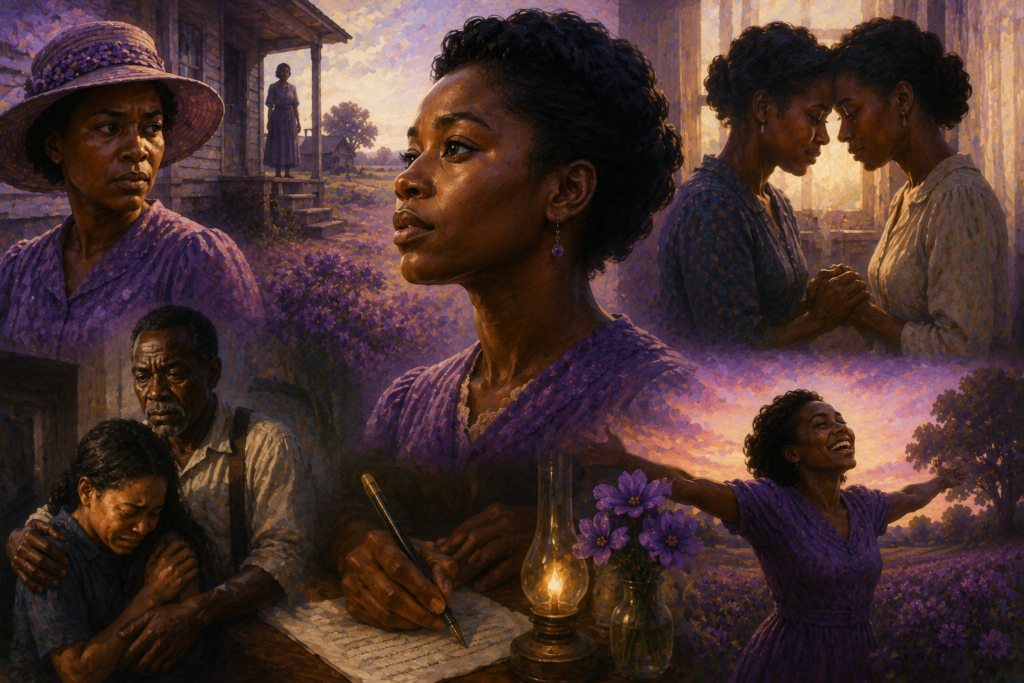
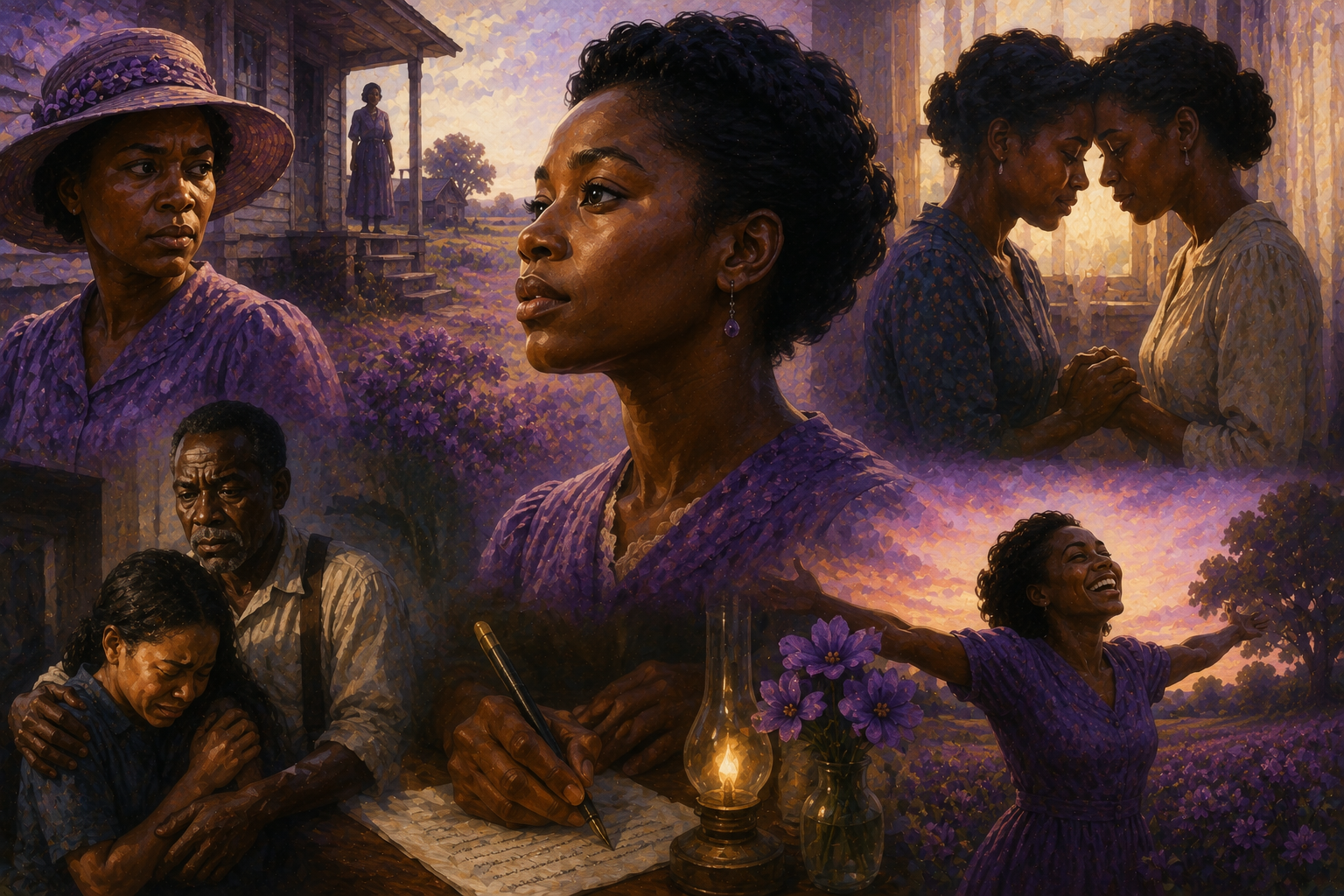
Celie is the emotional center of the novel. Her journey moves from silence to voice.

At the start, Celie has almost no power. She suffers abuse, loses her children, and enters a marriage where she is treated as property. Her letters become a private place where she can speak when no one else will listen.

Celie’s first motivation is survival. She tries to stay safe by obeying others. This does not mean she is weak. It means she has learned how dangerous the world can be.

Her conflict is both external and internal. Mister controls her home life, while fear controls her sense of self. Over time, Shug helps Celie see that she has a body, a voice, and a right to joy.

For any The Color Purple character analysis, Celie’s change is the main proof of the novel’s message. She does not become powerful in one sudden moment. She builds power through love, work, truth, and self-respect.

image-slider-with-thumbnail1.jpeg
PlayPause
previous arrow
next arrow
image-slider-with-thumbnail1.jpeg
image-slider-with-thumbnail3.jpeg
image-slider-with-thumbnail4.jpeg
ChatGPT Image Jun 27, 2026, 06_33_13 PM
ChatGPT Image Jun 27, 2026, 06_36_37 PM
ChatGPT Image Jun 27, 2026, 06_38_39 PM
ChatGPT Image Jun 27, 2026, 06_31_22 PM
image-slider-with-thumbnail7.jpeg
ChatGPT Image Jun 27, 2026, 06_29_43 PM
ChatGPT Image Jun 27, 2026, 06_27_44 PM
image-slider-with-thumbnail6.jpeg
ChatGPT Image Jun 27, 2026, 06_15_07 PM
image-slider-with-thumbnail5.jpeg
ChatGPT Image Jun 27, 2026, 06_22_43 PM
ChatGPT Image Jun 27, 2026, 06_25_37 PM
ChatGPT Image Jun 27, 2026, 06_19_43 PM
ChatGPT Image Jun 27, 2026, 06_12_00 PM
ChatGPT Image Jun 27, 2026, 06_08_50 PM
ChatGPT Image Jun 26, 2026, 04_54_23 PM
ChatGPT Image Jun 27, 2026, 05_53_51 PM
ChatGPT Image Jun 28, 2026, 08_35_55 AM
previous arrow
next arrow

Shug Avery: freedom, desire, and emotional power

Shug brings color and risk into Celie’s life. She is not perfect, but she helps Celie imagine a wider world.

Shug’s main motivation is freedom. She wants to love on her own terms and live outside strict rules about gender and respectability. People judge her, yet she refuses to shrink.

In The Color Purple character analysis, Shug often works as a catalyst. A catalyst is a character who sparks change in someone else. Shug shows Celie affection, helps her discover the truth about Nettie’s letters, and teaches her that God can be felt in beauty and life.

Shug’s conflict comes from her wish to be free and her fear of deep attachment. She loves Celie, but she also leaves. That makes her human instead of simple.

Sofia and Harpo: power inside marriage

Sofia and Harpo show how gender roles can harm people.

She is proud, direct, and strong-willed. Her main motivation is dignity. She refuses to let anyone beat her into obedience.

Her conflict with Harpo shows how pressure from society can twist love. Harpo cares for Sofia, but he believes a husband should control his wife. When he tries to act like Mister, he damages the marriage.

Sofia’s later conflict with white authority shows another layer of the novel. Her strength threatens people who expect Black women to obey. Her punishment exposes the cruelty of racism and sexism.

Harpo, unlike Mister at first, can learn. He must decide whether he wants power over Sofia or a real partnership with her. That choice makes him important in the novel’s study of masculinity.

Mister, Nettie, and the pull of change

Mister and Nettie shape Celie’s life in opposite ways. One harms her, while the other keeps hope alive.

Mister begins as a cruel figure. He marries Celie for labor, hides Nettie’s letters, and treats women as tools. His motivation is control, but that control comes from a broken model of manhood.

His later change does not erase his harm. It does show that Walker allows some characters to face what they have done. Mister becomes more honest when he loses power and must sit with himself.

Nettie represents love, memory, and connection. Her letters give Celie proof that she was not forgotten. Nettie’s story also widens the novel’s world beyond Celie’s home.

Nettie’s conflict centers on distance and separation. She cannot protect Celie directly, but her words help restore Celie’s sense of family.

The Color Purple character analysis: major conflicts

The novel’s conflicts are personal, social, and spiritual. They push characters to reveal who they are.

A useful The Color Purple character analysis should track conflict by asking who has power and who is denied it. Celie faces abuse in the home. Sofia faces racist violence. Shug faces judgment for her independence.

The most important conflict may be Celie versus her own silence. At first, she speaks only in letters. By the end, she builds a life where her voice matters in public and private ways.

There is also a spiritual conflict. Celie begins with a distant idea of God, shaped by fear. Shug helps her see God as part of beauty, love, and the natural world.

Symbols and motifs that reveal character

Walker uses repeated images to show inner change. These details can make your essay stronger.

Letters reveal voice and connection. Celie’s letters begin as survival, then become a record of growth.

The color purple points to beauty that people often miss. Shug’s lesson about noticing purple flowers helps Celie see that joy is not selfish.

Sewing and pants show Celie’s move toward independence. Her work becomes art, business, and self-expression.

These symbols do not stand apart from the characters. They help show how Celie’s inner life becomes visible.

Author context for deeper reading

Some background helps students understand Walker’s choices. It also helps avoid a flat reading of the novel.

Alice Walker writes about Black women’s lives with care, pain, faith, and humor. Her work often centers women who build strength inside unfair systems.

For reliable author background, see Britannica’s entry on Alice Walker. You can also read the Poetry Foundation profile of Alice Walker for more about her work as a poet and writer.

How to use The Color Purple character analysis in essays

A character essay needs a clear claim, not just a summary. Pick one character and explain how that person changes or affects Celie.

When you turn The Color Purple character analysis into an essay, start with motivation. Ask what the character wants. Then ask what conflict blocks that desire.

For example, an essay on Celie could argue that her voice grows through letters, love, and work. An essay on Sofia could argue that her strength exposes the cost of refusing unjust power.

Books to read next

These books pair well with Walker’s novel for class discussion or comparison.

  • The Color Purple by Alice Walker
  • In Search of Our Mothers’ Gardens by Alice Walker
  • Their Eyes Were Watching God by Zora Neale Hurston

You can find these through a school library, local bookstore, or Amazon without needing special editions.

FAQ

Here are quick answers to common student questions.

What is the main focus of The Color Purple character analysis?

The main focus is Celie’s growth from fear and silence into self-worth. Other characters matter because they shape that change.

Who changes the most in The Color Purple?

Celie changes the most. Mister also changes, but his growth does not cancel out the harm he caused.

Why is Shug Avery important?

Shug helps Celie discover love, desire, and spiritual freedom. She gives Celie a new way to see herself.

Is Sofia a foil to Celie?

Yes. Sofia’s bold resistance contrasts with Celie’s early silence, which helps readers see different ways women survive.

What is a good essay topic for this novel?

A strong topic is how Celie’s letters help her gain voice and identity over time.

Key Takeaway

The key insight: The characters in The Color Purple matter because their choices show how people can be harmed, changed, and healed. Celie’s story proves that voice is not given to her. She claims it.

Themes in The Color Purple: A Student-Friendly Guide

The Color Purple themes

Alice Walker’s novel asks readers to watch how people survive pain, claim a voice, and learn love. This guide breaks down the themes in The Color Purple so students can connect the letters, symbols, and conflicts to the novel’s larger meaning.

For helpful background on the author, see Britannica’s Alice Walker biography.

In this Guide

Use this table of contents to jump to the ideas you need for class or review.

  • Why theme matters in the novel
  • Voice and freedom
  • Abuse and survival
  • Sisterhood and chosen family
  • Gender roles and power
  • Faith and spiritual growth
  • Race and identity
  • Symbolism and theme
  • Essay tips and FAQ
The Color Purple themes

Why the themes in The Color Purple matter

The novel is not only about what happens to Celie. It is about how people find worth in a world that tries to silence them.

The themes in The Color Purple are not hidden from the plot. They grow through Celie’s letters, her changing view of God, and her ties with women who help her see herself in a new way.

For students, theme is the bridge between summary and analysis. A summary says Celie writes letters. Analysis asks why those letters matter.

Major themes in The Color Purple: voice and freedom

Celie’s growth begins with language. Her letters show how a silenced person can slowly claim the right to speak.

At the start, Celie writes because she has no safe person to talk to. Her letters to God hold fear, pain, and confusion. Yet even this private act becomes a form of strength.

As Celie changes, her voice changes too. She speaks more clearly about what she wants and what she refuses to accept.

This is one of the most important themes in The Color Purple because the novel links voice with freedom. To speak is not just to make sound. It is to say, I exist, and my life has value.

A useful comparison is Jane Eyre by Charlotte Brontë. Jane also must learn to speak for herself in a world that expects her to stay quiet.

Abuse and survival

The novel shows harm without treating pain as the whole story. Survival becomes a hard, active force.

Celie faces violence, control, and sexual harm. Walker does not present this only to shock the reader. She shows how abuse can shape a person’s sense of self.

At the same time, Celie is never only a victim. Her life shows the slow work of survival. She learns to name what happened, trust others, and build a future.

This theme can be hard to read, but it matters. The novel asks readers to see how systems of power can hurt people inside homes, not just in public life.

Sisterhood and chosen family

Love between women becomes one of the strongest sources of healing in the novel.

Celie’s bond with Nettie, Shug, and Sofia helps her grow. These relationships give Celie models of courage and self-respect.

Nettie represents loyalty across distance. Shug helps Celie see her body and spirit in a new light. Sofia shows open resistance to control.

One of the central themes in The Color Purple is that family is not only blood. Chosen family can help a person survive when the home has become unsafe.

This idea also appears in Little Women by Louisa May Alcott, where female bonds shape identity and moral growth.

Gender roles and power

Walker shows how strict gender roles can trap people.

Many men in the novel are taught that power means control. They expect women to cook, obey, and stay silent.

Celie’s life challenges that belief. Sofia’s anger also challenges it. Shug’s independence offers another path, one shaped by desire and choice.

The novel does not excuse cruel behavior, but it does show how harmful ideas pass from one generation to the next. Power becomes a pattern people learn, copy, and sometimes reject.

For an AP Literature essay, you could argue that Walker uses gender conflict to show how freedom requires a change in both private life and public values.

Faith and spiritual growth

Celie’s view of God changes as her view of herself changes.

At first, Celie imagines God as distant, male, and tied to authority. This image reflects the world that has hurt her.

Later, Shug helps Celie see God in nature, beauty, and human connection. This shift is not just religious. It is personal.

Faith becomes less about fear and more about wonder. Celie learns that the sacred can appear in color, touch, and love.

This is why the color purple itself matters. It points to beauty that people often miss. If you want help with that kind of detail, read our guide on how to find symbolism in a story.

Race and identity

The novel explores Black life in the American South and connects personal pain to larger social forces.

Celie and the other characters face not only sexism, but racism too. Sofia’s clash with white authority shows how race, gender, and class shape daily danger.

Nettie’s letters from Africa widen the novel’s world. They connect African American identity to African history, while also showing that no culture is simple or perfect.

Walker asks readers to see identity as layered. Race matters, but so do gender, family, faith, and place.

Symbolism connects to themes in The Color Purple

Symbols help the novel turn private details into larger ideas.

Students often understand themes in The Color Purple more clearly when they track repeated images. Letters, pants, sewing, gardens, and the color purple all carry meaning.

Letters symbolize voice and connection. Pants symbolize work, freedom, and a new self-image. The color purple suggests beauty, spirit, and attention to life.

When you write about symbols, do not just name them. Explain how they change across the novel. For more practice, use this student guide to symbolism.

How to write about themes in The Color Purple

A strong paragraph connects a theme to a clear choice Walker makes.

When you write about themes in The Color Purple, avoid broad claims like, “The book is about love.” Make the claim sharper.

Try this: “Walker presents love as a force that helps Celie recover her voice after years of silence.” That sentence gives you a theme and a direction.

Then use one short moment from the novel as evidence. Explain how the detail supports your idea. A good AP Literature paragraph should not just quote. It should interpret.

If you want a quicker study path, explore our student-friendly literature guides for theme review and essay prep.

Books to pair with this novel

These books work well for comparison essays or deeper reading.

  • Their Eyes Were Watching God by Zora Neale Hurston
  • Beloved by Toni Morrison

Both novels explore voice, memory, and the search for selfhood. They also pair well with high school, AP Literature, and college English study.

FAQ: themes in The Color Purple

These quick answers can help with review before a quiz, essay, or class talk.

What are the main themes in The Color Purple?

The main ideas include voice, survival, sisterhood, gender power, faith, race, and identity. Each one connects to Celie’s growth.

Why is voice so important in the novel?

Voice matters because Celie begins as someone who has been silenced. Her letters show her path toward self-worth and freedom.

What does the color purple symbolize?

It symbolizes beauty, spirit, and the need to notice joy in ordinary life. It also points to Celie’s new way of seeing the world.

Is The Color Purple a feminist novel?

Yes, many readers see it that way. The novel focuses on women’s strength, female bonds, and resistance to male control.

Key Takeaway

The themes in The Color Purple show how a person can move from silence toward selfhood. Walker’s novel is painful at times, but its deepest message is one of voice, beauty, and hard-won freedom.

error

Enjoy this article? Please spread the word :)

Follow by Email
BLUESKY
fb-share-icon
Reddit
LinkedIn
Share
RSS