

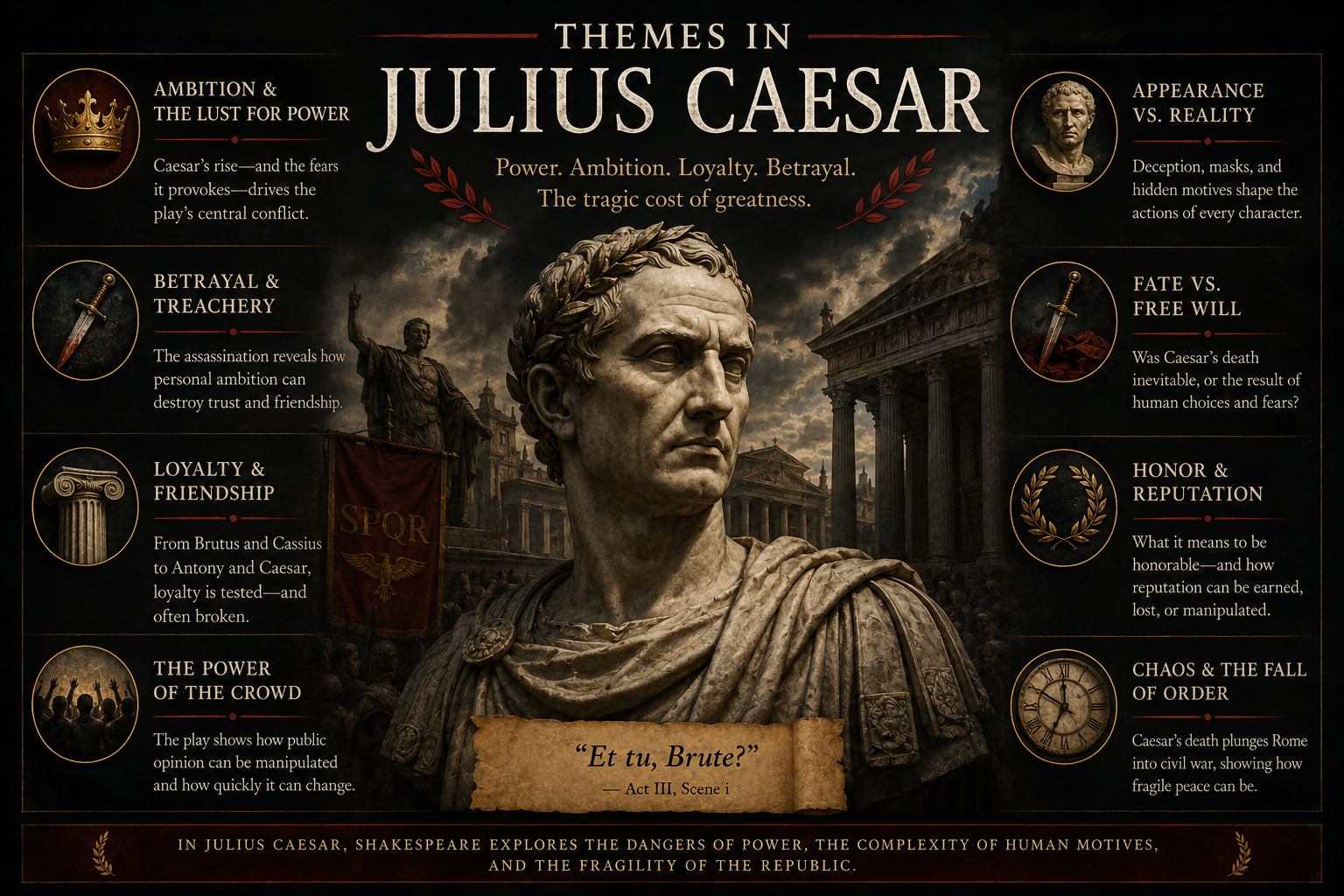
This student-friendly guide explains the themes in Julius Caesar and shows why Shakespeare’s play still feels sharp today.
You will see how power, honor, fear, and words shape the choices behind Caesar’s death. If you need help with the basics first, read this guide on how to identify theme in literature.
In this Guide
Use this section to find the idea you need most.
- What a theme means in this play
- Power and public honor
- Loyalty and betrayal
- Fate and omens
- Rhetoric and persuasion
- Essay help
- FAQ
Major themes in Julius Caesar
The play asks what happens when private beliefs meet public danger.
The major themes in Julius Caesar are not just single words like power or betrayal. A true theme is a message about life, people, or society.
Shakespeare shows Rome at a tense moment. Caesar is popular, but some leaders fear he may become a tyrant. Brutus believes he can stop danger before it grows, but his choice brings new chaos.
That tension makes the play rich for students. It does not give easy answers. It asks whether a person can do a violent act for a noble reason.
Political themes in Julius Caesar: power and public honor
Rome is a public world, so reputation can be as powerful as truth.
One of the clearest themes in Julius Caesar is the danger of political power. Caesar may not call himself a king, but many Romans act as if he is close to becoming one.
Cassius uses this fear to pull Brutus into the plot. He knows Brutus cares about Rome and wants to seem honorable. This shows how politics can turn virtue into a tool.
Brutus claims he kills Caesar because he loves Rome more than Caesar. That sounds noble, but the play asks if noble language can hide personal pride.
This theme is easy to compare with Macbeth. In both plays, ambition leads to violence. Yet Brutus is not Macbeth. Brutus thinks he protects the state, which makes his fall more painful.
Personal themes in Julius Caesar: loyalty and betrayal
The most painful conflicts in the play happen between people who trust each other.
Among the themes in Julius Caesar, loyalty and betrayal may feel the most personal. Caesar trusts Brutus, and that trust makes the murder shocking.
Brutus also betrays himself in a way. He says he acts for Rome, but he ignores warnings from Portia, Caesar, and his own doubts.
Portia’s role matters here. She asks Brutus to trust her with his secrets, but he keeps her outside the political world. Their marriage shows how public duty can damage private bonds.
A similar conflict appears in Antigone by Sophocles. A character must choose between law and conscience. In Shakespeare’s play, Brutus faces that kind of choice, but his answer harms the city he hopes to save.
Fate, omens, and the themes in Julius Caesar
Warnings fill the play, but people still choose how to respond.
Fate is one of the themes in Julius Caesar that gives the play its tragic mood. The soothsayer warns Caesar to beware the Ides of March. Calpurnia dreams of danger. Strange signs appear across Rome.
Caesar hears warnings, but he refuses to seem afraid. Brutus sees danger too, but he reads it through his political fear. Both men make choices, even when the play feels haunted by fate.
This is why the play works so well as tragedy. Shakespeare suggests that human pride can make fate feel unavoidable.
How rhetoric shapes the themes in Julius Caesar
Words do not just explain action in this play. They change what people believe.
The themes in Julius Caesar become clearest in the funeral speeches. Brutus speaks in a calm way and asks the crowd to trust his reason.
Antony speaks after him and turns the crowd with emotion. He repeats the word honorable until it sounds bitter. He also uses Caesar’s wounds like proof.
This scene shows how public opinion can shift fast. It also shows that truth often loses when a speaker knows how to move a crowd.
Students may notice a link to Animal Farm by George Orwell. In both works, political language shapes how people see power.
How to write about the play in an essay
A strong essay should connect theme to character choice.
Do not write only that the play is about ambition or betrayal. Instead, explain what Shakespeare says about that idea.
A stronger claim might say: Shakespeare uses Brutus to show that people can mistake pride for moral duty.
Then use evidence from Brutus’s speeches, the conspiracy scene, and Antony’s funeral speech. For extra practice, try the RapidReads Press literature study tools as you shape a claim.
You can also review how theme works in literature before you draft your essay.
Why the play still matters
Shakespeare’s Rome feels old, but its questions are still current.
The play asks how far people should go to stop a leader they fear. It also asks how crowds decide whom to trust.
Those questions matter in school, politics, and daily life. People still use noble words to defend harsh actions. People still mistake confidence for truth.
For background on the play, Britannica has a helpful overview of Julius Caesar by Shakespeare. You can also learn more about Shakespeare through the Poetry Foundation profile of William Shakespeare.
Helpful books to look up on Amazon
These books can help you read the play with more confidence.
- Julius Caesar by William Shakespeare, Folger Shakespeare Library edition
- Shakespeare: The World as Stage by Bill Bryson
FAQ about the play
Use these quick answers for review before a quiz or essay.
What are the main themes in Julius Caesar?
The main ideas include power, honor, betrayal, fate, and the danger of persuasive speech.
Is ambition a theme in the play?
Yes. Caesar’s rise creates fear, and Cassius uses that fear to push the conspiracy forward.
Why is Brutus important to the theme?
Brutus shows how a person can do harm while thinking he serves a noble cause.
What does Antony’s speech show?
It shows that language can control public feeling and turn grief into violence.
Key Takeaway
The play is not only about Caesar’s death.
The key insight is this: Shakespeare shows that power becomes dangerous when fear, pride, and persuasive speech replace clear moral judgment.












