Animal Farm Character Analysis: Key Characters, Motivations, and Conflicts

Animal Farm analysis

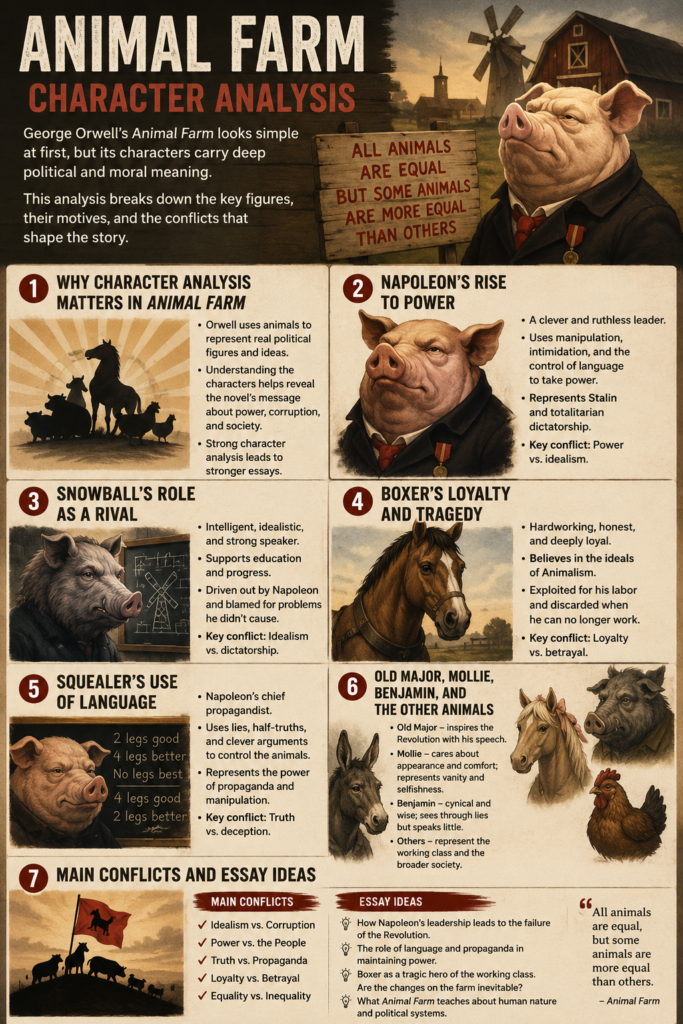
George Orwell’s Animal Farm looks simple at first, but its characters carry deep political and moral meaning. This Animal Farm character analysis breaks down the key figures, their motives, and the conflicts that shape the story.

Use this guide for class discussions, essays, and quote-based analysis.

In this Guide

  • Why character analysis matters in Animal Farm
  • Napoleon’s rise to power
  • Snowball’s role as a rival
  • Boxer’s loyalty and tragedy
  • Squealer’s use of language
  • Old Major, Mollie, Benjamin, and the other animals
  • Main conflicts and essay ideas
  • Books for further reading
  • FAQ
Animal Farm analysis

Animal Farm Character Analysis: Why the Characters Matter

The animals are not just farm creatures. They stand for people, groups, and ideas from the Russian Revolution and from human society in general.

Orwell uses each character to show how power can change a movement. A dream of fairness turns into a system ruled by fear.

This is why Animal Farm character analysis works best when you ask two questions: What does this character want? What does this character reveal about power?

If you want a wider method for studying fiction, read our guide on how to analyze characters in literature.

Animal Farm Character Analysis of Napoleon

Napoleon is the main force behind the farm’s collapse into tyranny. He begins as one of the leaders of the rebellion, but he soon makes power his true goal.

Napoleon does not win through wisdom or kindness. He wins through fear, secrecy, and control.

His dogs become his private police. Once he drives Snowball away, no one can challenge him. He changes rules, takes special privileges, and slowly becomes like the humans the animals once hated.

Napoleon’s motivation is clear: he wants total control. He claims to serve the farm, but his choices serve himself.

In an essay, Napoleon can be compared to Macbeth from Shakespeare’s Macbeth. Both characters let ambition swallow their morals. Once they gain power, they use violence to keep it.

Snowball: The Rival Who Becomes a Scapegoat

Snowball is smart, active, and full of plans. He wants the farm to improve, but he also wants influence.

Unlike Napoleon, Snowball believes in public speeches and big projects. His plan for the windmill shows his hope for progress. It also shows that not every leader with good ideas can survive a brutal power struggle.

After Napoleon forces him out, Snowball becomes a scapegoat. Whenever something goes wrong, Napoleon blames him.

This part of Animal Farm character analysis matters because Snowball becomes more useful to Napoleon as an enemy than as a real person. Fear of Snowball helps Napoleon control the animals.

Students can connect Snowball to the idea of the “outsider” in literature. Like many blamed figures in political stories, he is turned into a symbol of danger.

Boxer: Loyalty, Labor, and Tragedy

Boxer is one of the most painful characters in the novel. He is strong, honest, and deeply loyal to the farm.

His two sayings are “I will work harder” and “Napoleon is always right.” These lines show both his goodness and his weakness.

Boxer wants to help the rebellion succeed. He believes that hard work can fix every problem. Yet he does not question the leaders who use him.

His death is the emotional center of the book. When Napoleon sells Boxer to the knacker, the reader sees the full cruelty of the new system.

For discussion posts, Boxer is often the best character to use when writing about trust. He shows how loyalty can become dangerous when leaders do not deserve it.

Squealer: Language as a Tool of Control

Squealer is Napoleon’s speaker. He explains, excuses, and twists the truth.

He does not need to be strong because his power comes from words. He changes facts until the animals doubt their own memories.

When the commandments change, Squealer helps make the changes seem normal. When the pigs take more food, he makes it sound necessary. When Boxer is taken away, he tells a false story to calm the farm.

This Animal Farm character analysis shows that propaganda is one of Orwell’s main concerns. Squealer proves that language can protect injustice when people stop asking questions.

For helpful background on Orwell and his political writing, see the Britannica entry on George Orwell.

Old Major: The Dream That Starts the Rebellion

Old Major appears only at the start, but his ideas shape the whole novel. He gives the animals a vision of freedom from human control.

His speech inspires hope. He teaches the animals that their suffering comes from human greed.

Still, Old Major’s dream is simple compared with what happens later. He does not explain how power should be shared after the rebellion.

That gap matters. The animals know what they are against, but they do not know how to protect their new society from corruption.

Benjamin: The Quiet Witness

Benjamin is the donkey who sees more than he says. He is cynical, careful, and hard to fool.

He can read, and he understands that the pigs have betrayed the rebellion. Yet he rarely acts.

His silence raises a hard question: Is knowing the truth enough? Orwell suggests that wisdom without courage may not stop injustice.

Benjamin becomes most moving when Boxer is taken away. He finally speaks with urgency, but it is too late.

Mollie: Comfort Over Commitment

Mollie is often easy to dismiss, but she has an important role. She cares more about ribbons, sugar, and comfort than the ideals of the rebellion.

Her motivation is personal safety. She does not want freedom if it means sacrifice.

Mollie leaves the farm because the new life demands too much from her. In this way, she shows that not everyone joins a revolution for the same reason.

In Animal Farm character analysis, Mollie can help students write about class, privilege, and self-interest.

Clover, Moses, and the Sheep

Clover is caring and loyal, but she senses that something is wrong. She cannot always explain it, which makes her a realistic character.

She represents ordinary people who feel injustice but lack the tools to fight it.

Moses, the raven, talks about Sugarcandy Mountain. His stories offer comfort, but they also distract the animals from life on the farm.

The sheep repeat slogans without thought. Their role is simple but important. They show how noise can drown out reason.

Major Conflicts in Animal Farm

The main conflict begins as animals versus humans. The animals rebel against Mr. Jones because he neglects and exploits them.

After the rebellion, the deeper conflict becomes animals versus pigs. The pigs take control of the farm and turn the old oppression into a new one.

There is also a conflict between memory and propaganda. The animals remember the original commandments, but Squealer teaches them to doubt what they know.

This is a key point for any Animal Farm character analysis. Orwell shows that political control depends not only on force, but also on control of the past.

For more help with character-based essays, you can use this simple character analysis framework.

How Character Choices Shape the Story

Every major turn in the novel comes from a character’s choice. Napoleon chooses power. Boxer chooses trust. Benjamin chooses silence.

These choices build the tragedy of the farm. No single animal causes everything, but many choices allow the pigs to win.

This makes Animal Farm useful for student essays. You can argue that Orwell’s message is not only about bad leaders. It is also about the danger of passive followers.

Essay Ideas for Animal Farm Character Analysis

A strong essay should connect character traits to the novel’s larger message. Do not just say that Napoleon is cruel. Explain how his cruelty changes the farm.

You might write about Boxer as a symbol of exploited workers. You could also study Squealer as a symbol of propaganda.

Another strong option is Benjamin. His character helps you explore silence, guilt, and responsibility.

For quote-based writing, choose short lines that reveal motive. Boxer’s motto, Squealer’s speeches, and the final commandment all work well.

Relevant Books for Further Reading

If you want more context, these books can help:

  • Animal Farm by George Orwell
  • 1984 by George Orwell

For historical background, the Britannica overview of the Russian Revolution can help you connect the novel to real events.

FAQ: Animal Farm Character Analysis

Who is the most important character in Animal Farm?

Napoleon is the most important character because his choices control the farm’s future. His rise shows how a revolution can become a dictatorship.

What does Boxer represent?

Boxer represents loyal workers who give everything to a system that does not protect them. His story is tragic because his trust is used against him.

Why is Squealer important?

Squealer shows the power of propaganda. He uses language to hide lies and defend Napoleon’s rule.

Is Snowball a good character?

Snowball has better goals than Napoleon, but he is not perfect. He wants progress, yet he also wants leadership and control.

What is the main lesson from the characters?

The novel warns that power can corrupt leaders, but it also warns that silence and blind trust can help corruption grow.

Key Takeaway

Animal Farm character analysis helps readers see how Orwell builds a warning about power. The tragedy of the farm comes from ambition, fear, and the failure to question leaders before it is too late.


How to Find the Theme of a Story: A Simple Step-by-Step Guide

How to Find Story Theme

Learning how to find the Theme of a Story can make reading feel less confusing and more meaningful. A theme is the big idea a story explores, such as courage, greed, love, justice, or growing up.

This guide will show you a clear process you can use for homework, essays, class talks, or your own writing.

In this Guide

  • What theme means
  • How to find the theme step by step
  • How characters reveal theme
  • How conflict and endings point to theme
  • Examples from famous books
  • Common mistakes to avoid
  • Book suggestions
  • FAQ
How to Find Story Theme

What Does Theme Mean in a Story?

Theme is the message or idea a story asks you to think about.

A theme is not just one word. “Love” is a topic. A theme says something about that topic, such as “Love can make people brave.”

Stories can have more than one theme. A novel like To Kill a Mockingbird explores justice, prejudice, courage, and innocence.

If you want a deeper lesson on theme, this guide on how to identify theme in literature gives more examples and tips.

How to Find the Theme of a Story in 5 Clear Steps

A simple process can help you move from plot details to a strong theme statement.

When students ask How to Find the Theme of a Story, the best answer is to look for patterns. Theme is not hidden in one sentence. It grows from the whole story.

Step 1: Ask what the story is mostly about

Start with the main topics. These may be friendship, fear, power, family, freedom, or guilt.

In The Great Gatsby, some topics are wealth, dreams, love, and status. These topics are clues, but they are not full themes yet.

Step 2: Watch what the main character learns

Characters often change because of what they face. That change can point to the theme.

In A Christmas Carol, Ebenezer Scrooge learns that money matters less than kindness and human connection.

Step 3: Notice the main conflict

Conflict shows what the story tests. It may test a character’s honesty, loyalty, courage, or pride.

In Lord of the Flies, the conflict shows how quickly order can break down when fear and power take over.

Step 4: Study the ending

The ending often gives the clearest clue. Ask what the final events suggest about life or people.

Does the hero win? Does someone pay a price? Or, does the story end with hope or warning?

Step 5: Turn the idea into a full sentence

A strong theme statement should make a claim. It should not be just a topic.

Weak: “Friendship.”

Stronger: “True friendship helps people face fear.”

How to Find the Theme of a Story Through Characters

Characters are one of the best places to look for theme.

If you want to know How to Find the Theme of a Story, ask what the main character wants. Then ask what the story teaches them about that desire.

In The Hunger Games, Katniss wants to survive. Over time, the story also shows how love, sacrifice, and public courage can challenge an unfair system.

Look at the choices characters make under pressure. Their choices often reveal the story’s message.

How to Find the Theme of a Story Through Conflict and Ending

Conflict and endings often reveal what the author wants readers to notice.

Another useful way to practice How to Find the Theme of a Story is to ask, “What problem keeps returning?” A repeated problem usually connects to a key theme.

In Romeo and Juliet, the conflict between the two families leads to loss. One theme could be: “Long-held hatred can destroy innocent lives.”

The ending matters because it shows the result of the characters’ actions. If a character lies and loses everything, the story may explore honesty, pride, or trust.

Quick Examples of Theme in Well-Known Literature

Examples can make theme easier to see.

In To Kill a Mockingbird by Harper Lee, one theme is that real courage means doing what is right, even when you may not win.

In Animal Farm by George Orwell, one theme is that power can corrupt people who claim to fight for equality.

Lastly, in The Giver by Lois Lowry, one theme is that a safe life without freedom can cost people their humanity.

If you practice How to Find the Theme of a Story with books you already know, the skill gets easier fast.

Common Mistakes to Avoid When Finding Theme

These mistakes can lead to weak or unclear answers.

Mistake 1: Confusing theme with topic

A topic is one word or a short phrase. A theme is a full idea about that topic.

Topic: “Greed.”

Theme: “Greed can make people ignore what truly matters.”

Mistake 2: Writing a theme that is too broad

“Life is hard” is too general. It could fit almost any story.

Try to make the theme match the actual events in the text.

Mistake 3: Ignoring evidence

A theme needs support. Use character choices, conflict, symbols, or the ending as proof.

For more help with this skill, read our full guide on identifying theme in literature.

Mistake 4: Assuming there is only one theme

Many stories have several themes. Your answer can be right if you can support it with evidence.

How Writers Can Use Theme

Theme is not only for readers. Writers can use it to shape stronger stories.

If you write fiction, ask what your character must learn or face. That question can guide the plot.

You do not need to state the theme directly. Let readers see it through choices, conflict, and change.

Writers who understand How to Find the Theme of a Story often become better at creating theme in their own work.

Helpful Books for Learning Theme

These books are useful for students, teachers, and young writers.

  • How to Read Literature Like a Professor by Thomas C. Foster
  • The Elements of Style by William Strunk Jr. and E.B. White
  • Reading Like a Writer by Francine Prose

Helpful Outside Resources

For author background and literary context, Britannica’s literature overview is a reliable place to start.

For poetry, themes, and close reading, the Poetry Foundation offers poems, poet pages, and learning tools.

FAQ: How to Find the Theme of a Story

What is the easiest way to find the theme?

Look at what the main character learns. Then turn that lesson into a full sentence about life or people.

Can a story have more than one theme?

Yes. Many stories explore several themes. Choose one you can support with strong evidence.

Is theme the same as the moral?

Not always. A moral is usually a clear lesson. A theme can be more complex and open to discussion.

How do I write a theme statement?

Pick a topic, then say what the story suggests about it. Avoid using only one word.

Why is theme important?

Theme helps readers understand why the story matters beyond the plot.

Key Takeaway

How to Find the Theme of a Story comes down to one habit: look for what the story teaches through character choices, conflict, and the ending.

Next time you read, ask, “What does this story seem to say about life?” That question will lead you toward the theme. 📚

How to Analyze Characters in Literature

how to analyze characters in literature

A simple step-by-step guide to understanding fictional characters and writing stronger literary analysis essays

Understanding characters is one of the most important skills in literary analysis. Stories are built around people: their decisions, their desires, and their flaws. When readers learn how to analyze characters in literature, they begin to see how authors shape meaning through personality, conflict, and change.

A strong character analysis does more than describe someone in a story. It explains why the character acts the way they do and what their actions reveal about the themes of the work. Literary scholars often look closely at a character’s motivations, relationships, and development across the narrative.

In this guide, you’ll learn simple methods you can use to analyze characters in any novel, play, or poem—from Jane Austen’s sharp social portraits to the dark psychological figures in Gothic fiction.

This article contains affiliate links.

In This Guide 📚

What character analysis means
How authors create characters through characterization
How to analyze a character’s motivations
How to examine relationships between characters
How to track character development
Example character analysis from classic literature
Questions you can ask while reading

how to analyze characters in literature

What Character Analysis Means

Understanding the foundations of how to analyze characters in literature.

Character analysis is the process of examining a character’s traits, actions, motivations, and development in order to understand their role in a story. Instead of simply describing whether a character is “good” or “bad,” literary analysis asks deeper questions about why the character behaves the way they do and how those actions shape the narrative.

In literature, characters are created through a technique called characterization. This is the way authors reveal personality, beliefs, and emotional struggles through description, dialogue, and behavior.

💡 Key insight:
Character analysis connects personality to meaning.

When you understand a character’s motives and choices, you begin to see how the author explores larger themes like love, ambition, morality, or social pressure.

If you’re new to literary analysis, start with this guide first:
https://rapidreadspress.com/how-to-read-literature-like-a-scholar/

Direct and Indirect Characterization

One of the first steps in learning how to analyze characters in literature.

Authors reveal characters in two main ways:

Direct characterization happens when the narrator explicitly describes a character’s personality.

Example:
“The gentleman was proud and reserved.”

Indirect characterization happens when readers learn about a character through actions, speech, and relationships.

These clues appear through:
dialogue
behavior
appearance
thoughts
how others respond to them

Most authors rely heavily on indirect characterization because it allows readers to interpret the character themselves.

👉 Related guide:
https://rapidreadspress.com/literary-devices-list/

Analyze a Character’s Motivations

Understanding why characters act the way they do.

A key part of learning how to analyze characters in literature is asking what drives a character’s decisions.

Characters rarely act randomly. Their behavior usually comes from:

fear
desire
love
ambition
social pressure

📖 Example from Pride and Prejudice

Elizabeth Bennet often appears witty and confident, but her judgments are shaped by pride and prejudice of her own. When she rejects Mr. Darcy’s first proposal, her decision reveals both moral strength and personal bias.

Her character becomes clearer when we examine why she believes Darcy is arrogant and how those assumptions change.

Through Elizabeth’s development, Jane Austen explores themes of self-knowledge and social misunderstanding.

Examine Relationships Between Characters

Characters are often defined by their relationships.

A character rarely exists alone in literature. Instead, authors reveal personality through interactions with others.

When analyzing characters, consider:

How does the character treat friends or family?
How do other characters react to them?
Do their relationships change over time?

📖 Example from Frankenstein

Victor Frankenstein’s relationship with his creation reveals his deepest flaws. Instead of taking responsibility for the being he brings to life, Victor abandons the creature immediately.

This decision drives the tragedy of the novel.

The creature’s loneliness and anger reflect Victor’s moral failure, turning the story into a meditation on responsibility and creation.

👉 If you want to see how themes connect to characters, read:
https://rapidreadspress.com/how-to-identify-theme-in-literature/

Track Character Development

Look at how the character changes during the story.

Many of the most memorable literary characters undergo significant transformation.

A useful technique when learning how to analyze characters in literature is to compare:

the character at the beginning of the story
the character at the end

This change is called a character arc.

📖 Example from Emma

In Jane Austen’s Emma, the main character begins as confident and somewhat self-satisfied. She enjoys arranging relationships between others and believes she understands people perfectly.

Yet over time, Emma realizes her mistakes. She learns humility and emotional awareness.

Her transformation reveals one of the novel’s central themes: true maturity requires self-reflection.

Look for Symbolic or Thematic Meaning

Sometimes a character represents a larger idea.

In some works of literature, characters symbolize broader themes or philosophical ideas.

For example:

Dracula often represents fear of the unknown and cultural anxiety in Gothic fiction.

He is not only a villain but also a symbol of the anxieties surrounding modernity and foreign influence in Victorian England.

By examining how Dracula interacts with other characters and environments, readers see how Bram Stoker uses the character to explore fear, power, and desire.

Ask Questions While Reading

Simple questions that help you analyze characters more deeply.

When reading literature, pause occasionally and ask yourself:

What does this character want most?
What are their greatest fears?
How do they treat others?
What mistakes do they make?
How do they change?

These questions help transform passive reading into active literary analysis.

If you want to take better notes while reading fiction, this guide may help:
https://rapidreadspress.com/how-to-take-notes-while-reading-a-novel/

Example Character Analysis (Short Model)

Elizabeth Bennet in Pride and Prejudice represents the struggle between perception and truth. At first she believes she understands Darcy perfectly, interpreting his reserved manner as arrogance. Her judgments seem reasonable based on the limited information she receives. Yet as new facts emerge, Elizabeth gradually recognizes her own bias. This realization reshapes her understanding of Darcy and of herself. Through Elizabeth’s journey, Jane Austen illustrates how personal pride and social expectations can distort perception. The character’s development ultimately reveals that self-knowledge is necessary for genuine love and moral growth.

how to analyze characters in literature
Image by Carla Paton

How to Read Literature Like a Professor — Thomas C. Foster
Reading Like a Writer — Francine Prose
How to Read a Book — Mortimer Adler

Improve Your Literary Analysis Essays

If you want help structuring your essays, outlining arguments, and organizing quotes, you might find this useful:

👉 https://rapidreadspress.com/product/the-literary-analysis-essay-toolkit/

This toolkit includes templates and worksheets designed to make literary analysis essays much easier to write.

Key Takeaway 💡

Learning how to analyze characters in literature means moving beyond simple description. Instead of asking whether a character is “good” or “bad,” strong literary analysis explores motivations, relationships, and change. By examining these elements closely, readers uncover the deeper themes that authors embed within their stories.

FAQ – How to analyze characters in literature

What is character analysis in literature?

Character analysis is the process of examining a character’s traits, motivations, actions, and development in order to understand their role and meaning within a literary work.

Why is character analysis important?

Characters often carry the central themes of a story. Understanding them helps readers interpret the deeper message of the work.

What are the main things to analyze in a character?

Most literary analyses focus on personality traits, motivations, relationships, and how the character changes throughout the story.

What is characterization?

Characterization is the method authors use to reveal a character’s personality through description, actions, dialogue, and interactions with others.

For a deeper look at literary techniques, see:
https://rapidreadspress.com/literary-devices-list/

error

Enjoy this article? Please spread the word :)

Follow by Email
BLUESKY
fb-share-icon
Reddit
LinkedIn
Share
RSS