

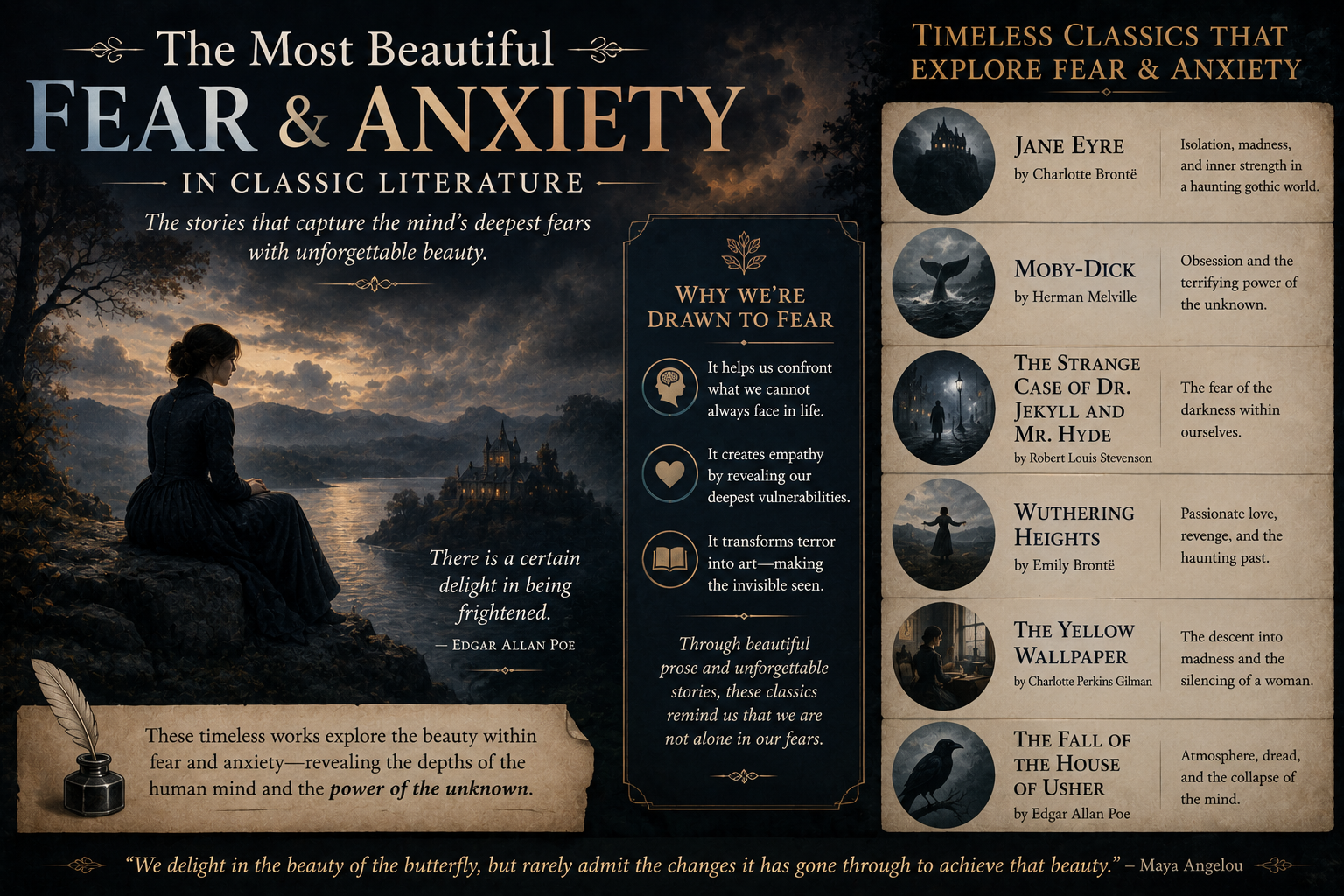
Some stories frighten us, yet they also feel strangely lovely. Most Beautiful Fear and Anxiety explores how literature turns dread into art, meaning, and deep emotion.
From Gothic novels to modern poetry, writers often use fear to show what humans hide, want, and lose. These works remind us that beauty can live inside unease.
In this Guide
- What Most Beautiful Fear and Anxiety means in literature
- Why readers are drawn to it
- Famous literary examples
- Symbols and themes to watch for
- Recommended books
- How to read fear with care
- FAQs
- Key takeaway
What Does Most Beautiful Fear and Anxiety Mean in Literature?
Fear in literature is not always just about terror.
Most Beautiful Fear and Anxiety describes moments when fear becomes meaningful, poetic, or even moving. A scene may feel dark, but it can also reveal truth.
Think of a lonely house, a storm at night, or a speaker who cannot calm their mind. These images may scare us, but they also create mood and mystery.
Writers use this feeling to show how fragile people can be. The fear matters because it points to love, loss, guilt, or change.
Why Most Beautiful Fear and Anxiety Pulls Readers In
Readers often enjoy safe fear because it lets them face hard feelings from a distance.
Most Beautiful Fear and Anxiety gives readers a way to explore dread without real danger. A book can hold fear in a shaped, careful form.
This is why Gothic fiction, tragic poetry, and strange short stories still matter. They help us sit with emotions that daily life may push away.
In class, this topic can also lead to strong literary analysis. Students can ask why a writer makes fear sound musical, why a setting feels alive, or why silence feels so heavy.
Famous Examples of Most Beautiful Fear and Anxiety
Many well-known works turn dread into art.
Edgar Allan Poe often creates beauty from unstable minds. In “The Tell-Tale Heart,” the narrator’s fear grows through sound, rhythm, and repetition.
Mary Shelley’s Frankenstein uses fear to ask what people owe to what they create. The novel feels haunted, but its sadness is just as strong as its horror.
Emily Dickinson also turns inner fear into sharp, strange beauty. Her poems about death, doubt, and the mind can feel quiet yet intense. For a close look at how form shapes meaning, read our guide to New Criticism and Emily Dickinson.
Charlotte Brontë’s Jane Eyre uses hidden rooms, strange laughter, and moral fear. The suspense matters because Jane must decide who she is and what she deserves.
Symbols and Themes Behind Most Beautiful Fear and Anxiety
Symbols help fear feel larger than one scary event.
In literature, darkness often suggests the unknown. It may point to death, secrecy, or a truth the character does not want to face.
Storms can show inner conflict. When a character feels torn inside, the weather may reflect that struggle.
Houses are also powerful symbols. A locked room, a cracked wall, or an empty hallway can show memory, guilt, or fear of the self.
Most Beautiful Fear and Anxiety often appears through these themes:
- Isolation: A character feels cut off from others.
- The unknown: A mystery grows because answers stay hidden.
- Inner conflict: A person fears their own thoughts or desires.
- Mortality: Death shapes the mood, even when it stays offstage.
These themes make fear more than a plot device. They connect fear to human life.
Recommended Books for Most Beautiful Fear and Anxiety
These books are strong choices for students, book clubs, or anyone who likes beautiful dark literature.
- Frankenstein by Mary Shelley
- The Haunting of Hill House by Shirley Jackson
Frankenstein works well for questions about creation, loneliness, and responsibility. Its fear comes from science, but its pain comes from rejection.
The Haunting of Hill House is a masterclass in mood. Shirley Jackson makes the house feel like a mind under pressure.
For more background on Gothic literature, Britannica’s overview of the Gothic novel is a helpful place to start.
How to Read Most Beautiful Fear and Anxiety in a Text
Slow down when a scene feels tense or strange.
Ask what makes the fear beautiful. Is it the language? The image? The rhythm of a sentence?
Watch for repeated words and patterns. Repetition can make anxiety feel trapped, like a thought that will not stop.
Notice the setting. A room, road, or landscape may reflect a character’s mind.
Pay attention to sound. Poe, Dickinson, and many other writers use rhythm to make fear feel alive. The Poetry Foundation’s Emily Dickinson page is useful for exploring how short poems can carry deep unease.
If you study poetry, our article on reading Emily Dickinson through New Criticism can help you focus on word choice, form, and structure.
Why Most Beautiful Fear and Anxiety Matters in Literary Culture
Dark literature gives readers language for feelings that are hard to name.
Most Beautiful Fear and Anxiety matters because it shows that fear is not only ugly or weak. It can be honest. It can be human.
Students often meet this idea in Gothic fiction, Romantic poetry, and modern novels. These works invite readers to think about the self, the unknown, and the limits of reason.
That is why this topic stays popular. It speaks to readers who know that life can feel both frightening and beautiful at once.
FAQs About Most Beautiful Fear and Anxiety
What is Most Beautiful Fear and Anxiety in literature?
It is the way literature turns fear or unease into something meaningful, artistic, or emotionally powerful.
Why do writers make fear seem beautiful?
Writers do this to show hidden truths about the mind, death, love, or guilt. Beauty can make fear feel deeper.
What books show this idea well?
Frankenstein by Mary Shelley and The Haunting of Hill House by Shirley Jackson are strong examples.
Is this idea only found in horror?
No. You can find it in poetry, tragedy, Gothic fiction, and many literary novels.
How can students write about it in an essay?
Focus on symbols, tone, setting, and word choice. Then explain how those details turn fear into meaning.
Key Takeaway
Most Beautiful Fear and Anxiety shows how literature can turn dread into insight. The best dark writing does more than scare us. It helps us understand what it means to be human.












