

Writing Memoir in Flashes: Creative Ways to Tell Your True Stories, One Memory at a Time by Lita Kurth
My rating: 5 of 5 stars
A Practical, Encouraging Guide That Helped Me Write a Publishable Flash Memoir
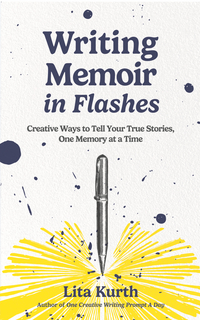
Lita Kurth’s Writing Memoir in Flashes is one of the most useful writing books I have read in a long time because it does exactly what a good creative writing guide should: it makes you want to stop reading and start writing. This book is warm, practical, generous, and deeply encouraging without ever claiming that memoir is easy. Kurth recognizes that writing true stories can be sensitive work. It can evoke sadness, embarrassment, humor, desire, remorse, and astonishment. Rather than seeing them as hurdles, she shows how they can become the very substance of a vigorous flash memoir.
I liked the book’s emphasis on small moments the most. Kurth does not ask any writer to make sense of their life or pin down a clear meaning to their past. She asks them to begin with an image, an object, a family saying, a food memory, a first time, a last time, or a single strong scene. Such a strategy makes memoir possible. Furthermore, it pays tribute to how memory works. Life does not have easily recognizable or clean chapters. We remember the drawer, the scent, the weird thing someone said, the room where something shifted.
The prompts are superb. They strike a level of specificity that snowballs the writer into action while leaving enough room to lead somewhere unexpected. I was drawn back to memories I hadn’t thought of in years. Most importantly, the exercises produced actual pages, not mere inspiration. I have already written a flash memoir using these methods, and it was accepted for publication. This is likely the highest compliment I can pay it. It does not simply make you feel like a writer. It helped me write something substantial to share with the world.
Kurth’s tone is also strong. She writes like a teacher who believes in her students but refuses to lie to them. She promotes honest, detailed writing, revision, reading aloud, and reflection on truth, fairness, and others’ privacy. I found the writing about families and the ethical questions surrounding memoir particularly helpful. The pages present the complexity of writing about oneself.
For some readers, the only flaw is that the book feels more like a workshop than a craft book. Through examples, reflections, prompts, and advice, it has a conversational feel. I liked this, but if you’re after a strict step-by-step system, you may find it a little loose. Nevertheless, this ambiguity fits the subject closely. This book respects that flash memoir often begins in fragments.
Overall, Writing Memoir in Flashes is an effective and emotionally astute guide for anyone seeking to write true stories, one memory at a time. It is especially valuable for writers who feel their lives are too banal to matter. Kurth demonstrates that no life is too insignificant for art when the writer pays sufficient attention.
View all my reviews












