Most Influential Redemption Arcs in Literature

Redemption arc

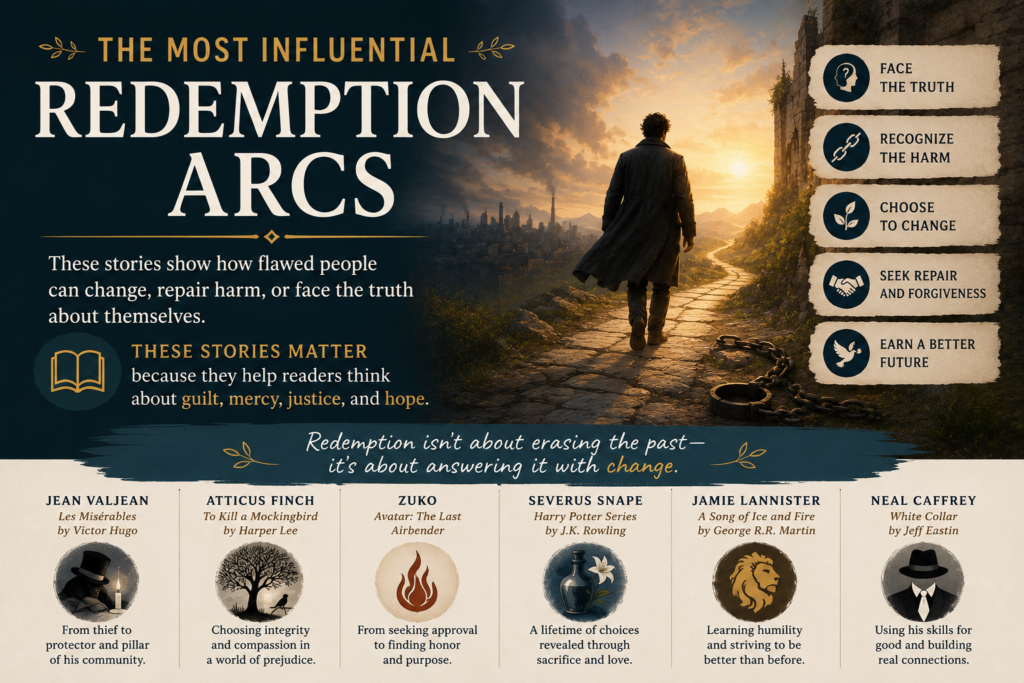
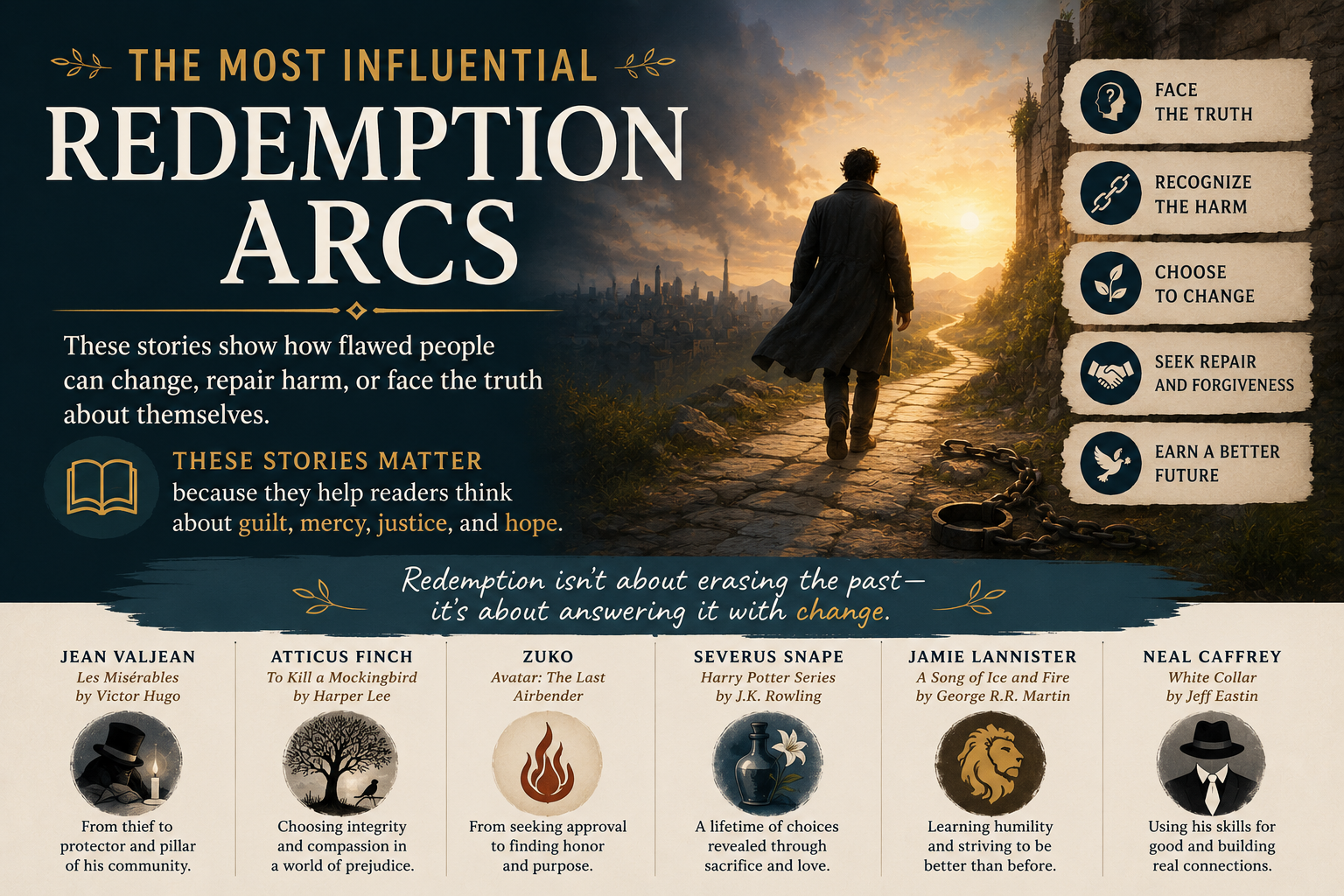
The Most Influential Redemption Arcs show how flawed people can change, repair harm, or face the truth about themselves. These stories matter because they help readers think about guilt, mercy, justice, and hope.

From old classics to modern novels, redemption arcs ask one hard question: can a person become better after doing wrong?

In this Guide

Redemption arc

Why the Most Influential Redemption Arcs Still Matter

Redemption arcs turn moral failure into a story of change.

The Most Influential Redemption Arcs do not excuse bad choices. They show what happens when a character sees the damage they caused and tries to change course.

This is why students often meet these arcs in English class. They give readers a clear way to study character growth, conflict, theme, and moral choice.

A strong redemption arc usually has a few key parts. The character causes harm, faces a crisis, feels the weight of guilt, and makes a choice that proves real change.

That final choice matters most. A character is not redeemed just because they feel sorry. They must act.

Most Influential Redemption Arcs in Classic Literature

Classic literature gives us some of the clearest examples of moral change.

These Most Influential Redemption Arcs have lasted because they feel honest. The characters do not become perfect overnight. Their change costs them something.

Ebenezer Scrooge in A Christmas Carol

Charles Dickens gives readers one of the most famous redemption stories ever written. Scrooge starts as cold, greedy, and cruel to the less fortunate.

After visits from the ghosts, he sees his past, present, and possible future. These visions force him to face the lonely life he has built.

Scrooge changes because he chooses kindness while he still has time. His redemption feels joyful, but it also comes from fear, shame, and self-knowledge.

For background on Dickens and his work, see Britannica’s overview of Charles Dickens.

Jean Valjean in Les Misérables

Victor Hugo’s Jean Valjean begins as a man marked by prison and poverty. After he steals silver from a bishop, the bishop protects him instead of turning him in.

That act of mercy changes Valjean’s life. He becomes a man who helps others, even when it puts him at risk.

Valjean’s arc shows that redemption is not one moment. It is a lifetime of hard choices.

Sydney Carton in A Tale of Two Cities

Sydney Carton starts as bitter and wasted. He sees himself as a failure with little purpose.

His final act changes how readers see him. By giving his life to save another man, he turns regret into sacrifice.

Carton’s redemption is tragic, but it is powerful. He cannot fix his whole past, yet he can give his life meaning.

Severus Snape in the Harry Potter Series

Snape is one of modern literature’s most debated redemption arcs. He is cruel, secretive, and often unfair.

Yet his hidden loyalty reveals a more complex person. His choices do not erase his harm, but they show a long struggle with guilt and love.

This is why Snape remains important in classroom and fan debates. His arc asks whether sacrifice can balance past cruelty.

Themes and Symbols in Redemption Arcs

Redemption stories often use symbols to show inner change.

Light and darkness appear often in redemption arcs. A character may move from shadow into light, which can show moral growth or new hope.

Journeys also matter. A road, a prison, or a return home can show that change takes effort. Jean Valjean’s movement through France reflects his search for grace and safety.

Names can carry meaning too. When a character takes a new name, it may show a new self. Valjean becomes Monsieur Madeleine, which points to his attempt to live beyond his prison past.

Time is another key symbol. In A Christmas Carol, the ghosts use time to teach Scrooge. The past brings regret, while the future offers warning.

If you want to sharpen your close reading of symbols, imagery, and word choice, try our guide on how to read Emily Dickinson. The same skills can help you study longer novels.

Modern Lessons from the Most Influential Redemption Arcs

Redemption arcs still shape how readers talk about justice and change.

The Most Influential Redemption Arcs are not simple “good guy” stories. They often ask if people deserve a second chance after real harm.

This question feels modern because people still debate it in schools, courts, families, and online spaces. Literature gives readers a safer place to think through the problem.

Some arcs stress forgiveness. Others focus on responsibility. The best ones do not make the answer too easy.

That is why redemption arcs work well in essays. You can ask what the character did wrong, what they learned, and whether their final choice truly repairs anything.

These books are strong choices for students who want deeper examples.

  • A Christmas Carol by Charles Dickens
  • Les Misérables by Victor Hugo

Both books show redemption in a clear but serious way. They also give students rich material for theme, character, and symbolism essays.

For shorter practice, pair a novel with poetry study. A poem can train you to notice small details that reveal change. Our post on reading Emily Dickinson is a useful place to start.

FAQs About the Most Influential Redemption Arcs

What are the Most Influential Redemption Arcs in literature?

The Most Influential Redemption Arcs often include Scrooge in A Christmas Carol, Jean Valjean in Les Misérables, and Sydney Carton in A Tale of Two Cities.

What makes a redemption arc believable?

A believable arc shows guilt, effort, and real change. The character must act in a way that proves they have learned from the past.

Is redemption the same as forgiveness?

No. A character may seek redemption without being fully forgiven. Forgiveness depends on others, while redemption depends on moral change.

Why do teachers assign books with redemption arcs?

These books help students study character growth, theme, and conflict. They also lead to strong essay topics about justice and mercy.

Key Takeaway

The Most Influential Redemption Arcs remind us that change is possible, but never cheap. Great literature shows that redemption requires truth, action, and the courage to become someone better.
Best Books for Identity and Belonging: A Student Guide to Finding Your Place

Identity Belonging Books

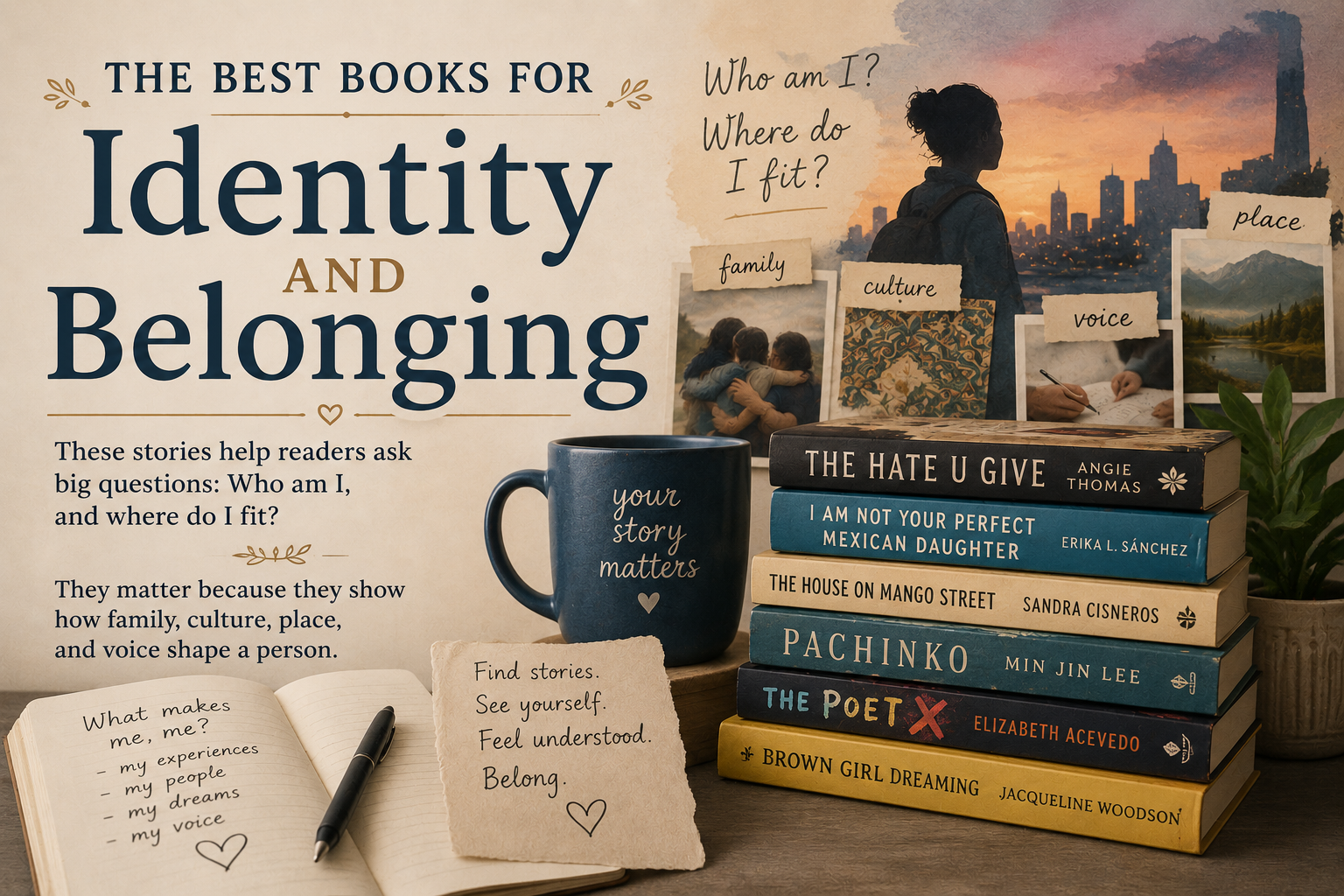
The Best Books for Identity and Belonging help readers ask big questions: Who am I, and where do I fit? These stories matter because they show how family, culture, place, and voice shape a person.

For students, these books can make class reading feel personal. They also give strong material for essays, discussions, and literary analysis.

In this Guide

  • Why identity and belonging matter in literature
  • Books to read first
  • Symbols and themes to notice
  • How students can read these books closely
  • More examples from classic and modern literature
  • Frequently asked questions
Identity Belonging Books

Why the Best Books for Identity and Belonging Matter

Stories about identity help readers see both difference and connection.

The Best Books for Identity and Belonging often follow characters who feel caught between worlds. They may face pressure from family, school, society, or their own fears.

These books show that identity is not always fixed. A character may change as they learn their history, speak their truth, or claim a place in the world.

Belonging can be just as complex. Sometimes a character wants to fit in. Other times, they learn that real belonging starts with self-respect.

Best Books for Identity and Belonging to Read First

These books are strong choices for high school, AP Literature, and college readers.

A good list of Best Books for Identity and Belonging should include voices from different cultures and time periods. The books below are often taught because they mix clear storytelling with deep themes.

The House on Mango Street by Sandra Cisneros

This short novel follows Esperanza, a young girl in a Chicago neighborhood, as she studies the world around her. She wants a home, but she also wants freedom.

Names, houses, windows, and streets become symbols of identity. Esperanza learns that belonging to a place does not mean she must be trapped by it.

The Namesake by Jhumpa Lahiri

This novel follows Gogol Ganguli, the son of Bengali immigrants, as he struggles with his name and his family history. His name becomes a symbol of love, burden, and memory.

The book asks a clear question: can a person honor their roots and still build a life of their own?

Their Eyes Were Watching God by Zora Neale Hurston

Janie Crawford searches for love, voice, and selfhood. Her journey shows how identity can grow through pain, choice, and courage.

The horizon is one of the novel’s key symbols. It represents hope, desire, and the dream of a wider life.

If you want to buy or borrow a few strong starting points, look for The House on Mango Street by Sandra Cisneros, The Namesake by Jhumpa Lahiri, and Their Eyes Were Watching God by Zora Neale Hurston.

Symbols and Themes in the Best Books for Identity and Belonging

Symbols make inner conflict visible on the page.

Across the Best Books for Identity and Belonging, authors often use objects, places, and names to show what a character feels but cannot always say.

A name may show family history. A house may show safety or limits. A road may show escape, growth, or the search for a new life.

In The House on Mango Street, the house is not just a building. It stands for poverty, shame, hope, and the need for self-definition.

In The Namesake, Gogol’s name carries memory from another country. It also becomes a source of conflict as he tries to decide who he wants to be.

Poetry can explore these same ideas in a smaller space. Langston Hughes often writes about voice, race, dream, and place. You can learn more from the Poetry Foundation profile of Langston Hughes.

If you want help with poems that explore identity, use this step-by-step poetry analysis guide to break down imagery, tone, and speaker.

How Students Can Read the Best Books for Identity and Belonging

Close reading helps you move from plot summary to real analysis.

When you read the Best Books for Identity and Belonging, track moments when a character feels accepted, rejected, or unseen. These moments often reveal the main conflict.

Pay attention to names, homes, language, clothing, food, and public spaces. These details often carry cultural meaning.

Ask what the character wants at the start. Then ask what they understand by the end. That shift can become the center of a strong essay.

You can also connect these books to the coming-of-age tradition. Britannica explains this type of story in its overview of the Bildungsroman.

More Examples of the Best Books for Identity and Belonging

Many famous works ask what it means to be seen and understood.

Invisible Man by Ralph Ellison explores race, power, and the pain of being unseen by society. The narrator’s identity changes as he learns how others try to define him.

American Born Chinese by Gene Luen Yang uses humor, myth, and graphic storytelling to explore shame and self-acceptance. It is a strong choice for students who like visual texts.

Jane Eyre by Charlotte Brontë follows a young woman who wants love without losing her sense of self. Jane’s voice is central to her identity.

Persepolis by Marjane Satrapi shows how politics, family, and memory shape a young person’s life. Its black-and-white art makes identity feel sharp and personal.

These works prove that the Best Books for Identity and Belonging do not all look the same. Some are novels. Some are graphic memoirs. And some are poems or plays.

FAQ: Best Books for Identity and Belonging

What makes a book about identity and belonging?

A book fits this theme when characters ask who they are, where they come from, and where they feel accepted.

Why are the Best Books for Identity and Belonging useful for students?

They give students clear themes for essays and class talks. They also connect literature to real life.

Are these books good for AP Literature?

Yes. Many of these books have rich symbols, complex characters, and strong themes, which makes them useful for AP-style analysis.

Can poetry count as literature about identity and belonging?

Yes. Poems often explore voice, culture, memory, and place in a direct way.

Key Takeaway

The Best Books for Identity and Belonging remind us that finding a place in the world is rarely simple. These stories show that identity grows through choice, memory, conflict, and voice.

For students, that makes them more than good reading. They are tools for thinking about literature, society, and the self. 📚

Best Novels About Memory and Trauma: Powerful Books That Stay with You

Best Novels about Memory and Trauma

The Best Novels About Memory and Trauma show how the past can shape a person’s life long after the event has ended. These books help readers understand pain, survival, silence, and the strange ways memory can return.

For students, these novels also offer rich themes, symbols, and character studies. They are strong choices for essays, class talks, and deeper reading.

In this Guide

  • Why novels about memory and trauma matter
  • Best novels to read first
  • How trauma changes storytelling
  • Common symbols and themes
  • How students can read these books with care
  • Book suggestions
  • FAQs
  • Key takeaway
Best Novels about Memory and Trauma

Why the Best Novels About Memory and Trauma Matter

These stories help readers see how the past lives inside the present.

The Best Novels About Memory and Trauma do not treat memory like a simple record. In these books, memory can be broken, hidden, repeated, or changed by fear.

That makes the reading experience feel more real. People who suffer often do not remember events in a neat order. A sound, place, smell, or word can bring the past back at once.

These novels also ask hard questions. Can a person heal if they cannot speak about what happened? Can a family move forward if it hides the truth? Or can a nation face its own violent history?

Books like Beloved by Toni Morrison and The Things They Carried by Tim O’Brien explore these questions with great care. They show that trauma is not only personal. It can also be passed through families, wars, and cultures.

Best Novels About Memory and Trauma to Read First

These books are strong starting points because they are often taught and widely discussed.

If you are new to the Best Novels About Memory and Trauma, start with books that use clear emotional conflicts and strong symbols. The stories below are well-known, but they still feel fresh because they ask deep human questions.

Beloved by Toni Morrison

Beloved is one of the most important American novels about memory, slavery, and grief. Set after the Civil War, it follows Sethe, a woman haunted by the past in both real and ghostly ways.

The novel shows how trauma can return through the body, the home, and family bonds. Morrison does not let the past stay buried. She turns memory into a living force.

You can learn more about Morrison’s life and impact through Britannica’s overview of Toni Morrison.

The Things They Carried by Tim O’Brien

This Vietnam War novel blurs the line between fact and fiction. O’Brien writes about soldiers, fear, guilt, and the stories people tell to survive.

Memory in this book is not perfect. It shifts because pain shifts it. That is part of the point.

The title itself is a symbol. The soldiers carry weapons and supplies, but they also carry shame, love, fear, and regret.

Slaughterhouse-Five by Kurt Vonnegut

Slaughterhouse-Five follows Billy Pilgrim, a man who becomes “unstuck in time.” His life moves back and forth between moments, including the bombing of Dresden during World War II.

The strange structure shows how trauma can break normal time. Billy does not simply remember the war. He seems trapped inside it.

This is one reason the novel remains one of the Best Novels About Memory and Trauma for students who want to study form and theme together.

The Remains of the Day by Kazuo Ishiguro

This quiet novel follows Stevens, an English butler who looks back on his life. At first, his memories seem calm and controlled.

As the story unfolds, readers see what he has avoided. His trauma comes through restraint, regret, and missed chances.

The book is a powerful example of emotional repression. It shows that silence can be just as painful as open grief.

Never Let Me Go by Kazuo Ishiguro

This novel may look like science fiction, but its deepest subject is memory. Kathy tells the story of her childhood at a strange boarding school and slowly reveals the truth about her life.

The novel studies how people remember youth when they know loss is near. It is calm on the surface, but deeply sad underneath.

For students, it is a great book for essays about identity, control, and the stories people tell themselves.

How Trauma Changes Storytelling

In many trauma novels, the form of the story reflects the mind of the character.

The Best Novels About Memory and Trauma often avoid a straight timeline. This is not a trick. It helps readers feel how trauma works.

A character may jump from the present to the past without warning. A scene may repeat with new details. A narrator may leave out facts because the truth is too painful.

In Beloved, memories arrive in pieces. In Slaughterhouse-Five, time itself feels broken. And in The Things They Carried, stories are retold because one version is never enough.

This style can feel hard at first. But it teaches readers to notice structure. The way a story is told can matter as much as what happens.

If you are studying older texts too, the same skill helps. Paying close attention to language and structure can make difficult works easier, as explained in this guide to understanding Shakespearean language.

Symbols and Themes in the Best Novels About Memory and Trauma

These novels often use objects, places, and repeated images to show what words cannot fully explain.

One common symbol is the house. In Beloved, the home is not just a setting. It holds grief, fear, and history.

Another key symbol is the body. Trauma often appears through scars, pain, habits, or silence. A character may not speak about the past, but the body still remembers.

Objects also carry meaning. In The Things They Carried, the items soldiers hold become signs of emotional weight. What they carry shows who they are and what they fear.

Time is another major theme. In the Best Novels About Memory and Trauma, the past is not really past. It presses into the present and changes how characters see themselves.

These books also focus on truth. A memory may be honest even if it is not fully accurate. That idea can lead to strong essay topics about narration and trust.

Why Memory Is Not Always Reliable

Memory can protect people, but it can also hide what hurts too much.

Many trauma novels use unreliable narrators. This does not always mean the narrator lies on purpose. Sometimes the narrator cannot face the full truth yet.

In The Remains of the Day, Stevens tells his life story in a careful voice. He seems proper and calm. But readers start to sense the sadness under his control.

In Never Let Me Go, Kathy’s memories feel gentle, but they lead toward a painful truth. Her calm tone makes the novel even more haunting.

This is why the Best Novels About Memory and Trauma reward close reading. Small details often reveal what the narrator cannot say directly.

How Students Can Read These Novels With Care

These books can be powerful, but some scenes may feel heavy.

When you read the Best Novels About Memory and Trauma, give yourself time. Do not rush through painful chapters just to finish the plot.

Take notes on repeated images, changes in time, and moments of silence. Ask what the character avoids. Ask what the book returns to again and again.

It also helps to learn basic facts about trauma. The National Institute of Mental Health page on PTSD offers clear information about how trauma can affect memory and daily life.

For class essays, focus on one clear idea. You might write about the haunted house in Beloved, the broken timeline in Slaughterhouse-Five, or the weight of objects in The Things They Carried.

Amazon Book Suggestions: Best Novels About Memory and Trauma

These titles are easy to find online, in libraries, and in many school reading lists.

If you want to build a reading list, these are strong choices:

  • Beloved by Toni Morrison
  • The Things They Carried by Tim O’Brien
  • Never Let Me Go by Kazuo Ishiguro

Each book gives a different view of memory and pain. Together, they show why the Best Novels About Memory and Trauma matter in modern literature.

Best Novels About Memory and Trauma for Essay Topics

These books offer rich ideas for literary analysis.

For an essay on symbolism, Beloved is a strong choice. You can study the house, the ghost, or the idea of rememory.

For an essay on structure, Slaughterhouse-Five works well. Its broken timeline shows how war changes the mind.

For an essay on narration, The Remains of the Day gives you a lot to explore. Stevens reveals his pain through what he refuses to admit.

If you need help with close reading, use skills that apply across many texts. This guide on how to understand difficult literary language can help you slow down and read with more focus.

FAQs About the Best Novels About Memory and Trauma

What makes a novel about memory and trauma powerful?

A powerful trauma novel shows how the past affects the present. It often uses symbols, broken timelines, or silence to reveal pain.

Are the Best Novels About Memory and Trauma hard to read?

Some can be emotionally difficult. They are worth reading with care, breaks, and class discussion when possible.

Which novel should students start with?

The Things They Carried is a good starting point because its chapters are short and its themes are clear. Beloved is deeper and more complex, but very rewarding.

Why do these novels often use non-linear time?

Trauma does not always feel like a normal memory. A broken timeline can show how the past returns without warning.

Can these books help with AP Literature essays?

Yes. The Best Novels About Memory and Trauma offer strong examples of theme, character, symbolism, and narrative structure.

Key Takeaway

The Best Novels About Memory and Trauma show that the past is never simple. These books help readers see how pain can shape identity, how silence can speak, and how stories can become a path toward truth.

For students, they are more than moving reads. They are some of the richest texts for close reading, essay writing, and serious thought.