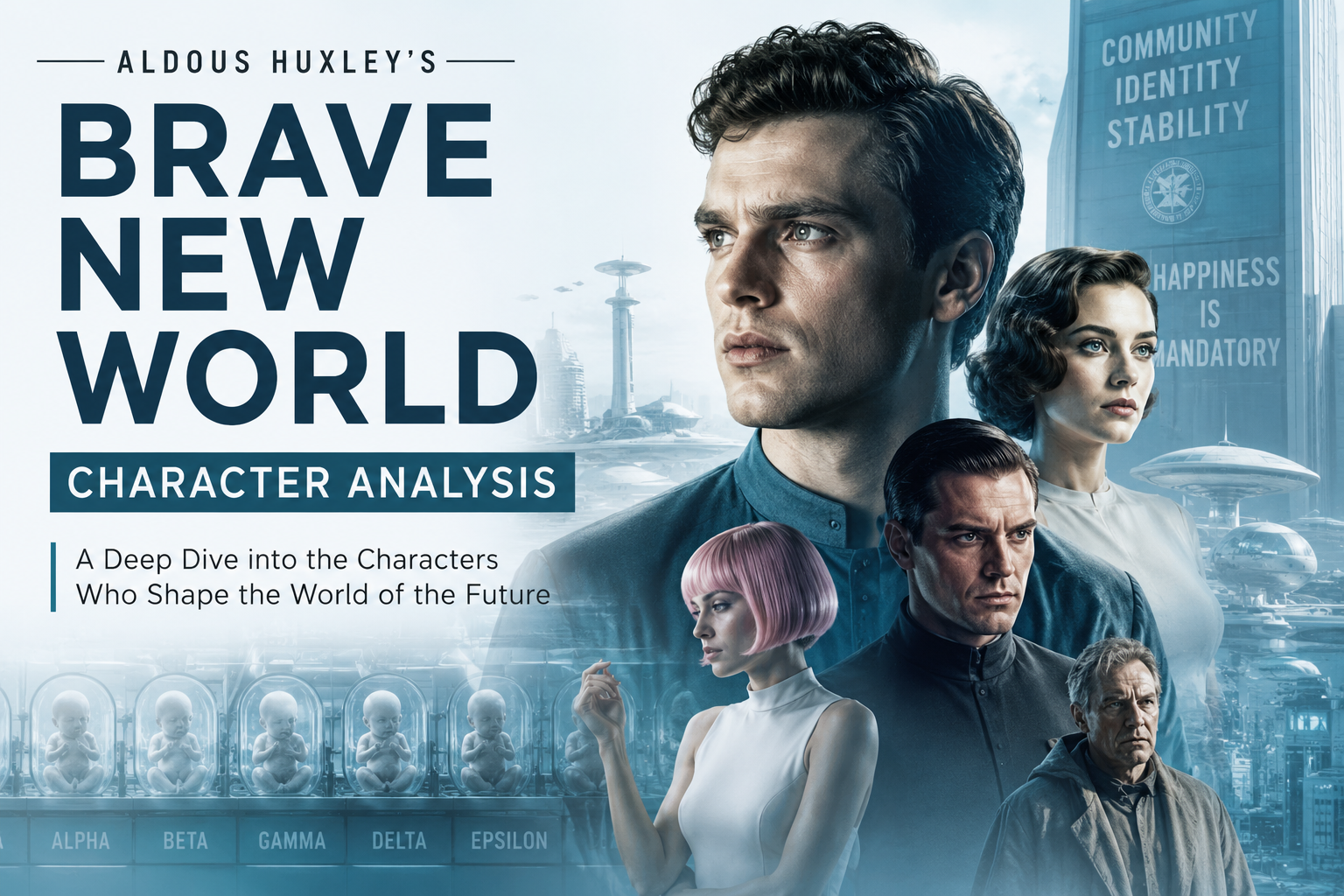
Brave New World character analysis helps readers see how Aldous Huxley builds a world where comfort costs people their freedom. Each major character shows a different response to control, pleasure, and pain.
This guide breaks down the main characters, their motives, and the conflicts that shape the novel.
In this Guide
- Why character analysis matters in the novel
- Bernard Marx and the need to feel special
- John the Savage and the search for meaning
- Lenina Crowne and social conditioning
- Mustapha Mond and the price of stability
- How to use this analysis in essays
- FAQ

Brave New World character analysis: why characters matter
The novel uses characters to test the values of the World State.
In Brave New World, people are trained to avoid deep love, strong grief, and private thought. The main characters matter because they reveal cracks in that system.
A strong Brave New World character analysis should not only ask what each person does. It should ask why they act, what they fear, and what their choices show about the society around them.
If you want a simple method for studying motives and conflicts, see our guide on how to analyze characters in literature.
Brave New World character analysis of Bernard Marx
Bernard wants to be different, but he also wants the approval of the world he criticizes.
Bernard Marx is an Alpha, so he has high status. Yet he feels insecure because he does not fit the ideal Alpha image. People mock his body, and that shame shapes much of his behavior.
At first, Bernard seems brave because he questions soma, casual relationships, and public life. He wants private feeling in a society that fears privacy.
But Bernard’s rebellion is shaky. Once he gains fame through John, he enjoys attention. He becomes proud, rude, and eager to use the same social system that once hurt him.
His main conflict is between the desire for truth and the desire for status. This makes him a flawed but useful character for essays.
Bernard is similar to some uneasy figures in modern literature who dislike society but still crave its rewards. Like Winston in 1984, he feels trapped by a system that controls human desire. Unlike Winston, Bernard’s courage fades fast.
Brave New World character analysis of John the Savage
John is the novel’s clearest outsider, and his pain exposes the World State’s emptiness.
John grows up on the Savage Reservation, where he learns pain, shame, religion, and longing. He also reads Shakespeare, which gives him a rich language for love and suffering.
When John enters the World State, he hopes to find wonder. Instead, he finds a clean, safe world that avoids deep human feeling.
John’s main motive is to live with meaning. He wants love to be sacred, not casual. He wants suffering to count, not vanish through soma.
His conflict with the World State is moral and emotional. He cannot accept a life built on comfort without truth.
John’s tragedy comes from his extreme idealism. He sees clearly that this world is false, but he cannot find a healthy way to live outside it.
For background on Huxley and the novel’s place in literature, Britannica offers a helpful overview of Brave New World.
Brave New World character analysis of Lenina Crowne
Lenina is not a villain. She shows how deeply the World State shapes normal people.
Lenina Crowne follows the rules of her society. She takes soma, repeats slogans, and believes that desire should be simple.
Still, Lenina is not flat. She has real feelings for John, even if she cannot understand his values. Her attraction to him proves that human longing still exists beneath social training.
Her main conflict is between conditioning and emotion. She feels drawn to John, but she can only express love in the terms her culture has taught her.
This makes Lenina a strong character for quote-based analysis. Her words often sound shallow, but they reveal a world where language itself has been shaped by power.
She is very different from a character like Elizabeth Bennet in Pride and Prejudice, who studies people and questions social pressure. Lenina has been taught not to question much at all.
Brave New World character analysis of Mustapha Mond
Mustapha Mond understands the truth, yet he chooses control.
Mond is one of the World Controllers. He knows about science, history, art, and religion. He is not fooled by the system, and he helps run it.
This makes him one of the most important characters in the novel. He can explain why the World State removed old forms of freedom.
Mond’s main motive is stability. He believes art, faith, and deep love create conflict. To him, peace is worth the loss of truth.
His conflict with John is the heart of the novel’s argument. John says people need the right to suffer, choose, and believe. Mond says most people are happier without those burdens.
A useful Brave New World character analysis should treat Mond with care. He is not simple. He is frightening because his logic can sound calm and reasonable.
Helmholtz Watson and the need for real expression
Helmholtz shows what happens when talent outgrows a controlled culture.
He has success, charm, and intelligence. Unlike Bernard, he is not driven by social shame. His problem is deeper.
He feels that his words should matter more. As a writer, he wants language to carry real feeling, but his world gives him shallow topics and easy slogans.
Helmholtz connects with John because both care about powerful language. Yet Helmholtz is more balanced than John. He can face exile with a sense of purpose.
His conflict is between creative force and social limits. He proves that even high-status people can feel trapped by a world that fears depth.
Linda and the pain of not belonging
Linda shows the human cost of a society that cannot deal with age, grief, or shame.
She was raised in the World State, then left behind on the Reservation. She cannot fully belong to either place.
On the Reservation, people judge her behavior. In the World State, people reject her body because she looks old and worn.
Her motive is simple. She wants comfort and escape. Soma gives her that escape, but it also removes her from real life.
Linda’s story helps students see that the World State’s promise of happiness is cruel. It only works for people who stay useful, young, and controlled.
Major character conflicts in the novel
The strongest conflicts in the novel are not only between people. They are between values.
John vs. Mond is the key debate. John defends truth and suffering. Mond defends peace and pleasure.
Bernard vs. society shows the weak side of rebellion. Bernard wants freedom, but he also wants fame.
Lenina vs. John shows two different ideas of love. Lenina sees desire as normal and easy. John sees love as sacred and full of duty.
Helmholtz vs. the World State shows the need for art. He wants language that can hold real emotion.
How to Use This Brave New World character analysis in essays
A good essay should connect character choices to the novel’s larger ideas.
Start with a clear claim. For example: Bernard Marx is not a true rebel because his desire for status is stronger than his desire for freedom.
Then use short quotes and explain them. Do not drop a quote and move on. Show how the words reveal motive, conflict, or change.
For more support, try our character analysis strategy guide before you draft your response.
You can also use our literature study resources to plan discussion posts, essays, and quote notes.
Suggested books for deeper study
These books can help you compare Huxley’s ideas with other works about control and freedom.
- Brave New World by Aldous Huxley
- 1984 by George Orwell
- Fahrenheit 451 by Ray Bradbury
For more on Huxley’s life and ideas, see Britannica’s page on Aldous Huxley.
FAQ: Brave New World character analysis
Who is the most important character in Brave New World?
John is often the most important because he directly challenges the World State. His clash with Mond reveals the novel’s main debate.
Is Bernard Marx a hero?
Bernard is not a clear hero. He questions society, but he also enjoys power when it benefits him.
What does Lenina Crowne represent?
Lenina represents social conditioning. She has real feelings, but she can only express them through the values she has been taught.
Why is Mustapha Mond important?
Mond explains the World State’s logic. He shows why comfort can become dangerous when it replaces freedom.
What is the best focus for a Brave New World character analysis essay?
Focus on one character’s main conflict. Then connect that conflict to a larger theme, such as freedom, stability, or truth.
Key Takeaway
A strong Brave New World character analysis shows that each major character tests the cost of comfort. Huxley’s novel asks whether a painless life is worth it if people must give up truth, art, and real love.