Animal Farm Character Analysis: Key Characters, Motivations, and Conflicts

Animal Farm analysis

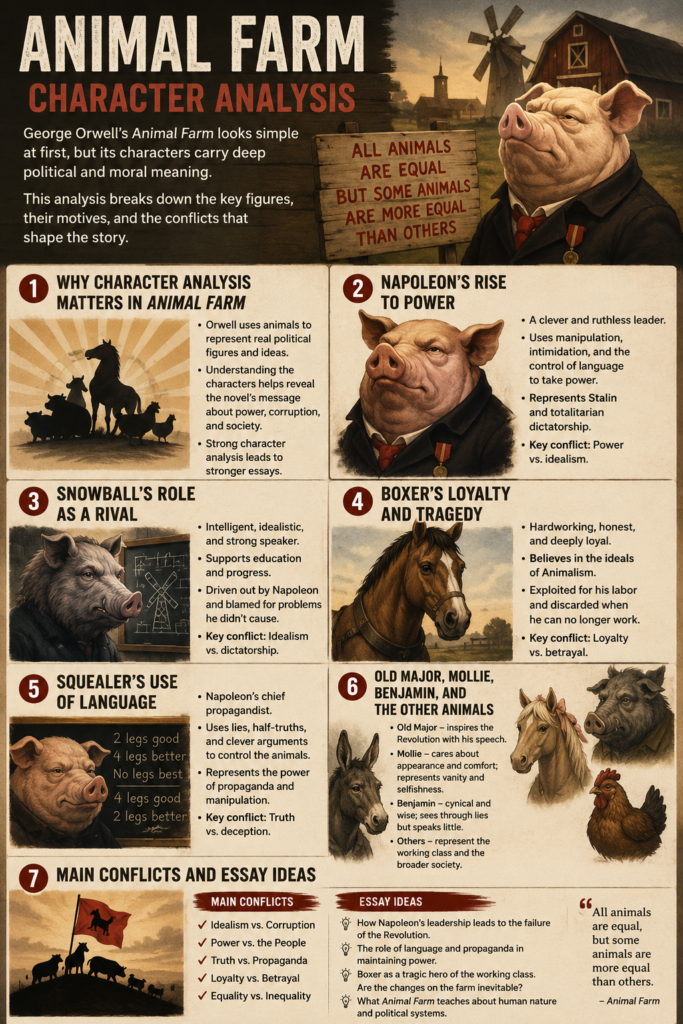
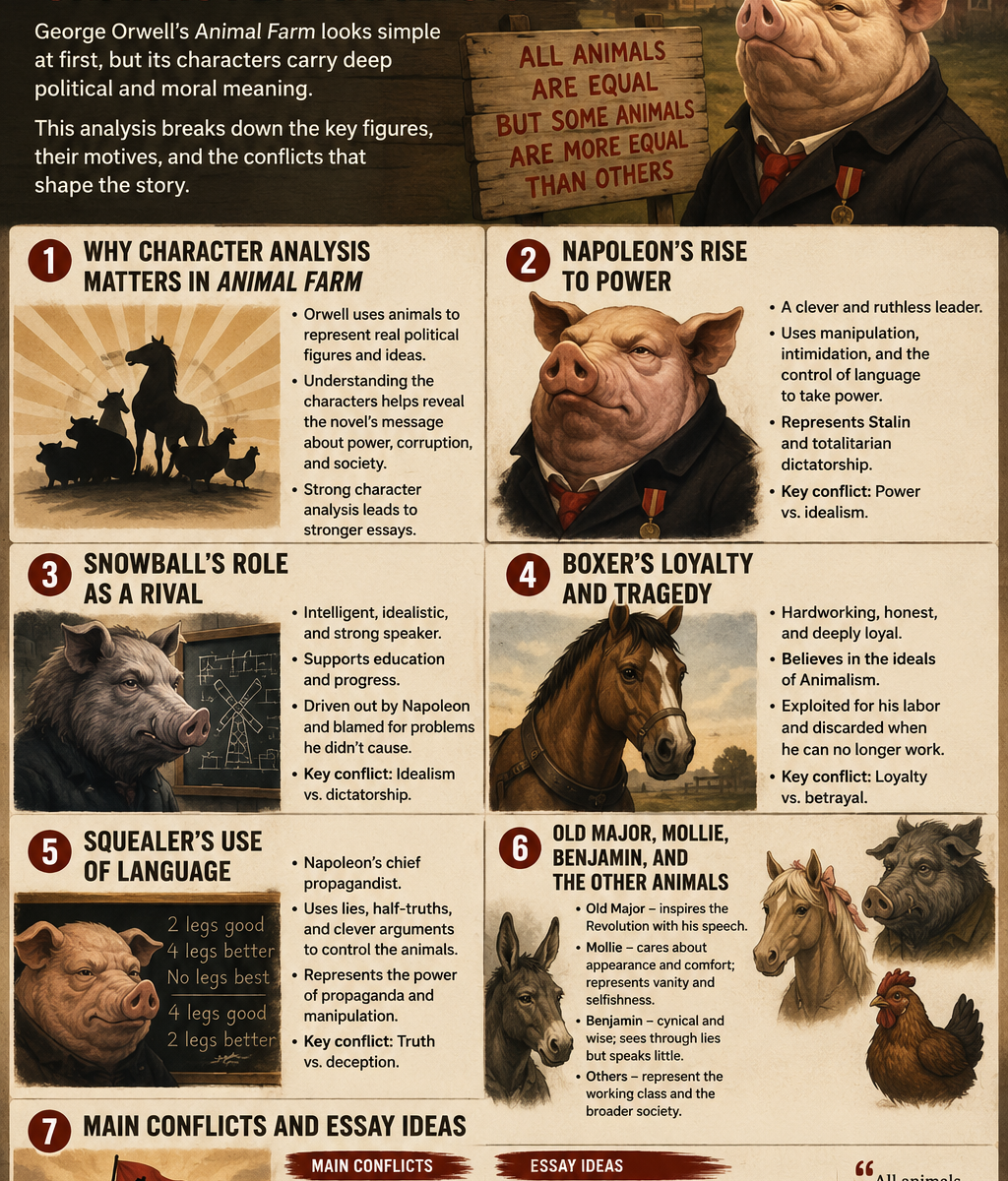
George Orwell’s Animal Farm looks simple at first, but its characters carry deep political and moral meaning. This Animal Farm character analysis breaks down the key figures, their motives, and the conflicts that shape the story.

Use this guide for class discussions, essays, and quote-based analysis.

In this Guide

  • Why character analysis matters in Animal Farm
  • Napoleon’s rise to power
  • Snowball’s role as a rival
  • Boxer’s loyalty and tragedy
  • Squealer’s use of language
  • Old Major, Mollie, Benjamin, and the other animals
  • Main conflicts and essay ideas
  • Books for further reading
  • FAQ
Animal Farm analysis

Animal Farm Character Analysis: Why the Characters Matter

The animals are not just farm creatures. They stand for people, groups, and ideas from the Russian Revolution and from human society in general.

Orwell uses each character to show how power can change a movement. A dream of fairness turns into a system ruled by fear.

This is why Animal Farm character analysis works best when you ask two questions: What does this character want? What does this character reveal about power?

If you want a wider method for studying fiction, read our guide on how to analyze characters in literature.

Animal Farm Character Analysis of Napoleon

Napoleon is the main force behind the farm’s collapse into tyranny. He begins as one of the leaders of the rebellion, but he soon makes power his true goal.

Napoleon does not win through wisdom or kindness. He wins through fear, secrecy, and control.

His dogs become his private police. Once he drives Snowball away, no one can challenge him. He changes rules, takes special privileges, and slowly becomes like the humans the animals once hated.

Napoleon’s motivation is clear: he wants total control. He claims to serve the farm, but his choices serve himself.

In an essay, Napoleon can be compared to Macbeth from Shakespeare’s Macbeth. Both characters let ambition swallow their morals. Once they gain power, they use violence to keep it.

Snowball: The Rival Who Becomes a Scapegoat

Snowball is smart, active, and full of plans. He wants the farm to improve, but he also wants influence.

Unlike Napoleon, Snowball believes in public speeches and big projects. His plan for the windmill shows his hope for progress. It also shows that not every leader with good ideas can survive a brutal power struggle.

After Napoleon forces him out, Snowball becomes a scapegoat. Whenever something goes wrong, Napoleon blames him.

This part of Animal Farm character analysis matters because Snowball becomes more useful to Napoleon as an enemy than as a real person. Fear of Snowball helps Napoleon control the animals.

Students can connect Snowball to the idea of the “outsider” in literature. Like many blamed figures in political stories, he is turned into a symbol of danger.

Boxer: Loyalty, Labor, and Tragedy

Boxer is one of the most painful characters in the novel. He is strong, honest, and deeply loyal to the farm.

His two sayings are “I will work harder” and “Napoleon is always right.” These lines show both his goodness and his weakness.

Boxer wants to help the rebellion succeed. He believes that hard work can fix every problem. Yet he does not question the leaders who use him.

His death is the emotional center of the book. When Napoleon sells Boxer to the knacker, the reader sees the full cruelty of the new system.

For discussion posts, Boxer is often the best character to use when writing about trust. He shows how loyalty can become dangerous when leaders do not deserve it.

Squealer: Language as a Tool of Control

Squealer is Napoleon’s speaker. He explains, excuses, and twists the truth.

He does not need to be strong because his power comes from words. He changes facts until the animals doubt their own memories.

When the commandments change, Squealer helps make the changes seem normal. When the pigs take more food, he makes it sound necessary. When Boxer is taken away, he tells a false story to calm the farm.

This Animal Farm character analysis shows that propaganda is one of Orwell’s main concerns. Squealer proves that language can protect injustice when people stop asking questions.

For helpful background on Orwell and his political writing, see the Britannica entry on George Orwell.

Old Major: The Dream That Starts the Rebellion

Old Major appears only at the start, but his ideas shape the whole novel. He gives the animals a vision of freedom from human control.

His speech inspires hope. He teaches the animals that their suffering comes from human greed.

Still, Old Major’s dream is simple compared with what happens later. He does not explain how power should be shared after the rebellion.

That gap matters. The animals know what they are against, but they do not know how to protect their new society from corruption.

Benjamin: The Quiet Witness

Benjamin is the donkey who sees more than he says. He is cynical, careful, and hard to fool.

He can read, and he understands that the pigs have betrayed the rebellion. Yet he rarely acts.

His silence raises a hard question: Is knowing the truth enough? Orwell suggests that wisdom without courage may not stop injustice.

Benjamin becomes most moving when Boxer is taken away. He finally speaks with urgency, but it is too late.

Mollie: Comfort Over Commitment

Mollie is often easy to dismiss, but she has an important role. She cares more about ribbons, sugar, and comfort than the ideals of the rebellion.

Her motivation is personal safety. She does not want freedom if it means sacrifice.

Mollie leaves the farm because the new life demands too much from her. In this way, she shows that not everyone joins a revolution for the same reason.

In Animal Farm character analysis, Mollie can help students write about class, privilege, and self-interest.

Clover, Moses, and the Sheep

Clover is caring and loyal, but she senses that something is wrong. She cannot always explain it, which makes her a realistic character.

She represents ordinary people who feel injustice but lack the tools to fight it.

Moses, the raven, talks about Sugarcandy Mountain. His stories offer comfort, but they also distract the animals from life on the farm.

The sheep repeat slogans without thought. Their role is simple but important. They show how noise can drown out reason.

Major Conflicts in Animal Farm

The main conflict begins as animals versus humans. The animals rebel against Mr. Jones because he neglects and exploits them.

After the rebellion, the deeper conflict becomes animals versus pigs. The pigs take control of the farm and turn the old oppression into a new one.

There is also a conflict between memory and propaganda. The animals remember the original commandments, but Squealer teaches them to doubt what they know.

This is a key point for any Animal Farm character analysis. Orwell shows that political control depends not only on force, but also on control of the past.

For more help with character-based essays, you can use this simple character analysis framework.

How Character Choices Shape the Story

Every major turn in the novel comes from a character’s choice. Napoleon chooses power. Boxer chooses trust. Benjamin chooses silence.

These choices build the tragedy of the farm. No single animal causes everything, but many choices allow the pigs to win.

This makes Animal Farm useful for student essays. You can argue that Orwell’s message is not only about bad leaders. It is also about the danger of passive followers.

Essay Ideas for Animal Farm Character Analysis

A strong essay should connect character traits to the novel’s larger message. Do not just say that Napoleon is cruel. Explain how his cruelty changes the farm.

You might write about Boxer as a symbol of exploited workers. You could also study Squealer as a symbol of propaganda.

Another strong option is Benjamin. His character helps you explore silence, guilt, and responsibility.

For quote-based writing, choose short lines that reveal motive. Boxer’s motto, Squealer’s speeches, and the final commandment all work well.

Relevant Books for Further Reading

If you want more context, these books can help:

  • Animal Farm by George Orwell
  • 1984 by George Orwell

For historical background, the Britannica overview of the Russian Revolution can help you connect the novel to real events.

FAQ: Animal Farm Character Analysis

Who is the most important character in Animal Farm?

Napoleon is the most important character because his choices control the farm’s future. His rise shows how a revolution can become a dictatorship.

What does Boxer represent?

Boxer represents loyal workers who give everything to a system that does not protect them. His story is tragic because his trust is used against him.

Why is Squealer important?

Squealer shows the power of propaganda. He uses language to hide lies and defend Napoleon’s rule.

Is Snowball a good character?

Snowball has better goals than Napoleon, but he is not perfect. He wants progress, yet he also wants leadership and control.

What is the main lesson from the characters?

The novel warns that power can corrupt leaders, but it also warns that silence and blind trust can help corruption grow.

Key Takeaway

Animal Farm character analysis helps readers see how Orwell builds a warning about power. The tragedy of the farm comes from ambition, fear, and the failure to question leaders before it is too late.
Symbols in The Catcher in the Rye: Meanings, Themes, and Why They Matter

Catcher in the Rye symbols

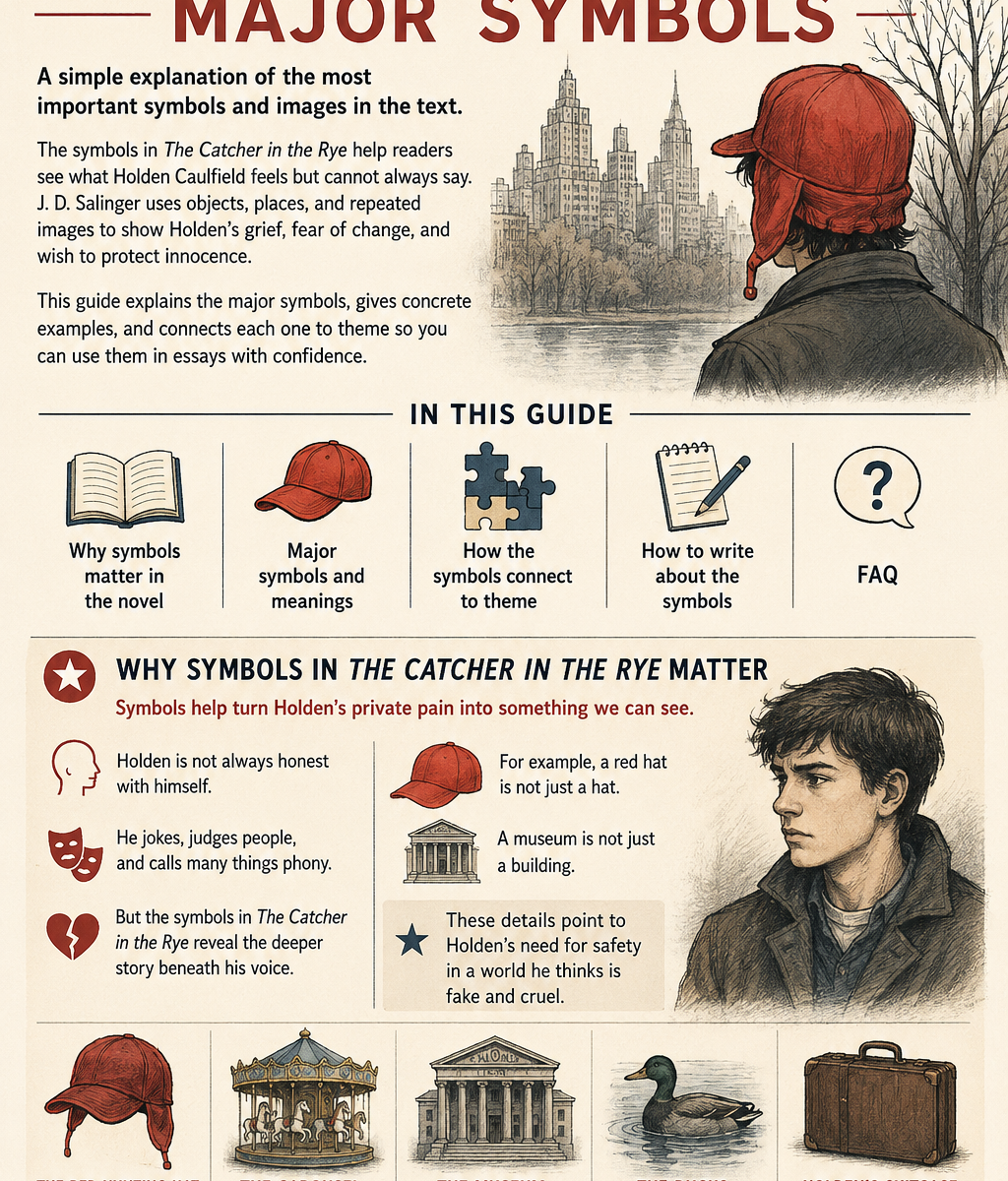
A simple explanation of the most important symbols and images in the text.

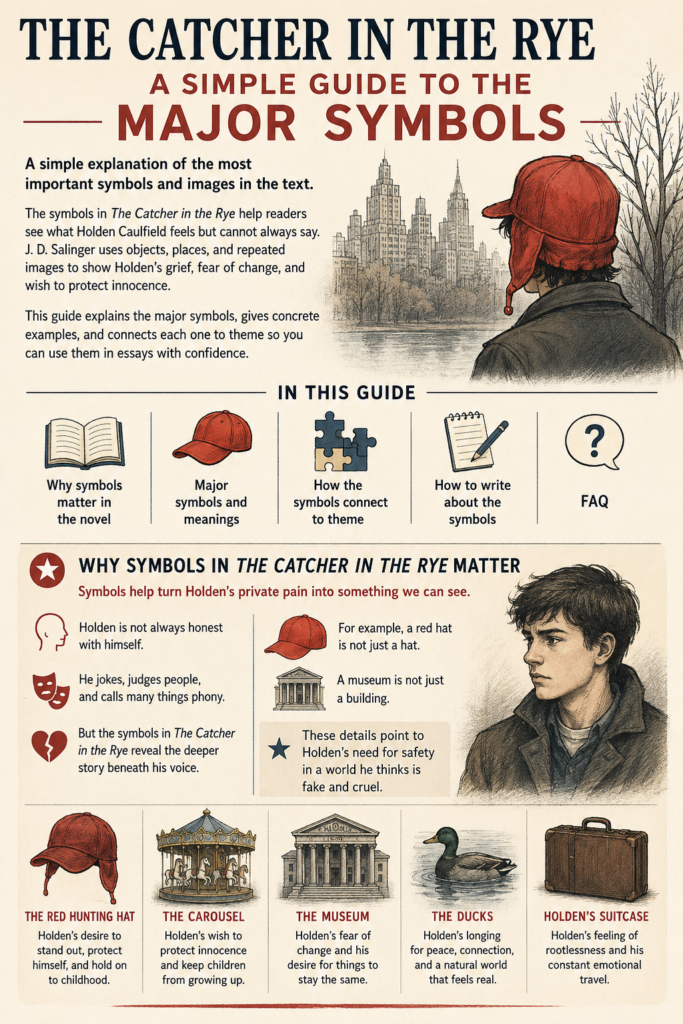
The symbols in The Catcher in the Rye help readers see what Holden Caulfield feels but cannot always say. J. D. Salinger uses objects, places, and repeated images to show Holden’s grief, fear of change, and wish to protect innocence.

This guide explains the major symbols, gives concrete examples, and connects each one to theme so you can use them in essays with confidence.

In this Guide

Catcher in the Rye symbols

Why Symbols in The Catcher in the Rye Matter

Symbols help turn Holden’s private pain into something we can see.

Holden is not always honest with himself. He jokes, judges people, and calls many things phony. But the symbols in The Catcher in the Rye reveal the deeper story beneath his voice.

For example, a red hat is not just a hat. A museum is not just a building. These details point to Holden’s need for safety in a world he thinks is fake and cruel.

If you need a quick refresher on symbolism as a literary tool, see this guide on how to find symbolism in a story.

Major Symbols in The Catcher in the Rye

The novel’s most important symbols show Holden’s inner conflict.

The most famous symbols in The Catcher in the Rye include the red hunting hat, the ducks in Central Park, the Museum of Natural History, and the catcher in the rye image. Each one connects to a major theme in the book.

The Red Hunting Hat

Holden’s red hunting hat is one of the clearest symbols in the novel. He buys it in New York after losing the fencing team’s equipment, which already links the hat to failure and shame.

The hat makes Holden feel unique. It helps him stand apart from other people, even while he feels lonely.

The color red may also connect to Allie, Holden’s dead brother, who had red hair. Because of that, the hat becomes a quiet sign of memory and grief.

Theme connection: The hat shows Holden’s need for identity and protection. He wants to be different, but he also wants comfort.

The Ducks in Central Park

Holden keeps asking where the ducks go when the lagoon freezes. This question seems odd at first, but it matters a lot.

The ducks stand for survival during change. Holden wants to know if living things can disappear and still be safe somewhere else.

This connects to his fear after Allie’s death. If the world can change so fast, Holden wants proof that someone or something will take care of the vulnerable.

Theme connection: The ducks show Holden’s fear of loss and his search for reassurance.

The Museum of Natural History

Holden loves the museum because nothing changes there. The displays stay the same each time he visits.

That matters because Holden hates the way real life keeps moving. People grow up. Families change. Innocence fades.

The museum offers a frozen world. Holden knows this is not real life, but he still wants it.

Theme connection: The museum represents Holden’s desire to stop time and avoid adulthood.

The Catcher in the Rye Image

The title symbol comes from Holden’s dream of standing in a field of rye, catching children before they fall off a cliff. He imagines himself as a protector of innocence.

But Holden misunderstands the Robert Burns poem he hears. That mistake matters because his dream is beautiful, but it is also impossible.

Children will grow up. Holden cannot stop every fall. He must learn that care does not mean control.

Theme connection: The catcher image shows Holden’s wish to protect innocence and his fear of growing up.

How Symbols in The Catcher in the Rye Connect to Theme

Every strong symbol in the novel points back to Holden’s fear of change.

Many symbols in The Catcher in the Rye connect to the same core struggle. Holden wants the world to stay simple and safe, but the world will not do that for him.

The red hat offers protection. The museum offers stillness. The ducks offer hope that change does not mean death. The catcher image offers a fantasy where no child has to fall.

This is similar to symbols in other well-known novels. In The Great Gatsby, the green light points to a dream that Gatsby can never fully reach. In Lord of the Flies, the conch shows order that slowly breaks apart.

Salinger’s symbols work the same way. They take a large theme and place it inside a clear image.

Writing About Symbols in The Catcher in the Rye

A good symbolism paragraph explains both the object and the idea behind it.

When students write about symbols in The Catcher in the Rye, they often stop too early. It is not enough to say the red hunting hat means individuality. You also need to explain why Holden needs that feeling.

Try this pattern: name the symbol, describe where it appears, explain what it suggests, and connect it to theme.

For example, you might write that the Museum of Natural History symbolizes Holden’s wish for a world without change. Then you can link that idea to his grief over Allie and his fear of adulthood.

For more help, read our full guide on spotting symbolism in fiction. You can also review RapidReads Press literature study resources for essay practice and reading support.

Quick Reference: Symbol Meanings

Use this section as a fast study tool before a quiz or essay.

  • Red hunting hat: protection, identity, grief, and the need to feel special.
  • Ducks: change, survival, and Holden’s fear of being left behind.
  • Museum: stillness, safety, and the wish to stop time.
  • Catcher image: innocence, protection, and Holden’s impossible dream.
  • Allie’s baseball glove: memory, love, and the pain of loss.

Allie’s Baseball Glove

Allie’s glove is a personal symbol of love and grief.

The glove belonged to Holden’s younger brother, Allie, who died of leukemia. Allie wrote poems on it so he could read them during baseball games.

This detail shows that Allie was thoughtful and creative. To Holden, the glove is not just a memory. It is proof that someone pure and good was taken from the world.

Theme connection: The glove shows how grief shapes Holden’s view of innocence.

Author and Context

Knowing a little background can help, but the text should still lead your ideas.

J. D. Salinger published The Catcher in the Rye in 1951. The novel became famous for its teen narrator, direct voice, and honest look at alienation.

You can read more about the novel’s history at Britannica’s overview of The Catcher in the Rye. For author background, see Britannica’s biography of J. D. Salinger.

Helpful Books to Read Next

These books can deepen your understanding of Salinger and coming-of-age fiction.

  • The Catcher in the Rye by J. D. Salinger
  • Nine Stories by J. D. Salinger

FAQ About Symbols in The Catcher in the Rye

What are the main symbols in The Catcher in the Rye?

The main symbols in The Catcher in the Rye are the red hunting hat, the ducks, the museum, the catcher image, and Allie’s baseball glove.

What does Holden’s red hunting hat symbolize?

It symbolizes protection, identity, and Holden’s grief. It helps him feel different, but it also shows how badly he wants comfort.

What do the ducks symbolize?

The ducks symbolize change and survival. Holden wants to know where they go because he fears loss and uncertainty.

Why is the Museum of Natural History important?

The museum matters because it never changes. Holden likes it because it gives him the stillness he cannot find in real life.

What does the catcher in the rye symbolize?

It symbolizes Holden’s dream of saving children from pain and adulthood. The image shows his kindness, but also his struggle to accept change.

Key Takeaway

The symbols in The Catcher in the Rye matter because they reveal Holden’s hidden fears. They show a teenager who wants to protect innocence, hold back change, and find safety after loss.

Count Dracula as a Symbol of Fear and Corruption in Dracula

Count Dracula as a symbol of fear and corruption

Count Dracula is one of the most famous villains in literature, yet his role goes far beyond a simple monster. In Dracula, he represents something deeper and more unsettling. He stands as a symbol of fear, moral decay, and the spread of corruption within society.

When readers look closely at his actions, his influence, and his presence in the novel, they begin to see that Dracula is not just a character. He is a force that threatens both the body and the soul.

This article contains affiliate links.

In this Guide 📚

  • What Dracula represents in the novel
  • How fear shapes his character
  • How corruption spreads through his victims
  • Why Dracula’s power goes beyond physical danger
  • What his defeat reveals about the novel’s message
Count Dracula as a symbol of fear and corruption
Image by Carla Paton

Count Dracula as a Symbol of Fear and Corruption

Dracula is more than a villain. He represents a deeper threat that spreads through fear and moral decay.

At the beginning of the novel, Count Dracula appears calm, polite, and even refined. Jonathan Harker meets a nobleman who speaks with care and shows control. Yet something feels wrong from the start. His strange habits and silent movements create unease long before his true nature is revealed.

This early tension matters because it shows that fear does not always appear in obvious ways. Dracula does not rely on loud violence at first. He creates fear through mystery and uncertainty. Readers feel this same unease as Harker slowly realizes he is trapped in the castle.

📌 Key Insight: Fear in Dracula begins with the unknown, not with open danger.

Count Dracula as a symbol of fear and corruption
Image by Carla Paton

How Dracula Represents Fear

Dracula’s power comes from his ability to appear, disappear, and remain unseen.

As the novel moves forward, Dracula’s supernatural abilities deepen this fear. He can change form, travel through darkness, and strike without warning. These traits make him difficult to fight because he cannot be understood in normal terms.

The characters struggle not just against a physical enemy, but against something they cannot fully explain. This sense of helplessness increases the tension of the story. Fear grows stronger when people feel they have no control.

Dracula’s presence also creates fear in the minds of his victims. He invades their thoughts and weakens their sense of self. This makes his threat feel personal and psychological, not just physical.

💬 “Fear grows strongest when it cannot be clearly seen or understood.”

Count Dracula as a symbol of fear and corruption
Image by Carla Paton

How Dracula Symbolizes Corruption

Dracula does not only harm his victims—he changes them.

One of the clearest examples of corruption appears in Lucy Westenra. She begins as kind and gentle, yet after Dracula’s attacks, she transforms into something dangerous. Her change shows how Dracula spreads his influence like a disease.

This transformation is not just about becoming a vampire. It represents the loss of innocence and moral stability. Lucy becomes a version of herself that reflects Dracula’s influence rather than her own character.

Mina Harker’s experience deepens this idea. Even though she is strong and intelligent, Dracula forms a connection with her that threatens her mind and identity. This shows that no one is fully safe from corruption, even those with strong character.

📌 Key Insight: Corruption in Dracula spreads quietly, often before anyone realizes it is happening.

Dracula’s Power Over Others

Dracula seeks control, not just survival.

Dracula does not act randomly. He plans carefully and moves with purpose. His journey from Transylvania to England shows his desire to expand his reach. He wants to spread his influence into new places and create more victims.

This ambition makes him more than a monster. He becomes a symbol of invading corruption that moves through society. His goal is not only to exist, but to multiply his power through others.

The group led by Van Helsing must work together to stop him. Their unity stands in contrast to Dracula’s isolation and control. This contrast highlights the difference between community and corruption.

💬 “Where Dracula divides and dominates, the others unite and resist.”

What Dracula’s Defeat Reveals

The ending of the novel shows that fear and corruption can be overcome.

Dracula’s defeat does not come from one person alone. It requires trust, courage, and shared purpose. Each character plays a role in stopping him, which suggests that evil cannot be defeated in isolation.

The novel presents a clear message. Fear may spread quickly, and corruption may take root, but they are not unstoppable. When people stand together with conviction, they can resist even the darkest forces.

This ending gives the story its lasting meaning. Dracula may be powerful, but he is not invincible.

Count Dracula as a symbol of fear and corruption
Image by Carla Paton

Why This Symbol Still Matters Today

Dracula remains powerful because his meaning goes beyond the story.

Readers still connect with Dracula because he represents fears that feel real. The fear of losing control, the fear of hidden danger, and the fear of moral decline all appear in modern life as well.

His character reminds us that the greatest threats are often the ones that spread quietly. They do not always appear as clear enemies. Instead, they work beneath the surface, shaping thoughts and actions over time.

Key Takeaway ✨

Count Dracula represents both fear and corruption, showing how evil can spread through secrecy, influence, and control—but also how it can be defeated through courage and unity.

FAQ – Count Dracula as a symbol of fear and corruption

Why is Dracula considered a symbol instead of just a villain?

Because his actions represent larger ideas like fear, moral decay, and loss of control rather than simple physical danger.

How does Dracula create fear in the novel?

He uses mystery, unpredictability, and psychological control, which makes him difficult to understand and resist.

What does Lucy’s transformation represent?

It shows how corruption spreads and how innocence can be lost through Dracula’s influence.

Why is Mina important to the symbolism?

She shows that even strong individuals can be affected, which makes Dracula’s threat more serious.

What is the main message of Dracula?

That fear and corruption are powerful, but they can be overcome through unity and moral strength.

Want to Go Deeper? 📖

If you want a full breakdown of Dracula with themes, characters, and analysis, check out the full guide here:
👉 https://rapidreadspress.com/product/dracula-study-guide/

Dracula Study guide

If you want to learn how to write essays like this step by step:
👉 https://rapidreadspress.com/product/literary-analysis-essay-examples/ (includes this analysis)

Lastly, for background on the novel’s publication and literary importance, Britannica provides a helpful overview of Dracula.

error

Enjoy this article? Please spread the word :)

Follow by Email
BLUESKY
fb-share-icon
Reddit
LinkedIn
Share
RSS