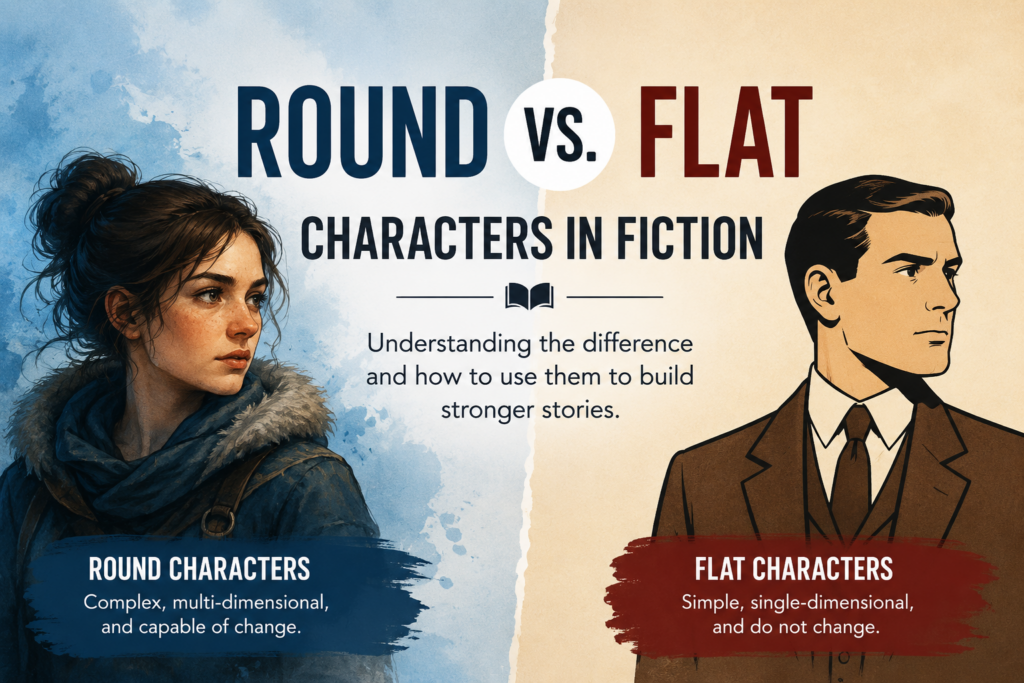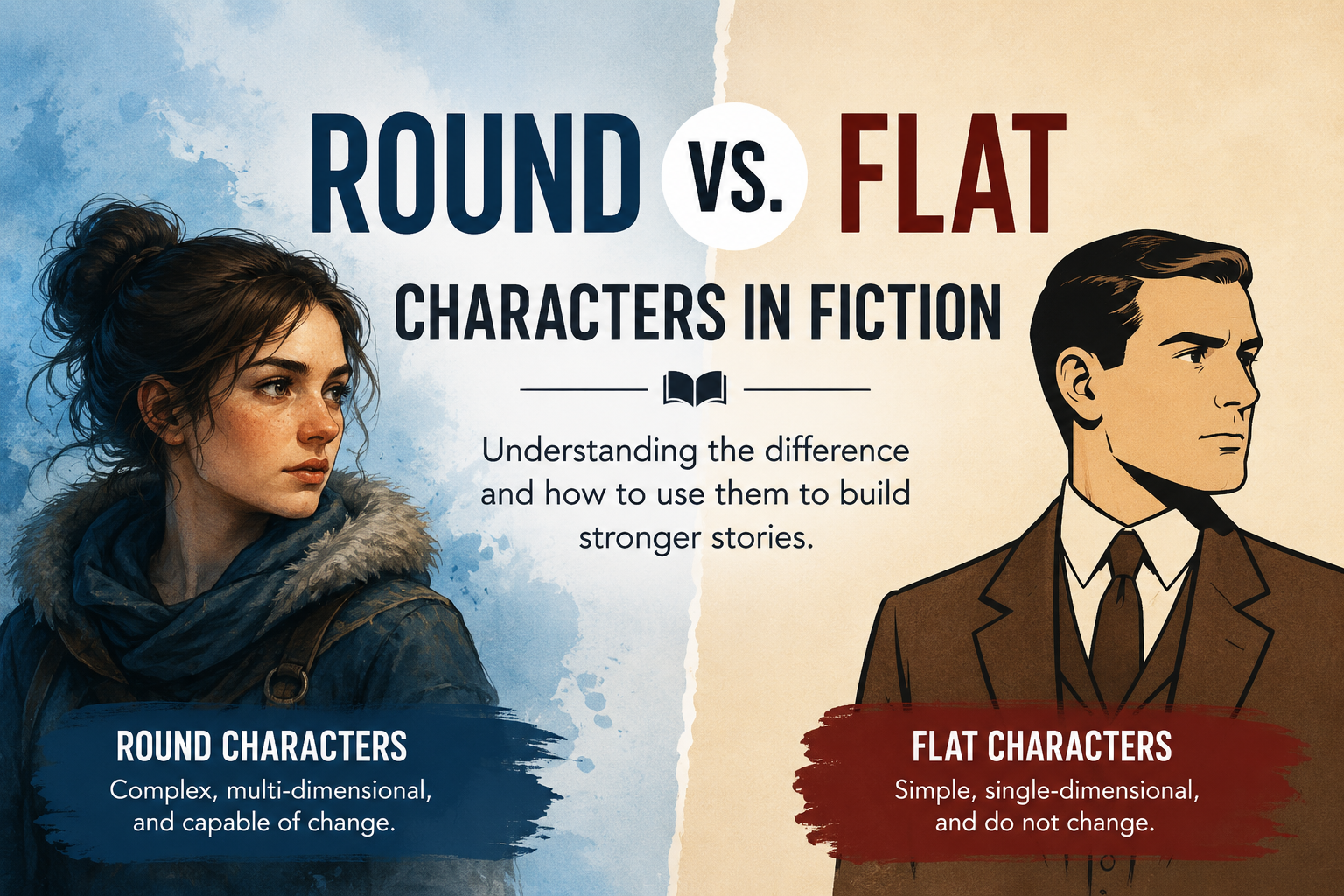
Round vs Flat Characters in Fiction: A Clear Guide

Round vs Flat Characters

Round vs Flat Characters in Fiction is a key idea in literary analysis. Once you know the difference, you can explain why some characters feel real and complex while others serve a clear, simple role.

This guide breaks the idea down in plain language, with examples from famous books and tips you can use in essays.

In this Guide

  • What round characters are
  • What flat characters are
  • Round vs Flat Characters in Fiction examples
  • How to use the idea in literary analysis
  • Common mistakes to avoid
  • Book suggestions
  • FAQ
Round vs Flat Characters

What Are Round Characters?

Round characters feel complex, layered, and close to real people.

A round character has more than one side. They may have mixed feelings, personal flaws, hidden fears, or changing beliefs.

Round characters often surprise us, but their actions still make sense. They are not random. Their choices grow out of who they are.

Elizabeth Bennet in Pride and Prejudice is a strong example. She is smart and funny, but she also misjudges Darcy. Her pride affects how she sees others.

By the end of the novel, Elizabeth learns more about herself. That growth makes her feel human.

You can read more background on the novel through Britannica’s overview of Pride and Prejudice.

What Are Flat Characters?

Flat characters are simple, clear, and easy to understand.

A flat character usually has one main trait. They do not have deep inner conflict, and they may not change much.

This does not mean they are badly written. Flat characters can be useful. They can add humor, reveal a theme, or push the plot forward.

Mr. Collins in Pride and Prejudice is a good example. He is proud, awkward, and eager to please Lady Catherine. He does not have much depth, but he plays an important role.

Flat characters often help readers see the main characters more clearly.

Round vs Flat Characters in Fiction: The Main Difference

Round vs Flat Characters in Fiction comes down to depth and complexity.

A round character has an inner life. A flat character has a simpler role. One is built with layers, while the other is shaped around a clear purpose.

Think of Scrooge in A Christmas Carol. At first, he may seem flat because he is greedy and cold. But as the story moves forward, we see his fear, regret, and pain.

Scrooge becomes round because the story reveals why he acts the way he does. His change also matters to the whole meaning of the book.

In contrast, some minor characters in the same story stay simple. They may show kindness, poverty, or social pressure without much personal depth.

That contrast helps the story work.

Round vs Flat Characters in Fiction Examples from Literature

Examples make Round vs Flat Characters in Fiction much easier to understand.

In To Kill a Mockingbird, Scout Finch is round. She grows as she learns about justice, fear, and unfair treatment. Her view of the world changes.

Atticus Finch also has depth. He is calm and moral, but he faces pressure from his town. His choices show courage without making him perfect.

In Animal Farm, many characters are flatter on purpose. Napoleon often stands for power and control. Boxer stands for loyalty and hard work.

George Orwell uses flat characters to support satire. The point is not deep psychology. The point is political meaning.

In Harry Potter, Harry is round because he has fear, anger, love, and doubt. Some side characters are flatter, but they still help build the world.

Why Writers Use Both Round and Flat Characters

Good fiction does not need every character to be round.

If every character had a deep backstory, many stories would feel crowded. Flat characters help keep the focus on the main conflict.

A round character often carries the emotional weight of the story. A flat character may create pressure, offer comic relief, or show a social idea.

In Romeo and Juliet, Romeo and Juliet feel more complex than many side characters. Their feelings change quickly, and their choices shape the tragedy.

Characters like the Nurse have strong traits that are easy to spot. She is lively and practical, which makes her memorable even if she is less complex.

Round vs Flat Characters in Fiction and Character Change

Round vs Flat Characters in Fiction is related to change, but it is not the same thing.

A round character does not always change. Some round characters stay the same, but readers still see many sides of them.

A flat character can change in a small way, but still remain simple. The key question is depth, not just change.

For example, a villain may become nicer at the end of a story. If we do not learn much about their mind, fears, or motives, they may still feel flat.

On the other hand, Hamlet is round even before he makes final choices. He thinks deeply, doubts himself, and struggles with grief.

How to Analyze Round vs Flat Characters in Fiction

Round vs Flat Characters in Fiction can help you write stronger literary analysis.

Start by asking what the character wants. Then look at what makes the character hard to define. A round character often has tension inside them.

Ask these questions:

  • Does the character have more than one clear trait?
  • Does the character face inner conflict?
  • Does the character change how readers understand the theme?
  • Does the character mostly serve one purpose?

If you want a fuller method, see our guide on how to analyze characters in literature.

When you write about the distinction, do not just label the character. Explain why the label matters.

For example, do not only say, “Scrooge is round.” Say, “Scrooge is round because Dickens reveals his fear of loneliness, which helps the story argue that people can change.”

Common Mistakes with Round vs Flat Characters in Fiction

Many students think “round” means good and “flat” means bad. That is not true.

A flat character can be well written if the role is clear. A round character can still fail if the author does not make the person believable.

Another mistake is to confuse flat characters with minor characters. A minor character can be round if the story gives them depth.

Readers also mix up flat characters with static characters. A static character does not change much. A flat character lacks deep complexity.

The terms overlap sometimes, but they do not mean the same thing.

How to Use Round vs Flat Characters in Fiction in an Essay

Round vs Flat Characters in Fiction gives you a useful tool for claims about theme.

Your essay should connect character type to meaning. Ask why the author made a character simple or complex.

Here is a strong sentence frame:

“The author presents [character] as a [round/flat] character in order to show [theme or idea].”

Example:

“Orwell presents Boxer as a mostly flat character in order to show how loyalty can be used by those in power.”

This kind of sentence does more than name a term. It links the character to the author’s message.

Books to Look Up on Amazon

These books are useful if you want more practice with Round vs Flat Characters in Fiction.

  • Pride and Prejudice by Jane Austen
  • A Christmas Carol by Charles Dickens
  • Animal Farm by George Orwell

Each book gives clear chances to compare deep characters with simpler ones.

Quick Reference: Round vs Flat Characters in Fiction

Round vs Flat Characters in Fiction is easiest to remember this way:

  • Round characters have depth, conflict, and layers.
  • Flat characters have a simple role or main trait.
  • Both types can be useful in a strong story.

For more general background on fiction as a literary form, see Britannica’s article on the novel.

FAQ: Round vs Flat Characters in Fiction

What is the difference between round and flat characters?

A round character has depth and complexity. A flat character is simpler and usually has one main role or trait.

Can a flat character be important?

Yes. Flat characters can support the plot, reveal a theme, or make the main character stand out.

Is a round character always a main character?

No. Main characters are often round, but some minor characters can also have depth.

Is a flat character the same as a static character?

No. A static character does not change much. A flat character lacks depth. A character can be both, but the terms are different.

How do I write about round and flat characters in an essay?

Explain how the character type helps show a theme. Do not stop at the label.

Key Takeaway

Round vs Flat Characters in Fiction is not about good versus bad writing. It is about how much depth a character has and how that character helps the story make meaning.

How to Analyze Characters in Literature

how to analyze characters in literature

A simple step-by-step guide to understanding fictional characters and writing stronger literary analysis essays

Understanding characters is one of the most important skills in literary analysis. Stories are built around people: their decisions, their desires, and their flaws. When readers learn how to analyze characters in literature, they begin to see how authors shape meaning through personality, conflict, and change.

A strong character analysis does more than describe someone in a story. It explains why the character acts the way they do and what their actions reveal about the themes of the work. Literary scholars often look closely at a character’s motivations, relationships, and development across the narrative.

In this guide, you’ll learn simple methods you can use to analyze characters in any novel, play, or poem—from Jane Austen’s sharp social portraits to the dark psychological figures in Gothic fiction.

This article contains affiliate links.

In This Guide 📚

What character analysis means
How authors create characters through characterization
How to analyze a character’s motivations
How to examine relationships between characters
How to track character development
Example character analysis from classic literature
Questions you can ask while reading

how to analyze characters in literature

What Character Analysis Means

Understanding the foundations of how to analyze characters in literature.

Character analysis is the process of examining a character’s traits, actions, motivations, and development in order to understand their role in a story. Instead of simply describing whether a character is “good” or “bad,” literary analysis asks deeper questions about why the character behaves the way they do and how those actions shape the narrative.

In literature, characters are created through a technique called characterization. This is the way authors reveal personality, beliefs, and emotional struggles through description, dialogue, and behavior.

💡 Key insight:
Character analysis connects personality to meaning.

When you understand a character’s motives and choices, you begin to see how the author explores larger themes like love, ambition, morality, or social pressure.

If you’re new to literary analysis, start with this guide first:
https://rapidreadspress.com/how-to-read-literature-like-a-scholar/

Direct and Indirect Characterization

One of the first steps in learning how to analyze characters in literature.

Authors reveal characters in two main ways:

Direct characterization happens when the narrator explicitly describes a character’s personality.

Example:
“The gentleman was proud and reserved.”

Indirect characterization happens when readers learn about a character through actions, speech, and relationships.

These clues appear through:
dialogue
behavior
appearance
thoughts
how others respond to them

Most authors rely heavily on indirect characterization because it allows readers to interpret the character themselves.

👉 Related guide:
https://rapidreadspress.com/literary-devices-list/

Analyze a Character’s Motivations

Understanding why characters act the way they do.

A key part of learning how to analyze characters in literature is asking what drives a character’s decisions.

Characters rarely act randomly. Their behavior usually comes from:

fear
desire
love
ambition
social pressure

📖 Example from Pride and Prejudice

Elizabeth Bennet often appears witty and confident, but her judgments are shaped by pride and prejudice of her own. When she rejects Mr. Darcy’s first proposal, her decision reveals both moral strength and personal bias.

Her character becomes clearer when we examine why she believes Darcy is arrogant and how those assumptions change.

Through Elizabeth’s development, Jane Austen explores themes of self-knowledge and social misunderstanding.

Examine Relationships Between Characters

Characters are often defined by their relationships.

A character rarely exists alone in literature. Instead, authors reveal personality through interactions with others.

When analyzing characters, consider:

How does the character treat friends or family?
How do other characters react to them?
Do their relationships change over time?

📖 Example from Frankenstein

Victor Frankenstein’s relationship with his creation reveals his deepest flaws. Instead of taking responsibility for the being he brings to life, Victor abandons the creature immediately.

This decision drives the tragedy of the novel.

The creature’s loneliness and anger reflect Victor’s moral failure, turning the story into a meditation on responsibility and creation.

👉 If you want to see how themes connect to characters, read:
https://rapidreadspress.com/how-to-identify-theme-in-literature/

Track Character Development

Look at how the character changes during the story.

Many of the most memorable literary characters undergo significant transformation.

A useful technique when learning how to analyze characters in literature is to compare:

the character at the beginning of the story
the character at the end

This change is called a character arc.

📖 Example from Emma

In Jane Austen’s Emma, the main character begins as confident and somewhat self-satisfied. She enjoys arranging relationships between others and believes she understands people perfectly.

Yet over time, Emma realizes her mistakes. She learns humility and emotional awareness.

Her transformation reveals one of the novel’s central themes: true maturity requires self-reflection.

Look for Symbolic or Thematic Meaning

Sometimes a character represents a larger idea.

In some works of literature, characters symbolize broader themes or philosophical ideas.

For example:

Dracula often represents fear of the unknown and cultural anxiety in Gothic fiction.

He is not only a villain but also a symbol of the anxieties surrounding modernity and foreign influence in Victorian England.

By examining how Dracula interacts with other characters and environments, readers see how Bram Stoker uses the character to explore fear, power, and desire.

Ask Questions While Reading

Simple questions that help you analyze characters more deeply.

When reading literature, pause occasionally and ask yourself:

What does this character want most?
What are their greatest fears?
How do they treat others?
What mistakes do they make?
How do they change?

These questions help transform passive reading into active literary analysis.

If you want to take better notes while reading fiction, this guide may help:
https://rapidreadspress.com/how-to-take-notes-while-reading-a-novel/

Example Character Analysis (Short Model)

Elizabeth Bennet in Pride and Prejudice represents the struggle between perception and truth. At first she believes she understands Darcy perfectly, interpreting his reserved manner as arrogance. Her judgments seem reasonable based on the limited information she receives. Yet as new facts emerge, Elizabeth gradually recognizes her own bias. This realization reshapes her understanding of Darcy and of herself. Through Elizabeth’s journey, Jane Austen illustrates how personal pride and social expectations can distort perception. The character’s development ultimately reveals that self-knowledge is necessary for genuine love and moral growth.

how to analyze characters in literature
Image by Carla Paton

How to Read Literature Like a Professor — Thomas C. Foster
Reading Like a Writer — Francine Prose
How to Read a Book — Mortimer Adler

Improve Your Literary Analysis Essays

If you want help structuring your essays, outlining arguments, and organizing quotes, you might find this useful:

👉 https://rapidreadspress.com/product/the-literary-analysis-essay-toolkit/

This toolkit includes templates and worksheets designed to make literary analysis essays much easier to write.

Key Takeaway 💡

Learning how to analyze characters in literature means moving beyond simple description. Instead of asking whether a character is “good” or “bad,” strong literary analysis explores motivations, relationships, and change. By examining these elements closely, readers uncover the deeper themes that authors embed within their stories.

FAQ – How to analyze characters in literature

What is character analysis in literature?

Character analysis is the process of examining a character’s traits, motivations, actions, and development in order to understand their role and meaning within a literary work.

Why is character analysis important?

Characters often carry the central themes of a story. Understanding them helps readers interpret the deeper message of the work.

What are the main things to analyze in a character?

Most literary analyses focus on personality traits, motivations, relationships, and how the character changes throughout the story.

What is characterization?

Characterization is the method authors use to reveal a character’s personality through description, actions, dialogue, and interactions with others.

For a deeper look at literary techniques, see:
https://rapidreadspress.com/literary-devices-list/

error

Enjoy this article? Please spread the word :)

Follow by Email
BLUESKY
fb-share-icon
Reddit
LinkedIn
Share
RSS