


Flash Memoir Prompt: Argument You Witnessed Between Adults in Your Family as a Child

flash memoir prompt argument

A focused writing invitation for remembering an argument you witnessed between adults in your family as a child, through one clear scene, one sharp detail, and the emotions you were too young to name.

The room may have changed before anyone raised a voice. Maybe a fork stopped halfway to someone’s mouth. Maybe a door shut too hard. Maybe you were sitting on the carpet, pretending to watch TV while every part of you listened.

This flash memoir prompt about an argument witnessed between adults in your family asks you to return to a moment when childhood met adult conflict. You do not have to solve the argument. You do not have to judge anyone. You only have to remember what it felt like to be there.

flash memoir prompt argument

The Prompt

Write about an argument you witnessed between adults in your family as a child.

This prompt can unlock a powerful flash memoir because children often notice what adults think they are hiding. You may remember the sound of a voice, the smell of dinner burning, or the way someone looked away instead of answering.

A memory like this does not need a full family history behind it. In fact, it may work better if you stay with one moment. A flash memoir prompt about an argument witnessed between adults in your family becomes strongest when it focuses on what the child saw, heard, and misunderstood.

Why This Memory Matters

Family arguments can mark a child’s understanding of safety, loyalty, silence, and power. Even if the argument was ordinary to the adults, it may have felt huge to you. Children often measure danger by tone, posture, and what happens after the shouting stops.

This kind of memoir does not have to accuse anyone. It can simply tell the truth of a child’s view. Maybe you thought the argument was your fault. Maybe you learned which parent to avoid. Maybe you discovered that adults could be scared too.

Writing this scene may also show how your younger self made meaning from limited information. That gap between what happened and what you understood is often where the deepest memoir writing lives.

If you are practicing close observation, the same skill you might use to analyze characters in literature can help here. Notice action before explanation. What did each person do with their hands? Who moved closer? Who left the room? Those details can reveal more than a summary ever could.

How to Approach This Prompt

Begin with a physical detail. Choose one object, sound, or movement from the scene. It might be a cracked plate, a buzzing kitchen light, a suitcase by the door, or your own knees pulled under your chin.

Then narrow the memory to one scene. Do not try to explain every argument your family ever had. Stay inside a short stretch of time. Let the reader stand where you stood.

You might write the first draft in present tense, as if the child is living it now. For example: “I am under the dining room table. My father’s shoes are beside my mother’s bare feet.” This can help you stay close to the original feeling.

Write what you noticed before you explain what it meant. A child may not understand divorce, money trouble, jealousy, grief, or stress. The child may only know that someone’s voice has changed. Let that limited understanding guide the piece.

If you feel stuck, make a quick note map before drafting. Write down where you were, who was there, what you heard, and what you did with your body. This is close to the way readers annotate literature, except you are marking your own memory instead of a page.

Try not to rush toward the lesson. The emotional truth may be small. Maybe the scene explains why you dislike closed doors. Maybe it shows the first time you realized adults could say things they could not take back.

The Flash Memoirist
previous arrow
next arrow

A Quick Example

I was nine, sitting on the stairs with my spelling book open on my lap. The word was “separate,” and I kept writing the second “a” too close to the “r.” In the kitchen, my aunt said my mother’s name like it was something breakable. Then my grandfather slapped his palm on the table, and all the glasses jumped. No one knew I was there, or maybe they did and decided I was too small to count. I remember the smell of onions in the pan and my mother’s voice getting very quiet. That scared me more than the shouting. When my uncle came into the hall, he smiled at me like nothing had happened. I looked back at my paper and wrote “separate” five more times.

Try It Yourself

Give yourself ten minutes with this prompt. Start with the room, not the reason. Let the memory stay partial if that is how it comes back to you.

You may choose to write from the child’s point of view first, then add one or two lines from your adult self at the end. That contrast can create depth without forcing a neat conclusion.

A flash memoir prompt about an argument witnessed between adults in your family can bring up strong feelings, so write at a pace that feels safe. You can change names, skip details, or stop after one paragraph. The goal is not to expose everything. The goal is to catch one honest moment on the page.

Want More Flash Memoir Prompts?

If this prompt helped you find a memory worth exploring, keep going with short, focused pieces. Explore all 365 prompts in The Memory Trigger: 365 Flash Memoir Writing Prompts.
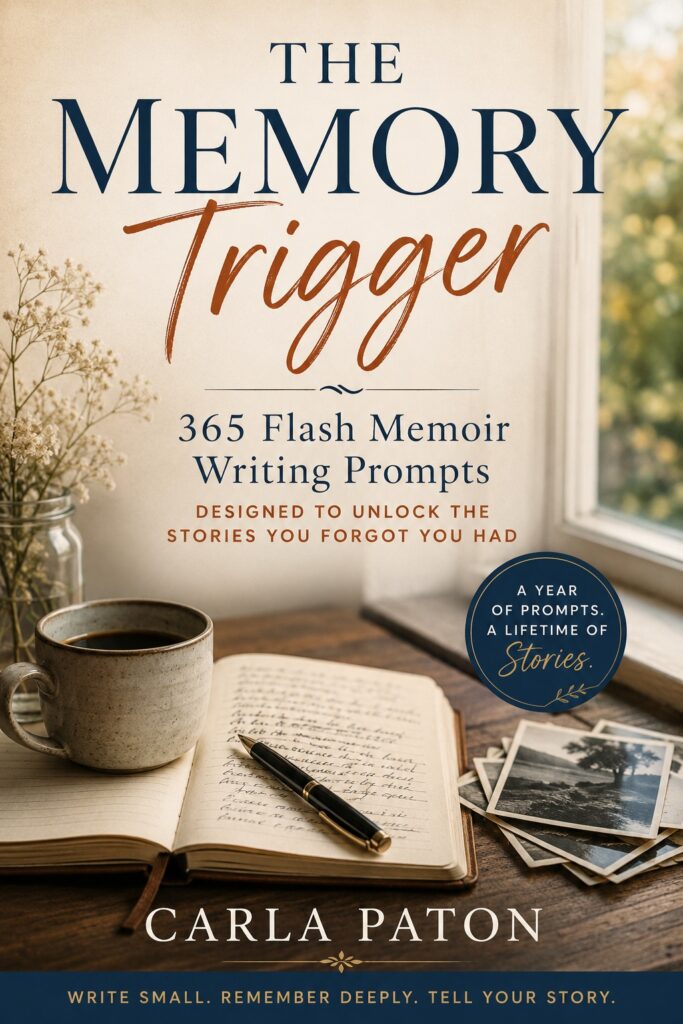

The Memory Trigger

Flash Memoir Prompt: Last Time You Felt Like a Child

Rapid Reads Press

A brief, tender writing invitation about the last time you felt small, safe, silly, scared, or suddenly young again.

Maybe it happened in a grocery store when you reached for the cereal you loved as a kid. Maybe it came over you during a storm, when thunder made you want to call someone older and wiser. Or maybe you felt it while laughing too hard over something completely ridiculous, the kind of laugh that makes you forget your age for a minute.

This flash memoir prompt last time felt like child asks you to notice one of those moments when adulthood loosened its grip. It does not have to be dramatic. In fact, the smaller the scene, the more honest it may become.

childhood prompt

The Prompt

Write about the last time you felt like a child.

This prompt can open a memory because feeling like a child is rarely about age alone. It may be about needing comfort. It may be about wonder. It may be about shame, joy, fear, play, or wanting someone else to take charge for a little while.

When you write from this prompt, try not to rush toward the meaning. Stay with the moment first. What room were you in? What did your hands do? What sound made you feel younger than you are?

Why This Memory Matters

Childhood does not fully disappear. It follows us in habits, cravings, jokes, fears, and soft spots we may not understand until they rise up again.

The last time you felt like a child might reveal a need you rarely admit. Maybe you wanted your mother’s soup when you were sick. Maybe you felt helpless while filling out a confusing form. Maybe you stood in front of a teacher, boss, doctor, or parent and felt your voice shrink.

It could also be a happy memory. You might have felt childlike while sledding, dancing in the kitchen, opening a gift, or walking into a library and smelling old paper. If you want to sharpen the way you notice small details, you might enjoy this guide on how to annotate literature, since close reading can also train you to read your own memories with care.

This kind of memory matters because it shows the meeting point between who you were and who you are now. A flash memoir prompt last time felt like child can help you write about that meeting point without turning it into a long life story.

How to Approach This Prompt

Begin with one physical detail. Choose something your body remembers before your mind explains it.

Maybe your knees were tucked under your chin. Maybe your face burned. Maybe you held a mug with both hands. Maybe you wanted to hide behind someone taller.

Once you find that detail, narrow the memory to one scene. Do not try to cover your whole childhood or explain your entire family history. Stay inside ten minutes, or even two.

Write what you noticed before you write what it meant. For example, instead of starting with “I felt vulnerable,” begin with the coat sleeve you pulled over your hand. Instead of “I was happy,” begin with the way you ran across wet grass in your socks.

You can also pay attention to tone. A memory like this might feel funny on the surface but sad underneath, or tender at first and then sharp. If you want help naming that difference, this simple explanation of tone vs. mood in literature may help you think about the feeling your scene creates.

One clear way to begin is with this sentence: “The last time I felt like a child, I was…” Then name the place. Keep going from there.

A Quick Example

The last time I felt like a child, I was sitting on the paper-covered table at urgent care with my shoes dangling above the floor. I am forty-one, but the crinkle of that paper made me feel eight. The nurse asked when the pain started, and I looked at my husband before I answered, as if he might know better than I did. My throat hurt more from trying not to cry than from being sick. When the doctor said it was only an infection, I nodded like a good student. In the car, I asked if we could stop for a milkshake. I meant it as a joke, but when he said yes, I felt such relief that I turned my face toward the window.

Try It Yourself

Set a timer for ten minutes and write from the prompt without planning the ending. Focus on the moment when you first noticed the feeling. Did it arrive as comfort, panic, delight, or embarrassment?

If the memory feels too big, choose one object from the scene. Write about the blanket, the cereal box, the hospital bracelet, the sidewalk chalk, or the phone in your hand. Let that object carry you into the truth of the moment.

You do not need to explain everything. A strong flash memoir often leaves a little space around the memory. Trust the scene. Trust the detail. Let the childlike feeling show itself through what you saw, said, wanted, or could not say.

This flash memoir prompt last time felt like child works best when you are honest about the exact kind of smallness you felt. Small can mean safe. Small can mean powerless. Small can mean full of wonder. Let your memory decide.

Want More Flash Memoir Prompts?

If this prompt helped you find a scene worth saving, keep going with short, focused memories. Explore all 365 prompts in The Memory Trigger: 365 Flash Memoir Writing Prompts.

The Memory Trigger
error

Enjoy this article? Please spread the word :)

Follow by Email
BLUESKY
fb-share-icon
Reddit
LinkedIn
Share
RSS