Ekphrasis Poetry Prompt: The Empty Chair in the Field

ekphrasis poetry prompt the empty chair

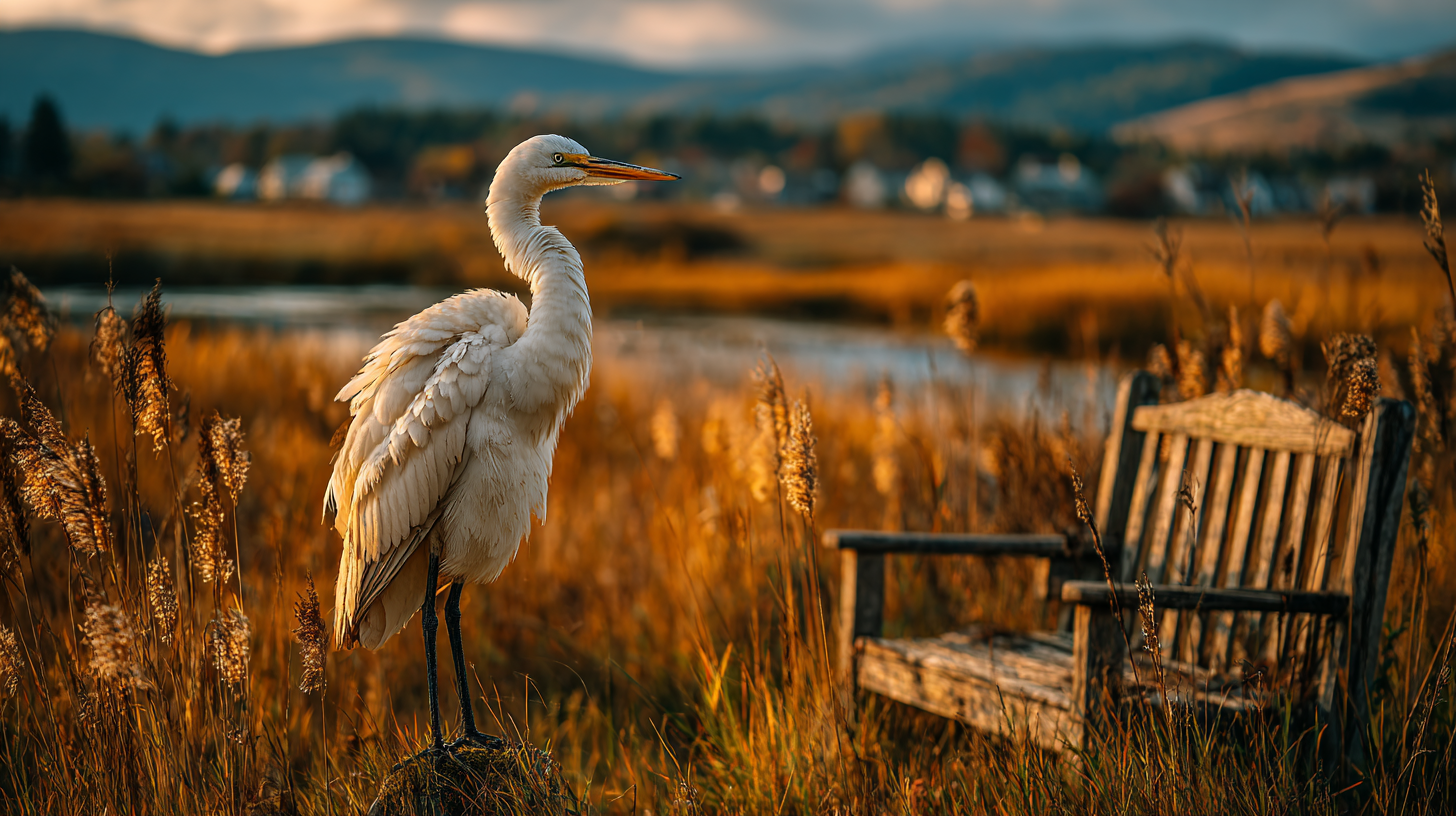
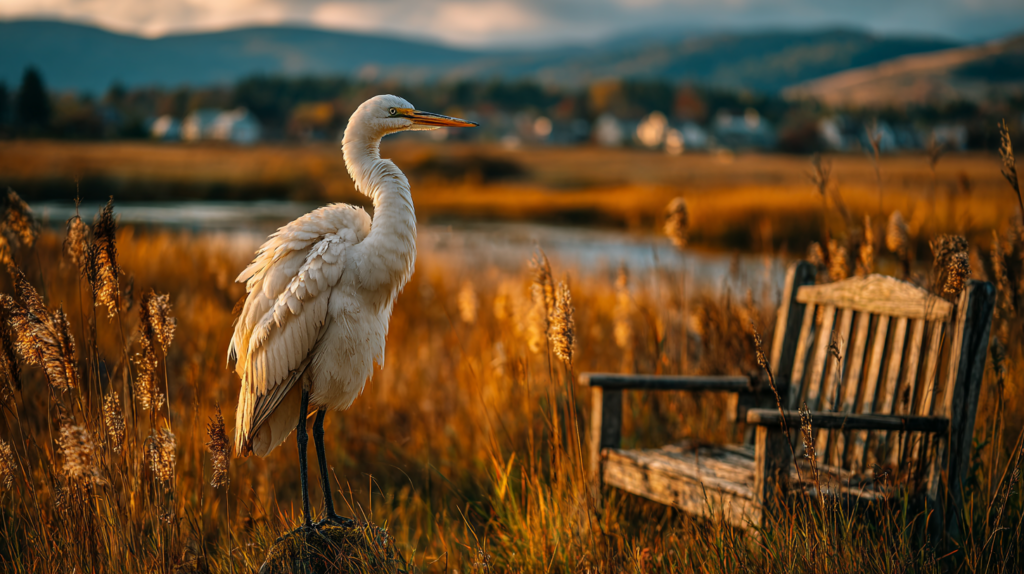
If you are looking for an ekphrasis poetry prompt that invites reflection, memory, and imagination, today’s image offers a rich place to begin. Picture a solitary white heron standing near an abandoned wooden chair in a field of golden grass. Mountains rise in the distance while the late afternoon sun casts long shadows across the landscape.

Ekphrastic poetry begins with close observation. The image becomes a doorway into emotion, story, symbolism, and personal insight. Whether you write free verse, formal poetry, or prose poetry, this scene provides many possible directions.

ekphrasis poetry prompt the empty chair

How to Approach This Ekphrasis Poetry Prompt

Before you begin writing, spend a few minutes studying the image. Notice the relationship between the bird and the chair. Ask yourself why the chair sits alone in the field. Consider who may have left it there and why the heron seems drawn to it.

An effective ekphrasis poetry prompt encourages curiosity rather than certainty. You do not need to explain the image. Instead, explore its possibilities.

You may find it helpful to review our guide on analyzing poetic imagery and meaning: https://rapidreadspress.com/how-to-analyze-poetry-step-by-step/

Writing Ideas for This Ekphrasis Poetry Prompt

The chair could symbolize absence, waiting, memory, or loss. The heron might represent patience, wisdom, solitude, or a messenger from another world.

Consider writing from one of these perspectives:

  • The heron observing the chair.
  • The former owner of the chair.
  • A traveler discovering the scene years later.
  • The chair itself telling its story.
  • An observer who believes the bird is guarding a secret.

You might focus on sensory details. What does the grass sound like in the wind? How does the sunlight change the mood of the landscape? What memories does the scene awaken?

Literary Devices for This Ekphrasis Poetry Prompt

Strong ekphrastic poems often rely on imagery, symbolism, metaphor, and personification. The contrast between the living bird and the abandoned chair creates natural tension that can drive a poem forward.

If you would like a refresher on poetic techniques, see our guide to literary devices: https://rapidreadspress.com/literary-devices-in-poetry/

For additional information about ekphrastic poetry as a literary form, the Poetry Foundation provides an excellent overview of poetry and poetic traditions: https://www.poetryfoundation.org/

The Prompt

Study the image carefully.

Write a poem about the relationship between the heron and the empty chair. Do not explain where they came from. Instead, allow the reader to discover their connection through images, actions, and details.

Challenge yourself to leave one important question unanswered by the end of the poem.

Final Thoughts

This ekphrasis poetry prompt works well because it balances mystery with simplicity. The image contains only a few elements, yet each one invites interpretation. Sometimes the most powerful poems emerge from scenes that appear quiet at first glance.

Take your time with the image. Let the landscape speak before you begin writing. Then follow the thread of curiosity wherever it leads.

Ekphrastic Poetry Prompt: The Conservatory Above the Sea of Flowers

ekphrastic poetry prompt flowers

Have you ever looked at an image and felt as though it was trying to tell you a story?

This ekphrastic poetry prompt invites you to step into a dreamlike scene filled with mystery, beauty, and unanswered questions. Ekphrastic writing encourages poets to respond to visual art with words. Instead of describing every detail, the goal is to explore the emotions, memories, and ideas the image awakens.

If you are new to the practice, our guide on how to analyze poetry step by step can help you notice the details that often inspire stronger poems: https://rapidreadspress.com/how-to-analyze-poetry-step-by-step/

ekphrastic poetry prompt flowers

Why This Ekphrastic Poetry Prompt Works

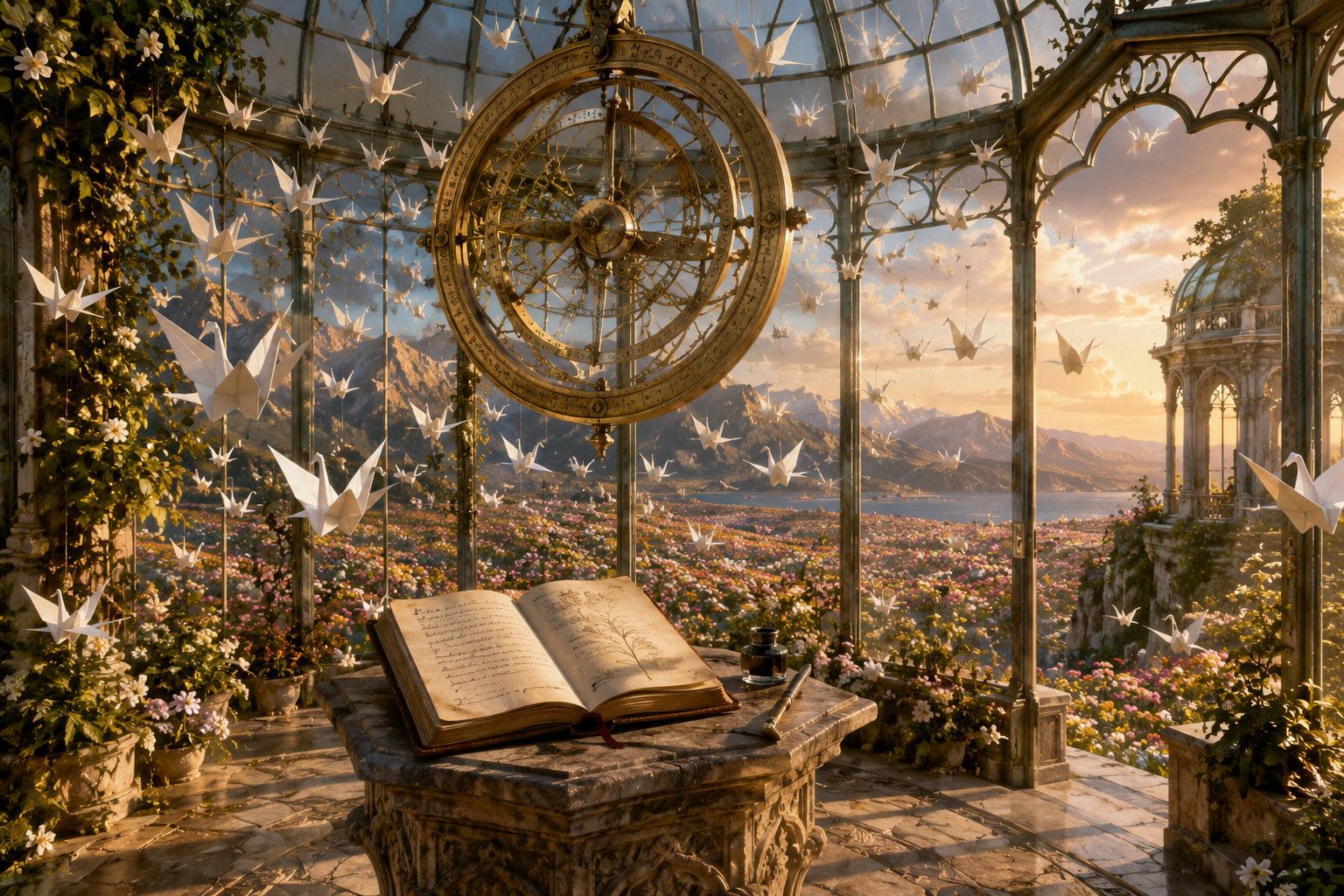
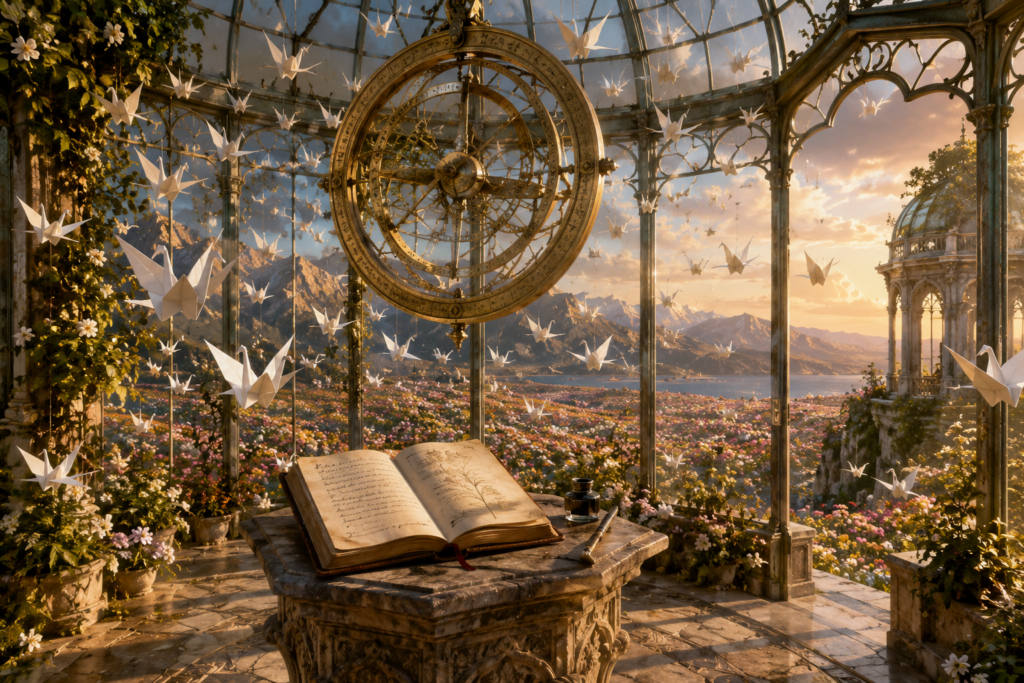
The image presents a strange but inviting setting. A glass conservatory sits above an endless field of flowers. White paper cranes move through the air. A giant astrolabe hangs suspended as if time itself has paused. An open journal waits on a stone pedestal.

Each object raises questions.

Who built this place? Why are the cranes gathering? What has been written in the journal? Is the astrolabe measuring stars, memories, or something else entirely?

Strong poetry often begins with curiosity. This ekphrastic poetry prompt gives you several symbolic elements that can spark a narrative, a meditation, or a lyrical exploration.

The Image

Imagine standing inside the conservatory. Sunlight filters through the glass walls. The scent of flowers drifts upward from the valley below. Hundreds of paper cranes circle overhead while the brass astrolabe slowly turns.

An open journal rests before you.

One page contains a message.

You cannot see all of the words.

You can only read the first sentence.

Write the poem that follows.

Writing From This Ekphrastic Poetry Prompt

You do not need to explain every detail in the scene. Focus on the element that captures your attention most strongly.

Perhaps the journal belongs to a traveler who never returned. Maybe the paper cranes carry messages from lost loved ones. The astrolabe could represent fate, memory, hope, or a search for direction.

As you write, pay attention to imagery and symbolism. If you would like a refresher on poetic techniques, our guide to literary devices in poetry offers useful examples: https://rapidreadspress.com/literary-devices-in-poetry/

Questions to Explore

What is written in the journal?

Why do the paper cranes circle the conservatory?

Who visits this place?

What does the astrolabe measure?

What emotion fills the space?

Or, what happens when the final crane lands?

You may answer one question or many. The strongest poems often grow from a single image that refuses to leave your mind.

A Creative Challenge

Write your poem in the voice of the conservatory itself.

What has it witnessed over the years?

What secrets does it keep?

How does it feel when visitors arrive searching for answers?

Changing the speaker can transform a familiar description into something surprising and memorable.

Learn More About Ekphrastic Poetry

Many poets throughout history have responded to visual art. The Academy of American Poets provides an excellent introduction to the tradition and examples of famous ekphrastic works: https://poets.org/glossary/ekphrasis

Whether your poem becomes a story, a reflection, or a meditation on wonder, this ekphrastic poetry prompt offers a rich visual world filled with symbols waiting for interpretation.

Take a few minutes to study the scene. Then begin with the first sentence you can imagine appearing in that journal and see where it leads.

Ekphrasis Poetry Prompt: The Motel Sign Still Buzzing

Ekphrasis Poetry Prompt Motel

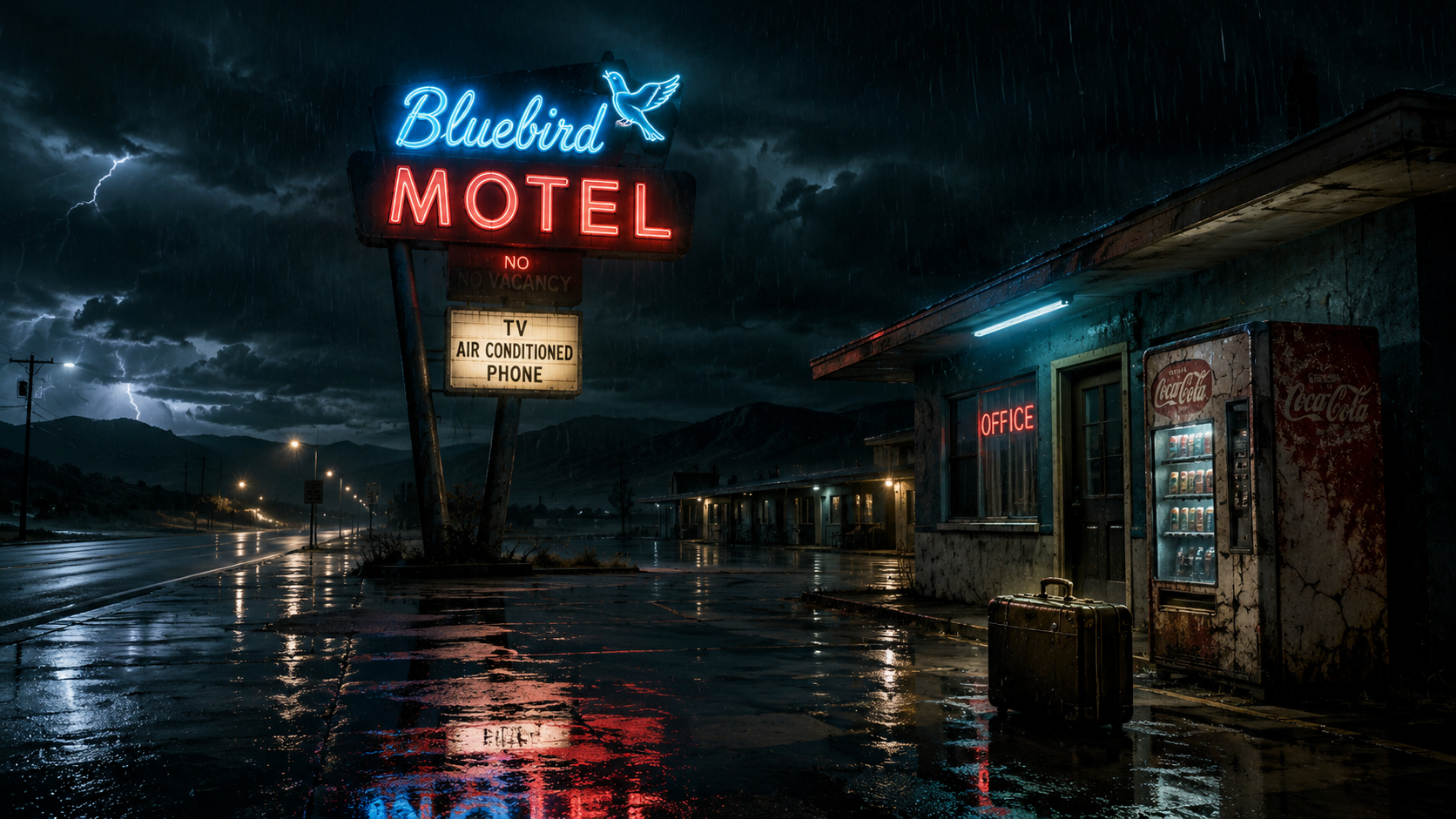
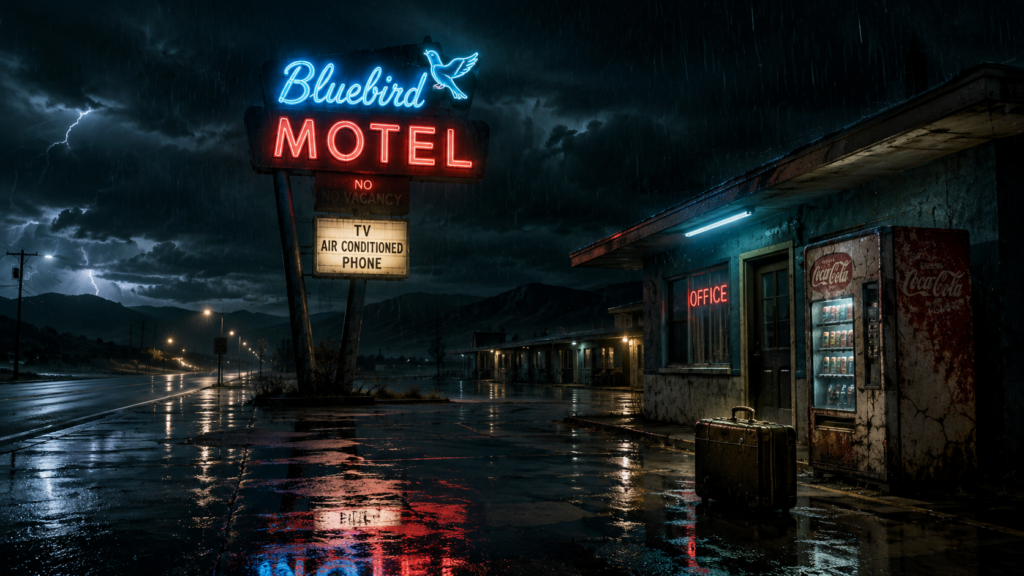
Some images feel like they already contain a story before a single word arrives. A flickering motel sign in the rain. A suitcase left beside a vending machine. An empty highway with no headlights coming. The image does not explain itself, which is exactly why it can unlock strong poetry.

This ekphrasis poetry prompt asks you to enter the emotional atmosphere of an image instead of simply describing it. You are not writing a summary of what you see. You are writing toward the feeling underneath it.

Ekphrasis Poetry Prompt: The Motel Sign Still Buzzing

Write a poem inspired by an empty roadside motel at midnight during a storm.

Somewhere nearby, a neon sign still buzzes. A suitcase sits abandoned beside a vending machine. Rain keeps falling. No one arrives.

Your speaker may be someone who stayed there years ago, someone passing through, someone waiting for a person who never came back, or even someone who cannot leave. The poem can stay realistic or drift toward the surreal.

Try to focus on sensory detail instead of explanation. Let the image create emotional pressure on its own.

Questions to Explore

Why was the suitcase left behind?

What does the storm seem to remember?

What feeling hangs in the silence?

Or, what happened just before this moment?

What does the speaker refuse to admit?

You do not need to answer every question directly. Sometimes the strongest poems leave part of the image unresolved.

Why This Ekphrasis Poetry Prompt Works

Ekphrasis poetry becomes powerful when the image feels emotionally alive. An empty motel can suggest escape, regret, loneliness, freedom, disappearance, memory, or reinvention without stating any of those ideas outright.

Images like this give poets something concrete to return to while writing. The glowing sign, the rainwater, the cracked pavement, and the abandoned suitcase can act as emotional anchors throughout the poem.

If the poem feels stuck, narrow your focus. Write only about the sound of the rain hitting the sign. Write only about the suitcase handle. Or, write only about the color of the reflected neon on the wet asphalt.

Small details often carry the emotional weight.

Try Different Angles

You could write this poem as:

A narrative free verse poem

A fragmented prose poem

A noir-inspired monologue

A memory poem about leaving home

A surreal dream poem

A poem spoken by the motel itself

The image does not need to stay literal. Let it shift as the poem develops.

A Final Thought

Good ekphrasis poetry does not just describe an image. It enters it. The goal is not accuracy. The goal is emotional resonance.

Somewhere in the storm, the motel sign is still buzzing. Let the poem begin there.

Ekphrasis Poetry Prompt: Writing a Poem from a Haunted Painting

Ekphrasis Poetry Prompt

Sometimes an image feels less like a picture and more like a memory waiting for language. That is part of what makes ekphrasis poetry so powerful. A poet looks closely at a visual image and begins to speak back to it. The poem becomes a conversation between silence and observation.

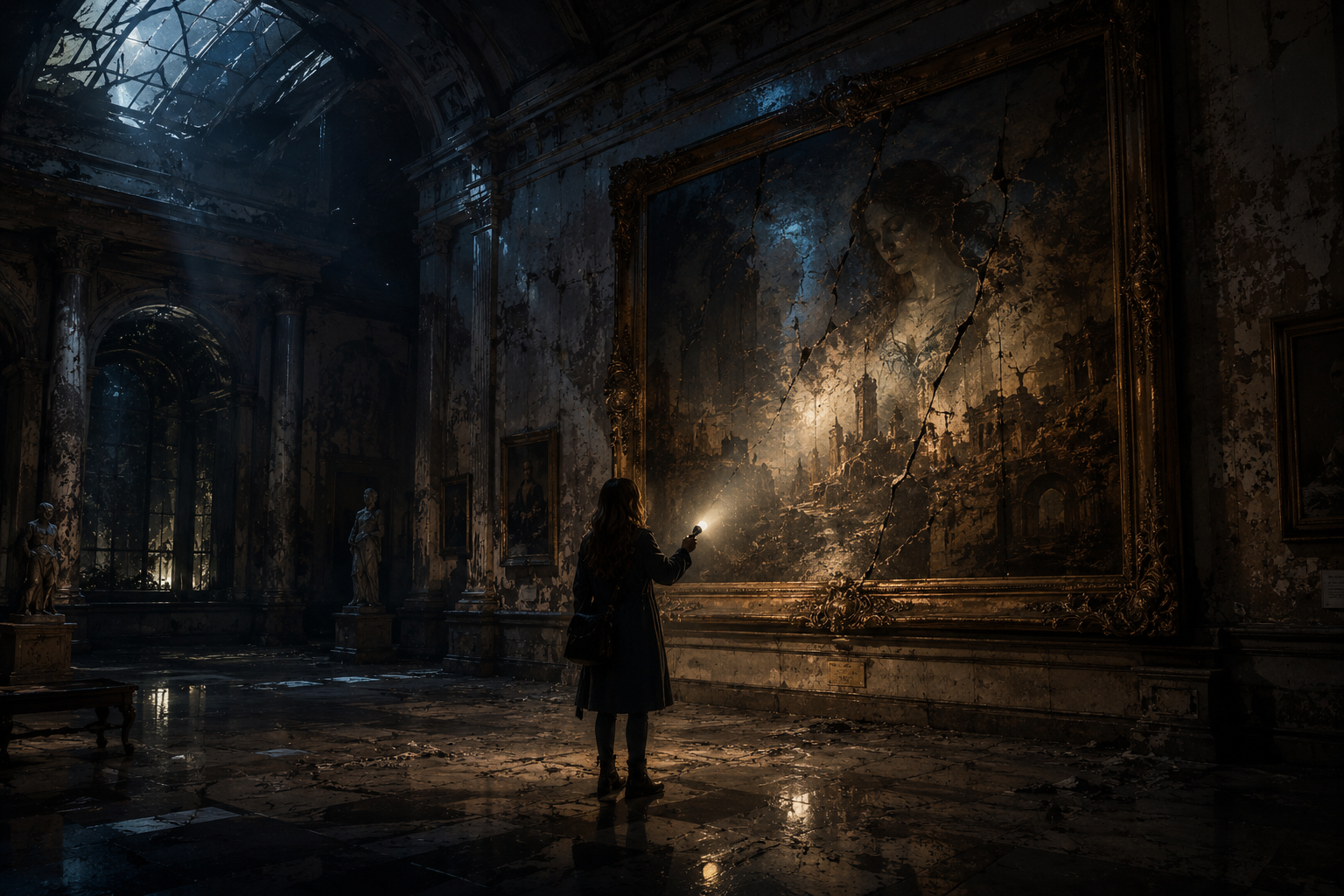
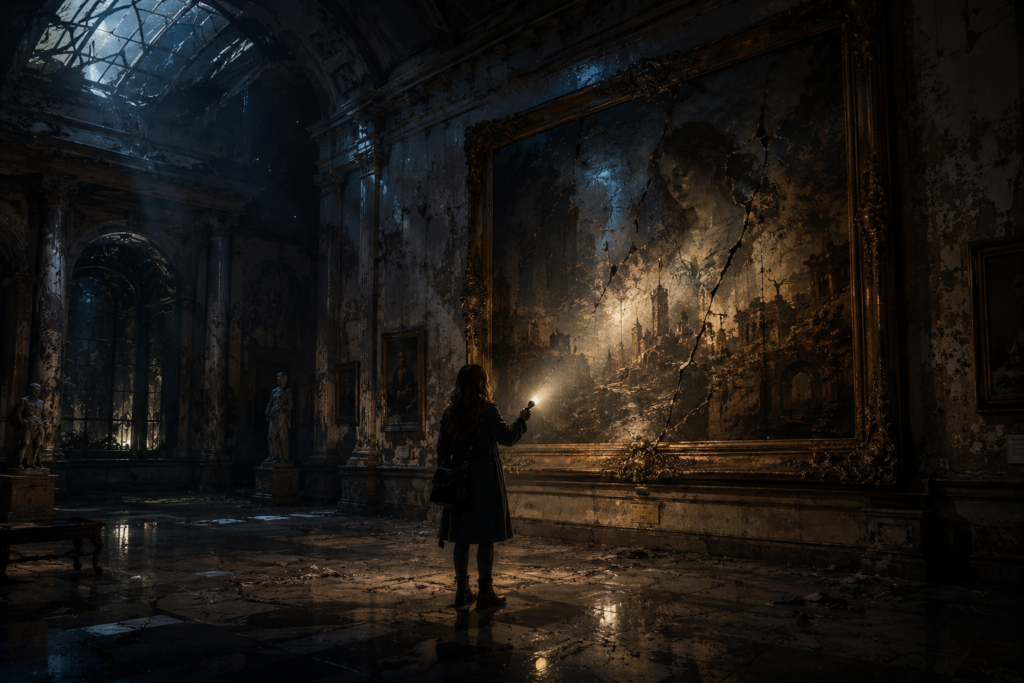
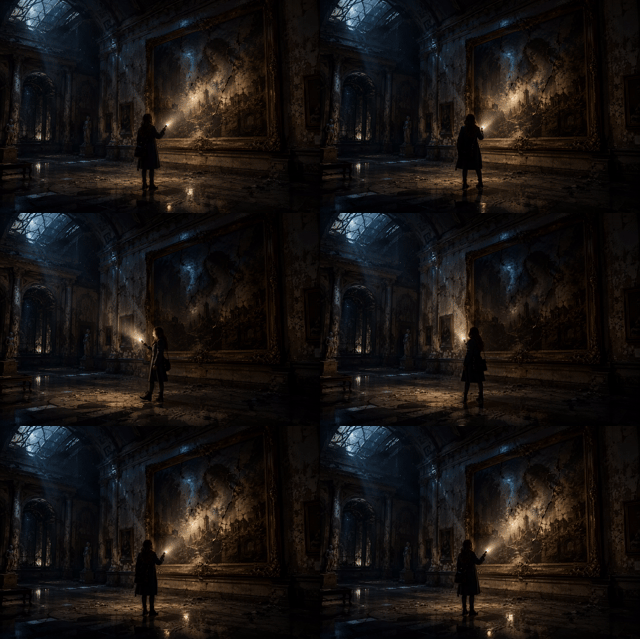
This ekphrasis poetry prompt invites you to write from the emotional atmosphere of an abandoned museum and a damaged painting that seems to hold a secret inside it.

Ekphrasis Poetry Prompt

In this Prompt

What ekphrasis poetry is

How to approach the image emotionally

A creative poetry prompt

Questions to deepen the poem

Tips for strong sensory writing

What Is Ekphrasis Poetry?

Ekphrasis poetry is poetry inspired by visual art.

The art can be real or imagined. A poet might respond to a painting, sculpture, photograph, film still, or even a mural seen on the side of a building. Sometimes the poem describes the image directly. Sometimes it explores the emotions, memories, or hidden story behind it.

John Keats’ “Ode on a Grecian Urn” remains one of the most famous examples. Modern poets often use ekphrasis to explore grief, identity, memory, fear, beauty, or history through visual details.

The goal is not to explain the image perfectly. The goal is to let the image open a door inside the poem.

The Prompt

Look at the image of the abandoned museum and the cracked painting.

Write a poem about the moment someone realizes the painting is trying to tell them something.

The message may be literal or emotional. The painting might remind the speaker of a forgotten memory, a lost relationship, a fear they buried, or a version of themselves they no longer recognize.

You can write in first person, second person, or third person.

You might focus on:

The silence of the museum

The flashlight beam moving across the damaged canvas

The feeling that the painting is watching back

What the cracks in the artwork reveal

Why the speaker came to the museum in the first place

Whether the painting offers comfort or warning

You do not need to explain everything. Mystery often gives ekphrasis poetry its emotional force.

Questions That Can Deepen the Poem

What emotion appears first when the speaker sees the painting?

What detail feels impossible to ignore?

Ask, what does the broken artwork reveal about the speaker’s own life?

What sounds fill the empty museum?

Does the speaker leave changed?

Tips for Writing the Poem

Focus on sensory detail before explanation. Let readers hear the echo of footsteps, smell dust in the air, or notice the cold light on marble floors.

Avoid summarizing the image too quickly. Stay inside one moment long enough for tension to build.

Strong ekphrasis poetry often moves from observation into reflection. The image becomes a mirror for something human.

You can also let the painting remain partly unknowable. Some of the strongest poems leave space for uncertainty.

Final Thought

A powerful image can hold emotion before language ever arrives. Ekphrasis poetry gives writers a way to step inside that silence and answer it.

The abandoned museum in this prompt is not just a setting. It is a place where memory, art, loneliness, and imagination begin speaking at the same time.