

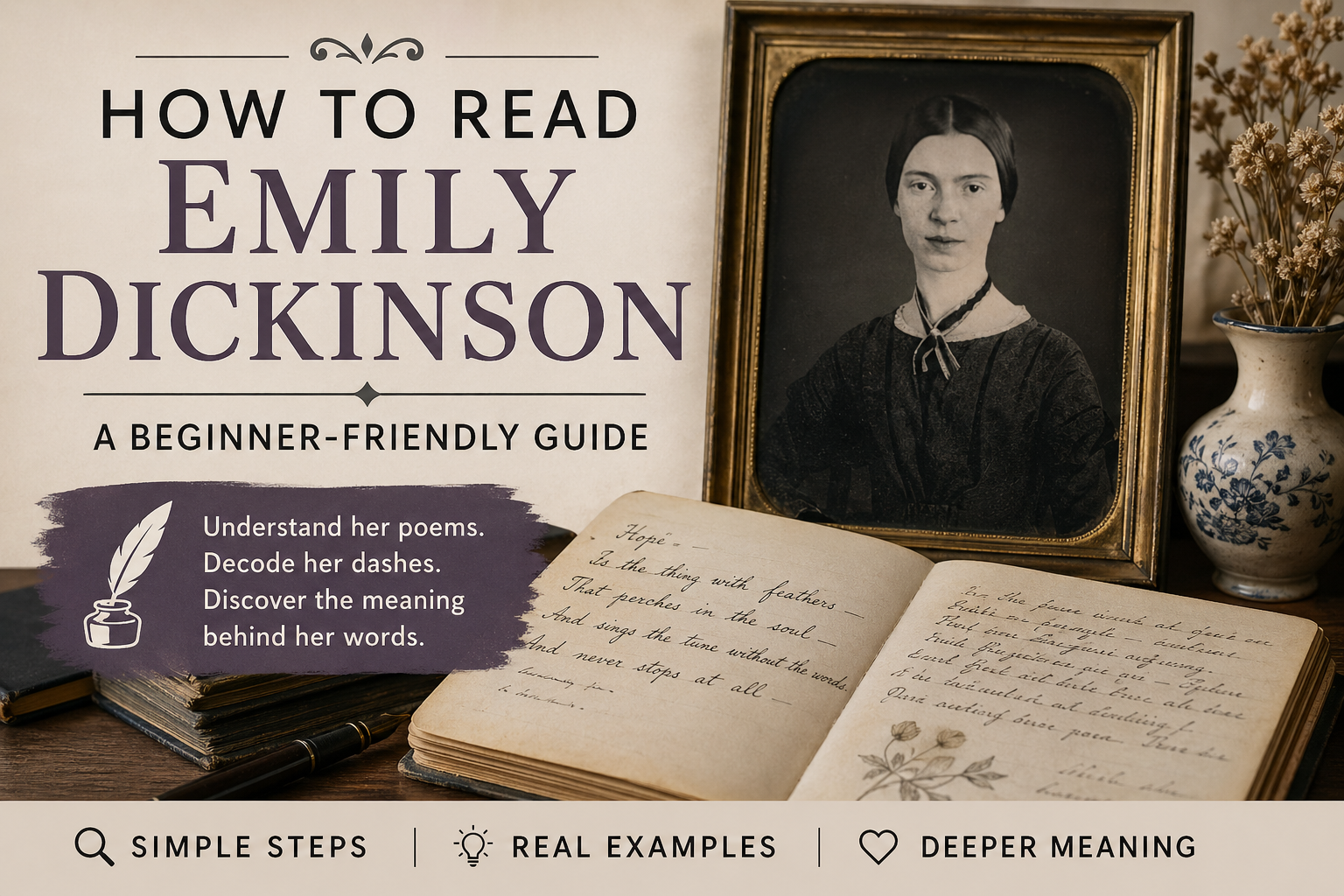
A clear, step-by-step way to understand Dickinson’s poems—even if they feel confusing at first
Emily Dickinson can feel strange the first time you read her. The short lines, the dashes, the capital letters, and the deep ideas can make even simple poems feel hard to follow. But once you learn how to read Emily Dickinson, her poems become surprisingly clear, powerful, and even personal. This guide will walk you through a simple method you can use right away, with real examples from her most famous poems.
This article contains affilate links.
In this Guide
- Why Emily Dickinson feels difficult
- Step 1: Read the poem slowly
- Step 2: Look at punctuation and dashes
- Step 3: Identify the speaker and situation
- Step 4: Find the central idea or theme
- Step 5: Notice imagery and symbolism
- Step 6: Paraphrase the poem
- Step 7: Connect it to a bigger meaning
- FAQs about reading Emily Dickinson
- Key takeaway
Why Learning How to Read Emily Dickinson Matters
Emily Dickinson’s poetry looks simple, but it carries deep meaning in very small spaces.
When you learn how to read Emily Dickinson, you are learning how to slow down and notice details. Her poems often deal with death, hope, faith, and the inner life, which makes them widely taught in schools. For example, in “Hope is the thing with feathers,” she turns hope into a bird. That sounds simple, but the meaning grows as you read more closely.
If you already know how to use strategies like those in our guides on how to read literature like a scholar or how to analyze poetry step by step, this approach will feel familiar. Dickinson just asks you to apply those skills more carefully.
Step 1: Read the Poem Slowly
Take your time. Dickinson rewards slow reading.
When learning how to read Emily Dickinson, the biggest mistake is rushing. Her poems are short, so each word matters.
For example, in “Because I could not stop for Death,” the opening line seems calm:
“Because I could not stop for Death – He kindly stopped for me –”
At first, it sounds polite. But if you slow down, you notice something strange: Death is personified as a polite driver. That small detail changes the tone completely.
👉 If you need help building this habit, our guide on what is close reading in literature pairs perfectly with Dickinson.
Step 2: Pay Attention to Dashes and Punctuation
Dickinson’s punctuation is not random. It shapes meaning.
One of the keys to how to read Emily Dickinson is understanding her famous dashes. They often signal pauses, shifts in thought, or emotional tension.
In “I’m Nobody! Who are you?” she writes:
“How dreary – to be – Somebody!”
Those dashes slow the line down and emphasize the feeling. Without them, the line loses its rhythm and emotional weight.
Think of the dashes as moments to pause and reflect.
You can explore punctuation and tone more deeply in our post on tone vs mood in literature.












Step 3: Identify the Speaker and Situation
Who is speaking, and what is happening?
Dickinson rarely tells a full story. Instead, she drops you into a moment.
In “Because I could not stop for Death,” the speaker is already riding in a carriage with Death. We are not told how it started.
That means you have to ask:
- Who is the speaker?
- What is happening right now?
- What is the emotional tone?
This step connects closely to our guide on how to analyze characters in literature, even though the “character” may be more symbolic than realistic.
Step 4: Find the Central Idea or Theme
Every Dickinson poem circles around a central idea.
When practicing how to read Emily Dickinson, try to summarize the poem in one sentence.
For example, “Hope is the thing with feathers” explores the idea that hope is constant and resilient, even in hardship.
Look at these lines:
“And never stops – at all –”
That simple phrase captures the theme. Hope continues no matter what.
If you want to go deeper, our post on how to identify theme in literature gives a helpful framework for this step.
Step 5: Notice Imagery and Symbolism
Dickinson uses simple images to express complex ideas.
A big part of how to read Emily Dickinson is recognizing symbolism.
In “Hope is the thing with feathers,” the bird represents hope. But it is not just any bird. It:
- Sings
- Endures storms
- Never asks for anything
That tells us hope is persistent, self-sustaining, and quiet.
👉 See more in our guide on how to find symbolism in a story.
Step 6: Paraphrase the Poem in Your Own Words
Put the poem into plain language.
This is one of the most effective ways to master how to read Emily Dickinson.
Take a line like:
“The Carriage held but just Ourselves – And Immortality.”
A paraphrase might be:
The speaker is riding with Death, and the journey represents entering eternity.
When you rewrite the poem this way, it becomes clearer.
Our guide on how to write a literary analysis essay can help you turn this understanding into strong writing.
Step 7: Connect the Poem to a Bigger Meaning
Ask why the poem matters.
Dickinson’s poems often move from a small moment to a big idea about life.
In “Because I could not stop for Death,” the carriage ride becomes a reflection on the nature of mortality and eternity.
This is where interpretation happens. You move from understanding the poem to explaining its significance.
👉 For practice, you can pair this step with our literary devices list to identify how the meaning is created.
Recommended Books to Deepen Your Understanding
If you want to go further with how to read Emily Dickinson, these are excellent resources:
- The Complete Poems of Emily Dickinson edited by Thomas H. Johnson
- Emily Dickinson: Selected Poems and Commentaries by Helen Vendler
- Lives Like Loaded Guns: Emily Dickinson and Her Family’s Feuds by Lyndall Gordon
More resources:
- Poetry Foundation: https://www.poetryfoundation.org/poets/emily-dickinson
- Academy of American Poets (https://poets.org/)
FAQs About How to Read Emily Dickinson
Why is Emily Dickinson so hard to understand?
Her poems are compressed and leave out context. She expects readers to fill in the gaps.
What do the dashes mean?
They create pauses, emphasize ideas, and show shifts in thought or emotion.
Do Dickinson’s poems have one correct meaning?
No. Many poems allow for multiple interpretations, as long as they are supported by the text.
Where should beginners start?
Start with well-known poems like “Hope is the thing with feathers” and “Because I could not stop for Death.”
Key Takeaway
Learning how to read Emily Dickinson is about slowing down and noticing details. Her poems may look simple, but they reward careful reading. When you pay attention to punctuation, imagery, and theme, her work becomes clear and deeply meaningful.












