Flash Memoir Prompt: Goodbye You Said without Knowing It Was Goodbye

goodbye prompt

A brief, tender writing invitation for returning to an ordinary last moment, with one clear scene, sensory detail, and the emotional truth you understand now.

Maybe it was a wave from a porch, a rushed “see you later” in a hospital hallway, or a quick hug beside a car with the engine still on. At the time, it did not feel historic. You had no reason to pause. You did not know you were standing inside the final version of that moment.

This flash memoir prompt goodbye said without knowing goodbye asks you to look back at a farewell that seemed small when it happened. The power of the story comes from the gap between what you knew then and what you know now.

goodbye prompt

The Prompt

Write about a goodbye you said without knowing it was goodbye.

This prompt can open a meaningful memory because it starts with something ordinary. Most final goodbyes do not announce themselves. They hide inside errands, school days, phone calls, family dinners, and casual promises to “talk soon.”

When you write from this prompt, you do not need to explain an entire relationship. You only need to return to one moment when you left, hung up, walked away, or closed a door. The scene itself can carry more weight than a long explanation.

Why This Memory Matters

A goodbye you did not recognize can reveal what mattered before you knew it mattered. It may show the shape of a friendship, a family bond, a first love, a childhood place, or a version of yourself that no longer exists.

The story might be sad, but it does not have to be tragic. Maybe it was your last day in a house before your family moved. Maybe you said goodbye to a teacher, a neighbor, a pet, or a grandparent. Maybe the person is still alive, but the relationship changed so much that the old goodbye became the last one of its kind.

That is what makes this prompt rich. It lets you write about change without needing to name it right away. The reader can feel the shift through what you noticed: the smell of rain on a jacket, the sound of a screen door, the way someone kept their hand on your shoulder a second longer than usual.

If you want to study how details carry meaning, it can help to read with a pencil in hand. This guide on how to annotate literature offers a useful way to notice patterns, images, and emotional clues in a text. You can use the same habit when you reread your own memory.

How to Approach This Prompt

Begin with the physical detail you remember most clearly. Do not start with the lesson. Start with the coat on the chair, the coffee cup in the sink, the school bell, the cracked phone screen, or the person’s shoes near the door.

Then narrow the memory to one scene. A flash memoir prompt works best when you resist the urge to tell everything. Instead of covering years of history, choose the last five minutes, the final sentence, or the moment when you turned your back and left.

Write what you noticed before you explain what it meant. At the time, you may have noticed the weather, a joke, a suitcase, or the way the other person would not meet your eyes. Let the reader stand with you in that moment.

After the scene is clear, you can add the truth you understand now. Keep it simple. A line such as “I thought I would see him the next Sunday” can be more powerful than a long reflection.

Pay attention to tone, too. This memory may feel tender, regretful, grateful, confused, or even strangely calm. If you are unsure how tone differs from the mood a reader feels, this explanation of tone vs. mood in literature can help you shape the emotional atmosphere of your piece.

As you draft, try using the focus keyphrase as a reminder of your aim: flash memoir prompt goodbye said without knowing goodbye. You are not writing an obituary or a full life story. You are writing the final ordinary moment before the meaning changed.

A Quick Example

I was late for work, so I only leaned halfway into the kitchen. My dad was at the table, peeling an orange with his thumbnail. The radio was low, and the whole room smelled bright and sharp from the fruit. He asked if I wanted a slice. I said no, already backing toward the door. He lifted one orange wedge anyway, like an offer I could still change my mind about. “Drive safe,” he said. I rolled my eyes and told him I always did. That was the last normal morning. For years, I remembered the hospital more than the kitchen. Now I remember the orange, the small white threads on his fingers, and the way I almost went back for one piece.

Try It Yourself

Set a timer for ten minutes. Write the scene without trying to make it beautiful. Let it be plain at first. Where were you? What did you say? What did the other person do? What did you fail to notice because you thought there would be more time?

If the memory feels too heavy, write around the edges. Describe the room, the weather, the object in your hand. You can move toward the emotion slowly. Flash memoir does not require you to solve the past. It asks you to look at one true piece of it.

Before you finish, add one sentence from your present self. Let that sentence show what you know now. That contrast between then and now is where this flash memoir prompt goodbye said without knowing goodbye often finds its quiet power.

Want More Flash Memoir Prompts?

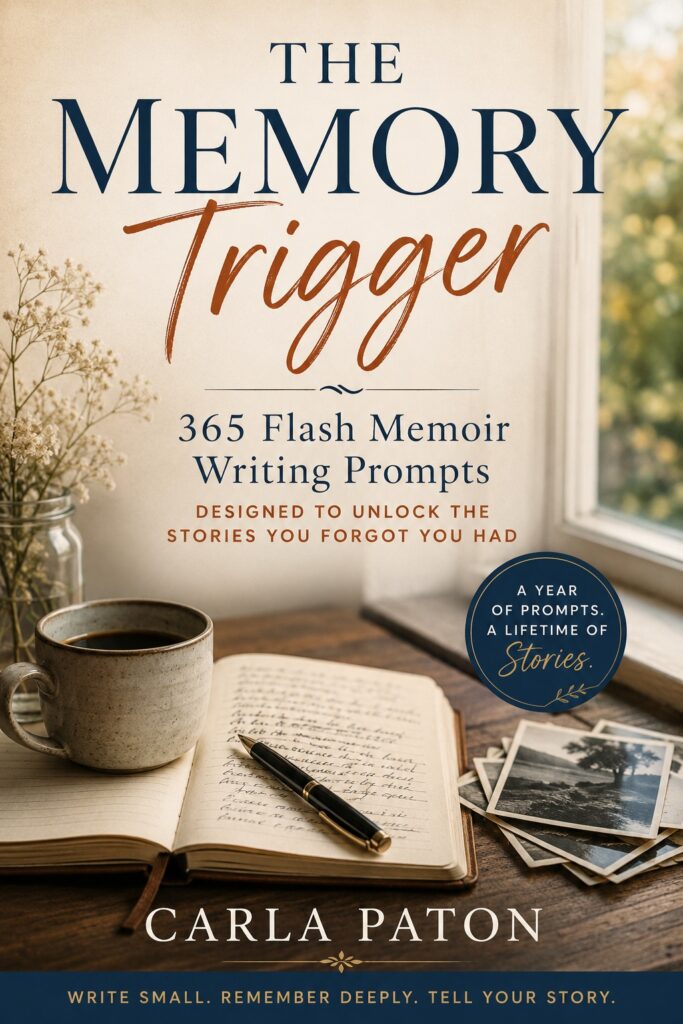
If this prompt led you somewhere honest, keep going. A daily prompt can help you build a steady writing habit, one small memory at a time. Explore all 365 prompts in The Memory Trigger: 365 Flash Memoir Writing Prompts.

The Memory Trigger

Flash Memoir Prompt: Last Time You Did Something with a Parent before They Became Older

Memoir Prompt parent

A brief writing invitation for remembering the last ordinary thing you shared with a parent before age changed the way you saw them.

Maybe you did not know it was the last time. You were carrying groceries together, walking through an airport, painting a fence, or sitting in the front seat while your parent drove too fast and knew every shortcut.

Then, later, something shifted. They stopped climbing ladders. They handed you the keys. They asked you to read the small print. This flash memoir prompt last time something parent before old age became visible asks you to return to that earlier scene, when your parent still seemed like the stronger one.

Memoir Prompt parent

The Prompt

Write about the last time you did something with a parent before they became older.

This prompt can unlock a memory you may have passed over because it seemed normal at the time. The day itself may not have announced anything. There may have been no hospital room, no dramatic talk, no clear goodbye to who your parent had been.

That is what gives the memory power. Often, we notice change only after it has already happened. A flash memoir prompt about the last time you did something with a parent before age changed them can help you study the small evidence: a hand on a steering wheel, a laugh across a table, a parent carrying something you would later carry for them.

Why This Memory Matters

This kind of story often lives in the space between childhood and adulthood. Even if you were already grown, your parent may still have felt fixed in your mind. Capable. Busy. Hard to impress. Hard to imagine as fragile.

Then one memory, when viewed from years later, becomes a hinge. Maybe it was the last hike before their knees started to fail. Maybe it was the last road trip before night driving became too much. Maybe it was the last time they lifted a grandchild, danced at a wedding, or stood at the grill like the whole backyard depended on them.

The story is not only about age. It is about what you did not know you were losing. It is about the moment before the roles began to tilt.

When you write this memory, try not to turn your parent into a symbol too quickly. Let them be a person first. If they complained, include that. If they were stubborn, proud, silly, or distracted, let that stay in the scene. A real parent on the page will feel more honest than a perfect one.

If you want a helpful way to think about your parent as a person in the story, you might borrow tools from literature. This guide on how to analyze characters in literature can help you notice habits, contradictions, and choices without flattening someone into one simple role.

How to Approach This Prompt

Begin with one physical detail. Do not start by explaining your whole relationship. Start with your father’s work boots by the back door. Start with your mother’s sunglasses on the dashboard. Start with the paper cup of gas station coffee your parent balanced between their knees.

Then narrow the memory to one scene. A scene gives the reader a place to stand. Instead of covering a decade of decline, choose the afternoon at the lake, the grocery run after church, or the last time your parent helped you move a couch.

Write what you noticed before you explain what it meant. At the time, maybe you noticed your parent’s quick walk, their joke, their impatience, or the way they waved away help. Years later, you may see that memory differently. Let both versions exist.

You can use this simple starting line if you need one: “The last time I remember my parent seeming young was when…” Then move right into action.

Keep the first draft small. You do not have to tell the whole story of illness, aging, family duty, or grief. This flash memoir prompt last time something parent before age changed the family works best when you stay close to one moment and let the meaning rise from the details.

If marking up memories helps you think, you may enjoy using the same habits readers use with books. This guide on how to annotate literature can also work for memoir drafts. Circle the strongest image. Underline the sentence that feels most true. Ask what the scene is really about.

A Quick Example

The last time my mother seemed young to me was at the garden center in April. She lifted two bags of potting soil into the cart before I could stop her. “Don’t fuss,” she said, wiping her hands on her jeans. She had dirt under one thumbnail and a blue sweatshirt tied around her waist. I was thirty-two, with my own mortgage and my own gray hairs starting, but beside her I still felt like a child sent to fetch the marigolds. We argued over tomato plants. She wanted the tall ones. I wanted the cheap ones. She won, of course. Three summers later, I would kneel in her yard and plant everything myself while she watched from a folding chair. But that day she pushed the cart, fast and crooked, like she had somewhere important to be.

Try It Yourself

Set a timer for ten minutes and write the scene as plainly as you can. Choose one shared action: driving, cooking, shopping, fixing, walking, waiting. Let the memory stay ordinary.

If emotion arrives, let it in, but do not force a big ending. You might close on an object, a gesture, or a line of dialogue. The quietest ending may be the one that stays with the reader.

This flash memoir prompt last time something parent before they became old may bring up tenderness, regret, gratitude, or surprise. You do not need to solve those feelings today. Just put one true moment on the page.

Want More Flash Memoir Prompts?

If this prompt helped you remember one clear scene, keep going. Short prompts can open doors you did not know were still there. Explore all 365 prompts in The Memory Trigger: 365 Flash Memoir Writing Prompts.

The Memory Trigger

Flash Memoir Prompt: Version of Your Family that No Longer Exists

flash memoir family

A focused flash memoir invitation for remembering a version of your family that has faded, changed, or quietly disappeared.

You might notice it at a holiday table, when someone reaches for a serving spoon that used to belong to your grandmother. Or in a photo where everyone is younger, louder, closer, and you realize that exact group of people will never sit in the same room again.

This flash memoir prompt about a version of your family that no longer exists is not only about loss. It can also be about change, distance, growing up, divorce, moving away, old routines, or the strange way families become new families over time.

flash memoir family

The Prompt

Write about a version of your family that no longer exists.

This prompt can open a strong memory because it asks you to look at your family as it once was, not as a full history, but as one lived moment. Maybe the old version of your family was noisy and crowded. Maybe it was quiet because everyone avoided the same subject. Maybe it was happy, but only in the way you understood happiness then.

A good flash memoir prompt version family no longer exists can help you find the small scene that holds the larger truth. You do not need to explain every change. You only need to show the reader what it felt like to be there before everything shifted.

Why This Memory Matters

Families change in ways that can be easy to miss while they are happening. Someone leaves for college. Someone stops calling. A parent remarries. A sibling becomes a stranger for a while. A child grows up and no longer believes the adults know everything.

When you write about a version of your family that no longer exists, you are writing about time. You are also writing about roles. Who made everyone laugh? Who kept the peace? Who always sat in the same chair? Who did you think you were in that family?

This kind of memory may uncover grief, but it may also uncover tenderness. You might remember the family before the big argument, before the move, before the illness, before everyone got their own phones and stopped watching the same movie on the couch.

If you enjoy looking closely at people and their choices, you may find it useful to think like a reader studying a novel. This guide on how to analyze characters in literature can help you notice patterns, motives, and quiet details in real life too.

How to Approach This Prompt

Begin with one physical detail. Choose something small enough to hold in your hand or picture clearly in your mind. A cracked bowl. A bunk bed. A station wagon. A stack of TV trays. A hallway light left on at night.

Then narrow the memory to one scene. Do not try to tell the whole family history at once. The whole story may be too large for a flash memoir piece. One evening can carry enough weight.

Write what you noticed before you explain what it meant. If your parents were still together then, show them passing plates across the table. If your siblings still shared a bedroom, show the line of stuffed animals between the beds. If your grandparents still hosted Sunday dinner, show the smell of soup in the entryway.

Try not to rush toward the lesson. Let the reader stand inside the old version of your family for a moment. Let them hear the voices, see the furniture, and sense what no one said out loud.

After you draft, you can reread your piece and mark the details that feel alive. Writers do this in memoir the same way students mark important lines in a story. If that skill helps you, here is a simple guide on how to annotate literature that can also work for your own drafts.

A Quick Example

Before my parents sold the house, Sunday mornings belonged to pancakes. My father stood at the stove in his robe, flipping them too early, so the middles stayed soft. My mother read the paper at the table and circled grocery coupons with a red pen. My brother and I fought over the syrup bottle even though there was plenty. The dog slept under my chair because I dropped crumbs on purpose. Nothing about it seemed special then. It was just breakfast. Years later, after the divorce and the apartment kitchens and the holidays split into two calendars, I found the old griddle in a box. The handle was loose. I held it for a minute and could almost hear my mother say, “Use a plate, not a napkin.”

Try It Yourself

Set a timer for ten minutes and write about one version of your family that no longer exists. Start with the room, the object, or the sound that brings it back fastest.

You do not have to make the memory neat. You do not have to decide if it was good or bad. Just return to the scene and tell the truth from where you stood then.

If the writing surprises you, follow that surprise. The best flash memoir pieces often begin with a simple image and end with a feeling the writer did not expect to find.

Want More Flash Memoir Prompts?

If this prompt helped you remember a scene you had not thought about in years, keep going. Explore all 365 prompts in The Memory Trigger: 365 Flash Memoir Writing Prompts.

The Memory Trigger

Flash Memoir Prompt: Last Time You Felt Like a Child

Rapid Reads Press

A brief, tender writing invitation about the last time you felt small, safe, silly, scared, or suddenly young again.

Maybe it happened in a grocery store when you reached for the cereal you loved as a kid. Maybe it came over you during a storm, when thunder made you want to call someone older and wiser. Or maybe you felt it while laughing too hard over something completely ridiculous, the kind of laugh that makes you forget your age for a minute.

This flash memoir prompt last time felt like child asks you to notice one of those moments when adulthood loosened its grip. It does not have to be dramatic. In fact, the smaller the scene, the more honest it may become.

childhood prompt

The Prompt

Write about the last time you felt like a child.

This prompt can open a memory because feeling like a child is rarely about age alone. It may be about needing comfort. It may be about wonder. It may be about shame, joy, fear, play, or wanting someone else to take charge for a little while.

When you write from this prompt, try not to rush toward the meaning. Stay with the moment first. What room were you in? What did your hands do? What sound made you feel younger than you are?

Why This Memory Matters

Childhood does not fully disappear. It follows us in habits, cravings, jokes, fears, and soft spots we may not understand until they rise up again.

The last time you felt like a child might reveal a need you rarely admit. Maybe you wanted your mother’s soup when you were sick. Maybe you felt helpless while filling out a confusing form. Maybe you stood in front of a teacher, boss, doctor, or parent and felt your voice shrink.

It could also be a happy memory. You might have felt childlike while sledding, dancing in the kitchen, opening a gift, or walking into a library and smelling old paper. If you want to sharpen the way you notice small details, you might enjoy this guide on how to annotate literature, since close reading can also train you to read your own memories with care.

This kind of memory matters because it shows the meeting point between who you were and who you are now. A flash memoir prompt last time felt like child can help you write about that meeting point without turning it into a long life story.

How to Approach This Prompt

Begin with one physical detail. Choose something your body remembers before your mind explains it.

Maybe your knees were tucked under your chin. Maybe your face burned. Maybe you held a mug with both hands. Maybe you wanted to hide behind someone taller.

Once you find that detail, narrow the memory to one scene. Do not try to cover your whole childhood or explain your entire family history. Stay inside ten minutes, or even two.

Write what you noticed before you write what it meant. For example, instead of starting with “I felt vulnerable,” begin with the coat sleeve you pulled over your hand. Instead of “I was happy,” begin with the way you ran across wet grass in your socks.

You can also pay attention to tone. A memory like this might feel funny on the surface but sad underneath, or tender at first and then sharp. If you want help naming that difference, this simple explanation of tone vs. mood in literature may help you think about the feeling your scene creates.

One clear way to begin is with this sentence: “The last time I felt like a child, I was…” Then name the place. Keep going from there.

A Quick Example

The last time I felt like a child, I was sitting on the paper-covered table at urgent care with my shoes dangling above the floor. I am forty-one, but the crinkle of that paper made me feel eight. The nurse asked when the pain started, and I looked at my husband before I answered, as if he might know better than I did. My throat hurt more from trying not to cry than from being sick. When the doctor said it was only an infection, I nodded like a good student. In the car, I asked if we could stop for a milkshake. I meant it as a joke, but when he said yes, I felt such relief that I turned my face toward the window.

Try It Yourself

Set a timer for ten minutes and write from the prompt without planning the ending. Focus on the moment when you first noticed the feeling. Did it arrive as comfort, panic, delight, or embarrassment?

If the memory feels too big, choose one object from the scene. Write about the blanket, the cereal box, the hospital bracelet, the sidewalk chalk, or the phone in your hand. Let that object carry you into the truth of the moment.

You do not need to explain everything. A strong flash memoir often leaves a little space around the memory. Trust the scene. Trust the detail. Let the childlike feeling show itself through what you saw, said, wanted, or could not say.

This flash memoir prompt last time felt like child works best when you are honest about the exact kind of smallness you felt. Small can mean safe. Small can mean powerless. Small can mean full of wonder. Let your memory decide.

Want More Flash Memoir Prompts?

If this prompt helped you find a scene worth saving, keep going with short, focused memories. Explore all 365 prompts in The Memory Trigger: 365 Flash Memoir Writing Prompts.

The Memory Trigger

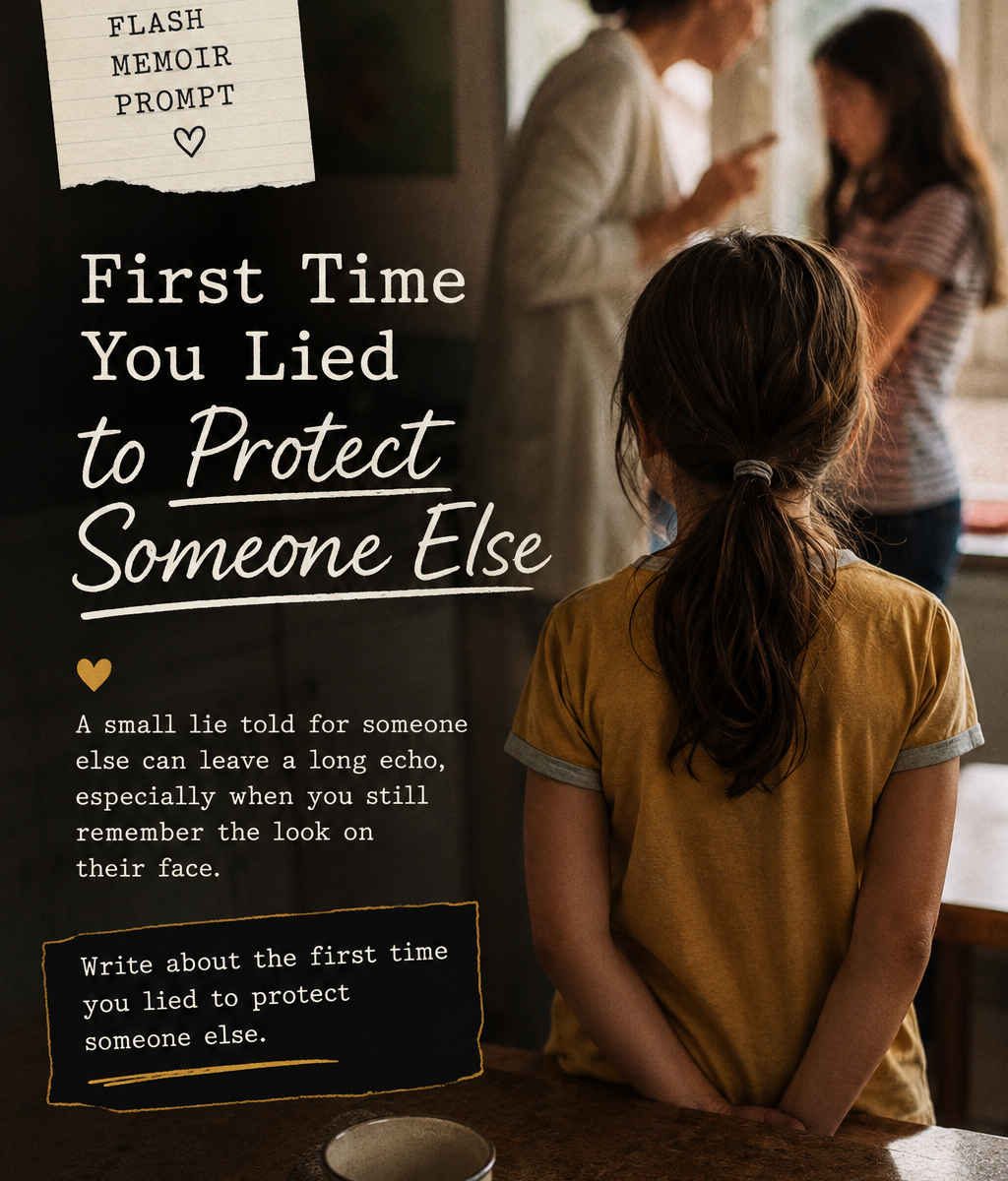
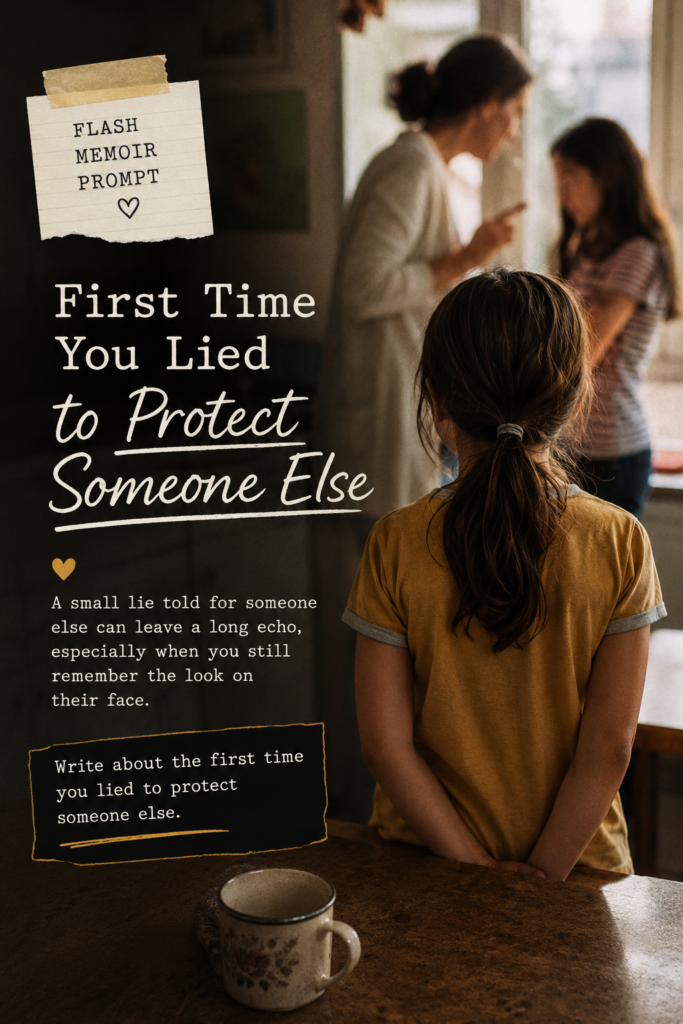
Flash Memoir Prompt: First Time You Lied to Protect Someone Else

flash memoir prompt first time lied protect someone

A small lie told for someone else can leave a long echo, especially when you still remember the look on their face.

If you are looking for a flash memoir prompt about the first time you lied to protect someone, this one asks you to return to a moment when loyalty, fear, love, or pressure shaped what came out of your mouth. Maybe it happened in a kitchen, a classroom, a back seat, or a hallway where everything suddenly felt too quiet.

The lie may have been tiny. “She was with me.” “I broke it.” “He didn’t say that.” At the time, it may have felt fast and necessary. Later, it may have become more complicated.

flash memoir prompt first time lied protect someone

The Prompt

Write about the first time you lied to protect someone else.

This prompt can unlock a strong memory because it puts you inside a choice. You were not just telling a lie. You were deciding who needed protection, what truth might cost, and what kind of person you wanted to be in that moment.

A flash memoir does not need the whole history. It needs one clear scene. Focus on the first time you remember crossing that line for someone else. Let the reader feel the room, hear the question, and understand why the lie came so quickly.

Why This Memory Matters

The first protective lie often reveals a lot about your younger self. It can show who you loved, who scared you, or who you believed deserved saving. It can also show what you did not understand yet.

Maybe you lied for a sibling who had already been in trouble too many times. Maybe you covered for a friend because you knew their parents would overreact. Maybe you protected an adult, even though no child should have had to do that.

This kind of memory can carry more than guilt. It may carry tenderness. It may carry anger. It may carry pride. The emotional truth depends on the scene.

As you write, pay attention to the person you protected. What did they need from you? What did you think would happen if you told the truth? If you enjoy studying motives in fiction, the same skill can help here. Thinking about how to analyze characters in literature can remind you to notice desire, fear, and pressure in real life, too.

The point is not to judge your younger self too quickly. The point is to return to the moment with honesty. What did you know then? What do you know now?

How to Approach This Prompt

Begin with a physical detail instead of an explanation. Start with the sound of a door closing, the sweat under your collar, the chipped mug on the table, or the teacher’s shoes beside your desk.

Then narrow the memory to one scene. Do not begin with, “My brother and I had always been close.” Begin with the moment the question landed in the room.

For example, you might start with: “My mother held the broken lamp cord in her hand and asked whose idea it was.” That first line gives you a place, an object, and a problem.

After that, write what you noticed before you explain what it meant. What did the other person do? Did they look at you, look away, kick your foot, or go still? Small movements can carry the weight of the whole story.

Try not to tell the reader the lesson too soon. Let the scene do some of the work. If the memory has a larger meaning, it will rise from the details.

This flash memoir prompt, the first time you lied to protect someone, also invites you to think about the theme. Was the memory about loyalty? Fear? Family rules? Silence? If you want help naming the deeper idea in a piece of writing, this guide on how to identify theme in literature can help you look beneath the action without forcing a moral.

A Quick Example

The first time I lied to protect someone, I was nine, and my cousin had taken my aunt’s red lipstick from the bathroom drawer. She drew a crooked heart on the hallway mirror, then froze when we heard footsteps. My aunt asked who did it, and my cousin’s face folded in on itself before she even opened her mouth. I said, “I did.” The lipstick felt cold in my hand when my aunt made me clean the glass. My cousin stood behind her, silent, with one red smear on her thumb. I remember feeling proud for about ten seconds. Then I saw my aunt’s disappointment in the mirror, right beside my own face. I had saved my cousin from trouble, but I had stepped into a different kind of trouble, one that followed me longer.

Try It Yourself

Set a timer for ten minutes and write the scene as simply as you can. Start at the moment before the lie. End soon after it leaves your mouth.

You do not have to decide whether the lie was right or wrong before you begin. In fact, it may be better if you do not. Let the younger version of you act first. Let the older version watch closely.

If you get stuck, write the question someone asked you. Then write your answer. The space between those two lines is where the memoir lives.

This flash memoir prompt, the first time you lied to protect someone, works best when you keep the memory small and honest. You are not writing a courtroom defense. You are writing about a human moment when care and fear got tangled together.

Want More Flash Memoir Prompts?

If this prompt opened a memory you did not expect, keep going. Short prompts can help you find stories hiding in ordinary moments, especially the ones you have not thought about in years.

Explore all 365 prompts in The Memory Trigger: 365 Flash Memoir Writing Prompts.

The Memory Trigger

error

Enjoy this article? Please spread the word :)

Follow by Email
BLUESKY
fb-share-icon
Reddit
LinkedIn
Share
RSS