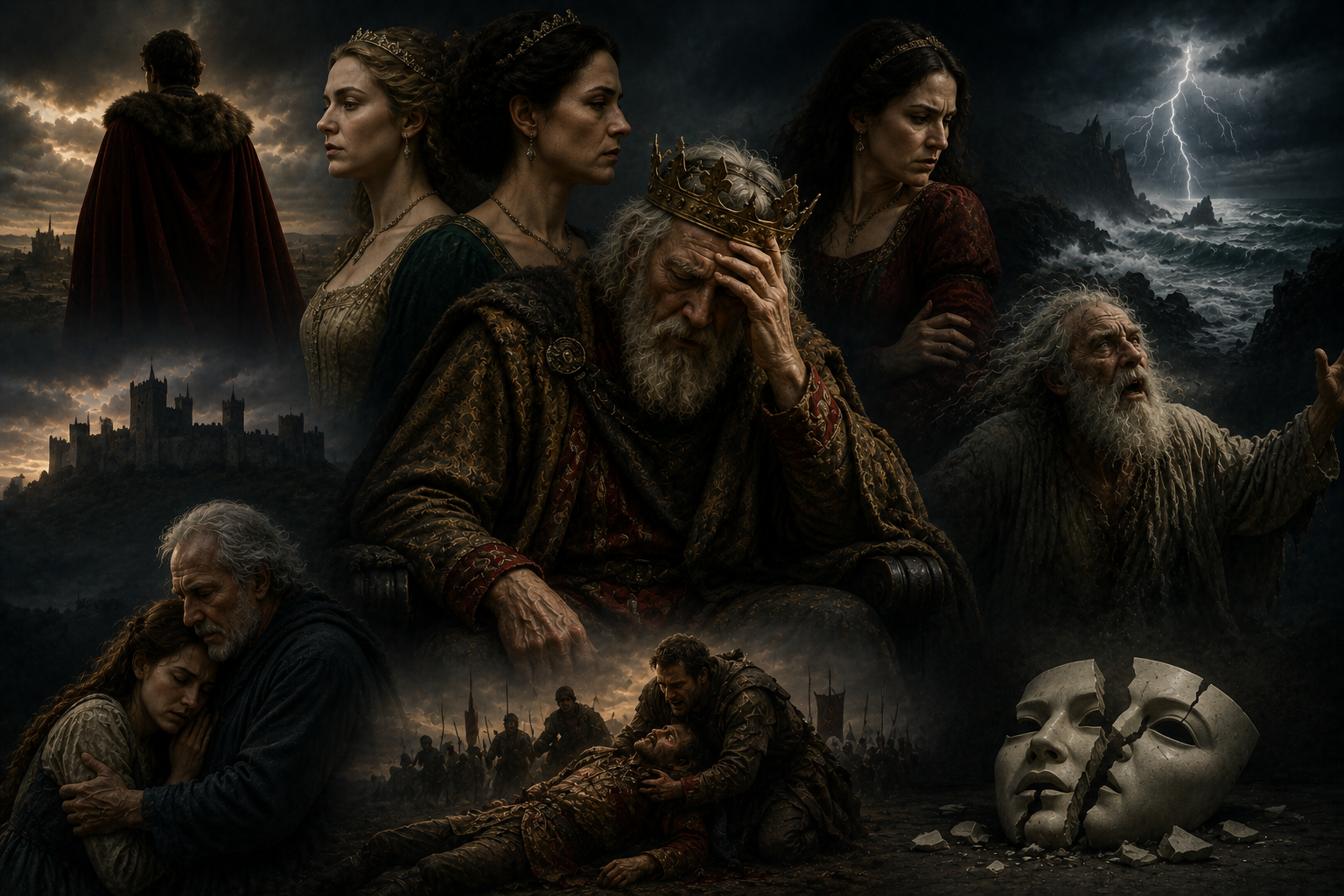
Themes in King Lear: A Student-Friendly Guide

King Lear Themes

Shakespeare’s tragedy can feel huge at first, but the themes in King Lear make the play easier to understand. This guide breaks down the major ideas students should notice, with clear examples and study tips.

In this Guide

  • Why themes matter in the play
  • Power and authority
  • Family loyalty and betrayal
  • Madness and insight
  • Justice and suffering
  • Nature and order
  • Helpful books and FAQ
King Lear Themes

Why themes in King Lear Matter

The play is not only about one old king. It is about what happens when love, power, and truth fall apart.

The themes in King Lear help students see the deeper meaning behind the plot. Lear gives away his kingdom, trusts the wrong people, and loses almost everything.

That story may seem distant, but its questions still feel real. Who deserves power? Can family love survive pride? Does the world punish evil fairly?

If you need help connecting theme to character choices, this guide on how to analyze characters in literature can make your reading stronger.

Power and Authority: One of the Central Themes in King Lear

King Lear shows that power without wisdom can destroy a family and a nation.

Among the themes in King Lear, power is one of the most important. Lear begins the play as a king, but he wants to keep the honor of power while giving away the work of rule.

This choice creates chaos. Once Lear loses real control, Goneril and Regan no longer treat him with respect. His title means little without authority behind it.

Shakespeare asks students to think about what makes a good ruler. Is it age, rank, kindness, or judgment? Lear has the crown at first, but he lacks self-knowledge.

This theme also appears in Macbeth, where desire for power leads to fear and violence. In both plays, rule becomes dangerous when it serves pride instead of duty.

Family Loyalty and Betrayal in the Themes in King Lear

The play turns family love into a test, and almost everyone fails in some way.

This part of the themes in King Lear begins with Lear’s love test. He asks his daughters to prove their love with words before he divides the kingdom.

Goneril and Regan flatter him, but their love is false. Cordelia speaks honestly, yet Lear rejects her because her answer wounds his pride.

The Gloucester plot mirrors this conflict. Edmund betrays his father and brother, while Edgar stays loyal even after he is forced into exile.

These family conflicts make the play painful. Shakespeare shows that love based on performance is weak. Real loyalty may look quiet, but it lasts longer than praise.

Madness, Insight, and the Themes in King Lear

Lear loses his social power, but he starts to see the truth more clearly.

The themes in King Lear often work through opposites. Lear seems mad on the heath, yet his suffering helps him understand poverty, weakness, and human need.

Before his fall, Lear cares most about honor and obedience. After the storm, he sees that many people live without comfort or protection.

The Fool also matters here. He speaks in jokes, but his words reveal truth. In Shakespeare, the person who seems foolish often sees more than the powerful people around him.

This idea also appears in Hamlet. Hamlet’s strange behavior makes others doubt him, but it also helps him expose hidden corruption.

Justice and Suffering in the Themes in King Lear

The play asks a hard question: does the world make moral sense?

Justice is one of the darkest themes in King Lear. Good people suffer, cruel people gain power, and punishment does not always feel fair.

Gloucester is blinded after he helps Lear. Cordelia dies even though she is honest and kind. Lear suffers deeply before he learns the truth.

Students often expect tragedy to reward virtue in the end. King Lear refuses that comfort. It presents a world where goodness matters, even when it does not save a person from pain.

This is why the ending feels so powerful. The play does not give easy answers. It forces readers to sit with grief and moral shock.

Nature, Order, and Disorder

The storm outside reflects the broken order inside Lear’s world.

Nature appears in many forms throughout the play. Characters speak of storms, animals, age, and human weakness.

When Lear stands on the heath, the weather feels like more than background. The storm mirrors his mind and the disorder in the kingdom.

The play also questions what is natural in family life. Should children obey parents forever? Should parents earn respect through care? Shakespeare does not make these questions simple.

For a helpful overview of the play’s background, see Britannica’s entry on King Lear.

Blindness and Self-Knowledge

Many characters must lose something before they understand the truth.

Blindness is both literal and symbolic in the play. Gloucester cannot see Edmund’s lies until it is too late. After he is blinded, he understands who truly loves him.

Lear has the same kind of inner blindness. He cannot see Cordelia’s honesty at first. He mistakes loud praise for love.

This theme is common in tragedy. In Oedipus Rex, Oedipus also seeks truth but cannot see the truth about himself until the damage is done.

In King Lear, self-knowledge comes at a terrible cost. That cost is part of what makes the play so haunting.

How to Write About Themes in King Lear

A strong essay connects a theme to character choices, key scenes, and the ending.

When you write about themes in King Lear, do not just name the theme. Explain how Shakespeare builds it through conflict and change.

For example, if you write about power, start with Lear’s decision to divide the kingdom. Then show how that decision changes his family and weakens the state.

If you write about justice, focus on the ending. Ask why Cordelia’s death matters and what it suggests about suffering.

You can also use student-friendly literature study guides to review key scenes before you write.

Books That Pair Well with King Lear

These books can help if you want more context or a stronger essay.

  • King Lear by William Shakespeare, especially a student edition with notes
  • Shakespearean Tragedy by A. C. Bradley

You can look for these through Amazon, your school library, or a public library.

FAQ: themes in King Lear

What is the main theme of King Lear?

The main theme is the danger of pride and poor judgment. Lear’s need for praise causes his fall and harms the whole kingdom.

Why is family betrayal important in the play?

Family betrayal drives the plot. Goneril, Regan, and Edmund use trust for personal gain, while Cordelia and Edgar show quiet loyalty.

How does madness connect to wisdom?

Lear seems mad after he loses power, but his suffering helps him see truth. He becomes more human after he loses his pride.

Is there justice at the end of King Lear?

The ending gives only partial justice. Some evil characters are punished, but innocent people still suffer, which makes the tragedy feel harsh.

Key Takeaway

The themes in King Lear show a world where power can fail, love can be tested, and truth often arrives too late. That is why the play still feels urgent for students today.

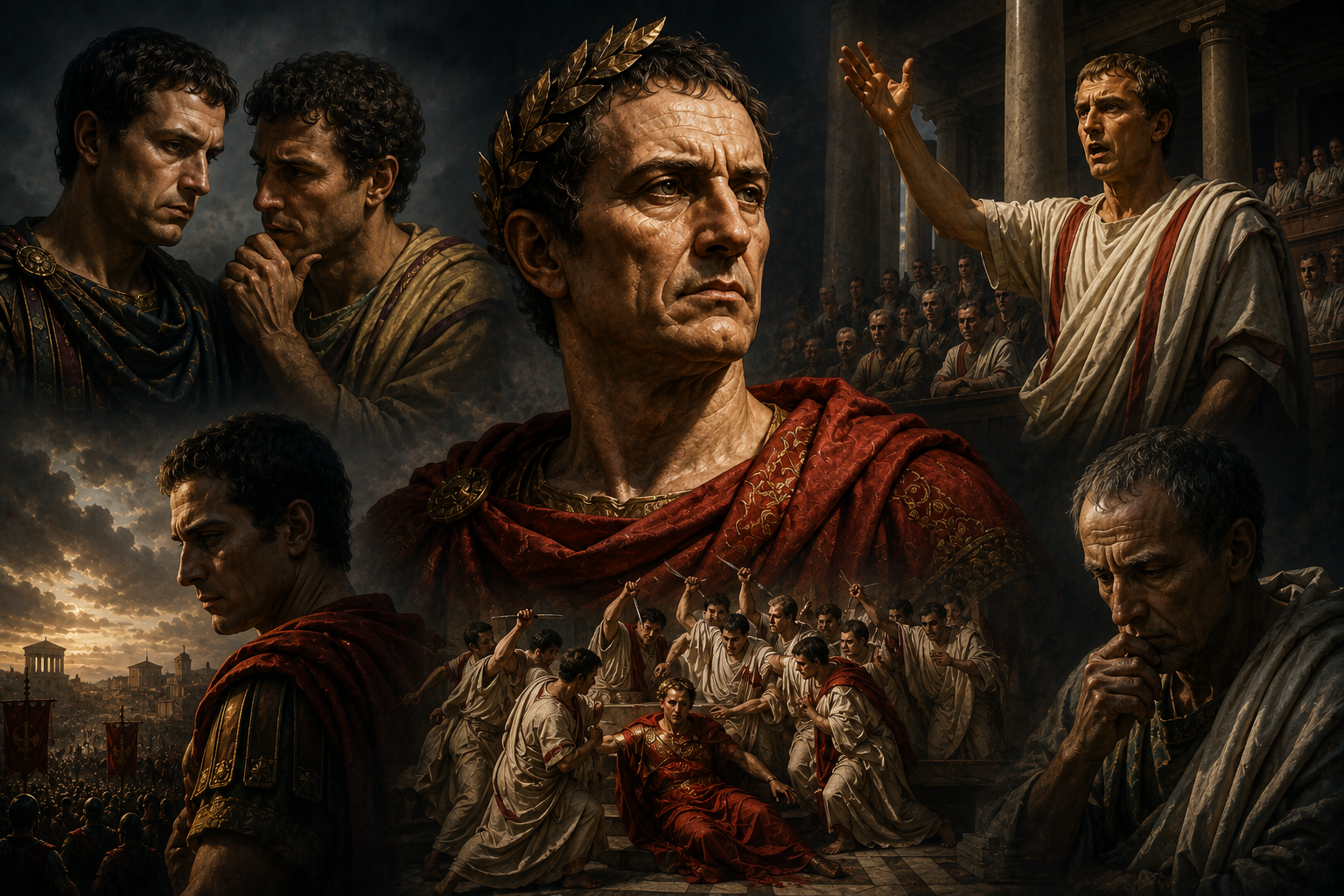
Julius Caesar Character Analysis: Key People, Motivations, and Conflicts

Julius Caesar character analysis

This Julius Caesar character analysis breaks down the main players in Shakespeare’s tragedy. You will see what each person wants, why conflicts grow, and how choices push Rome toward chaos.

In this Guide

Julius Caesar character analysis

Julius Caesar Character Analysis: Why Character Drives the Plot

The play is not just about one murder. It is about why people choose action over peace.

A strong Julius Caesar character analysis starts with motivation. Brutus acts from honor. Cassius acts from jealousy and fear. Antony acts from grief, loyalty, and political skill.

Shakespeare makes each choice feel personal. That is why the plot feels tense even when we know Caesar will die.

If you want a simple method for breaking down character motives, read our guide on how to analyze characters in literature.

Brutus: Honor, Fear, and the Tragic Choice

Brutus is the moral center of the play, but that does not mean he is always right.

For many students, this Julius Caesar character analysis begins with Brutus because his conflict is the clearest. He loves Caesar as a friend, but he fears Caesar may become a tyrant.

His main trait is honor. Brutus wants to protect Rome, not gain power for himself. That makes him different from Cassius.

His flaw is that he trusts ideas more than people. He believes noble reasons can make a violent act look pure. Once he joins the plot, he thinks the public will understand.

This is close to the tragic pattern we see in Hamlet. A thoughtful man faces a moral crisis, but thought does not save him from ruin.

Best quote idea: Brutus often talks about Rome, honor, and the danger of ambition. Use those moments to show how public duty fights with private loyalty.

Julius Caesar Character Analysis of Caesar: Power and Blind Spots

Caesar appears for only part of the play, yet his image controls the whole story.

Caesar is powerful, proud, and loved by many citizens. He also ignores warnings that could save his life.

His main conflict is between public strength and human weakness. He wants to seem fearless. Because of that, he treats danger as something beneath him.

Calpurnia’s dream scares him at first. Then Decius changes the meaning of the dream, and Caesar chooses pride over caution.

Caesar is not shown as a simple villain. Shakespeare leaves room for debate. Is Caesar truly dangerous, or do others fear what he might become?

For a trusted overview of the play, see the Britannica entry on Julius Caesar.

Cassius: Envy, Insight, and Control

Cassius understands people well, but he uses that skill to manipulate them.

A careful Julius Caesar character analysis must take Cassius seriously. He is not just angry. He sees Caesar’s rise as a threat to Roman freedom and to his own status.

Cassius knows Brutus has a good name. So he uses letters, praise, and pressure to pull Brutus into the conspiracy.

His main strength is insight. His main flaw is bitterness. Like Iago in Othello, he can read weakness in others and turn it into action.

Still, Cassius is not foolish. He often gives better practical advice than Brutus. For example, he wants to kill Antony too, but Brutus refuses.

Antony: Grief Turns into Strategy

Antony may seem loyal and emotional at first, but he is also one of the sharpest minds in the play.

No Julius Caesar character analysis feels complete without Antony’s funeral speech. He uses careful language to turn the crowd against the conspirators.

Antony does not attack Brutus directly at first. He repeats that Brutus is honorable, but each repeat makes the crowd doubt it more.

His strength is rhetoric, which means the art of persuasion. He understands public emotion better than Brutus does.

Antony’s conflict is also moral. He mourns Caesar, but he quickly uses Caesar’s death to gain power. Shakespeare lets us feel both his loyalty and his ambition.

You can read the full play through the Folger Shakespeare Library edition of Julius Caesar.

Portia and Calpurnia: Private Warnings in a Public World

Portia and Calpurnia show how private life suffers when public honor takes over.

Portia is Brutus’s wife. She sees that he is troubled and asks to share his burden. Her strength is loyalty, but the political world shuts her out.

Calpurnia is Caesar’s wife. She has a terrible dream and begs Caesar to stay home. Her warning is wise, but Caesar’s pride wins.

Both women sense danger before the men act with care. Their roles show a key idea in the play: Rome praises strength, but it often ignores wisdom.

Julius Caesar Character Analysis: Motivations and Conflicts

Each major character wants something different, and those wants crash into each other.

  • Brutus wants to protect Rome and keep his honor clean.
  • Caesar wants power, respect, and a strong public image.
  • Cassius wants Caesar stopped and wants influence over Brutus.
  • Antony wants revenge for Caesar and control of the crowd.
  • Portia and Calpurnia want truth, safety, and trust inside their homes.

The biggest conflict is not simply Caesar against the conspirators. It is idealism against reality. Brutus believes noble motives can guide politics, but Rome is more violent and unstable than he thinks.

This is why the play works so well for essays. You can argue about who is right, who is blind, and who changes the most.

Use This Julius Caesar Character Analysis in Essays

Good essays do more than describe a character. They explain how a character’s choices shape the play.

When you use Julius Caesar character analysis in a thesis, connect a trait to a result. For example: Brutus’s honor makes him noble, but it also makes him easy to use.

Here is a simple essay move:

  • Name the character’s main trait.
  • Show the conflict that tests that trait.
  • Explain the result of the choice.
  • Connect the result to a larger theme.

For more practice, use this character analysis strategy before you write your next paragraph.

If you want a ready-to-use study tool, try our student-friendly character analysis resource for quote-based notes and essay prep.

Suggested Books for Study

These books can help if you want more context or a stronger grasp of Shakespeare’s language.

  • Julius Caesar by William Shakespeare, Folger Shakespeare Library edition
  • Shakespeare: The World as Stage by Bill Bryson

FAQ: Julius Caesar Character Analysis

Quick answers can help you review before class or plan an essay. 💡

Who is the most important character in Julius Caesar?

Brutus is often the most important character because his choice to join the conspiracy drives the tragedy.

Is Caesar a hero or a villain?

Caesar is more complex than either label. He has pride and power, but the play never proves he would become a tyrant.

What is Brutus’s tragic flaw?

Brutus’s tragic flaw is his idealism. He believes honorable motives can control political violence.

Why is Antony’s funeral speech important?

Antony’s speech turns public opinion against the conspirators. It shows the power of language in politics.

What is the main idea of a Julius Caesar character analysis?

The main idea is that each character’s motive shapes the fall of Caesar and the collapse of Roman order.

Key Takeaway

The best Julius Caesar character analysis shows that the tragedy grows from human choices, not fate alone. Shakespeare’s characters act from honor, fear, pride, and loyalty, but none can control what their actions release.

Important The Odyssey Quotes Explained: A Student Guide

Odyssey Quotes

A guide to memorable passages and how students can use them in essays.

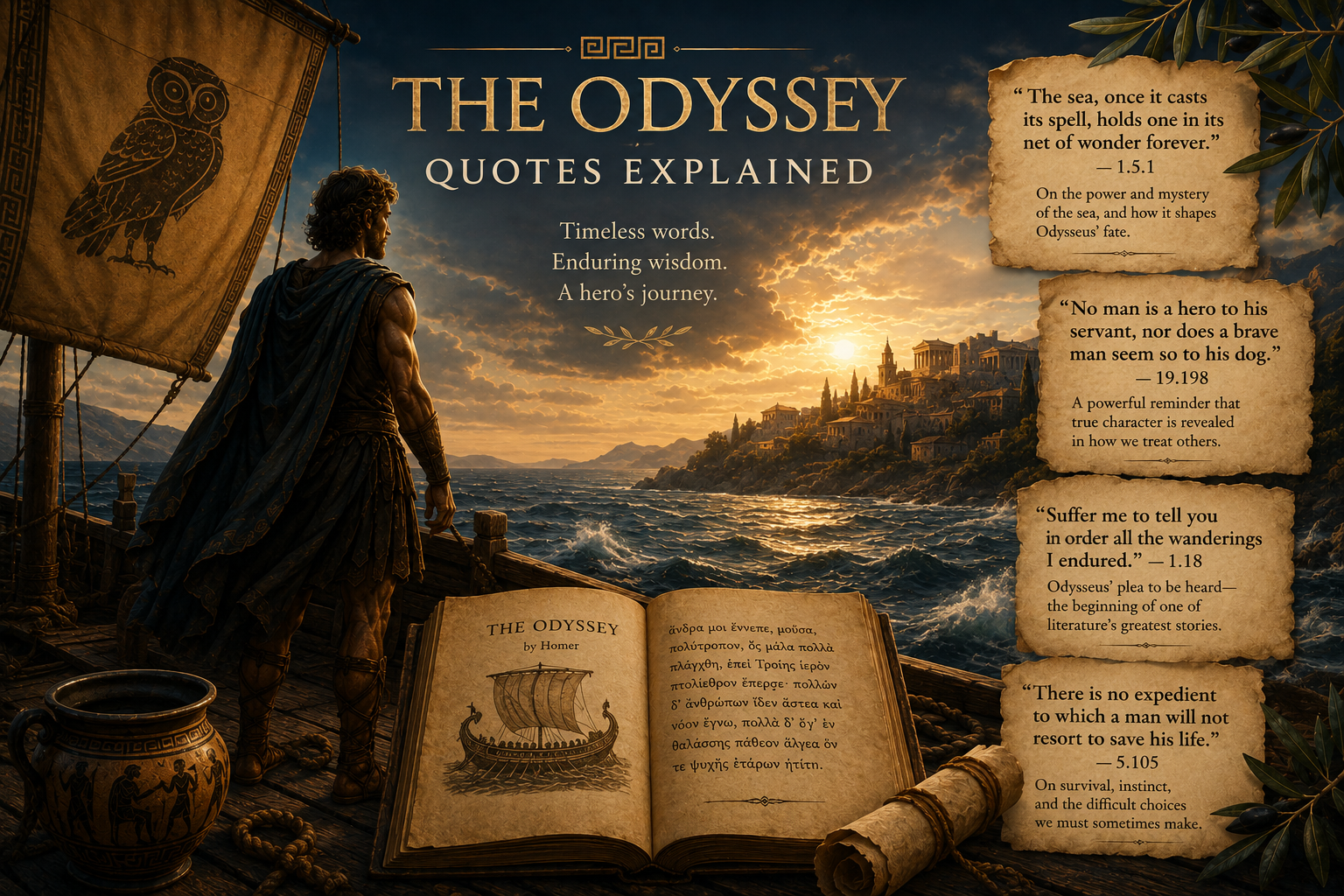
The Odyssey quotes explained can help students see how Homer builds a story about home, honor, loss, and wisdom. This guide uses short public-domain phrases when useful, then explains how each passage can support a strong essay claim.

In this Guide

Use this quick map to find the quote or skill you need.

  • Why the quotes matter
  • Identity and home
  • Pride and consequences
  • Loyalty and endurance
  • Essay tips for quote analysis
  • Books and resources
  • FAQ
Odyssey Quotes

Why The Odyssey quotes explained matter in essays

Great quotes do more than sound important. They reveal how a text thinks.

A useful set of The Odyssey quotes explained should connect each passage to a theme, a character choice, or a major conflict. In The Odyssey, those conflicts often come from temptation, pride, and the hard pull of home.

Homer also uses repeated ideas, such as storytelling and disguise. When you explain a quote, look for what changes in the character or what the line shows about the ancient Greek world.

The Odyssey quotes explained: identity and home

Odysseus spends much of the poem away from Ithaca, yet the idea of home shapes nearly every choice he makes.

“Tell me, O Muse…”

This short opening phrase comes from older public-domain translations of the poem. It shows that the epic begins with an invocation, which is a call for divine help in telling the story.

The line matters because it frames Odysseus as more than one man with a problem. His journey becomes a story about human weakness, clever thought, and survival.

When students search for The Odyssey quotes explained, this opening is one of the best places to start. You can use it to discuss the epic tradition and the role of fate.

“that ingenious hero”

Some public-domain translations describe Odysseus with this phrase. It points to his intelligence, which is often his greatest strength.

Odysseus wins many battles with words before he uses force. This is like Hamlet in Shakespeare’s Hamlet, where thought and speech shape action, even when the results turn painful.

In an essay, this quote can support a claim about Odysseus as a hero of the mind. He is not just brave. He survives because he studies people and adapts.

The Odyssey quotes explained: pride and consequences

Homer often shows that a hero’s strength can turn into a weakness.

“My name is Noman”

In the Cyclops episode, Odysseus uses a false name to escape danger. Older translations often give the name as “Noman,” while many modern classes use “Nobody.”

This moment shows his quick wit. He knows that language can become a weapon.

The quote also sets up a warning. Odysseus escapes through cleverness, but he later reveals too much and brings Poseidon’s anger on himself.

“I am Ulysses son of Laertes”

Older public-domain translations often use Ulysses for Odysseus. This line matters because he announces his true name after the Cyclops episode.

The moment feels heroic, but it also exposes his pride. Odysseus wants glory, and that desire costs him years of suffering.

This is a strong quote for an essay about heroic flaws. Like Achilles in The Iliad, Odysseus is great because of his passion, yet that same passion can harm him.

The Odyssey quotes explained: loyalty and endurance

The poem values cleverness, but it also honors patience and faithfulness.

Argus recognizes his master

Many students remember the scene with Argus, Odysseus’s old dog. The exact wording changes by translation, but the point is clear: Argus knows Odysseus when many people do not.

This scene is short, but it has deep emotional power. It shows that loyalty can outlast time, poverty, and disguise.

The Odyssey quotes explained often focus on Odysseus, but Argus can support a strong paragraph about recognition. Home is not only a place. It is also the bonds that still know you.

Penelope and the bed

Penelope tests Odysseus with the secret of their marriage bed. The scene proves that she is not passive or easily fooled.

Her test mirrors Odysseus’s own cleverness. Both of them use intelligence to protect what matters.

This moment works well in essays about marriage, trust, and identity. It also shows that the return home must be earned, not simply claimed.

How to use The Odyssey quotes explained in an essay

A quote should not sit in your paragraph like decoration. It should help prove your point.

The best The Odyssey quotes explained will follow a simple pattern: claim, quote, explanation, and link back to the thesis. If you need help with that structure, read our guide on how to write a literary analysis essay.

Here is a simple example:

Claim: Odysseus’s cleverness saves him, but his pride delays his return.

Quote: His false name, “Noman,” helps him escape the Cyclops.

Explanation: The name shows his gift for strategy. Yet after he escapes, he reveals his identity, which turns his success into a new danger.

Try to avoid a summary-only paragraph. Teachers want analysis, which means you explain why the words matter.

If you want a ready-to-use reference while you study, try our Odyssey quote study guide and pair it with your class notes.

The Odyssey quotes explained through major themes

The strongest quotes connect to themes that appear across the whole epic.

Home: Odysseus wants Ithaca, but he must learn restraint before he can fully return.

Pride: His desire for fame creates real danger, especially after the Cyclops episode.

Disguise: Odysseus’s hidden identity lets him test others before he acts.

Loyalty: Penelope, Telemachus, and Argus show that faithfulness has its own kind of courage.

Storytelling: Odysseus often survives by shaping how others see him. His words become part of his power.

Books and resources for The Odyssey quotes explained

Good background sources can help you understand the epic without replacing your own reading.

For a clear overview of the poem, visit Britannica’s article on The Odyssey. For the ancient Greek text and older translations, see the Perseus Digital Library.

Relevant books to search for

  • The Odyssey by Homer, translated by Emily Wilson
  • The Odyssey by Homer, translated by Robert Fagles
  • The World of Odysseus by M. I. Finley

Different translations use different wording, so always cite the version your class uses.

FAQ: The Odyssey quotes explained

Quick answers can help you choose the right passage for your essay.

What is the most important quote in The Odyssey?

The opening invocation is one of the most important because it sets up the epic style and introduces Odysseus as a complex hero.

Can I use a paraphrase instead of a quote?

Yes, but use direct quotes for key words or major moments. A short quote often gives stronger proof.

Why do translations of The Odyssey sound different?

Each translator makes choices about tone, rhythm, and word meaning. That is why your essay should name the translation you use.

What themes work best with Odysseus quotes?

Strong themes include home, pride, disguise, loyalty, and identity. Choose the one that fits your thesis.

Key takeaway

The best way to use The Odyssey quotes explained is to connect each phrase to a choice, a consequence, or a theme. A short quote with a clear explanation can make your essay sharper and more convincing.

Themes in The Odyssey: A Student-Friendly Guide

Odyssey Themes

Themes in The Odyssey: A Student-Friendly Guide

A clear guide to the major ideas, conflicts, and meanings students should notice in The Odyssey.

The themes in The Odyssey help explain why this ancient epic still feels alive in English class today. Homer’s story is not only about monsters and sea travel, but about home, pride, loyalty, and the hard work of becoming wise.

If you are writing an essay or preparing for class discussion, this guide will help you spot the ideas that matter most.

In this Guide

Odyssey Themes

Why Themes in The Odyssey Matter

Theme helps turn a plot summary into a deeper reading.

At first, The Odyssey may seem like a long adventure story. Odysseus fights danger, loses men, and tries to return to Ithaca after the Trojan War.

But the themes in The Odyssey show what the journey means. The poem asks what makes a person honorable, what a leader owes to others, and how much self-control matters.

That is why teachers often ask theme questions on essays and exams. They want you to move past “what happened” and explain “why it matters.”

Major Themes in The Odyssey

These are the core ideas students should know before writing about the poem.

The major themes in The Odyssey often overlap. Hospitality connects to justice. Pride connects to suffering. Loyalty connects to identity.

When you study them, do not treat each theme as a separate box. Homer builds meaning by letting the same event raise more than one question.

Hospitality and Respect for Strangers

Hospitality, also called xenia, is one of the most important ideas in the epic.

In Greek culture, hosts were expected to welcome guests, feed them, and treat them with honor. Guests also had duties. They had to respect the home and avoid abuse of kindness.

The Phaeacians show good hospitality when they help Odysseus. The suitors show the opposite. They invade Odysseus’s home, eat his food, and insult his family.

This theme gives the poem a moral system. Good hosts and guests help create order. Bad ones bring punishment.

Home and Belonging

Odysseus wants to return to Ithaca more than he wants comfort, pleasure, or fame.

Calypso offers him ease and even immortality, yet he still longs for home. This choice shows that home is not just a place. It is tied to memory, family, identity, and duty.

Many works of literature use a similar idea. In The Great Gatsby, Gatsby also longs for a lost home, but his dream is trapped in the past. Odysseus, by contrast, must restore a living home that still needs him.

Loyalty and Testing

Loyalty matters because almost every major character faces a test.

Penelope must decide how long to wait for Odysseus. Telemachus must grow into a son who can defend his house. Servants must choose between faithfulness and betrayal.

Even Odysseus is tested. He must stay loyal to his goal when comfort tempts him away from it.

This is one reason the themes in The Odyssey still connect to modern readers. The poem asks a simple but hard question: Who stays true when life gets difficult?

Pride, Self-Control, and Consequences

Odysseus is clever, brave, and skilled. He is also proud.

After he blinds Polyphemus, he reveals his name. That choice brings Poseidon’s anger and makes the journey home much harder.

His pride creates real cost. Homer does not show Odysseus as perfect. Instead, the poem presents a hero who must learn when to speak, when to hide, and when to control himself.

This theme appears in many classic works. In Macbeth, ambition pushes Macbeth toward ruin. In The Odyssey, pride works in a similar way, though Odysseus still has a chance to grow.

Cleverness and Survival

Odysseus wins because he thinks under pressure.

He uses the name “Nobody” to trick the Cyclops. He plans the escape from the cave. He enters his own home in disguise so he can judge the suitors before he acts.

The poem values strength, but it values intelligence even more. Odysseus survives because he can adapt.

This is one of the clearest themes in The Odyssey for students to track. Each challenge asks whether force or thought will lead to success.

Justice and Revenge

The ending of the poem raises a tough question: Is Odysseus’s revenge fair?

The suitors have broken the rules of hospitality. They plot against Telemachus, disrespect Penelope, and damage the household.

Odysseus punishes them with violence. To the Greek world of the poem, this restores order. To modern readers, the scene can feel harsh.

That tension makes the theme more interesting. The poem does not just show justice. It asks readers to think about what justice costs.

Identity and Recognition

Odysseus often hides who he is. He lies, wears a disguise, and waits before he reveals himself.

Yet the story keeps moving toward recognition. Telemachus, Penelope, Laertes, and others must come to know him again.

Identity in the poem is not only about a name. It is proven through memory, skill, loyalty, and shared history.

The bed that Odysseus built for Penelope becomes a key sign of this. Only the real Odysseus knows its secret.

Key Conflicts Behind the Themes in The Odyssey

Conflict helps reveal theme because pressure shows what characters value.

The themes in The Odyssey become clear when the characters face hard choices. Odysseus must choose between comfort and home. Penelope must choose between pressure and patience. Telemachus must choose between fear and action.

There is also a larger conflict between human desire and divine power. The gods shape events, but people still make choices. That mix makes the poem feel complex.

Odysseus cannot control the sea, Poseidon, or fate. He can control his courage, patience, and plans.

Symbols That Support Themes in The Odyssey

Symbols make the poem’s ideas easier to see.

The sea is a symbol of danger and uncertainty. It keeps Odysseus away from home and forces him to face limits.

The bow shows rightful power. When Odysseus strings it, he proves that he is still the true master of the house.

The marriage bed stands for shared truth. It connects love, memory, and identity in one powerful moment.

These symbols help students explain the themes in The Odyssey with strong evidence instead of vague claims.

How to Write About Themes in The Odyssey

A strong theme paragraph needs a clear claim and a specific example.

Start by naming the theme, then explain what Homer seems to say about it. Do not write, “The theme is loyalty.” That is only a topic.

Try a sharper claim: “Homer shows that loyalty requires patience, not just love.” Then use Penelope’s actions to prove the point.

If you need help shaping a thesis and using quotes, read our guide on how to write a literary analysis essay.

You can also use our student study guide resources to review major ideas before you draft.

Helpful Background Sources

For reliable context, the Encyclopaedia Britannica overview of The Odyssey gives a clear summary of the epic and its background.

The Poetry Foundation page on Homer offers useful details about the poet and the tradition behind the work.

Suggested Books for Students

These books can help you understand the poem and its world:

  • The Odyssey by Homer, translated by Emily Wilson
  • The Odyssey by Homer, translated by Robert Fagles
  • The World of Odysseus by M. I. Finley

FAQ About Themes in The Odyssey

What are the most important themes in The Odyssey?

The most important themes in The Odyssey include hospitality, loyalty, home, pride, justice, and identity.

What is the main message of The Odyssey?

One main message is that true heroism requires more than courage. Odysseus must learn patience, self-control, and respect for home.

How does hospitality work as a theme?

Hospitality shows whether people respect moral order. Good hosts help strangers, while bad guests like the suitors bring chaos.

Why is Odysseus not a perfect hero?

Odysseus is clever and brave, but his pride causes harm. His flaws make him more human and give the poem deeper meaning.

How can I use theme in an essay?

Make a claim about what the poem says, then support it with a scene, quote, or character choice. For more help, use this literary analysis essay guide.

Key Takeaway

The themes in The Odyssey show that the journey home is also a journey toward wisdom. Homer’s epic lasts because it links adventure with choices that still matter today. 📚