Animal Farm Character Analysis: Key Characters, Motivations, and Conflicts

Animal Farm analysis

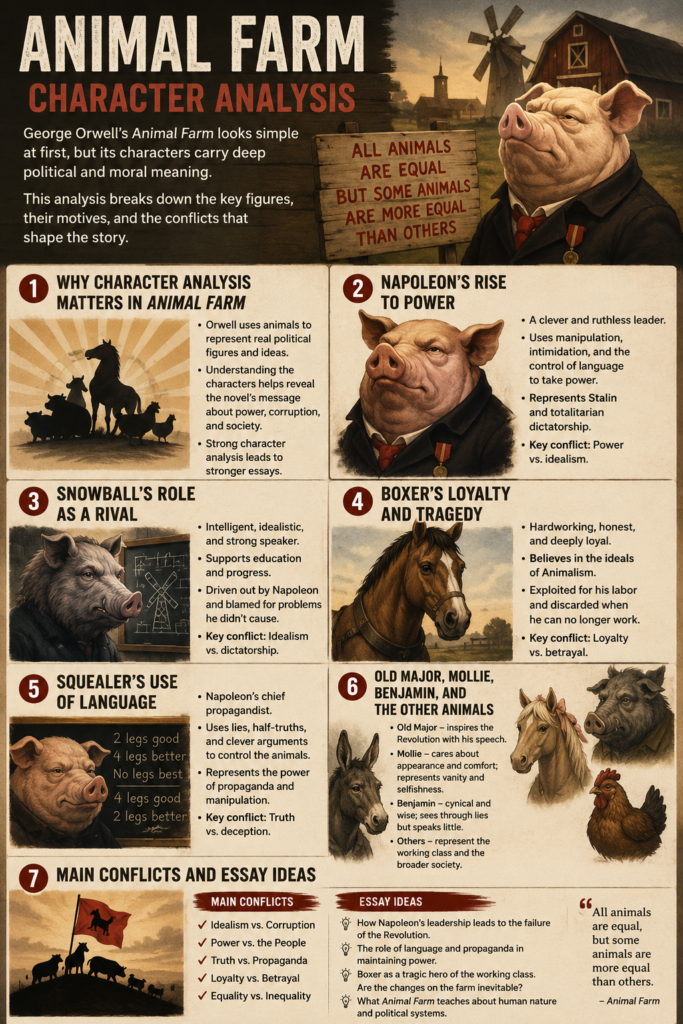
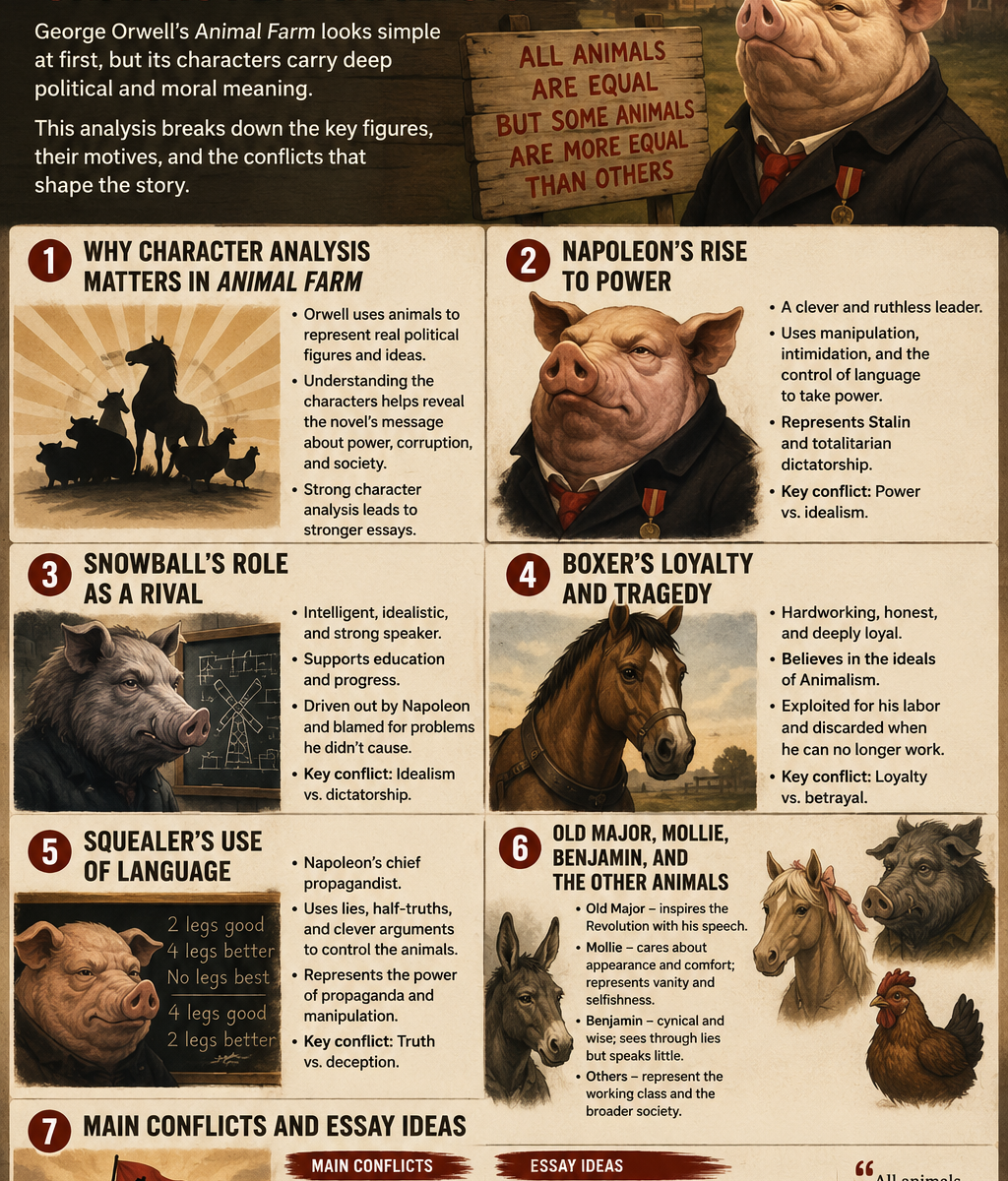
George Orwell’s Animal Farm looks simple at first, but its characters carry deep political and moral meaning. This Animal Farm character analysis breaks down the key figures, their motives, and the conflicts that shape the story.

Use this guide for class discussions, essays, and quote-based analysis.

In this Guide

  • Why character analysis matters in Animal Farm
  • Napoleon’s rise to power
  • Snowball’s role as a rival
  • Boxer’s loyalty and tragedy
  • Squealer’s use of language
  • Old Major, Mollie, Benjamin, and the other animals
  • Main conflicts and essay ideas
  • Books for further reading
  • FAQ
Animal Farm analysis

Animal Farm Character Analysis: Why the Characters Matter

The animals are not just farm creatures. They stand for people, groups, and ideas from the Russian Revolution and from human society in general.

Orwell uses each character to show how power can change a movement. A dream of fairness turns into a system ruled by fear.

This is why Animal Farm character analysis works best when you ask two questions: What does this character want? What does this character reveal about power?

If you want a wider method for studying fiction, read our guide on how to analyze characters in literature.

Animal Farm Character Analysis of Napoleon

Napoleon is the main force behind the farm’s collapse into tyranny. He begins as one of the leaders of the rebellion, but he soon makes power his true goal.

Napoleon does not win through wisdom or kindness. He wins through fear, secrecy, and control.

His dogs become his private police. Once he drives Snowball away, no one can challenge him. He changes rules, takes special privileges, and slowly becomes like the humans the animals once hated.

Napoleon’s motivation is clear: he wants total control. He claims to serve the farm, but his choices serve himself.

In an essay, Napoleon can be compared to Macbeth from Shakespeare’s Macbeth. Both characters let ambition swallow their morals. Once they gain power, they use violence to keep it.

Snowball: The Rival Who Becomes a Scapegoat

Snowball is smart, active, and full of plans. He wants the farm to improve, but he also wants influence.

Unlike Napoleon, Snowball believes in public speeches and big projects. His plan for the windmill shows his hope for progress. It also shows that not every leader with good ideas can survive a brutal power struggle.

After Napoleon forces him out, Snowball becomes a scapegoat. Whenever something goes wrong, Napoleon blames him.

This part of Animal Farm character analysis matters because Snowball becomes more useful to Napoleon as an enemy than as a real person. Fear of Snowball helps Napoleon control the animals.

Students can connect Snowball to the idea of the “outsider” in literature. Like many blamed figures in political stories, he is turned into a symbol of danger.

Boxer: Loyalty, Labor, and Tragedy

Boxer is one of the most painful characters in the novel. He is strong, honest, and deeply loyal to the farm.

His two sayings are “I will work harder” and “Napoleon is always right.” These lines show both his goodness and his weakness.

Boxer wants to help the rebellion succeed. He believes that hard work can fix every problem. Yet he does not question the leaders who use him.

His death is the emotional center of the book. When Napoleon sells Boxer to the knacker, the reader sees the full cruelty of the new system.

For discussion posts, Boxer is often the best character to use when writing about trust. He shows how loyalty can become dangerous when leaders do not deserve it.

Squealer: Language as a Tool of Control

Squealer is Napoleon’s speaker. He explains, excuses, and twists the truth.

He does not need to be strong because his power comes from words. He changes facts until the animals doubt their own memories.

When the commandments change, Squealer helps make the changes seem normal. When the pigs take more food, he makes it sound necessary. When Boxer is taken away, he tells a false story to calm the farm.

This Animal Farm character analysis shows that propaganda is one of Orwell’s main concerns. Squealer proves that language can protect injustice when people stop asking questions.

For helpful background on Orwell and his political writing, see the Britannica entry on George Orwell.

Old Major: The Dream That Starts the Rebellion

Old Major appears only at the start, but his ideas shape the whole novel. He gives the animals a vision of freedom from human control.

His speech inspires hope. He teaches the animals that their suffering comes from human greed.

Still, Old Major’s dream is simple compared with what happens later. He does not explain how power should be shared after the rebellion.

That gap matters. The animals know what they are against, but they do not know how to protect their new society from corruption.

Benjamin: The Quiet Witness

Benjamin is the donkey who sees more than he says. He is cynical, careful, and hard to fool.

He can read, and he understands that the pigs have betrayed the rebellion. Yet he rarely acts.

His silence raises a hard question: Is knowing the truth enough? Orwell suggests that wisdom without courage may not stop injustice.

Benjamin becomes most moving when Boxer is taken away. He finally speaks with urgency, but it is too late.

Mollie: Comfort Over Commitment

Mollie is often easy to dismiss, but she has an important role. She cares more about ribbons, sugar, and comfort than the ideals of the rebellion.

Her motivation is personal safety. She does not want freedom if it means sacrifice.

Mollie leaves the farm because the new life demands too much from her. In this way, she shows that not everyone joins a revolution for the same reason.

In Animal Farm character analysis, Mollie can help students write about class, privilege, and self-interest.

Clover, Moses, and the Sheep

Clover is caring and loyal, but she senses that something is wrong. She cannot always explain it, which makes her a realistic character.

She represents ordinary people who feel injustice but lack the tools to fight it.

Moses, the raven, talks about Sugarcandy Mountain. His stories offer comfort, but they also distract the animals from life on the farm.

The sheep repeat slogans without thought. Their role is simple but important. They show how noise can drown out reason.

Major Conflicts in Animal Farm

The main conflict begins as animals versus humans. The animals rebel against Mr. Jones because he neglects and exploits them.

After the rebellion, the deeper conflict becomes animals versus pigs. The pigs take control of the farm and turn the old oppression into a new one.

There is also a conflict between memory and propaganda. The animals remember the original commandments, but Squealer teaches them to doubt what they know.

This is a key point for any Animal Farm character analysis. Orwell shows that political control depends not only on force, but also on control of the past.

For more help with character-based essays, you can use this simple character analysis framework.

How Character Choices Shape the Story

Every major turn in the novel comes from a character’s choice. Napoleon chooses power. Boxer chooses trust. Benjamin chooses silence.

These choices build the tragedy of the farm. No single animal causes everything, but many choices allow the pigs to win.

This makes Animal Farm useful for student essays. You can argue that Orwell’s message is not only about bad leaders. It is also about the danger of passive followers.

Essay Ideas for Animal Farm Character Analysis

A strong essay should connect character traits to the novel’s larger message. Do not just say that Napoleon is cruel. Explain how his cruelty changes the farm.

You might write about Boxer as a symbol of exploited workers. You could also study Squealer as a symbol of propaganda.

Another strong option is Benjamin. His character helps you explore silence, guilt, and responsibility.

For quote-based writing, choose short lines that reveal motive. Boxer’s motto, Squealer’s speeches, and the final commandment all work well.

Relevant Books for Further Reading

If you want more context, these books can help:

  • Animal Farm by George Orwell
  • 1984 by George Orwell

For historical background, the Britannica overview of the Russian Revolution can help you connect the novel to real events.

FAQ: Animal Farm Character Analysis

Who is the most important character in Animal Farm?

Napoleon is the most important character because his choices control the farm’s future. His rise shows how a revolution can become a dictatorship.

What does Boxer represent?

Boxer represents loyal workers who give everything to a system that does not protect them. His story is tragic because his trust is used against him.

Why is Squealer important?

Squealer shows the power of propaganda. He uses language to hide lies and defend Napoleon’s rule.

Is Snowball a good character?

Snowball has better goals than Napoleon, but he is not perfect. He wants progress, yet he also wants leadership and control.

What is the main lesson from the characters?

The novel warns that power can corrupt leaders, but it also warns that silence and blind trust can help corruption grow.

Key Takeaway

Animal Farm character analysis helps readers see how Orwell builds a warning about power. The tragedy of the farm comes from ambition, fear, and the failure to question leaders before it is too late.
The Crucible Literary Analysis Essay: How to Write One

The Crucible literary analysis essay

Writing The Crucible literary analysis essay can feel hard because the play is both a courtroom drama and a warning about fear. This guide will help you build a clear thesis, choose strong evidence, and turn your ideas into a smart essay.

A focused The Crucible literary analysis essay should do more than retell the Salem witch trials. It should explain how Arthur Miller uses character, conflict, and language to reveal a deeper meaning.

The Crucible literary analysis essay

In this Guide

  • Why The Crucible works so well for analysis
  • The Crucible literary analysis essay: start with a real argument
  • Topic ideas that give you something to prove
  • Thesis statement examples
  • How to use evidence without plot summary
  • Helpful books and links
  • FAQ

Why The Crucible Still Works for Literary Analysis

Miller’s play gives students a rich way to study fear, power, guilt, and reputation.

The Crucible is set during the Salem witch trials, but it also speaks to Miller’s own time. He wrote it during the Red Scare, when many Americans feared communism and public accusation could destroy a life.

That double meaning gives you a lot to analyze. You can write about the events in Salem, but you can also explore why Miller wrote the play for a modern audience.

For helpful background, read Britannica’s overview of Arthur Miller. You can also review the real Salem witch trials to understand the history behind the drama.

The Crucible literary analysis essay: Start with a Real Argument

Your essay needs a claim that someone could debate.

A weak thesis says that fear is important in the play. That is true, but it is too broad. A stronger thesis explains what fear does and why it matters.

Your The Crucible literary analysis essay should answer a question like this: How does Miller show that fear can damage truth, justice, or personal identity?

Think of it like Macbeth. A weak essay might say Macbeth wants power. A stronger essay would argue that Shakespeare shows ambition as a force that destroys moral judgment.

The same rule applies here. Do not just name a theme. Make a claim about how that theme works.

If you need a full refresher on essay basics, this guide to how to write a literary analysis essay can help you review the core steps.

The Crucible Literary Analysis Essay Topic Ideas That Actually Work

The best topics give you a pattern to track across the play.

Here are useful directions for your essay:

  • Reputation and fear: Argue that characters protect their names even when truth is at risk.
  • Power and accusation: Explore how Abigail and the court use public fear to control others.
  • John Proctor’s moral growth: Show how Proctor moves from private guilt to public courage.
  • Religion and authority: Analyze how spiritual language becomes a tool of control.
  • Hysteria as a social force: Explain how fear spreads when people stop using reason.

Try to avoid topics that only describe the plot. For example, do not write only about what Abigail does. Write about how Miller uses Abigail to show the danger of unchecked power.

Sample Thesis Statements for The Crucible literary analysis essay

A strong thesis gives your essay direction before the first body paragraph begins.

A The Crucible literary analysis essay works best when the thesis names the theme and explains Miller’s message. Use these examples as models, not copy-and-paste answers.

In The Crucible, Arthur Miller shows that fear can destroy justice because a frightened society rewards accusation more than truth.

Through John Proctor’s conflict between guilt and honor, Miller argues that integrity becomes most meaningful when it costs something.

Miller presents Abigail Williams as more than a villain; he uses her rise to power to show how weak systems can reward lies.

In The Crucible, public reputation becomes a trap because characters fear shame more than moral failure.

Notice how each thesis makes a point. None of them simply says that the play has themes. Each one explains what Miller suggests about human behavior.

How to Structure Your The Crucible Literary Analysis Essay

A clear structure helps your reader follow your thinking.

Start with a short introduction. Give brief context, name the play and author, then end with your thesis.

Each body paragraph should focus on one idea. Begin with a topic sentence, then bring in one quoted detail or scene. Explain how that evidence proves your claim.

Your conclusion should not just repeat the thesis. Instead, show why your argument matters. By the end, The Crucible literary analysis essay should leave the reader with a sharper view of Miller’s warning.

If you want a faster way to plan your outline, thesis, quote notes, and commentary, check out The Literary Analysis Essay Toolkit. It is built to help students move from a blank page to a polished draft.

Use Evidence Without Retelling the Plot

Your teacher already knows what happens in the play.

Plot summary tells the reader that Proctor refuses to sign his confession. Analysis explains why that moment matters. It shows how the scene connects to identity, truth, and moral courage.

A helpful pattern is simple: make a claim, use evidence, and explain the meaning.

For example, you might discuss Proctor’s final choice. The evidence is his refusal to give the court a signed lie. The analysis should explain how Miller turns his name into a symbol of personal honor.

This is like writing about Hester Prynne in The Scarlet Letter. You would not only say she wears the scarlet letter. You would explain how the symbol changes meaning as the story develops.

Strong Evidence to Consider

Good evidence comes from major choices, repeated ideas, and key conflicts.

You may want to look closely at these parts of the play:

  • Proctor’s private guilt after his affair with Abigail
  • Abigail’s control over the other girls
  • Hale’s change from confidence to doubt
  • Elizabeth’s struggle with honesty and forgiveness
  • The court’s refusal to question its own power
  • Proctor’s final choice about his name

Do not use a quote just because it sounds famous. Pick evidence that helps prove your thesis.

When you write your commentary, ask: What does this moment reveal about the character? What does it suggest about society? How does it support Miller’s message?

Common Mistakes to Avoid

Most weak essays fail because they stay too general.

One common mistake is writing about the whole play at once. Choose a focused path. A paper about fear will be stronger if it studies one effect of fear, such as false confession or public shame.

Another mistake is treating characters like real people only. They do have emotions, but they are also literary tools. Ask why Miller shapes them this way.

Do not use modern slang or casual judgment. Instead of saying Abigail is just evil, explain how Miller uses her to expose fear, desire, and weak authority.

Books That Can Help

These books can support your reading and help you understand the play’s background.

  • The Crucible by Arthur Miller
  • Why I Wrote The Crucible by Arthur Miller
  • The Salem Witch Trials Reader edited by Frances Hill

You do not need to read every source before you write. Even a short background source can help you avoid shallow claims.

FAQ About The Crucible Literary Analysis Essay

These quick answers can help you plan with less stress.

What is the best topic for a The Crucible literary analysis essay?

A strong topic focuses on a theme with a clear argument. Reputation, fear, power, and integrity all work well.

Can I write about John Proctor?

Yes. Proctor is a strong choice if you focus on his moral conflict, not just his actions.

How many quotes should I use?

Use enough evidence to prove your point. For most school essays, one or two strong quotes per body paragraph is better than many weak ones.

Should I mention McCarthyism?

You can, if it supports your thesis. Keep the focus on the play unless your assignment asks for historical context.

Key Takeaway

A strong The Crucible literary analysis essay makes a clear claim about Miller’s message and proves it with focused evidence. Do not retell the play. Show how it works and why it still matters.

How to Write a Literary Analysis Essay

how to write a literary analysis essay

A Practical Guide to Turning Close Reading Into Clear Interpretation

Writing about literature can feel intimidating at first. Many students understand a story or poem when they read it, yet struggle to explain their ideas in an essay. The problem is rarely a lack of insight. More often, the challenge is learning how to organize observations and turn them into a clear argument.

Learning how to write a literary analysis essay begins with careful reading. Once you notice patterns in a text—imagery, tone shifts, repeated language—you can begin to ask questions about what those patterns mean. From there, your essay becomes a way of explaining how the author builds meaning.

If you have already practiced annotating literature for close reading, you are closer to literary analysis than you might think. Annotation helps you gather the raw material that eventually becomes interpretation.

👉 If you’re new to annotation, you might first read my guide on
how to annotate literature for close reading.

In this guide, we will walk through the steps scholars use when writing a literary analysis essay, from forming a thesis to organizing paragraphs and supporting claims with textual evidence.

⭐ Key Takeaway

Writing a literary analysis essay begins with careful reading.
When you notice patterns in imagery, language, tone, or structure, those observations can develop into a thesis that explains how a text creates meaning.

how to write a literary analysis essay
Image by Carla Paton

📚 In This Guide

In this article you’ll learn:

  • How to write a literary analysis essay step by step
  • How to develop a strong thesis statement
  • How to use textual evidence effectively
  • How to structure paragraphs for literary analysis
  • How scholars connect close reading with interpretation

How to Write a Literary Analysis Essay

Learning how to write a literary analysis essay is less about summarizing a story and more about explaining how the text works.

Scholars ask questions like:

  • Why does the author repeat certain images?
  • What does a shift in tone reveal about the speaker?
  • How does the structure of the story influence meaning?

Literary analysis focuses on interpretation rather than summary. Instead of retelling what happens in a novel or poem, your goal is to explain what the text suggests about themes, ideas, or human experience.

📖 If you want to deepen your reading process before writing, you may enjoy my article on
how to read literature like a scholar.

Step 1: Begin With Close Reading

Learning how to write a literary analysis essay starts with careful observation of the text.

Before writing anything, scholars spend time reading slowly and annotating.

Look for details such as:

  • imagery
  • tone shifts
  • symbolism
  • repeated language
  • structural changes

These details become the foundation of interpretation.

For example, if a poem repeatedly references winter imagery, you might ask whether winter symbolizes isolation, reflection, or emotional distance.

These early observations eventually lead to your thesis.

Understanding literary devices such as symbolism, imagery, and irony can also strengthen your interpretation when writing literary essays.

✏️ Close reading is where literary analysis begins.

Step 2: Develop a Clear Thesis

A strong thesis explains the insight you discovered while learning how to write a literary analysis essay.

Your thesis is the central argument of your essay.

It should explain:

  • what the text does
  • how it does it
  • why it matters

Example weak thesis:

This poem talks about loneliness.

Example stronger thesis:

Through repeated winter imagery and quiet natural scenes, the poem suggests that solitude can become a space for reflection rather than isolation.

The second thesis points to specific textual evidence and an interpretive idea.

Need more help writing literary essays?

The Literary Analysis Essay Toolkit walks you through every step of the process—from interpreting the assignment to organizing paragraphs and revising your final draft.

📘 Get the Literary Analysis Essay Toolkit

Step 3: Use Textual Evidence

Effective literary essays support ideas with specific passages from the text.

When explaining your interpretation, include short quotations from the text.

Example:

The speaker pauses to “watch his woods fill up with snow,” a quiet moment that emphasizes reflection and stillness.

Then explain why the passage matters.

Avoid dropping quotations into the essay without commentary. Instead, connect the evidence to your interpretation.

Scholars often call this process analysis of textual evidence.

You can explore more close reading techniques through the MLA Style Center, a widely respected academic resource.

Step 4: Organize Body Paragraphs Clearly

Good organization helps readers follow the logic of how to write a literary analysis essay.

Each paragraph should focus on one analytical idea.

A simple structure works well:

Topic sentence — introduces the analytical point
Evidence — quotation or example from the text
Explanation — interpretation of the evidence

Example paragraph structure:

Topic sentence
The poem repeatedly uses winter imagery to create a reflective atmosphere.

Evidence
The speaker pauses to observe snow falling quietly in the woods.

Explanation
This moment of stillness emphasizes contemplation rather than loneliness.

Clear structure helps readers understand how each observation supports your argument.

Step 5: Connect Interpretation to Larger Ideas

Strong literary essays explain why the interpretation matters.

Literature often explores broader themes:

  • identity
  • memory
  • nature
  • love
  • loss
  • human relationships

When writing a literary analysis essay, your goal is to explain how specific textual details contribute to these themes.

Scholars sometimes refer to this process as interpretive reading.

For more on literary criticism and research methods, the Purdue Online Writing Lab offers helpful guidance.

📚 Books That Help With Literary Analysis

These books provide excellent introductions to reading and analyzing literature (affiliate links).

How to Read Literature Like a Professor — Thomas C. Foster
A widely used guide that explains recurring patterns and symbols in literature.

How to Read Poetry Like a Professor — Thomas C. Foster
An accessible introduction to analyzing poetic language and imagery.

How to Read a Book — Mortimer J. Adler & Charles Van Doren
A classic guide to active reading and annotation.

These books reinforce many of the skills involved in writing a literary analysis essay.

Conclusion: Turning Reading Into Interpretation

Learning how to write a literary analysis essay is really about learning to notice details. When you read carefully, annotate patterns, and ask thoughtful questions, your ideas naturally begin to take shape.

A literary essay simply organizes those insights into a clear explanation. Instead of summarizing the story, you guide readers through your interpretation of the text.

With practice, literary analysis becomes less about following rules and more about participating in an ongoing conversation about literature.

FAQ — Writing a Literary Analysis Essay

What is a literary analysis essay?

A literary analysis essay explains how a text creates meaning. Instead of summarizing the story, the essay interprets elements such as imagery, tone, symbolism, and structure.

How long should a literary analysis essay be?

Most academic literary essays range from 3–7 pages, depending on the assignment and level of study.

Do I need to quote from the text?

Yes. Literary analysis relies on textual evidence. Short quotations allow you to show exactly where your interpretation comes from.

What citation style is used in literary essays?

Most literature courses use MLA citation style, especially when referencing primary texts and scholarly criticism.

You can learn more here:
https://style.mla.org

error

Enjoy this article? Please spread the word :)

Follow by Email
BLUESKY
fb-share-icon
Reddit
LinkedIn
Share
RSS