If a story feels tense, conflict is usually the reason. Internal vs External Conflict Explained helps you see whether a character struggles inside their own mind or against a force outside them.
This guide explains the difference in plain language, shows examples from literature, and helps you use conflict in stronger essays.
In this Guide
- The basic difference
- What internal conflict means
- What external conflict means
- Examples from literature
- How to use conflict in analysis
- Books that show conflict well
- FAQ
Internal vs External Conflict Explained: The Basic Difference
Conflict is the struggle that drives a story forward.
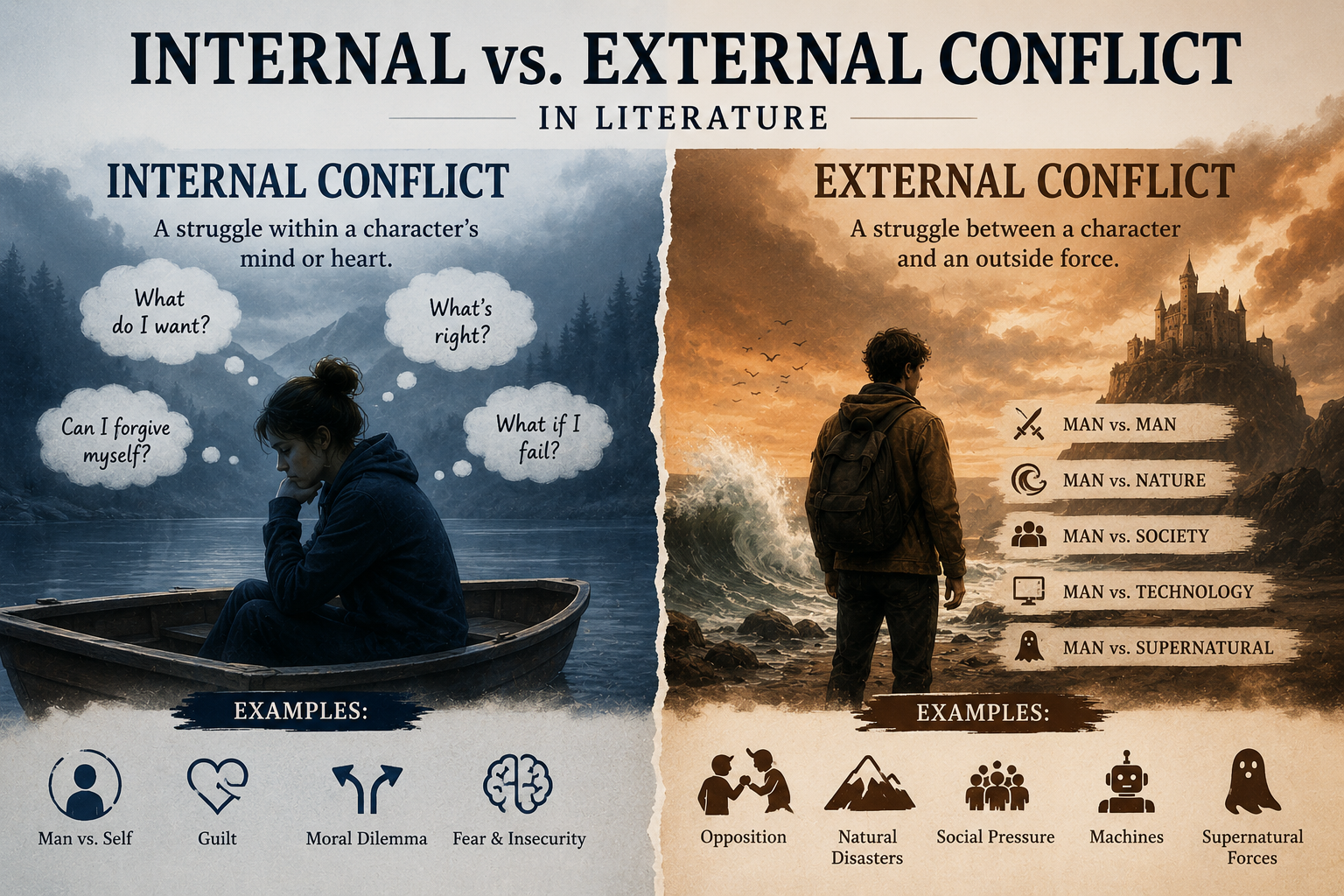
An internal conflict happens inside a character. It may involve guilt, fear, doubt, desire, or a hard choice.
An external conflict happens between a character and an outside force. That force may be another person, society, nature, or fate.
The easiest way to keep Internal vs External Conflict Explained in your mind is this: internal conflict is private, while external conflict is visible.
A character can have both at the same time. In fact, many strong stories use both because outer problems often expose inner struggles.
What Is Internal Conflict?
Internal conflict is a battle within the character.
A character may want two things that cannot both happen. They may feel pressure to act, but fear the result.
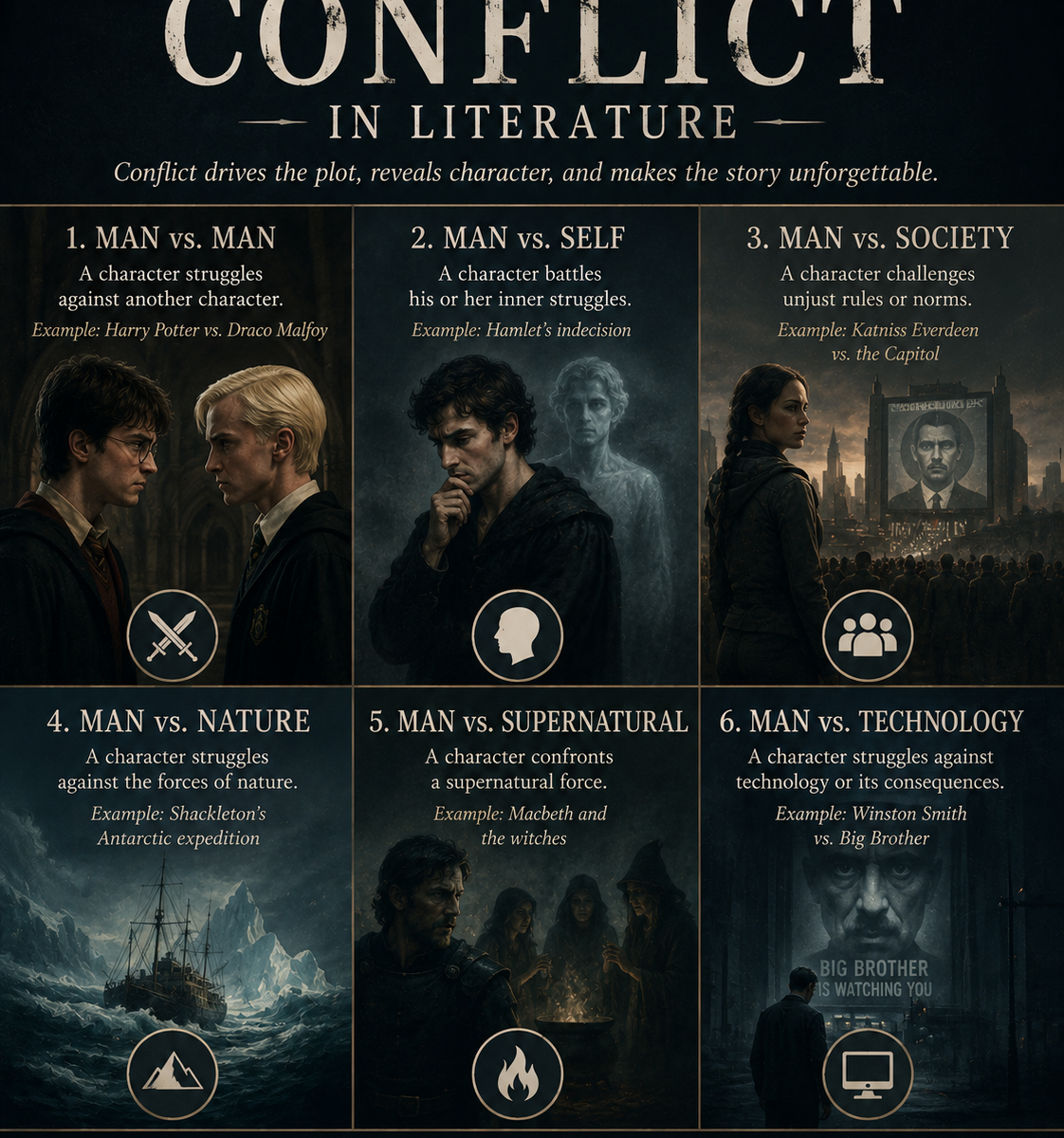
In Shakespeare’s Hamlet, Hamlet struggles with grief, anger, doubt, and the need for revenge. His outer problem is Claudius, but his inner problem is his own hesitation.
That inner struggle makes him more complex. He is not just a prince with a mission. He is a person trapped by thought, pain, and fear.
You can read more about the play through Britannica’s overview of Hamlet.
What Is External Conflict?
External conflict is a struggle against something outside the character.
This kind of conflict is often easier to spot. A character may fight a villain, face unfair laws, survive a storm, or resist social pressure.
In The Hunger Games by Suzanne Collins, Katniss faces the Capitol, the arena, and the other tributes. These are external conflicts because they exist outside her mind.
Yet Katniss also has internal conflict. She must decide how far she will go to survive without losing her sense of right and wrong.
That mix of inner and outer pressure is one reason the story feels so intense.
Internal vs External Conflict Explained Through Literary Examples
Examples make the difference much easier to see.
In Macbeth, Macbeth’s external conflict includes battles, enemies, and threats to his power. His internal conflict comes from ambition, guilt, and fear.
His wife pushes him toward murder, but the deepest struggle happens inside him. He knows what he wants, but he also knows the cost.
In The Great Gatsby, Gatsby’s external conflict includes class barriers and his rivalry with Tom Buchanan. His internal conflict comes from his dream of repeating the past.
This is where Internal vs External Conflict Explained becomes useful. Gatsby’s real tragedy is not only that society blocks him. It is also that he cannot let go of an impossible dream.
For helpful background, see Britannica’s entry on The Great Gatsby.
Internal vs External Conflict Explained for Essay Analysis
Conflict helps you move from plot summary to real analysis.
Use Internal vs External Conflict Explained as a lens. Do not just say what happens. Ask what the conflict reveals about the character, theme, or author’s message.
Start by asking where the pressure comes from. Is it inside the character, outside the character, or both?
Then ask what choice the character faces. A good conflict usually forces a decision, even if the character avoids it for a while.
You can also ask how the conflict changes the character. Does the character grow, break, lie to themselves, or see the world more clearly?
For a deeper method, try our guide on how to read literature like a scholar. It can help you connect conflict to symbols, themes, and character arcs.
Common Mistakes in Internal vs External Conflict Explained
The most common mistake is treating every problem as the same kind of conflict.
If a character feels guilty, that is internal. If a character is chased by an enemy, that is external.
Another mistake is ignoring how the two types connect. A storm, war, or argument may create pressure, but the character’s response can reveal fear, pride, or guilt.
Strong essays often explain that link. The outer conflict shows what the character faces. The inner conflict shows who the character is.
Amazon Books That Show Conflict Well
These books are useful if you want to study conflict in action.
- Macbeth by William Shakespeare: A strong example of ambition, guilt, and violence.
- The Hunger Games by Suzanne Collins: A clear example of survival, power, and moral choice.
You can find these titles on Amazon, at school libraries, or through most public library systems.
FAQ: Internal vs External Conflict Explained
What is the main difference between internal and external conflict?
Internal conflict happens inside a character’s mind or heart. External conflict happens between a character and an outside force.
Can a story have both types of conflict?
Yes. Most strong stories use both. The external conflict creates pressure, while the internal conflict shows how the character reacts.
Why is Internal vs External Conflict Explained important for essays?
It helps you write about more than plot. You can explain how conflict reveals theme, character, and meaning.
Is fear an internal or external conflict?
Fear itself is internal. The thing causing the fear may be external, such as a villain, law, storm, or social rule.
Key Takeaway
Internal vs External Conflict Explained comes down to where the struggle happens. Internal conflict is inside the character, external conflict comes from outside, and the best analysis often shows how both work together.