Literary Devices: A Clear Student Guide with Examples

literary devices

Literary devices help writers shape meaning, mood, and character. When you learn how they work, poems, novels, and plays become easier to understand.

This guide explains literary devices in plain language, with examples from books students often read in class.

This article contains affiliate links.

In this Guide

  • What literary devices are
  • Why they matter in literature
  • Common examples students should know
  • How to analyze them in essays
  • Helpful books and study links
  • FAQ
literary devices

What Are Literary Devices?

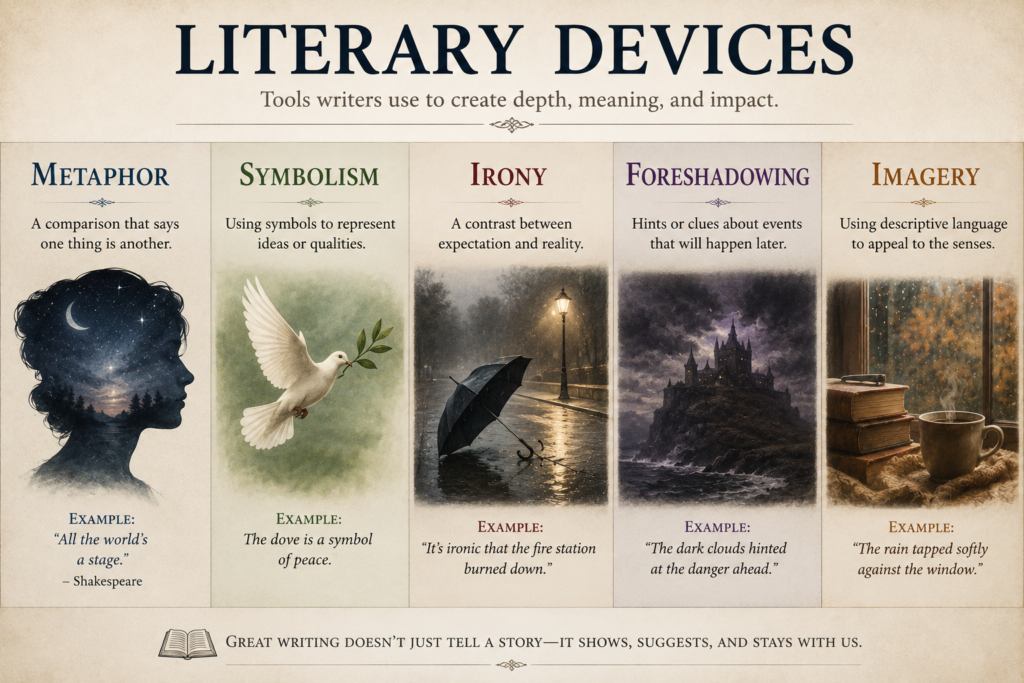
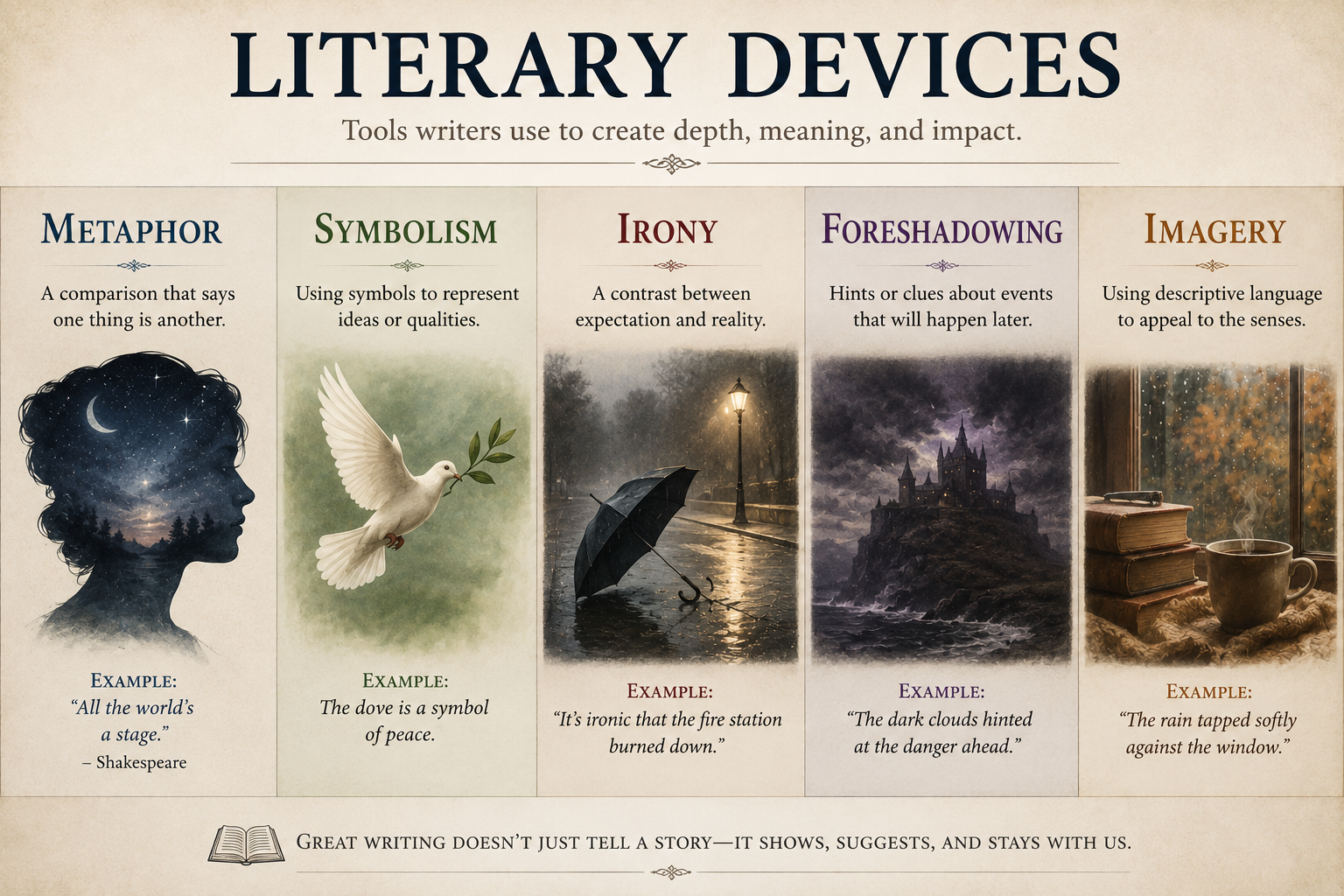
Literary devices are tools writers use to create meaning beyond the basic plot.

A writer may use a symbol, a repeated image, or a sharp contrast to guide how readers feel. These choices help turn a simple story into art.

For example, in The Great Gatsby, the green light is not just a light. It stands for Gatsby’s dream, his hope, and his distance from the life he wants.

Why Literary Devices Matter in Literature

They help you see how a text works, not just what happens in it.

Plot tells you the events. Literary devices show you why those events feel powerful.

In Romeo and Juliet, Romeo calls Juliet the sun. This metaphor shows how bright and life-giving she seems to him. It also reveals his intense, risky view of love.

Once you spot these choices, your essays become stronger. You can explain the author’s craft instead of only retelling the story.

Common Literary Devices Students Should Know

Start with the terms that appear most often in class texts and exams.

Metaphor

A metaphor compares two unlike things without using “like” or “as.” It helps readers see one idea in a fresh way.

When Shakespeare writes that Juliet is the sun, he gives Romeo’s love a bright and dramatic force.

Symbolism

A symbol is an object, place, or image that stands for a larger idea. Symbols often grow in meaning as the story moves on.

The conch in Lord of the Flies stands for order and shared rules. As the conch loses power, the boys lose control.

Irony

Irony creates a gap between what seems true and what is true. It can add humor, tension, or sadness.

In Oedipus Rex, Oedipus seeks the truth about a crime, but the truth points back to him. That irony makes the tragedy hit harder.

Foreshadowing

Foreshadowing hints at what may happen later. It builds tension and helps the ending feel earned.

In Of Mice and Men, early scenes prepare readers for the final choice George must make.

Imagery

Imagery uses sensory details to help readers picture a scene. It can appeal to sight, sound, touch, taste, or smell.

Poetry often relies on imagery. You can explore more terms in the Poetry Foundation glossary.

How to Analyze Literary Devices in an Essay

Good analysis connects the device to meaning.

Do not stop after naming the device. Explain what it does in the text.

A strong sentence might sound like this: “The green light in The Great Gatsby symbolizes Gatsby’s dream, but its distance shows that the dream may never become real.”

This sentence names the symbol, explains its meaning, and connects it to the novel’s larger theme.

For more help with close reading, see our guide to analyzing literature quotes. If you want a faster study plan, try our literature study guide bundle.

Quick Study Tips for Literary Devices

You do not need to memorize every term at once.

Choose a few key terms and practice with short passages. Ask: What stands out? What feeling does it create? How does it connect to theme?

When you mark a passage, look for repeated images or unusual word choices. Repetition often points to meaning.

For a broader view of literature as an art form, you can also read Britannica’s overview of literature.

Relevant Books to Read

These books can help students build confidence with analysis.

FAQ About Literary Devices

What are literary devices in simple terms?

They are writing tools that help authors create deeper meaning, emotion, or style.

What is the easiest device to spot?

Symbolism is often easy to find because it links a concrete object to a larger idea.

Are literary devices only used in poetry?

No. They appear in novels, plays, short stories, speeches, and songs.

How many should I discuss in an essay?

Focus on one or two strong examples. It is better to explain them well than to list many terms.

Key Takeaway

Literary devices help you move from summary to real analysis. When you ask how a writer creates meaning, you read with more skill and write with more confidence.
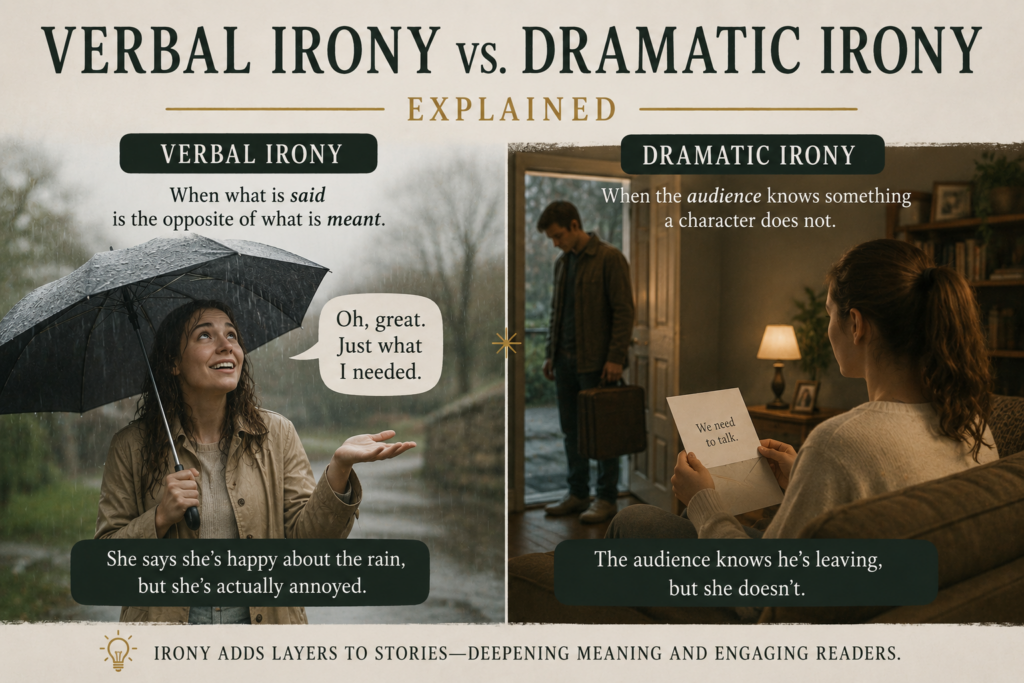
Verbal Irony vs Dramatic Irony Explained

Verbal irony
Verbal irony

Knowing the difference between verbal irony and dramatic irony can make literature feel much less confusing. In this guide, Verbal Irony vs Dramatic Irony Explained, you will learn what each term means, how to spot it, and how to use it in a strong essay.

Both types of irony deal with a gap between what seems true and what is true. The key is knowing where that gap happens.

In this Guide

Verbal Irony vs Dramatic Irony Explained: The Core Difference

The simplest way to tell them apart is to ask who knows the truth.

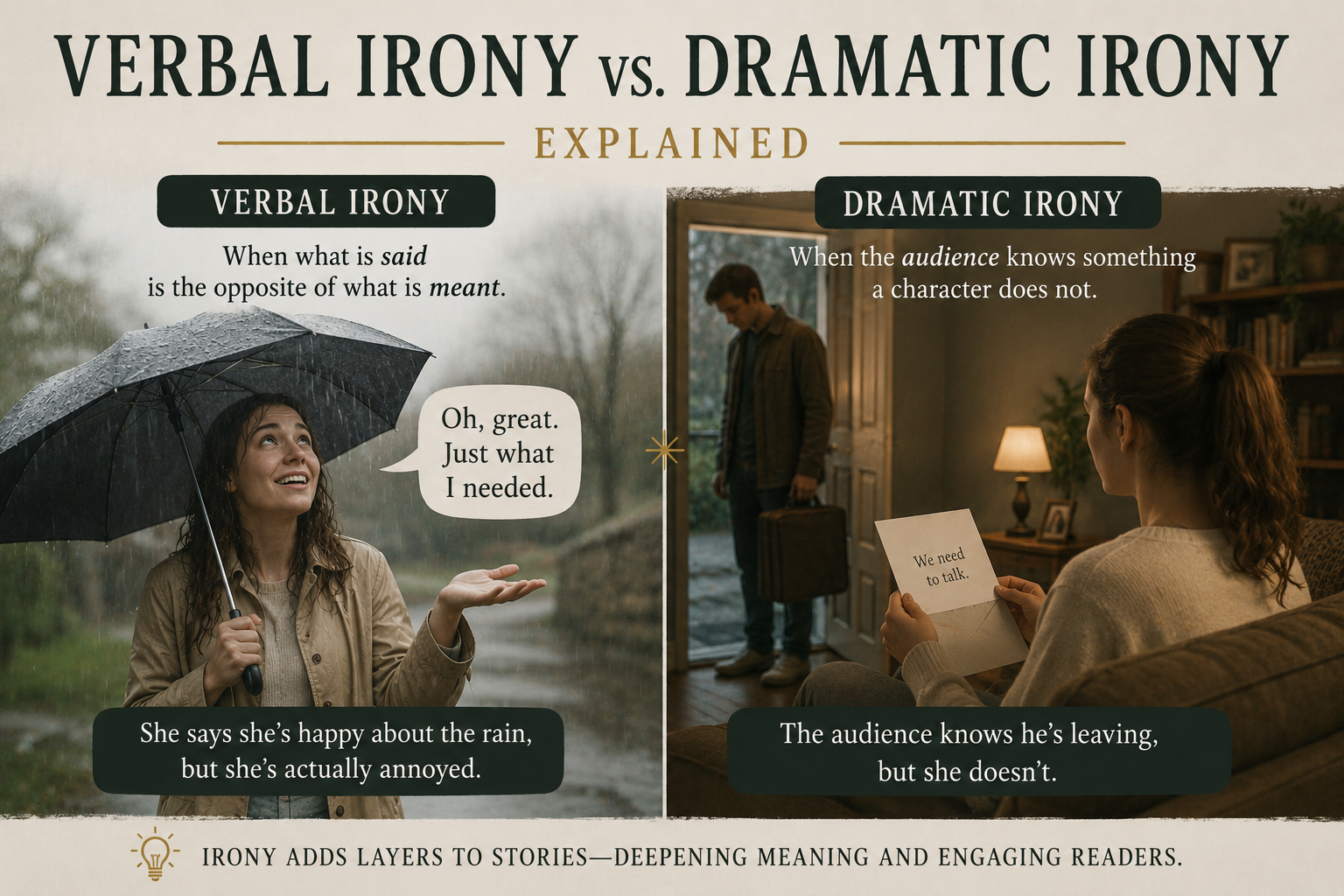
Verbal irony happens when a speaker says one thing but means something different. The meaning often depends on tone, context, or contrast.

Dramatic irony happens when the audience knows something a character does not know. This creates tension because readers can see the danger, mistake, or truth before the character can.

So, Verbal Irony vs Dramatic Irony Explained comes down to this: verbal irony is about what a character says, while dramatic irony is about what the audience knows.

If you want a broader review of related terms, this literary devices list can help you connect irony to satire, foreshadowing, and tone.

Verbal Irony vs Dramatic Irony Explained: What Verbal Irony Means

Verbal irony is a gap between words and meaning.

When a character uses verbal irony, they do not mean the literal words they say. Sometimes the line is funny. Other times, it feels sharp or bitter.

For example, if a student walks out of a hard test and says, “Well, that was easy,” the student likely means the opposite. That is verbal irony.

In literature, verbal irony often helps reveal a character’s attitude. It can show anger, pride, wit, or hidden pain.

Jane Austen uses verbal irony in Pride and Prejudice. The famous opening line says, “It is a truth universally acknowledged, that a single man in possession of a good fortune, must be in want of a wife.”

On the surface, the line sounds serious. But Austen is poking fun at social rules about marriage and money. The words sound grand, but the meaning is satirical.

This is why Verbal Irony vs Dramatic Irony Explained matters for close reading. If you miss the tone, you may miss the real meaning of the line.

Verbal Irony vs Dramatic Irony Explained: What Dramatic Irony Means

Dramatic irony is a gap between the audience’s knowledge and a character’s knowledge.

The character speaks or acts without the full truth. The reader knows more, so the scene feels tense, sad, or darkly funny.

In Romeo and Juliet, the audience knows Juliet is not truly dead. Romeo does not know this. When he finds her and believes she has died, the scene becomes tragic because readers can see the mistake before he can.

This is one of the clearest examples of dramatic irony in English literature. The audience wants Romeo to learn the truth, but he acts too soon.

Sophocles also uses dramatic irony in Oedipus Rex. Oedipus searches for the cause of a plague, but the audience slowly sees that he himself is tied to the crime he wants to solve.

For more background on the term, you can read Britannica’s overview of irony in literature.

Verbal Irony vs Dramatic Irony Explained Through Literature

Examples make the difference easier to see.

In Julius Caesar, Mark Antony calls Brutus an “honourable man” during his funeral speech. He repeats the phrase while proving that Brutus acted with betrayal. The words say one thing, but the meaning points the other way.

That is verbal irony. Antony’s tone and context change the meaning.

In Macbeth, King Duncan trusts Macbeth and praises his castle. The audience already knows Macbeth plans to kill him. Duncan does not know he has entered a place of danger.

That is dramatic irony. The audience’s knowledge makes the scene feel tense.

In The Odyssey, Odysseus hides his identity when he returns home. The audience knows who he is, but many characters do not. Their words and actions carry extra meaning because readers know the truth.

When you compare these examples, Verbal Irony vs Dramatic Irony Explained becomes much clearer. One depends on speech. The other depends on unequal knowledge.

Verbal Irony vs Dramatic Irony Explained for Literary Analysis

To write about irony well, do more than name the device.

Start by explaining the gap. Ask: what is said versus what is meant? Or ask: what does the audience know that the character does not?

For verbal irony, focus on tone. A character may sound polite but mean an insult. A narrator may sound serious but expose a foolish idea.

For dramatic irony, focus on effect. The audience may feel fear, pity, or suspense because they know what the character cannot see.

A strong sentence might look like this:

“Shakespeare uses dramatic irony in Romeo and Juliet because the audience knows Juliet is alive, while Romeo believes she is dead. This makes Romeo’s choice feel more tragic because the reader sees that the disaster could have been avoided.”

For verbal irony, you might write:

“Austen uses verbal irony in the opening of Pride and Prejudice to mock the social belief that wealthy men must be seeking wives. The formal tone makes the idea sound official, but the real meaning is critical and playful.”

That is the heart of Verbal Irony vs Dramatic Irony Explained in essay form. Identify the type, explain the gap, then connect it to the author’s purpose.

Quick Comparison: Verbal Irony vs Dramatic Irony Explained

A quick side-by-side view can help before a quiz or essay.

Type of Irony Where the Gap Happens Simple Example Common Effect
Verbal irony Between words and meaning A character says “Lovely weather” during a storm Humor or criticism
Dramatic irony Between audience knowledge and character knowledge The reader knows a secret that the character misses Suspense or tragedy

If you are not sure which one you see, ask one question: is the irony in the words, or is it in what the audience knows?

Common Mistakes Students Make

Many students mix up verbal irony and sarcasm.

Sarcasm is a kind of verbal irony, but it is usually harsher. Verbal irony can be funny, polite, or subtle. Sarcasm tends to mock.

Another common mistake is calling every surprise “dramatic irony.” A plot twist is not always dramatic irony. The audience must know something important before the character does.

It also helps to avoid vague phrases like “this makes the story interesting.” Instead, explain the exact effect. Does the irony create suspense? Does it reveal a flaw? Does it help the author criticize society?

For more help with terms that often appear in essays, see this guide to literary devices.

Books That Help You Study Irony

These books include strong examples of verbal irony, dramatic irony, or both.

  • Pride and Prejudice by Jane Austen
  • Romeo and Juliet by William Shakespeare
  • Oedipus Rex by Sophocles

You can also explore the Folger Shakespeare Library’s resources on Romeo and Juliet for more context on Shakespeare’s tragedy.

FAQ: Verbal Irony vs Dramatic Irony Explained

What is the main difference between verbal irony and dramatic irony?

Verbal irony happens when someone says one thing but means another. Dramatic irony happens when the audience knows something a character does not.

Is sarcasm the same as verbal irony?

Not exactly. Sarcasm is a sharper form of verbal irony. It often aims to mock or criticize.

Can dramatic irony happen in a novel?

Yes. Dramatic irony can happen in novels, plays, short stories, and films. It only needs a gap between what the audience knows and what a character knows.

Why do authors use irony?

Authors use irony to create humor, build tension, reveal character, or criticize a belief.

How do I write about irony in an essay?

Name the type of irony, explain the gap, and connect it to the meaning of the work.

Key Takeaway

Verbal Irony vs Dramatic Irony Explained is simple once you focus on the gap. Verbal irony is about words versus meaning, while dramatic irony is about audience knowledge versus character knowledge.

If you can explain that difference with a clear example, you can use irony with confidence in any literature essay.

What Is Irony in Literature? A Beginner-Friendly Guide

Literary Irony

Have you ever read a scene where the reader knows the truth, but a character does not? That gap is one reason students ask, What Is Irony in Literature? Irony can make a story more powerful, more painful, or more funny.

In this Guide

Literary Irony

What Is Irony in Literature? A Simple Definition

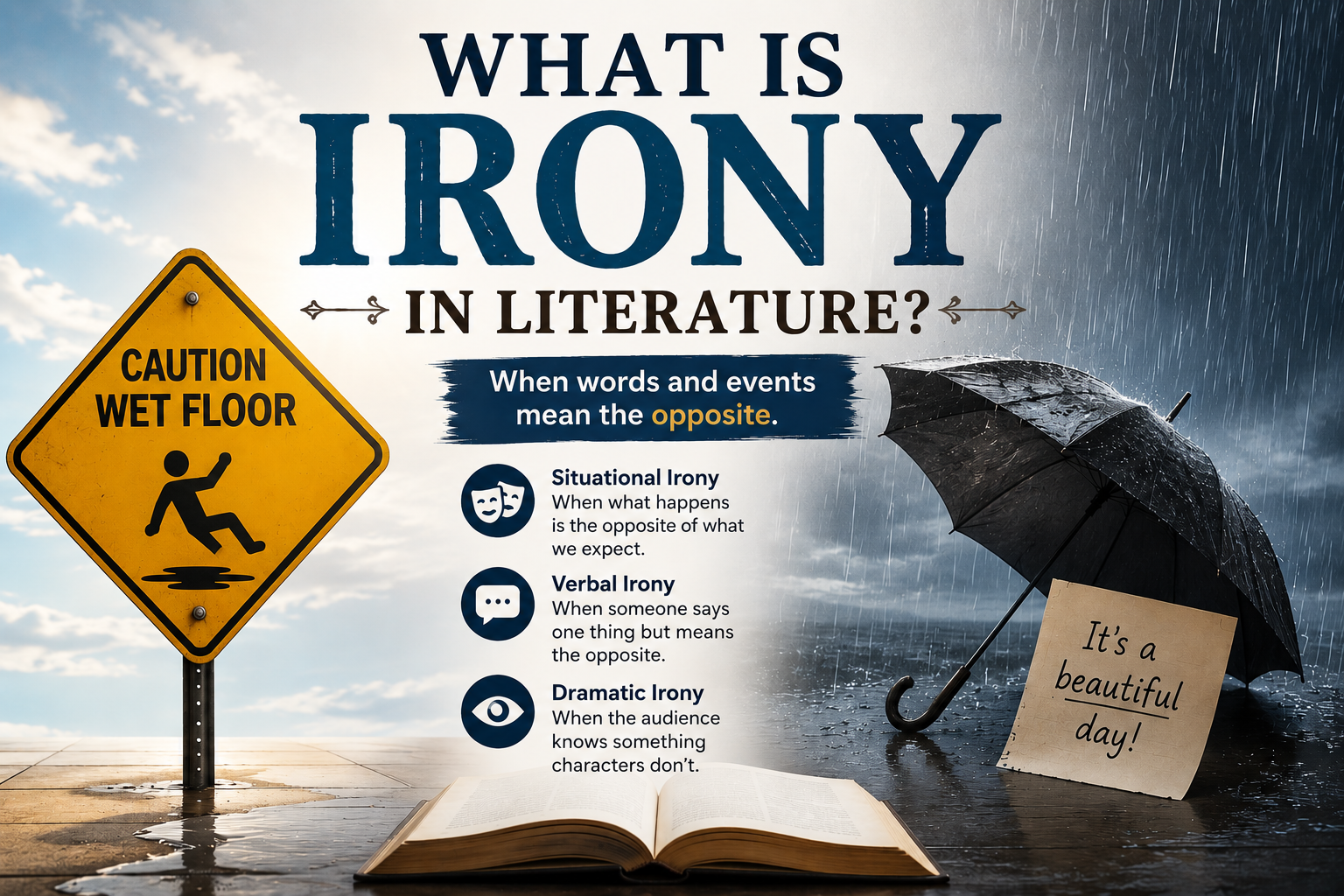
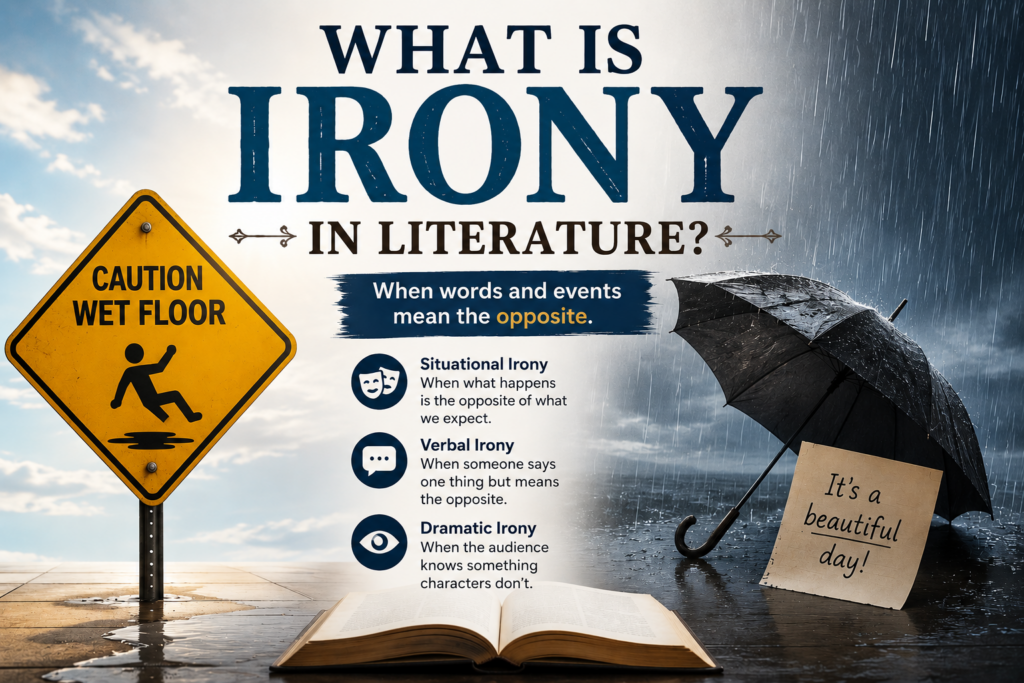
Irony happens when there is a clear gap between what seems true and what is actually true.

In literature, irony often appears when words, events, or situations do not match what we expect. The mismatch creates meaning.

When teachers ask, What Is Irony in Literature?, they are usually asking you to notice this gap. Irony is not just a random surprise. It must reveal something important about a character, theme, or conflict.

For example, if a fire station burns down, that is ironic because the place meant to stop fires becomes a victim of fire. In a story, that kind of twist can point to weakness, pride, bad luck, or a deeper message.

What Is Irony in Literature? Common Types to Know

Most classroom discussions focus on a few major forms of irony.

Verbal Irony

Verbal irony happens when a speaker says one thing but means something different.

This is not always sarcasm, though sarcasm is one type of verbal irony. Sarcasm is often sharp or mocking. Verbal irony can be gentle, funny, bitter, or serious.

In Jane Austen’s Pride and Prejudice, the famous opening line sounds serious: “It is a truth universally acknowledged…” Yet Austen is also mocking the way society treats marriage and money.

Dramatic Irony

Dramatic irony happens when the audience knows something a character does not know.

Shakespeare uses this often. In Romeo and Juliet, the audience knows Juliet is alive, but Romeo believes she is dead. This makes the scene heartbreaking because we can see the truth before he can.

Dramatic irony can create suspense because readers wait for the character to learn what they already know.

Situational Irony

Situational irony happens when the result of an event is the opposite of what we expect.

O. Henry’s “The Gift of the Magi” is a classic example. Della sells her hair to buy Jim a chain for his watch. Jim sells his watch to buy Della combs for her hair.

Their gifts become useless in a practical sense, but the irony shows their deep love.

What Is Irony in Literature? Why It Matters in Stories

Irony helps writers say more without spelling everything out.

A simple answer to What Is Irony in Literature? is this: it is a tool that reveals hidden truth. It can show that a character is blind to reality. It can expose unfair rules in society. It can also make a happy scene feel uneasy.

Irony often works with tone and foreshadowing. If you want to compare it with other story tools, visit our literary devices list.

Irony matters because it asks readers to think. Instead of just accepting what a character says, we must ask what the story really means.

What Is Irony in Literature? Famous Examples

Well-known books and plays use irony to build theme, conflict, and emotion.

Romeo and Juliet by William Shakespeare

The ending of Romeo and Juliet is full of dramatic irony. Romeo believes Juliet is dead, but the audience knows she has taken a sleeping potion.

This irony makes the tragedy feel even worse. The audience sees that the disaster could have been avoided.

“The Gift of the Magi” by O. Henry

This short story is one of the clearest examples of situational irony. Both main characters give up their most valuable item to buy a gift for the other.

The twist is painful and sweet at the same time. The gifts no longer work, but the love behind them becomes clear.

Animal Farm by George Orwell

In Animal Farm, the animals rebel because they want freedom. Over time, their new leaders become just as cruel as the humans they replaced.

This irony supports Orwell’s warning about power. The story shows how a revolution can fail when leaders become corrupt.

For more background on the term, you can explore Britannica’s entry on irony.

How to Spot Irony While You Read

The best way to find irony is to look for a gap.

Ask yourself what a character believes. Then ask what the reader knows. If those answers do not match, you may have dramatic irony.

Next, look at what a character says. If the words do not match the true meaning, you may have verbal irony.

Then check the outcome of a scene. If the result flips what you expected, you may have situational irony.

When you ask What Is Irony in Literature? during analysis, do not stop at naming the type. Explain what the irony does. Does it create humor? Does it reveal a flaw? Does it support the theme?

How to Answer What Is Irony in Literature? in an Essay

A strong essay answer should define irony, identify the type, and explain its effect.

Here is a simple sentence frame:

The author uses irony when [describe the gap] to show [explain the meaning].

For example:

Shakespeare uses dramatic irony when the audience knows Juliet is alive but Romeo does not, which makes the ending of the play more tragic.

This kind of answer is clear because it does more than label the device. It connects the device to meaning.

Books That Help You Practice Irony

These books are easy to find on Amazon or at most libraries. They give clear examples of irony in action.

  • The Gift of the Magi and Other Stories by O. Henry
  • Animal Farm by George Orwell

To review irony alongside other terms, you can also use our guide to common literary devices.

FAQ: What Is Irony in Literature?

What Is Irony in Literature?

Irony in literature is a gap between what is expected and what is true. That gap helps create meaning, humor, tension, or surprise.

Is irony the same as sarcasm?

No. Sarcasm is a sharp form of verbal irony. Irony is broader and can appear in speech, events, or whole plots.

What is the easiest type of irony to spot?

Dramatic irony is often the easiest to spot. If you know something a character does not know, you are likely seeing dramatic irony.

Why do authors use irony?

Authors use irony to reveal truth in a clever way. It can expose a character’s mistake, criticize society, or make a scene more emotional.

How can I write about irony in a paragraph?

Name the type of irony, describe the gap, and explain why it matters. Always connect irony to theme or character.

Key Takeaway

Irony is all about contrast. When you notice a gap between appearance and reality, pause and ask what the author wants you to understand. That one habit can make your reading and analysis much stronger.

Important Fahrenheit 451 Quotes Explained for Students

Fahrenheit 451 quotes

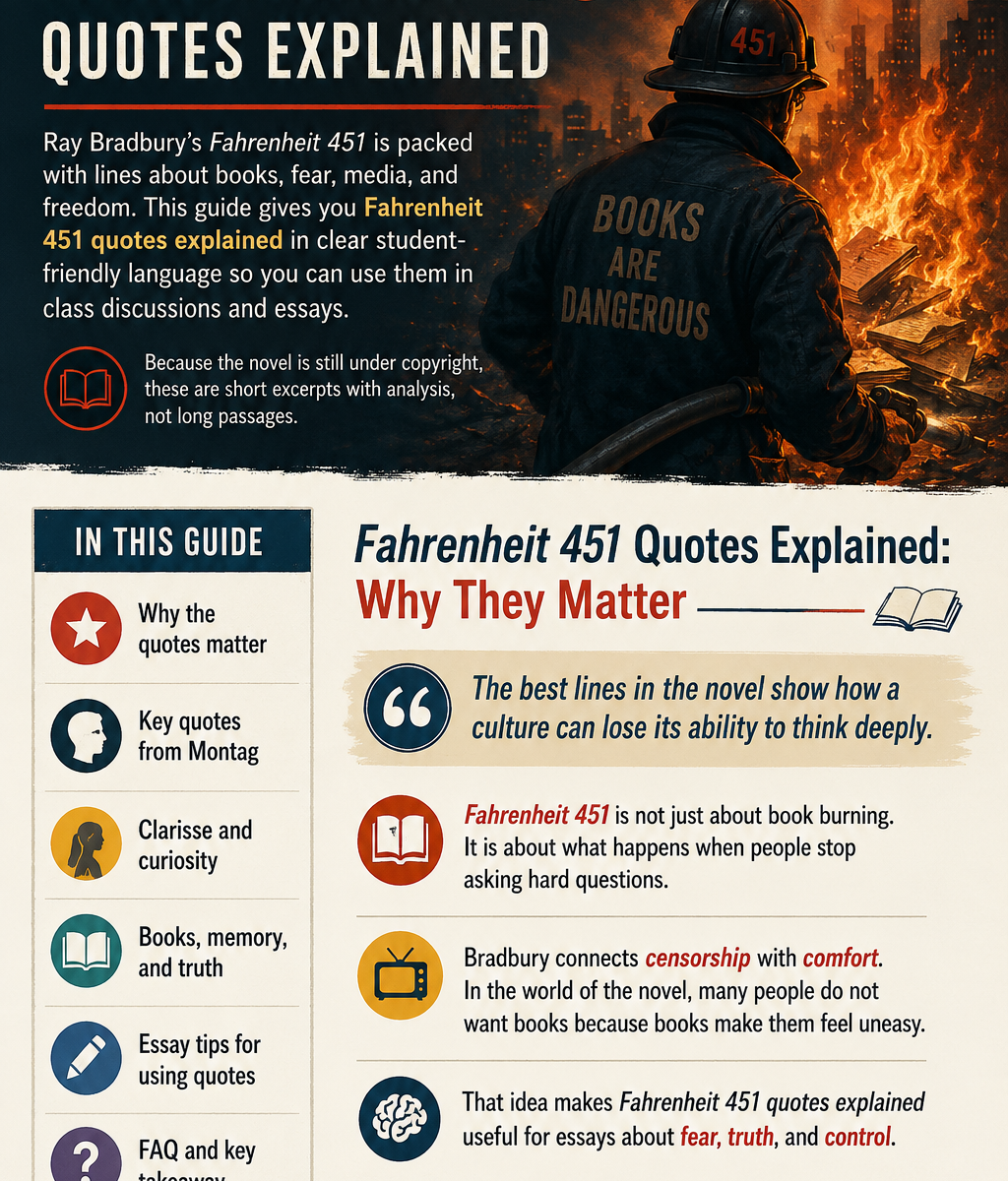
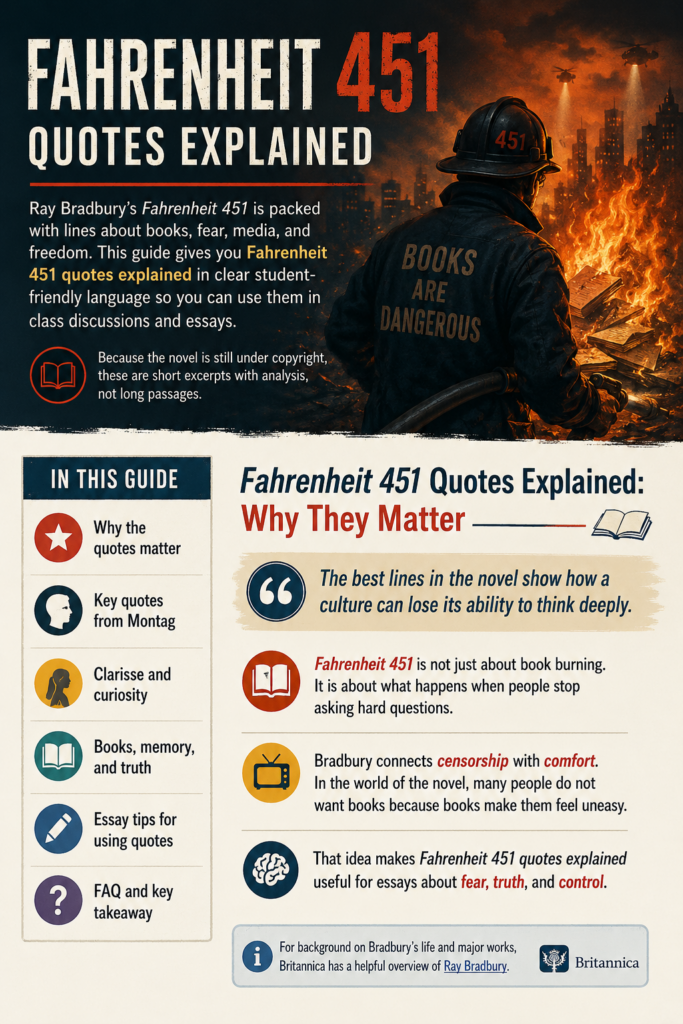
Ray Bradbury’s Fahrenheit 451 is packed with lines about books, fear, media, and freedom. This guide gives you Fahrenheit 451 quotes explained in clear student-friendly language so you can use them in class discussions and essays.

Because the novel is still under copyright, these are short excerpts with analysis, not long passages.

Fahrenheit 451 quotes

In this Guide

  • Why the quotes matter
  • Key quotes from Montag
  • Clarisse and curiosity
  • Books, memory, and truth
  • Essay tips for using quotes
  • FAQ and key takeaway

Fahrenheit 451 Quotes Explained: Why They Matter

The best lines in the novel show how a culture can lose its ability to think deeply.

Fahrenheit 451 is not just about book burning. It is about what happens when people stop asking hard questions.

Bradbury connects censorship with comfort. In the world of the novel, many people do not want books because books make them feel uneasy. That idea makes Fahrenheit 451 quotes explained useful for essays about fear, truth, and control.

For background on Bradbury’s life and major works, Britannica has a helpful overview of Ray Bradbury.

“It was a pleasure to burn.”

This opening line is short, sharp, and disturbing.

Montag begins the novel as a fireman who enjoys destroying books. The word “pleasure” tells us that violence has become normal to him.

This quote works well in essays about irony. Firefighters usually protect homes, but in Bradbury’s world they attack knowledge. That reversal builds the novel’s warning from the first page.

You can compare this to Macbeth, where a character’s first choices reveal the direction of the tragedy. Montag’s early joy does not last, but it shows how far he must change.

“Are you happy?”

Clarisse’s question cuts through Montag’s entire life.

This is one of the most important short quotes in the novel. Clarisse does not argue with Montag. She asks a simple question he has avoided.

When students look for Fahrenheit 451 quotes explained, this line is a strong choice because it reveals conflict. Montag looks successful in his society, but he feels empty.

In an essay, you might say the question starts Montag’s inner change. It makes him see that his job, marriage, and culture may not be as stable as they seem.

“We need to be really bothered once in a while.”

This line shows Bradbury’s belief that comfort can become dangerous.

The novel suggests that people grow when they face hard ideas. Books matter because they challenge readers instead of simply calming them.

This quote is useful for writing about the theme of discomfort. Bradbury does not present pain as good by itself. He shows that honest thought often begins when something shakes us awake.

If you need help turning a quote into a paragraph, read our guide on how to write a literary analysis essay.

“A book is a loaded gun…”

Beatty uses this image to explain why the government fears books.

A gun is powerful because it can change a situation fast. By comparing books to weapons, Beatty admits that ideas have force.

This is one of the clearest censorship quotes in the novel. It shows that the state is not only afraid of pages. It is afraid of independent thought.

For Fahrenheit 451 quotes explained in an essay, this line fits a claim about power. Books threaten control because they help people question what they are told.

“There must be something in books…”

Montag begins to see books as more than objects.

He notices that people suffer to protect them. That makes him wonder what books contain that could matter so much.

This quote is important because it marks a shift in Montag’s mind. He moves from blind obedience toward curiosity.

In a student essay, you could connect this moment to theme. Bradbury suggests that curiosity is the first step toward freedom.

Fahrenheit 451 Quotes Explained for Essays

A strong essay does more than place a quote in the paragraph.

After you use a quote, explain how the words support your claim. Do not assume the quote speaks for itself.

Here is a simple method: make a claim, give the short quote, then explain a key word or image. For example, in “It was a pleasure to burn,” the word “pleasure” matters because it shows Montag’s early emotional state.

When writing about Fahrenheit 451 quotes explained, keep your focus on meaning, not plot summary. Your teacher wants to see how you read the language.

If you want a ready tool for planning paragraphs, you can also use this literary analysis study resource.

“The magic is only in what books say…”

Faber explains that books are valuable because they hold human experience.

He does not treat books as sacred objects by themselves. The value comes from the ideas, details, and honest thought inside them.

This quote helps students avoid a weak essay claim. Bradbury is not saying paper is magic. He is saying that careful thought matters.

This connects to many classic works. In To Kill a Mockingbird, reading and empathy matter because they help people see beyond fear and rumor.

“Remember, the firemen are rarely necessary.”

Beatty’s point is chilling because it places blame on the culture itself.

The government burns books, but many citizens have already stopped caring about them. That means censorship can happen before any fire is lit.

This quote is great for essays about social responsibility. Bradbury warns that freedom can fade when people choose distraction over thought.

As Fahrenheit 451 quotes explained go, this one is especially useful for modern connections. It asks readers to think about what people ignore, not only what governments ban.

“Stuff your eyes with wonder…”

Granger’s advice points toward hope after destruction.

This line tells readers to stay awake to the world. Wonder is the opposite of numb entertainment in the novel.

Bradbury’s ending does not solve every problem, but it gives Montag a new purpose. Memory, attention, and shared stories can help rebuild a damaged world.

You can connect this idea to Matthew Arnold’s poem “Dover Beach,” which appears in the novel. The poem’s line about “ignorant armies” fits Bradbury’s fear of a confused society. You can read the poem at the Poetry Foundation.

More Fahrenheit 451 Quotes Explained by Theme

These short quotes can help you choose evidence for different essay topics.

Censorship and control

Use “A book is a loaded gun…” when you want to show that ideas threaten authority. This quote supports arguments about fear and power.

Technology and distraction

Mildred’s world of screens shows a society that avoids silence and thought. For this theme, focus on scenes where the parlor walls replace real connection.

Change and awakening

Use “Are you happy?” to show the start of Montag’s change. It is a small question with a huge effect.

For more help with essay structure, see our step-by-step post on building a literary analysis essay.

Books to Read with Fahrenheit 451

If you are studying dystopian literature, these books pair well with Bradbury’s novel:

  • 1984 by George Orwell
  • Brave New World by Aldous Huxley
  • The Giver by Lois Lowry

Each book explores control and social pressure in a different way.

FAQ: Fahrenheit 451 Quotes Explained

What is the most famous quote from Fahrenheit 451?

“It was a pleasure to burn” is one of the most famous lines because it opens the novel and sets the dark tone.

What quote shows Montag changing?

“There must be something in books…” shows Montag starting to question his world and his job.

What quote is best for an essay about censorship?

“A book is a loaded gun…” is a strong choice because it shows why people in power fear ideas.

Can I use short quotes from Fahrenheit 451 in a school essay?

Yes. Use brief quotes, cite them as your teacher asks, and spend more time explaining the language than repeating plot.

Key Takeaway

Fahrenheit 451 quotes explained well can help you show how Bradbury uses simple lines to reveal big ideas about freedom, fear, and thought. The best essays do not just quote the novel. They explain why the words matter.

New Criticism and the Poetry of Emily Dickinson

New Criticism Emily Dickinson

How Close Reading, Paradox, and Imagery Reveal Meaning in Dickinson’s Poetry

Literary theory gives us different lenses for interpreting literature. Each theory asks us to look at a text in a different way. Some theories focus on history. Some focus on the author. Others focus on culture or politics. New Criticism (also known as Formalism) is different because it tells us to focus only on the text itself.

When we read Emily Dickinson through New Criticism, we begin to notice how much meaning is hidden in her word choice, punctuation, rhyme, and imagery. Her poems are short, but they are very dense.

This makes them perfect for close reading and formal analysis. If you want to learn the basics of close reading first, read this guide: https://rapidreadspress.com/what-is-close-reading-in-literature/

This article contains affiliate links.

In this Guide

What New Criticism Is
Key Ideas of New Criticism
New Criticism Emily Dickinson Analysis
Example Passages and Analysis
How to Write a New Criticism Essay
Final Thoughts
FAQ

New Criticism Emily Dickinson
Image by Carla Paton

What Is New Criticism?


New Criticism Emily Dickinson begins with a simple idea: the meaning of a poem is inside the poem itself. We do not need the author’s biography. We do not need historical background. And, we do not need to know what the author intended.

Instead, we look closely at the words on the page. We pay attention to imagery, rhyme, paradox, irony, tone, and structure. New Critics believed that a poem is like a machine. Each part works together to create meaning.

If you want to learn how to mark up a poem as you read, you may find this helpful: https://rapidreadspress.com/how-to-annotate-literature/

Key Ideas of New Criticism

New Criticism Emily Dickinson analysis usually focuses on a few important ideas. The first is close reading, which means reading slowly and paying attention to every word.

The second is paradox, which is when a poem contains ideas that seem to contradict each other but are both true.

The third is irony, where the meaning is different from what we expect.

The fourth is tension, which is the conflict between different ideas in the poem.

The fifth is unity, which means that all parts of the poem work together to create a single meaning.

Dickinson’s poetry is full of paradox and tension, which is why New Criticism works so well with her poems.

If you need a refresher on literary devices like paradox and irony, see this list: https://rapidreadspress.com/literary-devices-list/

image-slider-with-thumbnail1.jpeg
PlayPause
previous arrow
next arrow
image-slider-with-thumbnail1.jpeg
image-slider-with-thumbnail3.jpeg
image-slider-with-thumbnail4.jpeg
ChatGPT Image Jun 27, 2026, 06_33_13 PM
ChatGPT Image Jun 27, 2026, 06_36_37 PM
ChatGPT Image Jun 27, 2026, 06_38_39 PM
ChatGPT Image Jun 27, 2026, 06_31_22 PM
image-slider-with-thumbnail7.jpeg
ChatGPT Image Jun 27, 2026, 06_29_43 PM
ChatGPT Image Jun 27, 2026, 06_27_44 PM
image-slider-with-thumbnail6.jpeg
ChatGPT Image Jun 27, 2026, 06_15_07 PM
image-slider-with-thumbnail5.jpeg
ChatGPT Image Jun 27, 2026, 06_22_43 PM
ChatGPT Image Jun 27, 2026, 06_25_37 PM
ChatGPT Image Jun 27, 2026, 06_19_43 PM
ChatGPT Image Jun 27, 2026, 06_12_00 PM
ChatGPT Image Jun 27, 2026, 06_08_50 PM
ChatGPT Image Jun 26, 2026, 04_54_23 PM
ChatGPT Image Jun 27, 2026, 05_53_51 PM
ChatGPT Image Jun 28, 2026, 08_35_55 AM
previous arrow
next arrow

New Criticism Applied to Emily Dickinson

New Criticism Emily Dickinson analysis works well because Dickinson’s poems are very compact. She uses dashes, slant rhyme, and unusual capitalization. These are not random choices. New Critics would say that every punctuation mark matters. Every word matters. Every sound matters.

For example, in the poem “Because I could not stop for Death,” Death is described as kind and polite. This creates tension because death is normally frightening. The poem creates meaning through this contrast.

The slow rhythm of the poem also mirrors the slow carriage ride toward death. A New Critic would focus on how the rhythm, imagery, and tone all work together to create meaning.

Not on Dickinson’s life. Not on history. Only on the poem.

If you want to get better at poetry analysis, this guide will help: https://rapidreadspress.com/how-to-analyze-poetry-step-by-step/

Example Passages and Analysis

Let’s look at a short example from Emily Dickinson:

“Hope is the thing with feathers
That perches in the soul”

A New Criticism Emily Dickinson reading would focus on the metaphor of the bird. Hope is not described as an idea. It is described as a living creature. The word “perches” suggests that hope stays and does not leave easily. The image of feathers suggests something light and gentle.

The poem never clearly defines hope, but the metaphor helps us understand it emotionally. The poem also creates tension because hope sings during storms. This creates a contrast between suffering and comfort.

A New Critic would argue that the meaning of the poem comes from this contrast and from the extended metaphor.

If you want to learn how to turn an observation like this into an essay, read this: https://rapidreadspress.com/how-to-write-a-literary-analysis-essay/

How to Write a New Criticism Essay

If you are writing a New Criticism Emily Dickinson essay, focus only on the poem. Do not write about Dickinson’s biography. Do not write about history unless it appears in the poem itself.

Start with a thesis about how the poem creates meaning through literary devices. Then write body paragraphs about imagery, paradox, tone, and structure.

Always include short quotations from the poem as evidence. Then explain how the words create meaning.

If you need help writing a thesis, this guide will help: https://rapidreadspress.com/how-to-write-a-thesis-statement-for-a-literary-analysis-essay/

If you want to see full essay examples, you can also look here: https://rapidreadspress.com/product/literary-analysis-essay-examples/

Or if you want a full toolkit for literary analysis essays, see this: https://rapidreadspress.com/product/the-literary-analysis-essay-toolkit/

Final Thoughts

New Criticism Emily Dickinson analysis teaches us an important lesson. Great poems are carefully constructed. Every word matters. Every image matters. When we slow down and read carefully, we begin to see patterns, contrasts, and symbols that we did not notice at first.

Emily Dickinson’s poetry is perfect for this kind of reading because her poems are short but full of meaning. New Criticism helps us see how much meaning can fit into just a few lines of poetry. Once you learn this method, you will start to see poetry differently. You will start to see that poems are not just written. They are built.

Key Takeaway

New Criticism teaches us to focus on the text itself, and Emily Dickinson’s poetry shows us why this method works so well. Her poems create meaning through imagery, paradox, irony, and structure, and close reading helps us see how all the parts work together.

FAQ – New Criticism Emily Dickinson

What is New Criticism in simple terms?

New Criticism is a way of reading literature that focuses only on the text itself, not the author’s life or historical background.

Why is Emily Dickinson good for New Criticism?

Her poems are short, dense, and full of literary devices like paradox, symbolism, and irony, which makes them perfect for close reading.

What literary devices do New Critics look for?

They often look for paradox, irony, symbolism, imagery, tone, and structure.
Do New Critics care about the author’s life?

No. New Criticism focuses only on the text itself.
How do you write a New Criticism essay?

Focus on literary devices, include quotations, and explain how the words create meaning.

error

Enjoy this article? Please spread the word :)

Follow by Email
BLUESKY
fb-share-icon
Reddit
LinkedIn
Share
RSS