Have you ever looked at an image and felt as though it was trying to tell you a story?
This ekphrastic poetry prompt invites you to step into a dreamlike scene filled with mystery, beauty, and unanswered questions. Ekphrastic writing encourages poets to respond to visual art with words. Instead of describing every detail, the goal is to explore the emotions, memories, and ideas the image awakens.
If you are new to the practice, our guide on how to analyze poetry step by step can help you notice the details that often inspire stronger poems: https://rapidreadspress.com/how-to-analyze-poetry-step-by-step/
Why This Ekphrastic Poetry Prompt Works
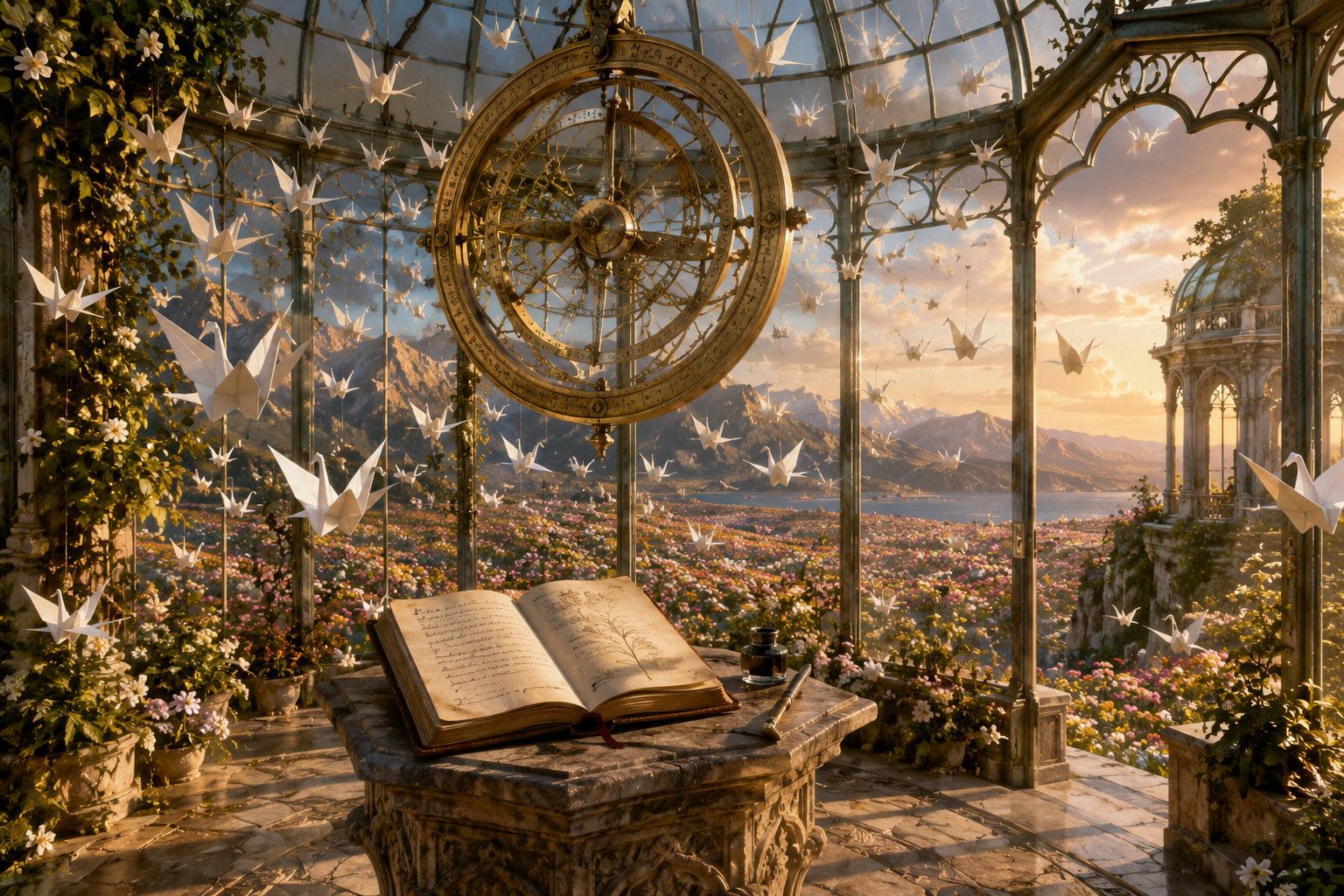
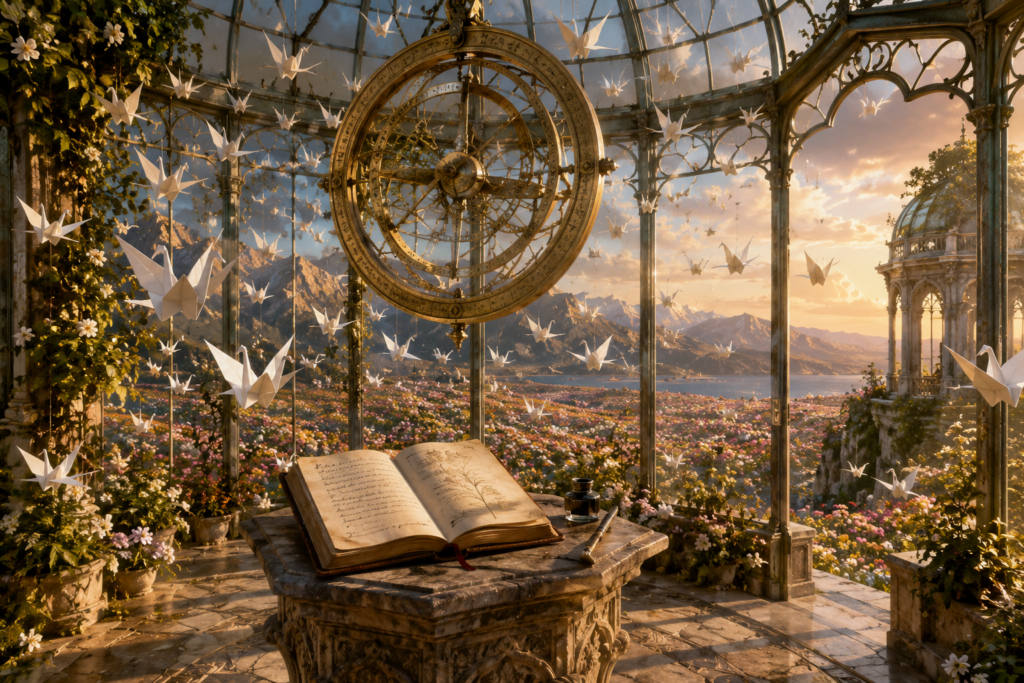
The image presents a strange but inviting setting. A glass conservatory sits above an endless field of flowers. White paper cranes move through the air. A giant astrolabe hangs suspended as if time itself has paused. An open journal waits on a stone pedestal.
Each object raises questions.
Who built this place? Why are the cranes gathering? What has been written in the journal? Is the astrolabe measuring stars, memories, or something else entirely?
Strong poetry often begins with curiosity. This ekphrastic poetry prompt gives you several symbolic elements that can spark a narrative, a meditation, or a lyrical exploration.
The Image
Imagine standing inside the conservatory. Sunlight filters through the glass walls. The scent of flowers drifts upward from the valley below. Hundreds of paper cranes circle overhead while the brass astrolabe slowly turns.
An open journal rests before you.
One page contains a message.
You cannot see all of the words.
You can only read the first sentence.
Write the poem that follows.
Writing From This Ekphrastic Poetry Prompt
You do not need to explain every detail in the scene. Focus on the element that captures your attention most strongly.
Perhaps the journal belongs to a traveler who never returned. Maybe the paper cranes carry messages from lost loved ones. The astrolabe could represent fate, memory, hope, or a search for direction.
As you write, pay attention to imagery and symbolism. If you would like a refresher on poetic techniques, our guide to literary devices in poetry offers useful examples: https://rapidreadspress.com/literary-devices-in-poetry/
Questions to Explore
What is written in the journal?
Why do the paper cranes circle the conservatory?
Who visits this place?
What does the astrolabe measure?
What emotion fills the space?
Or, what happens when the final crane lands?
You may answer one question or many. The strongest poems often grow from a single image that refuses to leave your mind.
A Creative Challenge
Write your poem in the voice of the conservatory itself.
What has it witnessed over the years?
What secrets does it keep?
How does it feel when visitors arrive searching for answers?
Changing the speaker can transform a familiar description into something surprising and memorable.
Learn More About Ekphrastic Poetry
Many poets throughout history have responded to visual art. The Academy of American Poets provides an excellent introduction to the tradition and examples of famous ekphrastic works: https://poets.org/glossary/ekphrasis
Whether your poem becomes a story, a reflection, or a meditation on wonder, this ekphrastic poetry prompt offers a rich visual world filled with symbols waiting for interpretation.
Take a few minutes to study the scene. Then begin with the first sentence you can imagine appearing in that journal and see where it leads.