
Themes in The Sun Also Rises: A Student-Friendly Guide

Lost Generation

Students often find Hemingway’s novel simple on the surface but complex underneath. This guide explains the themes in The Sun Also Rises so you can see how the characters, setting, and style work together.

By the end, you will have clearer ideas for class discussion, essays, and AP Literature style analysis.

In this Guide

Lost Generation

Why the themes in The Sun Also Rises matter

The novel’s major ideas grow from what the characters cannot say directly.

Ernest Hemingway writes with a spare style. His characters drink, travel, joke, and argue, but their deepest pain often stays hidden.

That is why the themes in The Sun Also Rises can feel quiet at first. The meaning sits beneath the scene, not always in the dialogue.

If you need help with the difference between topic and theme, start with this guide on how to identify theme in literature. It can help you turn a broad topic like “love” into a full theme statement.

The Lost Generation and postwar emptiness

Hemingway shows a world where old beliefs no longer feel strong enough.

One of the central themes in The Sun Also Rises is the damage left by World War I. Jake Barnes and his friends live after the war, but they do not seem healed.

They move from Paris to Spain, fill their days with meals and drinks, and avoid silence. Their lives seem full, yet the mood often feels hollow.

This is why the novel is often linked to the Lost Generation. These people survived a world crisis, but they lost trust in older ideas about honor, love, and purpose.

For helpful background on Hemingway’s life and era, see Britannica’s biography of Ernest Hemingway.

Love, desire, and emotional wounds

Love in this novel is real, but it is rarely simple or healing.

Jake loves Brett, and Brett cares for Jake. Still, their relationship cannot become the life they want.

Jake’s war wound makes their love painful in a very direct way. It also stands for a wider emotional wound that the whole group carries.

Brett is often desired by men around her, but attention does not bring peace. She has freedom, yet she also feels trapped by need and regret.

These themes in The Sun Also Rises show love as something that exposes pain rather than solves it. Hemingway does not treat romance as an easy cure.

A useful comparison is F. Scott Fitzgerald’s The Great Gatsby. Gatsby also believes desire can rebuild a broken life, but the novel proves that longing can twist reality.

Masculinity, pride, and insecurity

The men in the novel often act tough because they feel weak inside.

Masculinity is one of the most important themes in The Sun Also Rises. Jake, Robert Cohn, Mike Campbell, and Pedro Romero all show different versions of masculine identity.

Jake is calm and observant, but his injury shapes how he sees himself. Cohn uses boxing and fantasy to defend his pride.

Mike uses insults to hide shame. Romero, the bullfighter, seems controlled and graceful, which makes him powerful in Brett’s eyes.

Hemingway does not offer one simple answer about what it means to be a man. He shows how pride can protect a person, but it can also break them.

Escape through travel, drink, and pleasure

The characters keep moving because stillness would force them to face themselves.

The novel moves from Paris nightlife to the festival in Pamplona. The settings are lively, but they also reveal the characters’ need to escape.

Alcohol is everywhere in the novel. It helps the characters bond, but it also makes jealousy and cruelty worse.

Travel works in a similar way. Changing places gives the group brief relief, but it does not fix their deeper loneliness.

This is one reason the themes in The Sun Also Rises still feel modern. Many people know what it is like to stay busy in order to avoid grief.

Values, codes, and self-control

Hemingway respects people who follow a code, even when life feels broken.

Jake often seems strongest when he keeps control of himself. He suffers, but he does not explain every feeling.

Romero also follows a code through bullfighting. He has discipline, focus, and style under pressure.

The bullring becomes more than a sport setting. It shows a world where courage and order still seem possible.

These themes in The Sun Also Rises connect to Hemingway’s wider idea of grace under pressure. The world may be chaotic, but a person can still choose how to act.

For another view of literary modernism and its broken forms, browse the Poetry Foundation’s overview of modernism.

Nature, peace, and the need for order

The fishing trip offers a rare break from the noise of the social world.

When Jake and Bill go fishing, the tone changes. The air feels cleaner, and the pace slows.

This section matters because it shows what Jake lacks in Paris and Pamplona. Nature gives him a temporary sense of peace.

The trip does not erase his pain. Still, it gives the reader a glimpse of balance.

What makes the themes in The Sun Also Rises powerful is this contrast. The novel places noisy public life beside quiet private need.

How to write about themes in The Sun Also Rises

A strong theme statement should say what the novel argues, not just name a topic.

Do not write, “The theme is love.” That is too broad.

Try a full claim instead: “Hemingway shows that love can remain powerful even when trauma makes happiness impossible.”

For an essay, choose one theme and trace it across several scenes. You might focus on Jake and Brett, the fishing trip, or the bullfights.

AP Literature students should link theme to craft. Notice Hemingway’s short sentences, indirect dialogue, and repeated scenes of social escape.

For extra practice, use this theme analysis method before you draft your essay. You can also pair it with our student-friendly literature study resource for quick review.

Helpful books for deeper study

These books can help you place Hemingway’s novel in a wider literary context.

  • The Sun Also Rises by Ernest Hemingway
  • A Moveable Feast by Ernest Hemingway
  • The Great Gatsby by F. Scott Fitzgerald

FAQ: themes in The Sun Also Rises

What are the main themes in The Sun Also Rises?

The main themes in The Sun Also Rises include postwar emptiness, wounded love, insecure masculinity, escape, and the search for personal values.

Why is the Lost Generation important in the novel?

The Lost Generation helps explain the characters’ aimless lives. They survived the war era, but they struggle to believe in old ideals.

Is Brett Ashley a symbol?

Brett can be read as a symbol of modern freedom and modern pain. She resists old rules, yet she still feels trapped by desire and loss.

What does bullfighting represent?

Bullfighting represents control, courage, and ritual. It gives the novel a sharp contrast to the messy behavior of Jake’s social group.

How should I start an essay on this novel?

Start with one clear theme claim. Then choose scenes that show how Hemingway builds that idea through action, setting, and style.

Key takeaway

The best way to understand the themes in The Sun Also Rises is to look beneath the surface. Hemingway’s characters may sound casual, but their choices reveal a deep struggle to live with loss.
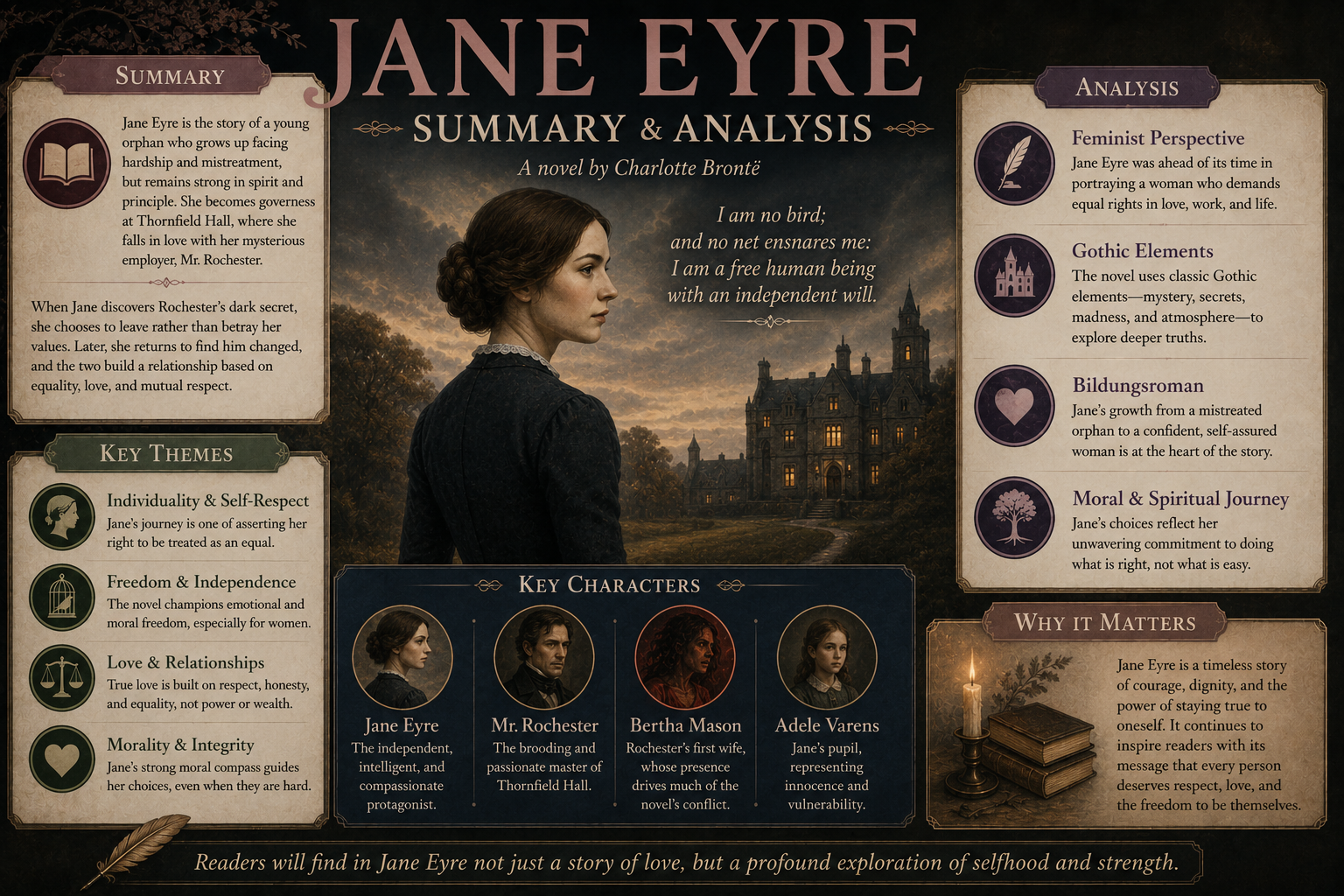
Jane Eyre Summary and Analysis for Students

Jane Eyre Summary

Jane Eyre is one of the most important novels of the Victorian age. This Jane Eyre summary and analysis gives students a clear path through the plot, structure, conflicts, and deeper meaning.

Charlotte Brontë tells a story about a young woman who wants love, faith, and freedom without losing herself.

In this Guide

Use this guide as a map before class, essays, or exams.

  • Quick overview
  • Plot summary by major stage
  • Structure and point of view
  • Main conflicts
  • Themes, symbols, and meaning
  • Helpful books and FAQ
Jane Eyre Summary

Jane Eyre summary and analysis: quick overview

The novel follows Jane from a harsh childhood to a hard-won adult life.

Jane is an orphan raised by cruel relatives at Gateshead. She later goes to Lowood School, becomes a governess at Thornfield Hall, and falls in love with Mr. Rochester.

This Jane Eyre summary and analysis matters because the novel is not just a romance. It is also a story about self-respect, moral choice, and the right to speak.

For a short reference overview, see Britannica on Jane Eyre.

Jane Eyre summary and analysis: plot by major stages

Brontë builds Jane’s life in clear stages, and each place tests her in a new way.

Gateshead: Jane learns she is unwanted

Jane lives with her aunt, Mrs. Reed, and her cousins. They treat her as a burden, not a child with feelings.

The red-room scene is one of the novel’s key moments. Jane is locked in the room where her uncle died, and her fear shows how trapped she feels.

Lowood: Jane learns discipline and loss

At Lowood School, Jane meets Helen Burns, a gentle girl with deep faith. Helen teaches Jane patience, but her death also shows the cruelty of neglect.

Mr. Brocklehurst uses religion to control the girls. Brontë criticizes this false form of faith.

Thornfield: Jane finds love and danger

Jane becomes a governess at Thornfield Hall. She meets Mr. Rochester, who treats her as an equal in conversation.

They fall in love, but the wedding stops when Jane learns Rochester already has a wife, Bertha Mason, hidden in the attic. Jane leaves because she will not become his mistress.

Moor House: Jane faces a different kind of trap

Jane is rescued by the Rivers family, who later turn out to be her cousins. St. John Rivers asks Jane to marry him and serve as a missionary wife.

His offer is respectable, but it has no love. Jane refuses because it would crush her spirit.

Ferndean: Jane returns by choice

Jane later returns to Rochester after a fire destroys Thornfield. Bertha dies in the fire, and Rochester loses his sight and one hand.

Jane marries him only after they can meet on more equal ground. Use this Jane Eyre summary and analysis to notice that Jane’s happy ending depends on freedom, not surrender.

How Jane Eyre is structured

The novel has a life-story shape that helps readers track Jane’s growth.

Jane Eyre is a first-person novel. Jane tells her own story as an adult, so we see both her childhood feelings and her mature judgment.

A Jane Eyre summary and analysis should also note that the book is a Bildungsroman, or coming-of-age novel. Like Great Expectations by Charles Dickens, it follows a young person through pain, mistakes, and self-knowledge.

The setting changes as Jane changes. Gateshead shows rejection, Lowood shows discipline, Thornfield shows desire, and Ferndean shows chosen love.

If you want to study Brontë’s word choices more closely, this guide to close reading in literature can help.

Main conflicts in Jane Eyre

The novel’s conflicts are personal, social, and moral.

Jane versus society is one major conflict. Jane is poor, female, and often powerless, but she refuses to accept shame as her proper place.

Jane versus herself is just as important. She wants love, but she also knows that love without respect can destroy her.

Jane versus Rochester creates the central romantic tension. Rochester loves Jane, but he tries to hide the truth about Bertha, which makes their first union morally wrong.

Jane versus St. John tests her in another way. St. John offers duty without passion, while Rochester offers passion that must be purified by honesty.

Themes in Jane Eyre summary and analysis

Brontë uses Jane’s story to ask what a person needs in order to live with dignity.

Independence and self-respect

Jane’s strongest trait is her sense of inner worth. She has little money or status, but she believes her soul is equal to anyone else’s.

For students, Jane Eyre summary and analysis often begins with this point. Jane does not reject love. She rejects love that demands the loss of self.

Love and equality

Jane and Rochester’s best moments come when they speak honestly. Their worst moments come when power is uneven.

Like Elizabeth Bennet in Pride and Prejudice, Jane must judge whether a man’s love respects her mind as well as her heart.

Religion and moral choice

The novel offers different forms of faith. Helen Burns shows patient faith, Mr. Brocklehurst shows cruel hypocrisy, and St. John shows duty without warmth.

Jane’s faith is tied to conscience. She leaves Rochester because she believes love must answer to moral truth.

Class and gender

Jane lives in a world where class shapes every chance she has. As a governess, she is educated but not rich, so she stands between social groups.

Brontë also shows how women had narrow choices. Jane wants work, love, and respect, not a life chosen for her by others.

Symbols and Gothic elements

The novel uses dark, strange, and intense images to reveal hidden fears.

The red-room stands for childhood trauma and social punishment. Jane is treated as if her anger is a crime.

Thornfield Hall stands for mystery and buried truth. The house looks grand, but it hides pain in its upper rooms.

Fire often marks passion, danger, and change. It destroys Thornfield, but it also clears the way for a more honest life.

These Gothic touches connect Jane Eyre to novels like Wuthering Heights, where setting and emotion feel closely linked.

Literary meaning and why Jane Eyre still matters

Jane’s story still feels modern because she fights for a voice.

This Jane Eyre summary and analysis also shows why the novel is more than a love story. Jane’s final happiness comes because she chooses it from a place of strength.

The famous line about Jane being no bird captures the heart of the book. She refuses to be caged by gender, class, fear, or romance.

To learn more about Charlotte Brontë as a writer, see the Poetry Foundation biography of Charlotte Brontë.

For more study support, our student literature guides can help you review major novels with clearer notes.

Helpful books for Jane Eyre study

These books are useful for students who want more context or a reliable edition.

  • Jane Eyre by Charlotte Brontë, Penguin Classics edition
  • The Madwoman in the Attic by Sandra M. Gilbert and Susan Gubar

You can look for these through a school library, local bookstore, or Amazon Books.

FAQ: Jane Eyre summary and analysis

Here are quick answers to common student questions.

What should a Jane Eyre summary and analysis include?

It should cover Jane’s life stages, her conflicts, major themes, key symbols, and the meaning of her final choice.

What is the main message of Jane Eyre?

The novel argues that love must include equality, honesty, and self-respect.

Why does Jane leave Rochester?

Jane leaves because Rochester is already married. She loves him, but she will not betray her conscience.

Is Jane Eyre a feminist novel?

Many readers see it that way because Jane demands dignity, work, and moral freedom in a world that limits women.

Key Takeaway

A strong Jane Eyre summary and analysis should show how Jane moves from isolation to self-command. The novel’s power comes from one clear idea: Jane wants love, but never at the cost of her soul.

error

Enjoy this article? Please spread the word :)

Follow by Email
BLUESKY
fb-share-icon
Reddit
LinkedIn
Share
RSS