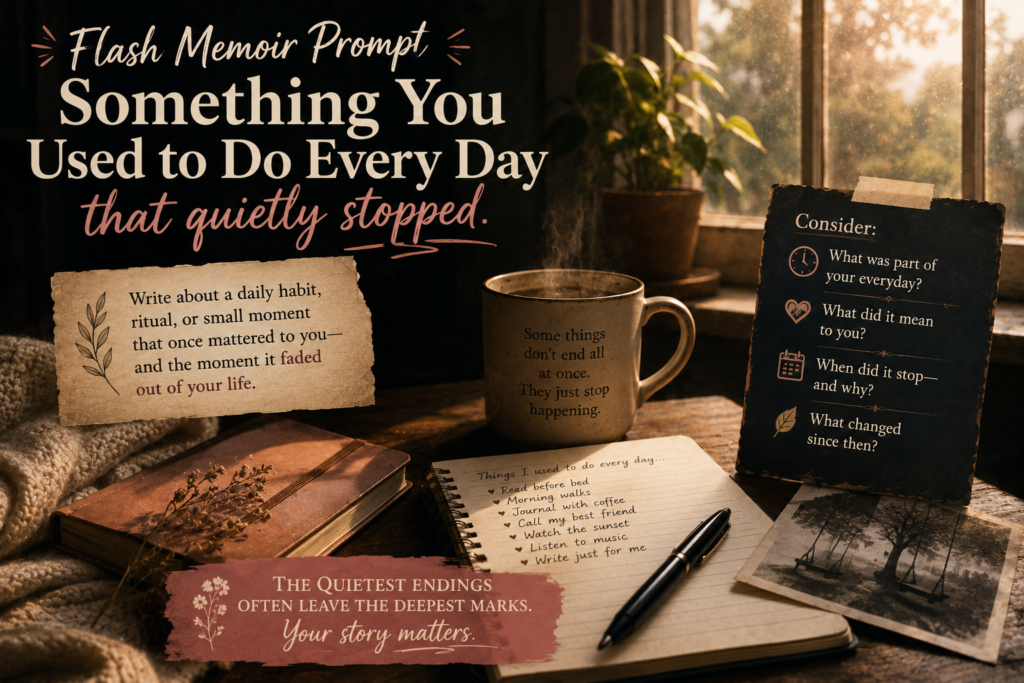
Flash Memoir Prompt: Last Time You Felt Completely at Ease in Your Own Body

Flash Memoir Prompt body

A gentle flash memoir invitation for remembering a moment when your shoulders dropped, your breath settled, and your body felt like a safe place to be.

Maybe it happened in a place no one else would call special. Your feet were tucked under a kitchen chair. Your hair was still damp from a shower. You were walking home with a warm drink in your hand, and for once you were not fixing, hiding, judging, or bracing.

If you searched for a flash memoir prompt last time felt completely at ease in your own body, this prompt is asking you to pause on that kind of moment. Not the perfect version of yourself. Not the body you wished for. The body you had, in one exact scene, when it felt enough.

Flash Memoir Prompt body

The Prompt

Write about the last time you felt completely at ease in your own body.

This prompt can unlock a meaningful memory because the body often remembers peace before the mind has words for it. You may not recall the date or every detail, but you might remember the weight of a blanket, the feel of bare feet on cool floor, or the deep breath you did not have to force.

A flash memoir prompt last time felt completely at ease can lead to a quiet story. It does not need a big plot. The power may be in the small shift from tension to rest.

Why This Memory Matters

Many of us spend a lot of time aware of our bodies in critical ways. We notice discomfort, awkwardness, tiredness, pain, size, age, or how others might see us. So a memory of ease can feel surprisingly tender.

This kind of story may uncover more than comfort. It may reveal safety, trust, relief, or belonging. You might remember a time when you were alone and free from performance. You might remember being with someone who made you feel accepted without effort.

For some writers, the memory may be connected to movement. Dancing in a living room. Swimming after a hard week. Stretching in the sun. For others, it may be rest. Sitting on a porch. Lying in bed with clean sheets. Holding a child who finally fell asleep.

As you write, notice the emotional weather of the scene. Is the memory calm, playful, surprised, or bittersweet? If you want help naming the feeling around the memory, this guide to tone and mood in literature can help you see the difference between what happened and how it felt.

How to Approach This Prompt

Begin with one physical detail. Do not start by explaining your relationship with your body across your whole life. That is too much for one short piece. Start smaller.

You might write, “My feet were in the lake,” or “The sweatshirt was too big in the best way,” or “I had just stopped holding my stomach in.” Let the body open the door.

Then narrow the memory to one scene. Choose ten minutes, not ten years. Where were you? What was touching your skin? What sounds were near you? Or what did your body no longer feel the need to do?

Try to write what you noticed before you explain what it meant. This is the same skill readers use when they slow down and mark details in a text. If you want a simple method for paying closer attention, this piece on how to annotate literature offers a useful way to notice first and interpret second.

For this prompt, you might ask yourself one focused question: What did ease feel like in my body? Maybe it felt like warmth, looseness, balance, silence, or a laugh that came out before you could stop it.

Avoid trying to make the memory sound profound right away. Let it be ordinary. The meaning can rise from the details.

A Quick Example

The last time I felt completely at ease in my body, I was floating in my sister’s backyard pool after everyone else had gone inside. It was late August, and the water held the day’s heat. My ears were under the surface, so the world sounded far away and soft. I remember looking up at the porch light and seeing moths circle it like tiny scraps of paper. For once, I was not thinking about how I looked in a swimsuit. I was not pulling at the fabric or comparing myself to anyone. My arms drifted out beside me. My knees rose and sank. I felt my breath move through me, steady and plain. But I did not feel beautiful exactly. I felt unbothered. That was better.

Try It Yourself

Set a timer for ten minutes and write from the prompt without stopping to judge the memory. If more than one moment comes to mind, choose the one with the clearest physical detail.

You do not have to write a body-positive essay. You do not have to solve every complicated feeling. Just return to one moment of ease and describe it honestly.

This flash memoir prompt last time felt completely at ease in your body works best when you trust the small scene. Let the chair, the water, the blanket, the sidewalk, or the quiet room carry part of the story for you.

Want More Flash Memoir Prompts?

If this prompt opened a memory you did not expect, keep going. Short prompts can help you build a steady writing habit, one scene at a time. Explore all 365 prompts in The Memory Trigger: 365 Flash Memoir Writing Prompts.
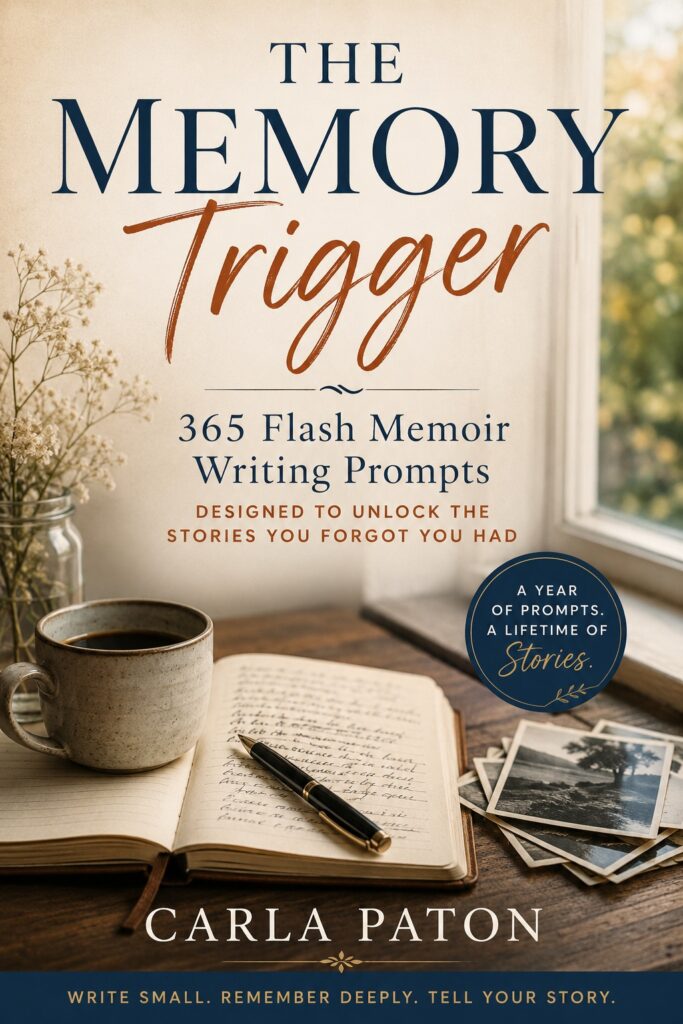

The Memory Trigger

Flash Memoir Prompt: Dream or Plan You Quietly Let Go of without Telling Anyone

flash memoir dreams

A warm flash memoir prompt for remembering the dream or plan you quietly let go of, through one small scene, one physical detail, and the truth you may not have said out loud.

Maybe it lived in a notebook for a while. Maybe it was a course catalog folded into your bag, a half-finished application, a business idea scribbled on the back of a receipt, or a town you kept checking on weather apps even though you never moved there.

Some dreams do not end with a dramatic speech. They do not slam the door. They simply stop being mentioned. Today’s flash memoir prompt dream plan quietly let go invites you to look at one of those quiet endings with care, not judgment.

flash memoir dreams

The Prompt

Write about a dream or plan you quietly let go of without telling anyone.

This prompt can unlock a meaningful memory because private disappointments often leave small traces. You may remember the day you stopped practicing, the evening you closed the browser tab, or the moment you put the folder in a drawer and did not open it again.

The story does not have to be tragic. Letting go can happen for many reasons. You grew older. Money changed. Someone needed you. The dream no longer fit. Or maybe you were tired of wanting something that kept moving away.

Why This Memory Matters

A dream you never announced can still shape your life. In fact, it may carry a special kind of weight because no one else knew enough to ask what happened.

This kind of memory often reveals the difference between who you imagined becoming and who you became. That does not mean one version is better. It means there was a turning point, even if no one saw it.

Maybe you once planned to become a singer, but you stopped showing up for auditions. Maybe you wanted to leave your hometown, but your suitcase never made it past the closet. Or maybe you planned to write a novel, start over, learn a language, adopt a child, open a bakery, or tell someone how you felt.

The quiet part is important. When a dream is public, people help create the story around it. They ask questions. They offer comfort. And they make comments. But when a dream is private, the memory stays close to the body. You might remember the smell of coffee beside your laptop, the ache in your neck, or the sound of rain while you deleted a file.

That is where good flash memoir often begins. It starts before the explanation. It starts with what you noticed.

How to Approach This Flash Memoir Prompt Dream Plan Quietly Let Go

Begin with one object connected to the dream. Choose something ordinary: a form, a pair of shoes, a brochure, a musical instrument, a saved email, a paintbrush, a recipe card, a gym bag.

Do not try to tell the whole history of the dream. Pick one scene. Maybe it is the moment you realized you had stopped caring. Maybe it is the day you packed the object away. Or maybe it is the moment you watched someone else do the thing you once wanted for yourself.

Write what your hands did first. Did you fold the paper? Close the box? Leave the room? Pretend to be busy? Small actions can reveal more than a long explanation.

Then let the emotion arrive slowly. You do not need to name it right away. Try writing the scene as if you are observing yourself from across the room. What would a camera see? What sound would it pick up? And what would be easy to miss?

If you enjoy looking closely at details, you might also like this guide on how to annotate literature. The same skill can help in memoir. You learn to notice patterns, repeated images, and the quiet places where meaning gathers.

For this flash memoir prompt dream plan quietly let go, resist the urge to wrap the piece in a perfect lesson. You may not know exactly why you let the plan fade. That uncertainty can make the writing feel honest.

A Quick Example

I kept the community college catalog under my bed for almost a year. The pages were soft at the corners because I had turned to the nursing program so many times. I liked the photograph of the students in blue scrubs, all of them smiling like they had somewhere important to be. On a Saturday morning, I pulled the catalog out while my kids watched cartoons in the next room. The application deadline was circled in purple pen. I stared at it while my toast cooled on the plate. Then I slid the catalog into the recycling bin under the sink. I did not cry. I rinsed a cereal bowl and let the water run too long. No one asked what I had thrown away.

Try It Yourself

Set a timer for ten minutes and write about the object, place, or day connected to the plan you stopped speaking about. Start small. Let the first sentence be plain: “The folder was blue,” or “I stopped going after the third lesson.”

Try to stay with one memory instead of explaining your whole life around it. If you feel tempted to defend your choice, pause and return to the scene. What was the light like? What did you do next? Who was nearby and unaware?

You may discover that the dream did not vanish. It may have changed shape. Or you may find that letting it go was an act of survival, wisdom, fear, love, or timing. The page does not need you to decide right away.

This flash memoir prompt dream plan quietly let go is not about blaming yourself for what did not happen. It is about giving a private ending a place to be seen.

Want More Flash Memoir Prompts?

Explore all 365 prompts in The Memory Trigger: 365 Flash Memoir Writing Prompts. It offers a full year of short, focused invitations for writing real memories with honesty and detail.

The Memory Trigger

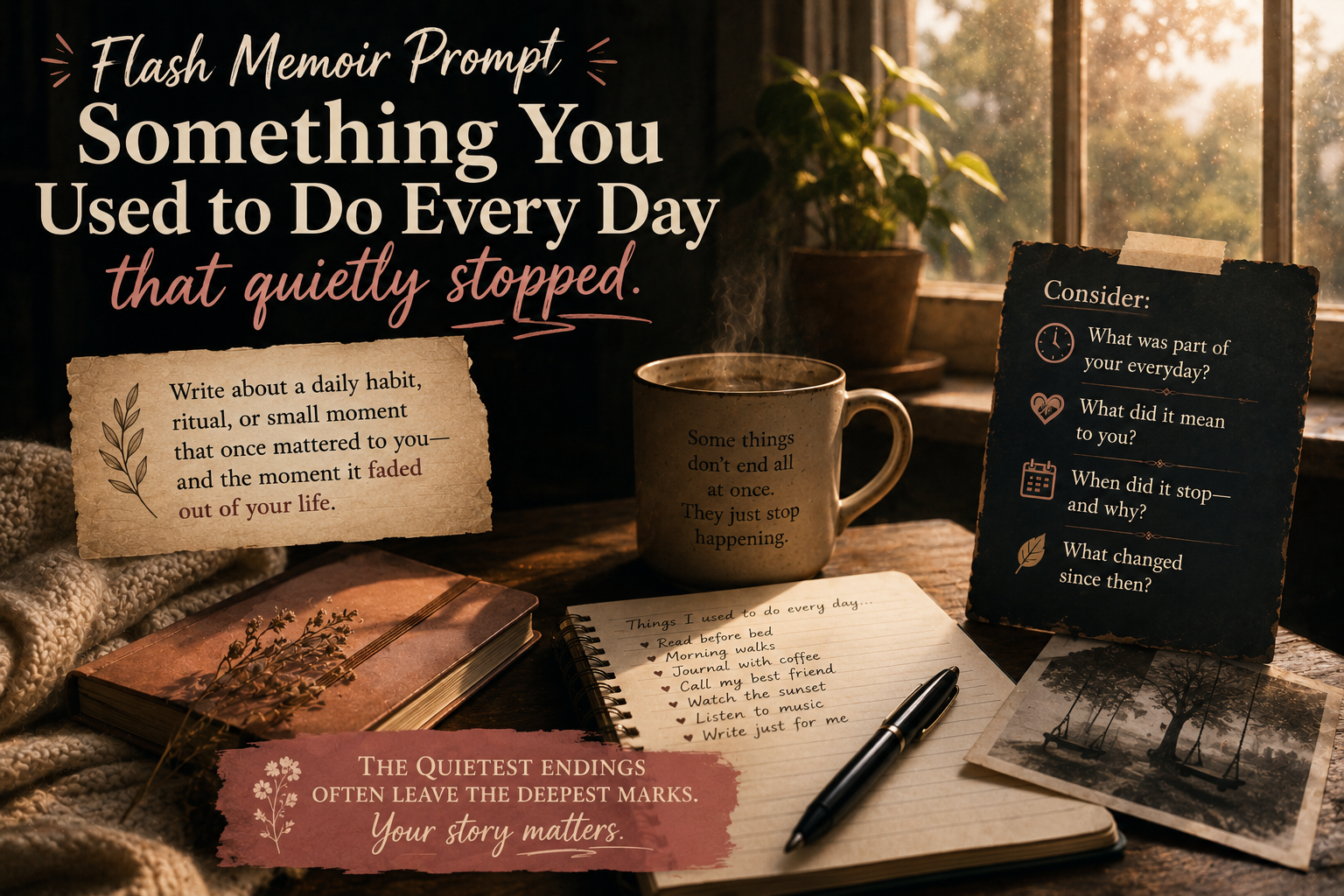
Flash Memoir Prompt: Something You Used to Do Every Day that Quietly Stopped

flash memoir prompt habit

You find the old charger in a drawer, or hear the kettle click, and suddenly remember a whole version of yourself: the person who once did the same small thing every day until, without ceremony, you stopped.

The Prompt

Write about something you used to do every day that quietly stopped.

This flash memoir prompt about something you used to do every day invites you to notice the small routines that shaped a season of your life. It might be a phone call, a walk, a lunch packed in a certain way, a game on the bus, or the habit of checking the window before bed.

The quiet part matters. This is not about a dramatic ending. It is about the kind of change you only see later. One day was the last day, but no one knew it at the time.

flash memoir prompt habit

Why This Memory Matters

Daily habits can tell the truth about who we were. They show what we needed, what we feared, who we loved, and how we made it through our days.

You may write about something childish that faded as you grew up. Maybe you stopped sleeping with the hallway light on. Maybe you stopped drawing stars in the margins of your notes. Maybe you stopped waiting for someone to call because, at some point, waiting became too heavy.

You may also write about a habit that belonged to a relationship. A good morning text. A ride to school. A shared snack after practice. A certain seat at the dinner table. When the habit stopped, the relationship may have changed too, even if no one said it out loud.

That is why this flash memoir prompt something used do every day can lead to a strong piece of writing. A small routine can hold a larger story. The trick is to stay close to the moment instead of trying to explain your whole life at once.

If you enjoy looking closely at meaning in small details, you may also like this guide on how to annotate literature. The same skill helps in memoir: mark what stands out, then ask why it stayed with you.

How to Approach This Prompt

Begin with the object or action, not the explanation. Put your reader in the room with you.

Instead of starting with, “I used to be really close to my grandmother,” try starting with the phone cord twisted around your finger. Start with the smell of toast in her kitchen. Start with the way the call always ended with the same sentence.

Narrow the memory to one scene. Pick one ordinary day when the habit still existed. Do not rush to the last time yet. Let us see the routine while it was still normal.

For example, if you used to write in a diary every night, choose one night. Where were you sitting? What pen did you use? Were you hiding the notebook under your pillow? Was your handwriting neat at first, then tired by the end?

After you write what you noticed, you can move toward what it meant. This order helps the memory feel alive. The meaning will land better if the reader has already touched the scene through your details.

You might also think about tone. Is this memory funny now? Sad? Tender? A little embarrassing? If you want help naming that feeling, this explanation of tone vs. mood in literature can help you think about the emotional effect of your own writing.

Try not to force a big lesson. The strongest ending may be simple: you noticed the habit was gone, and you missed the person you had been when it still mattered.

A Quick Example

Every morning in seventh grade, I checked the mailbox before school, even though the mail never came that early. I was waiting for a letter from my father, who had moved two states away and promised he would write. The mailbox was cold in winter and hot in May. I remember the metal handle sticking to my fingers and the hollow sound when I pulled the door open. Most days there was nothing inside except dust and a curled grocery flyer from the day before. I stopped checking sometime that spring. I do not remember deciding to stop. I only remember walking past it one morning with my backpack bouncing against my hip and realizing, halfway to the bus stop, that I had not looked.

Try It Yourself

Set a timer for ten minutes and write the first version quickly. Choose one habit that belonged to a clear part of your life. It can be small. In fact, small may work better.

Use this flash memoir prompt something used do every day as a doorway into one scene. Write the daily action first. Let the emotion arrive later. If you get stuck, finish this sentence: “I did it every day until one day I didn’t, and I didn’t notice because…”

You do not need to solve the memory. You only need to notice it honestly. The quiet stopping may be the whole point.

Want More Flash Memoir Prompts?

If this prompt opened a memory, keep going. Short prompts can help you build a steady writing practice without pressure. Explore all 365 prompts in The Memory Trigger: 365 Flash Memoir Writing Prompts.
The Memory Trigger


error

Enjoy this article? Please spread the word :)

Follow by Email
BLUESKY
fb-share-icon
Reddit
LinkedIn
Share
RSS