
Themes in Cry, the Beloved Country: A Student-Friendly Guide

Cry Beloved Country Themes

The themes in Cry, the Beloved Country help students see why Alan Paton’s novel still matters. This guide explains the book’s big ideas in clear language, with examples you can use for class notes or essays.

In this Guide

Use this roadmap to find the main ideas fast.

  • Why the novel’s themes matter
  • Land and broken community
  • Fear and injustice
  • Family and loss
  • Faith and moral action
  • How to write about the themes
  • FAQ
Cry Beloved Country Themes

Why themes in Cry, the Beloved Country Matter

The novel is set in South Africa during a time of deep racial division. Paton shows a country in pain through the story of Stephen Kumalo, a rural priest who travels to Johannesburg to find his son.

When students search for themes in Cry, the Beloved Country, they often expect one simple message. The novel is more complex. It shows how private grief connects to public injustice.

Theme means more than a topic. A topic might be fear, but a theme explains what the novel says about fear.

Major themes in Cry, the Beloved Country

Paton’s themes focus on how people live when a society has been damaged by injustice.

One major theme is the damage caused by racial inequality. Black South Africans face poverty, weak schools, unsafe labor, and unfair laws. These problems do not stay in the background. They shape the choices people can make.

Another major idea is moral responsibility. Paton asks whether people can help heal a broken country, even when the damage feels too large.

These themes in Cry, the Beloved Country work together. The novel does not only ask, Who did wrong? It also asks, What kind of society makes wrong more likely?

Themes in Cry, the Beloved Country: Land and Broken Community

The land in the novel reflects the state of the people who live on it.

Ndotsheni, Kumalo’s village, is dry and poor. The soil is weak, and young people leave for the city. This setting shows a deeper problem: rural communities have been drained of hope.

This is one of the most important themes in Cry, the Beloved Country because the land is not just scenery. It becomes a symbol of social collapse.

You can compare this idea to The Grapes of Wrath by John Steinbeck. In that novel, damaged land also pushes families away from home. In both books, the land shows human suffering.

Fear and Injustice among themes in Cry, the Beloved Country

Fear spreads through the novel like a sickness.

White characters fear crime and change. Black characters fear poverty, police, and the loss of family. Paton shows fear as a force that divides people who already live apart.

Arthur Jarvis tries to fight injustice through his writing and public work. His death is tragic because he is one of the people who wants real change.

This theme can remind students of To Kill a Mockingbird by Harper Lee. Both novels show how fear and prejudice can twist justice.

Family, Lost Sons, and Broken Bonds

The search for family gives the novel its emotional power.

Kumalo travels to Johannesburg to find his sister, brother, and son. What he finds is painful. His family has changed, and his son Absalom has become part of a tragedy he cannot undo.

James Jarvis also loses a son. At first, he knows little about Arthur’s beliefs. After Arthur’s death, Jarvis begins to understand the moral work his son cared about.

The two fathers suffer in different ways. Their grief creates one of the novel’s strongest connections.

Faith, Forgiveness, and Moral Action

Faith in the novel is not easy or simple.

Kumalo is a priest, but he still feels fear, anger, and doubt. Paton does not present faith as a magic cure. He shows it as a hard path that asks people to keep choosing mercy.

Forgiveness matters because the novel is full of wounds. Yet Paton does not say that forgiveness erases injustice. Instead, forgiveness opens a door to action.

Jarvis helps Ndotsheni after his son’s death. His aid does not fix the whole country, but it shows that one person can choose repair over hatred.

How to Write About the themes in Cry, the Beloved Country

Strong essays connect theme to character, setting, and conflict.

Do not write, The theme is racism, and stop there. A better claim would say that Paton shows racial injustice as a force that breaks families and weakens whole communities.

Use short quotes and explain them closely. Look at what the quote shows about power, fear, or moral choice.

If you need help shaping a thesis, use this guide on how to write a literary analysis essay. It can help you turn theme notes into a clear argument.

From Idea to Novel Blueprint

Historical Context That Shapes the Novel

The novel was published in 1948, the same year apartheid became official policy in South Africa.

Paton wrote about racial injustice before many global readers understood its full reach. That context helps explain the novel’s urgent tone.

For more background on the author, visit Britannica’s overview of Alan Paton.

Books to Search on Amazon or at Your Library

These books pair well with this novel for theme study.

  • Cry, the Beloved Country by Alan Paton
  • Things Fall Apart by Chinua Achebe
  • The Grapes of Wrath by John Steinbeck

FAQ: themes in Cry, the Beloved Country

These quick answers can help before a quiz or essay.

What are the main themes in Cry, the Beloved Country?

The main themes in Cry, the Beloved Country include racial injustice, fear, broken family bonds, faith, and the need for moral action.

What does the land symbolize in the novel?

The land shows the health of the community. Dry soil and damaged farms reflect poverty, neglect, and social breakdown.

Why is fear so important in the story?

Fear keeps people apart. It leads to suspicion, harsh choices, and more suffering.

Is the novel hopeful or sad?

It is both. The story is full of grief, but it also shows small acts of repair that point toward hope.

Key Takeaway

The themes in Cry, the Beloved Country show that personal pain and social injustice are deeply linked. Paton’s novel asks readers to face suffering honestly, then choose compassion and repair.
Themes in Jane Eyre: A Student-Friendly Guide

Jane Eyre Themes

A clear guide to the major ideas, conflicts, and meanings students should notice in Jane Eyre.

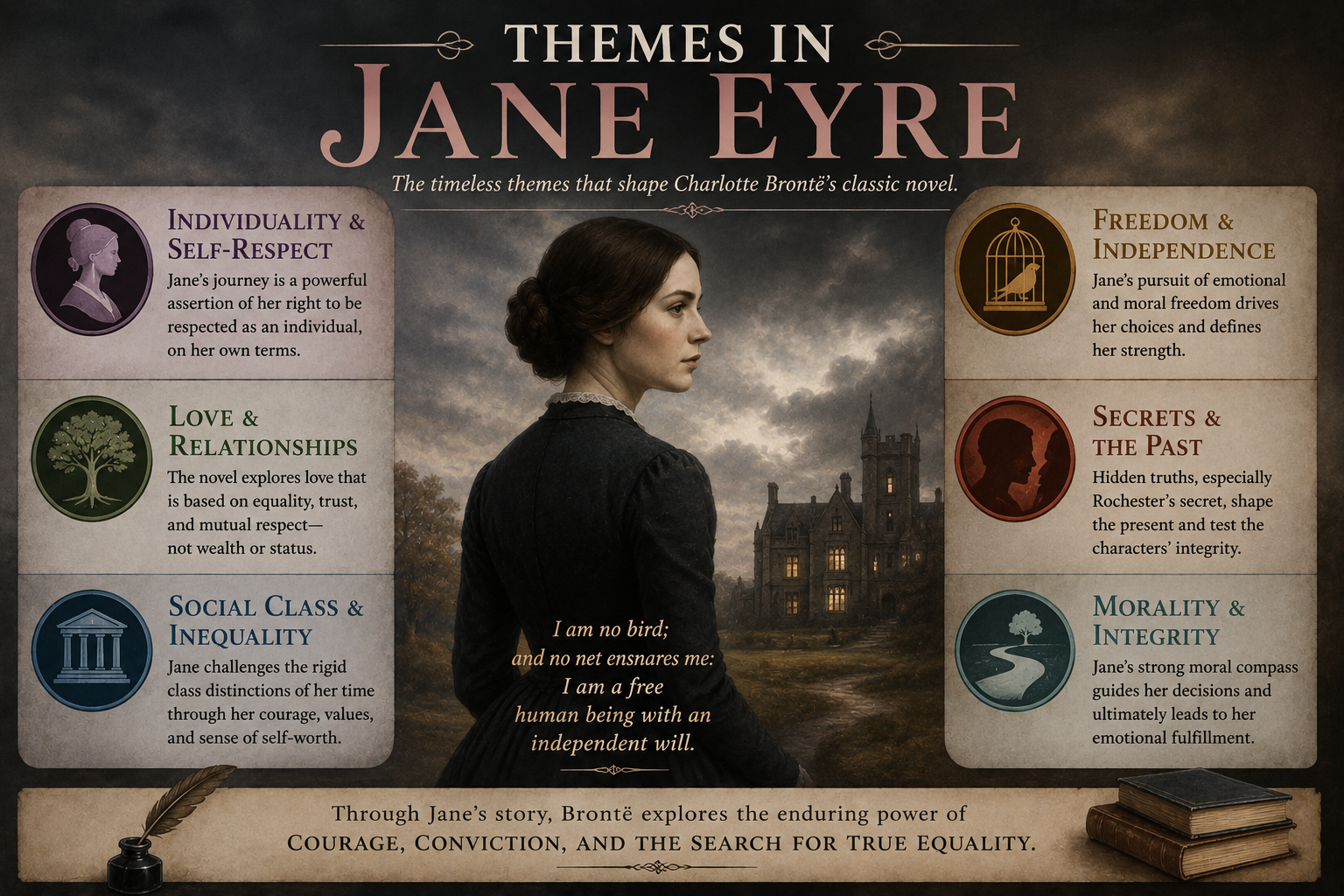
The themes in Jane Eyre help explain why Charlotte Brontë’s novel still matters in English classes today. The book is not just a love story. It is also about self-respect, power, faith, and the search for a true home.

In this Guide

Jane Eyre Themes

Why the themes in Jane Eyre matter

Brontë uses Jane’s life to ask what a person needs in order to live with dignity.

The main themes in Jane Eyre grow from Jane’s biggest conflicts. She wants love, but she will not give up her values to get it. She wants safety, but she also wants freedom.

That balance makes the novel useful for high school, AP Literature, and college essays. You can connect almost every major scene to one question: How does Jane protect her inner self in a world that tries to control her?

One reason students remember the themes in Jane Eyre is that Jane changes without losing her core beliefs. Like Elizabeth Bennet in Pride and Prejudice, she learns about love while also learning what she will not accept.

Themes in Jane Eyre: Independence and Self-Respect

Jane’s strongest desire is not wealth or romance. It is the right to live as her own person.

From the start, Jane knows what it feels like to have no power. At Gateshead, Mrs. Reed and John Reed treat her as less than family. At Lowood, harsh rules and public shame teach Jane how cruel authority can be.

Yet Jane does not become passive. She speaks the truth when she can, even when the cost is high. Her famous moral strength starts in childhood.

This is one of the most important themes in Jane Eyre because Jane’s independence shapes every major choice. She leaves Thornfield after Rochester asks her to live against her conscience. She refuses St. John Rivers because his plan would make her useful but unhappy.

Jane’s self-respect is not loud pride. It is moral independence. She would rather be alone than live as someone else’s possession.

Love and Equality

Brontë presents love as powerful, but never enough by itself.

Jane loves Rochester, and their bond is one of the novel’s central forces. Still, the novel tests that love through secrets, power, and social rank.

Among the major themes in Jane Eyre, love and equality are closely linked. Jane cannot accept a relationship where Rochester has all the control. His wealth, age, and social position place him above her at first.

Jane’s choice to leave Thornfield proves that she values equal love over emotional comfort. She does not stop loving Rochester. She chooses to protect her soul.

By the end, their relationship changes. Jane has family, money, and freedom. Rochester has lost some of his power and must depend on her. This shift matters because Brontë suggests that true love needs mutual respect.

Social Class and Gender Limits

Jane lives in a world where birth and money decide how people are treated.

As a poor orphan, Jane has few options. She becomes a governess, which places her in a strange middle position. She is educated, but not wealthy. She works in a rich home, but she is not fully part of its class.

This makes Thornfield tense. Jane can speak with Rochester as an intellectual equal, but society sees her as beneath him. Blanche Ingram shows the opposite problem. She has status, but little real feeling.

Gender also limits Jane. Victorian women were often expected to depend on men. Jane resists that role. She wants work, thought, movement, and choice.

For more background on Charlotte Brontë and the world that shaped the novel, see Britannica’s overview of Charlotte Brontë.

Religion and Moral Choice

Religion in the novel is not simple. Brontë shows both harmful faith and healing faith.

Mr. Brocklehurst uses religion to control children and shame the poor. His faith looks holy, but his actions are cruel and selfish.

Helen Burns offers a different model. She teaches patience, forgiveness, and spiritual peace. Jane admires Helen, but she does not fully copy her. Jane still believes injustice should be named.

St. John Rivers gives another version of faith. He is disciplined and brave, but he is cold. He wants Jane to marry him for duty, not love.

These themes in Jane Eyre show that Brontë values spiritual integrity over empty rule-following. Jane’s faith helps her choose what is right, but it does not erase her need for human love.

Appearance, Identity, and Inner Worth

Many characters judge by appearance, but the novel asks readers to look deeper.

Jane is often described as plain. Rochester is not shown as a perfect romantic hero either. Brontë avoids the idea that beauty equals goodness.

Blanche Ingram looks like the ideal match for Rochester, but her values are shallow. Jane has less social shine, yet she has honesty, intelligence, and courage.

This theme works well in essays because it connects to point of view. Since Jane tells her own story, readers see her inner world. We learn that identity is not just what others see. It is what a person knows to be true inside.

Home, Belonging, and Freedom

Jane spends much of the novel searching for a place where she can belong without losing herself.

Gateshead is a house, but it is not a home. Lowood gives Jane education and friendship, but it also brings suffering. Thornfield offers love, but it hides a secret that makes it unsafe.

Moor House gives Jane family and stability. Still, St. John’s control threatens her freedom. Ferndean, near the end, becomes the closest thing to a true home because Jane can love Rochester as an equal.

This theme matters because home in the novel is not just a building. It is a place where Jane’s body, mind, and conscience can rest.

Symbols that support themes in Jane Eyre

Brontë uses setting, weather, and repeated images to deepen the novel’s meaning.

Symbols make the themes in Jane Eyre easier to see. The red-room at Gateshead shows fear, punishment, and isolation. Fire often connects to passion, anger, or life. Ice and cold often mark emotional distance.

Thornfield itself becomes a symbol of hidden truth. Its beauty covers a locked secret, much like Rochester’s charm covers his past.

If you want help spotting patterns like these, read our guide on how to find symbolism in a story. It can help you turn symbols into stronger essay points.

You can also use the British Library’s article on Jane Eyre and 19th-century women for context on gender and society.

How to write about the themes in Jane Eyre

A strong essay should not just name a theme. It should explain how Brontë builds that idea through conflict and character choice.

For example, do not only say that independence is important. Show how Jane’s choices at Gateshead, Thornfield, and Moor House prove that she values self-respect over comfort.

Try this sentence frame:

Brontë develops the theme of [idea] by showing how Jane [choice or conflict], which reveals [larger meaning].

You can also connect theme to symbol. The red-room shows Jane’s early powerlessness, while Ferndean shows a quieter form of freedom. This kind of pattern helps an essay feel focused.

For more support, you can explore our Jane Eyre study resources as you plan your notes.

Helpful books for students

If you want a print copy or a study-friendly edition, look for these titles through Amazon, a local bookstore, or your school library:

  • Jane Eyre by Charlotte Brontë
  • The Madwoman in the Attic by Sandra M. Gilbert and Susan Gubar

The first gives you the full novel. The second is more advanced, but it is useful for college-level study of gender and power.

FAQ: Themes in Jane Eyre

What are the main themes in Jane Eyre?

The main themes in Jane Eyre include independence, love, class, gender, religion, identity, and belonging.

What is the most important theme in the novel?

Independence may be the most important theme because nearly every major choice Jane makes protects her self-respect.

How does Jane Eyre show feminism?

The novel shows feminism through Jane’s demand for equality, work, thought, and moral choice in a society that limits women.

Why does Jane leave Rochester?

Jane leaves because staying would break her conscience. She loves Rochester, but she will not give up her moral freedom.

How do symbols connect to theme?

Symbols like the red-room, fire, and Thornfield turn abstract ideas into concrete images. They help readers see fear, passion, and hidden truth.

Key Takeaway

The themes in Jane Eyre all point to one clear idea: real love and real faith must respect the self. Jane’s journey matters because she gains belonging without surrendering her freedom.

error

Enjoy this article? Please spread the word :)

Follow by Email
BLUESKY
fb-share-icon
Reddit
LinkedIn
Share
RSS