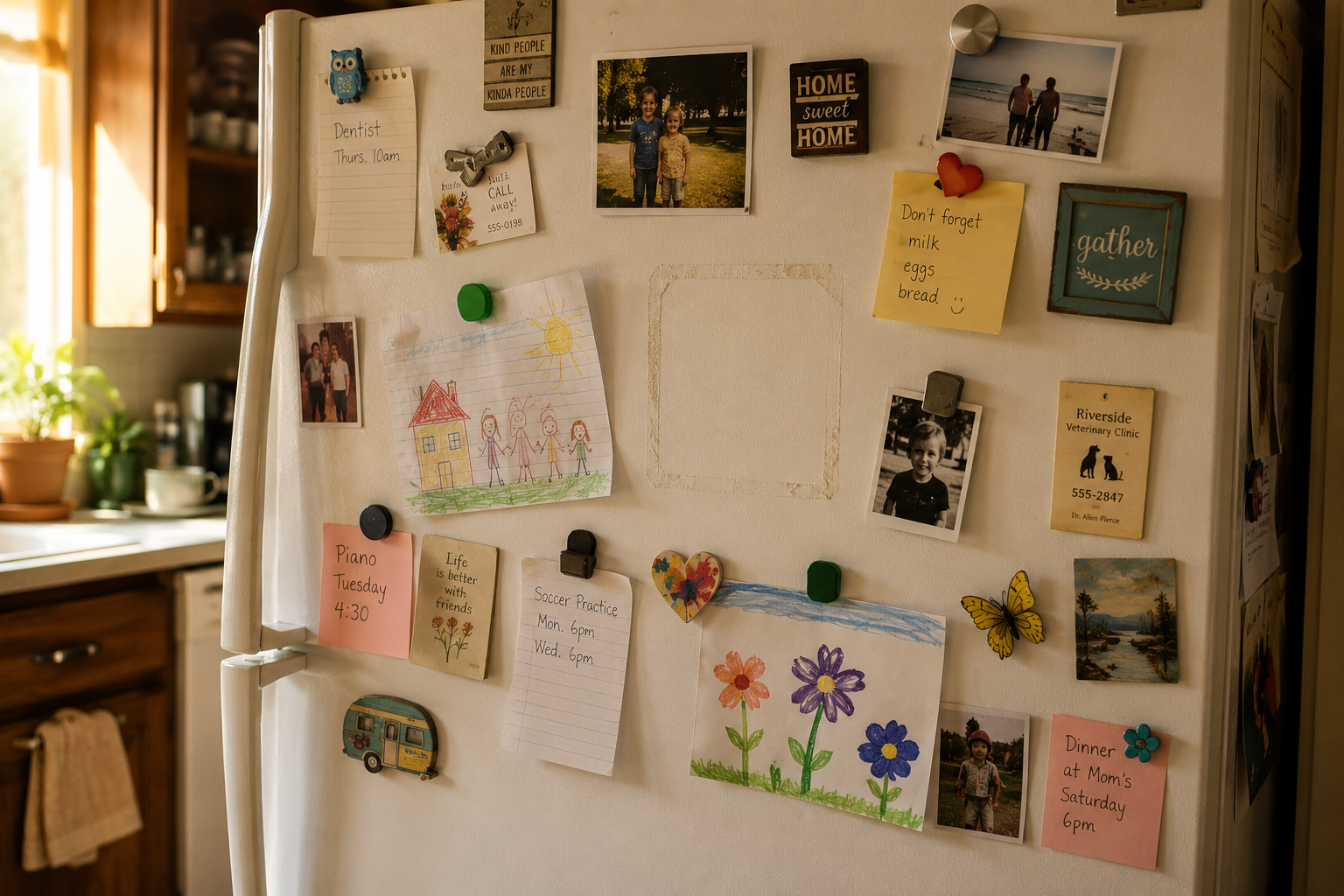
An ekphrasis poetry prompt does not require a dramatic image. Sometimes the most ordinary objects carry the deepest stories. A refrigerator door may seem like an unlikely source of inspiration, yet it often serves as a record of daily life. Photographs, notes, reminders, children’s artwork, and keepsakes gather there over the years. They become a quiet archive of a household’s history.
In this image, the refrigerator door displays a collection of familiar items. Family photos sit beside grocery lists and appointment cards. Children’s drawings fade with age. Near the center, however, an empty space remains where something once hung. The absence immediately draws attention. What occupied that spot? Why was it removed? Who took it away?
That unanswered question creates the heart of this ekphrasis poetry prompt.
If you are new to writing poetry from images, our guide on how to analyze poetry can help you think more deeply about symbolism and meaning:
Why This Ekphrasis Poetry Prompt Inspires Stories
A successful ekphrasis poetry prompt invites curiosity. The image does not provide a complete narrative. Instead, it offers clues.
The refrigerator door functions almost like a scrapbook. Every photograph represents a memory. Every note marks a moment in time. The empty space introduces tension because it suggests change.
Perhaps someone moved away. Perhaps a relationship ended. Or perhaps a child grew up and left home. The missing item could represent loss, growth, forgiveness, regret, or hope.
Poetry often begins with questions rather than answers. This image provides many questions for a writer to explore.
Looking Closely at the Details
Before writing, spend several minutes examining the image.
Notice the faded edges of photographs. Look at the handwriting on notes. Consider why some items remain while others disappear. Think about who placed these objects on the refrigerator and who sees them each day.
Small details often produce powerful poems.
As you observe, pay attention to literary devices such as symbolism, imagery, and metaphor. If you would like a refresher on these techniques, see our guide to literary devices in poetry:
You may also enjoy exploring examples of image-inspired poetry through the resources available at the Poetry Foundation:
https://www.poetryfoundation.org
Ekphrasis Poetry Prompt: The Missing Magnet
Study the image carefully.
Then write a poem that begins with this line:
“The empty spot on the refrigerator door mattered more than everything around it.”
As you continue, consider one of the following possibilities:
- Write from the perspective of the person who removed the missing item.
- Write from the perspective of someone who notices the empty space years later.
- Imagine the object that once occupied that place.
- Describe the memories attached to the missing item.
- Explore how ordinary objects become symbols of larger life changes.
Allow the poem to focus on memory, absence, family history, or the passage of time.
Taking the Prompt Further
After completing your first draft, challenge yourself to write a second poem from a different perspective.
A parent and a child may tell very different stories about the same photograph. A refrigerator might remember events differently than the people who stand before it. Even the missing object could become a speaker in the poem.
These shifts in perspective often reveal unexpected emotional depth.
Final Thoughts
This ekphrasis poetry prompt reminds us that poetry does not always emerge from extraordinary scenes. A refrigerator door covered with everyday objects can hold years of memories. One missing item can raise questions that linger long after the image disappears.
The best poems often begin by noticing something small. In this case, that small detail is simply an empty space waiting to be filled with a story.