Themes in Othello: A Student-Friendly Guide

Themes in Othello

Shakespeare’s tragedy is full of conflict, fear, and painful choices. This guide explains the themes in Othello so you can understand the play and write about it with more confidence.

Whether you need a class answer or an essay idea, the play gives you a lot to work with. Its biggest ideas still connect to real life today.

In this Guide

Use this quick menu to find the idea you need.

  • Why the play’s themes still matter
  • Jealousy and insecurity
  • Race and outsider identity
  • Appearance versus reality
  • Trust and manipulation
  • Gender and power
  • Reputation and honor
  • Tragedy and responsibility
  • Essay tips, books, and FAQ
Themes in Othello

Why the Themes in Othello Still Matter

Othello is old, but its problems still feel close.

The plot is about a respected soldier, a new marriage, and a lie that grows out of control. The deeper meaning comes from the way people react to fear, status, love, and doubt.

The themes in Othello help us see why the play is more than a story about one jealous man. Shakespeare shows how private feelings can become dangerous when others know how to use them.

That is why students still study this play. It asks hard questions about trust, identity, and the damage people cause when they refuse to seek the truth.

Themes in Othello: Jealousy as a Destructive Force

Iago turns a private fear into public ruin.

Jealousy is one of the central themes in Othello. It begins as a small doubt, then grows until Othello can no longer see clearly.

Iago warns Othello, “O, beware, my lord, of jealousy.” The warning sounds wise, but it is part of the trap. Iago knows that naming the danger will make Othello think about it even more.

Othello does not see Desdemona betray him. He hears suggestions, watches small moments, and fills in the rest with fear. That is what makes the jealousy so painful. It is not built on real proof.

This theme also appears in other famous works. In The Great Gatsby, jealousy and status push characters toward reckless choices. In Othello, jealousy becomes even darker because it destroys love from within.

For an essay, do not just say, “Othello is jealous.” Ask what causes the jealousy and why he accepts it so quickly. That question leads to a stronger claim.

Themes in Othello: Race and Outsider Identity

Othello has power, but Venice never fully accepts him.

Othello is a skilled general. He has earned respect through service and courage. Yet he is also treated as an outsider because he is a Moor in Venetian society.

Some characters speak about him with racist language. Brabantio cannot accept that Desdemona chose Othello freely, so he imagines magic or trickery. His reaction shows how prejudice can twist the truth.

The themes in Othello ask us to look at the pressure Othello faces. He must prove himself in a world that respects his talent but questions his place.

This matters because Iago attacks Othello’s weak spots. He knows Othello fears not being loved, trusted, or seen as equal. Iago does not create every fear, but he gives those fears a voice.

A strong reading of this play should not ignore race. Othello’s fall is personal, but it also happens inside a society that makes him feel unsafe in his own marriage.

Themes in Othello: Appearance Versus Reality

Nearly everyone in the play judges by what seems true.

Iago is called “honest Iago” again and again. The name is bitter because the audience knows he is lying. This gap between what people believe and what is real drives the whole tragedy.

Othello thinks he is seeing signs of betrayal. In truth, he is seeing a story that Iago has built for him. That story feels real because Iago controls the details.

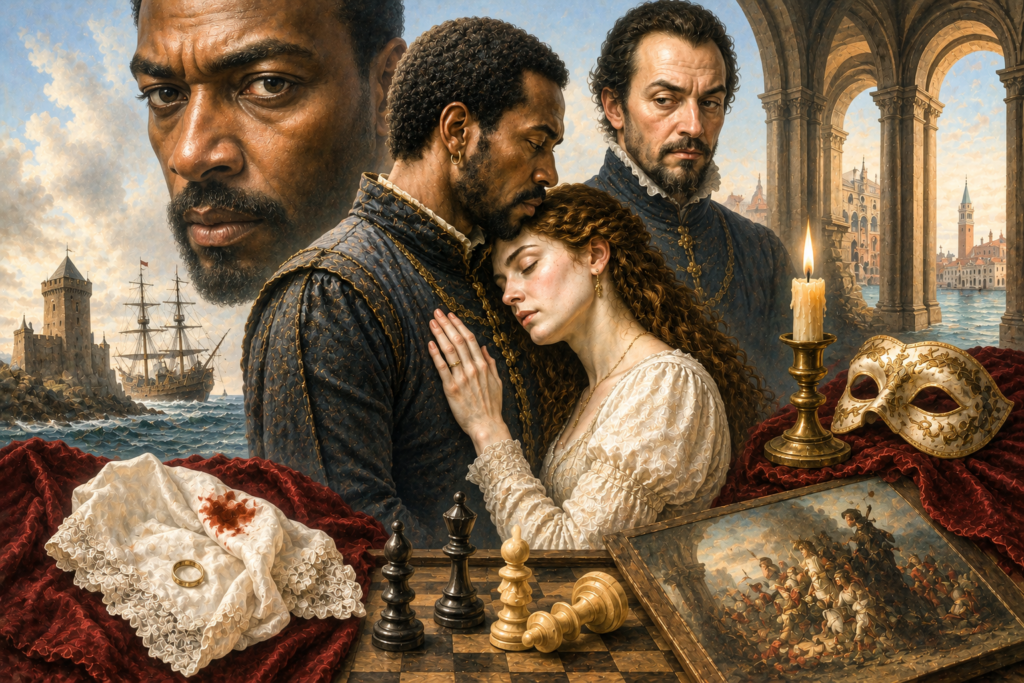
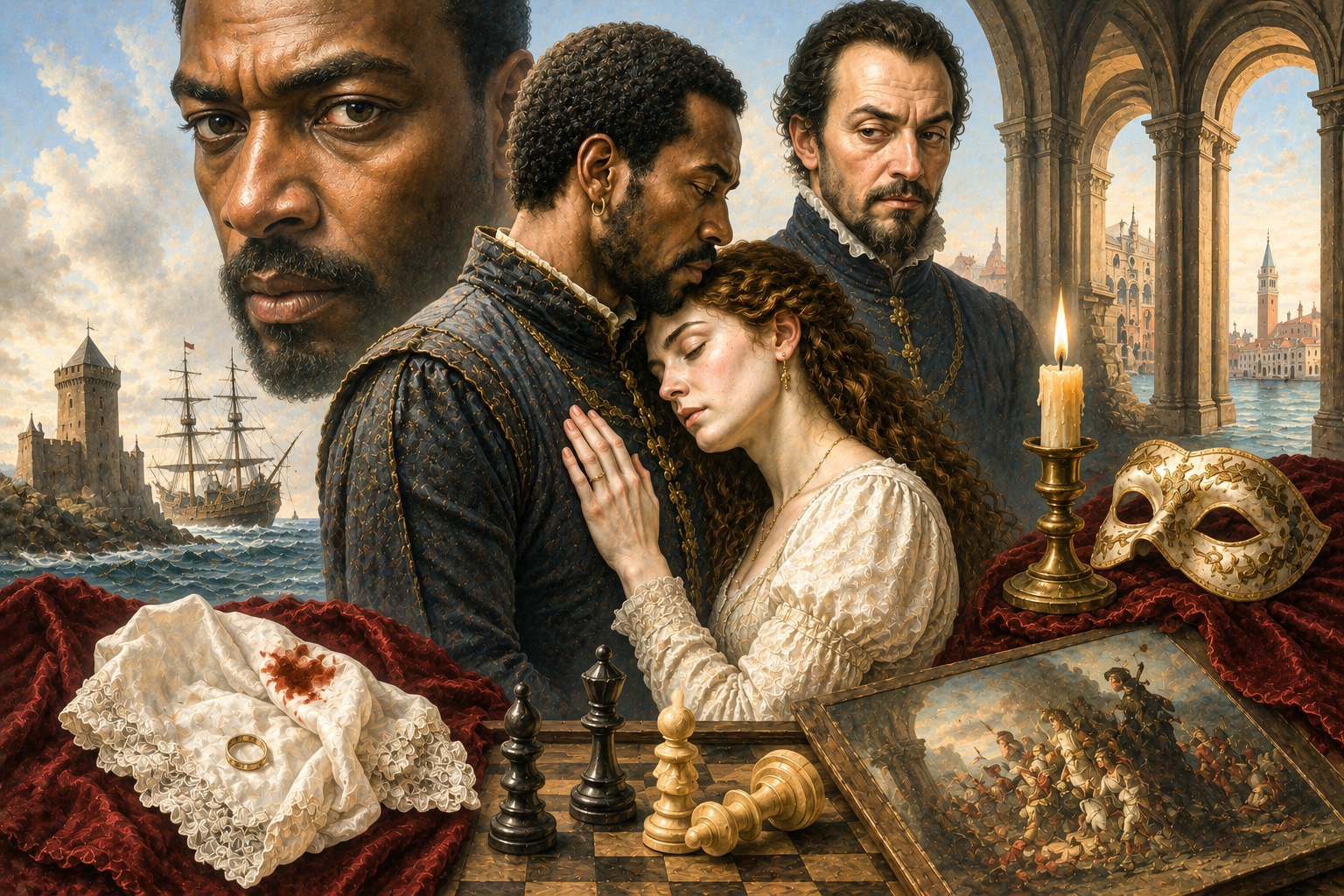
The handkerchief is the clearest object tied to this theme. It is a small gift, but Iago turns it into false evidence. If you want to practice reading objects like this, this guide on how to find symbolism in a story can help.

Many themes in Othello connect through this gap between image and truth. Love looks like betrayal. Honesty looks like deceit. Proof looks solid, even when it is false.

This theme is useful for essays because it lets you discuss dramatic irony. The audience knows more than Othello, so we watch him move toward a terrible mistake.

Trust and Manipulation in Othello

The play shows how language can reshape a person’s mind.

Iago does not need to shout or force Othello to act. He uses hints, pauses, and careful questions. He lets Othello think the worst idea came from his own mind.

This makes Iago one of Shakespeare’s most dangerous villains. He understands people well, but he uses that knowledge to harm them.

Othello asks for “ocular proof,” meaning proof he can see. Yet he accepts weak signs because Iago has already changed the way he reads the world.

This theme pairs well with jealousy. Othello’s jealousy grows because he trusts the wrong person. He doubts Desdemona, who loves him, and believes Iago, who hates him.

Gender and Power in Othello

Desdemona is strong, but her world gives men more control.

Desdemona chooses Othello and speaks for that choice in public. She is not weak or silent at the start of the play. Still, she lives in a society where men often decide what women are allowed to be.

Once Othello doubts her, Desdemona has little power to defend herself. Her words do not count as proof. Her honesty is treated as another act.

Emilia helps us see this theme more clearly. She understands that men can be unfair and cruel. Near the end, she tells the truth even when it costs her life.

The female characters are often judged by male fear. Desdemona is accused of sin she did not commit. Emilia is used by Iago. Both show how dangerous a male-controlled world can be.

Reputation and Honor in Othello

Public image matters so much that it can crush private truth.

Cassio loses his position after a fight, and he feels ruined. He says reputation is a huge part of who he is. Without it, he feels empty.

Othello also cares deeply about honor. He wants to be seen as noble, loyal, and controlled. When he believes Desdemona has betrayed him, he thinks his name has been stained.

This is where the tragedy becomes even more painful. Othello begins to care more about restoring honor than protecting the person he loves.

Reputation also helps Iago hide. Because others think he is honest, his good name becomes a mask. Shakespeare shows that reputation can protect the guilty and harm the innocent.

Tragedy and Moral Responsibility in Othello

The ending feels both shocking and avoidable.

Othello is a tragedy because noble people suffer, but the suffering does not come from fate alone. Human choices cause the disaster.

Iago chooses evil again and again. Othello chooses to trust him. Emilia chooses truth too late, though her final courage still matters.

This theme is common in Shakespeare. In Macbeth, ambition opens the door to violence. In Othello, jealousy and false trust lead to the same kind of collapse.

The play does not let us blame only one cause. That is part of its power. The tragedy grows from lies, prejudice, fear, and the failure to pause before action.

How to Write About the Themes in Othello

Strong essays move from theme to claim.

Students often name a theme but stop too soon. A better essay explains what Shakespeare says about that theme.

For example, do not write only, “Jealousy is a theme.” Try a claim like this: Shakespeare presents jealousy as a force that makes false stories feel stronger than truth.

When you write about the themes in Othello, connect your idea to a pattern. Look at repeated words, repeated doubts, and repeated mistakes.

You can also build a paragraph around an object, such as the handkerchief. For more help with that skill, use this student guide to spotting symbolism.

If you want a quick study support, you can also check our Othello theme notes for students.

Helpful Books and Resources

These resources can help you understand the play more deeply.

For background, the Britannica overview of Othello gives a clear summary of the play and its history.

You can also read the full text through the Folger Shakespeare Library’s online edition of Othello.

Relevant books to consider:

  • Othello by William Shakespeare, Folger Shakespeare Library edition
  • Shakespeare: The World as Stage by Bill Bryson

FAQ: Themes in Othello

Here are quick answers to common student questions.

What are the main themes in Othello?

The main themes include jealousy, race, appearance versus reality, trust, gender, reputation, and tragedy.

What is the most important theme in Othello?

Jealousy is often seen as the most important theme because it drives Othello’s downfall and shapes the main conflict.

How does Iago connect to the play’s themes?

Iago connects to many themes because he uses language, reputation, and doubt to control others.

Why is the handkerchief important?

The handkerchief becomes false proof. It shows how a simple object can gain dangerous meaning.

Key Takeaway

The themes in Othello show how trust can break when fear takes control.

Shakespeare’s play warns that lies become powerful when people already feel insecure. That is why the tragedy still matters in class, in essays, and in real life. 📚

Themes in To Kill a Mockingbird: A Complete Guide

Themes in To Kill a Mockingbird

Understanding the Major Themes in To Kill a Mockingbird
A novel about growing up, justice, and moral courage in a divided society.

The major themes in To Kill a Mockingbird (affiliate link) help readers understand why this novel is still widely taught in schools today. On the surface, the story is about Scout Finch growing up in a small Southern town, but beneath that story, the novel explores serious issues like racism, injustice, empathy, courage, and innocence. Harper Lee uses the experiences of Scout and Jem to show how people learn right and wrong in a complicated world. The trial of Tom Robinson is the central event of the novel, but the book is really about moral growth and learning to see the world from other people’s perspectives.

In this guide, we will look at the most important themes in To Kill a Mockingbird and how they appear throughout the novel.

In This Guide

Racism and Injustice
Moral Courage
Coming of Age
Empathy
Social Class
Good vs Evil
Education
Innocence

Themes in To Kill a Mockingbird
Image by Carla Paton

Racism and Injustice in To Kill a Mockingbird

The trial of Tom Robinson shows how prejudice can destroy justice.

One of the most important themes in To Kill a Mockingbird is racism and injustice. This theme is most clearly shown during the trial of Tom Robinson. Even though Atticus proves that Tom Robinson is innocent, the jury still finds him guilty. This shows that racism in Maycomb is so powerful that it overrides truth and justice. The courtroom is supposed to be a place of fairness, but in this case, prejudice determines the outcome.

The novel also shows the hypocrisy of Maycomb. Many people in the town believe they are good and moral, yet they support a system that treats Black citizens unfairly. Scout even notices that her teacher criticizes Hitler for prejudice while ignoring racism in her own town. Harper Lee uses this contrast to show that people often recognize injustice in other places but fail to see it in their own communities.

Tom Robinson represents the most tragic example of this theme. He is an innocent man who is destroyed by a racist society, which connects directly to the symbol of the mockingbird — an innocent creature harmed by others.

Moral Courage in To Kill a Mockingbird

Doing what is right even when you know you might lose.

Another major theme in To Kill a Mockingbird is moral courage. Atticus Finch represents this theme more than any other character. He agrees to defend Tom Robinson even though he knows the town will criticize him and that he will probably lose the case. Atticus explains that he must defend Tom because he has to live with his own conscience.

The novel also shows courage through Mrs. Dubose, who fights to overcome her morphine addiction before she dies. Atticus explains to Jem that real courage is not about physical strength, but about doing what is right even when you know the situation is difficult or hopeless.

Even Scout shows courage when she stands up for Walter Cunningham and when she unknowingly stops the mob at the jail by speaking politely to Mr. Cunningham. The novel shows that courage can be quiet and moral, not just physical.

Coming of Age in To Kill a Mockingbird

Scout and Jem grow up and learn that the world is not always fair.

To Kill a Mockingbird is a coming-of-age novel because Scout and Jem grow up and learn important lessons about the world. At the beginning of the novel, they are innocent and believe that the world is fair. They believe Boo Radley is a monster and that the legal system always tells the truth.

As the novel progresses, Jem and Scout begin to understand that people are more complicated and that the world is not always fair. Jem especially struggles after Tom Robinson is found guilty because he believed that the truth would lead to justice. This moment represents Jem’s loss of innocence.

By the end of the novel, Scout learns the most important lesson of all — empathy. When she stands on Boo Radley’s porch and sees the world from his perspective, she finally understands what Atticus has been trying to teach her.

Empathy in To Kill a Mockingbird

“You never really understand a person until you climb into his skin and walk around in it.”

Empathy is one of the central themes in To Kill a Mockingbird. Atticus teaches Scout that she must try to understand people by seeing the world from their perspective. This lesson appears many times in the novel and helps Scout understand Boo Radley, Mayella Ewell, and even the people who hate Atticus.

Scout shows empathy when she understands why Walter Cunningham cannot accept lunch money and when she speaks to Mr. Cunningham at the jail. Her kindness reminds him that he is part of a community, and the mob leaves. This moment shows that empathy can be powerful enough to stop violence.

By the end of the novel, Scout understands Boo Radley and realizes that he has been protecting them the entire time. The novel suggests that many conflicts and injustices happen because people fail to understand one another.

Social Class in To Kill a Mockingbird

Maycomb is divided into strict social groups.

Social class is another important theme in To Kill a Mockingbird. The town of Maycomb is divided into different social groups, including wealthy families, poor farmers like the Cunninghams, and very poor families like the Ewells. Black citizens are at the bottom of the social structure because of racism.

The Ewells are especially important because even though they are poor and uneducated, they are still treated as socially superior to Black citizens. This shows that race is more important than class in Maycomb’s social system.

Through these social divisions, Harper Lee shows that social class is often unfair and does not reflect a person’s character or morality.

Good vs Evil in To Kill a Mockingbird

The novel shows both kindness and cruelty in human nature.

The novel explores the theme of good versus evil by showing both kindness and cruelty. Characters like Atticus, Scout, Jem, and Boo Radley represent kindness, compassion, and moral courage. Characters like Bob Ewell represent cruelty, hatred, and ignorance.

However, the novel does not suggest that people are completely good or completely evil. Instead, it shows that most people are a mixture of both. Mayella Ewell is a good example of this because she is both a victim and a person who causes injustice.

The conflict between good and evil is most clearly shown in the trial and in Bob Ewell’s attack on Scout and Jem. Boo Radley’s rescue of the children shows that good can exist even in a world where evil is present.

Education in To Kill a Mockingbird

The novel shows that true education is moral education.

Education is an important theme in the novel, but Harper Lee suggests that education is not just what students learn in school. Scout’s teacher represents formal education, but she does not understand the students or the town of Maycomb. In contrast, Atticus and Calpurnia teach Scout important life lessons about empathy, respect, and responsibility.

The novel suggests that true education means learning how to think, how to understand people, and how to do what is right.

Innocence in To Kill a Mockingbird

The mockingbird represents innocent people who are harmed by society.

Innocence is one of the most important themes in To Kill a Mockingbird, and it is closely connected to the symbol of the mockingbird. A mockingbird represents innocence because it does no harm and only brings beauty into the world. Tom Robinson and Boo Radley are both compared to mockingbirds because they are innocent but are harmed by others.

Children also represent innocence in the novel. Scout and Jem begin the story as innocent children, but as they learn about racism and injustice, they lose some of that innocence and gain understanding.

The novel suggests that innocence is something valuable that should be protected.

Why These Themes Matter

If you understand the themes in To Kill a Mockingbird, you understand the novel. Most essay questions and test questions focus on themes, especially racism, courage, innocence, and empathy. These themes help explain the characters, the symbols, and the major events in the story.

If you are studying the novel for school, it is important to understand:

  • What each theme means
  • Which characters represent each theme
  • Which events develop each theme
  • Which quotes connect to each theme

For a full breakdown of chapter summaries, character analysis, symbols, quotes, essay topics, and test questions, you can use this complete study guide:
https://rapidreadspress.com/product/to-kill-a-mockingbird-study-guide/

To Kill a Mockingbird Study Guide

If you are writing a literary analysis essay, this guide may also help:
https://rapidreadspress.com/product/literary-analysis-essay-examples/

For more historical background on the novel and the Civil Rights era, you can also visit:
https://www.britannica.com/topic/To-Kill-a-Mockingbird
https://www.history.com/topics/civil-rights-movement

Key Takeaway

The most important themes in To Kill a Mockingbird are racism and injustice, moral courage, empathy, innocence, and coming of age. The novel teaches that doing what is right is not always easy, that people must try to understand one another, and that innocent people must be protected. Scout’s journey from innocence to understanding is what gives the novel its lasting meaning.

FAQ – Themes in To Kill a Mockingbird

What is the main theme in To Kill a Mockingbird?

The main theme is racism and injustice, shown through Tom Robinson’s trial.

What theme does Atticus represent?

Atticus represents moral courage and justice.

What theme does Boo Radley represent?

Boo Radley represents empathy and innocence.

Is To Kill a Mockingbird a coming-of-age novel?

Yes, it is a coming-of-age novel because Scout and Jem grow up and learn important moral lessons.

Why is the mockingbird important?

The mockingbird represents innocent people who are harmed by society, especially Tom Robinson and Boo Radley.

error

Enjoy this article? Please spread the word :)

Follow by Email
BLUESKY
fb-share-icon
Reddit
LinkedIn
Share
RSS