

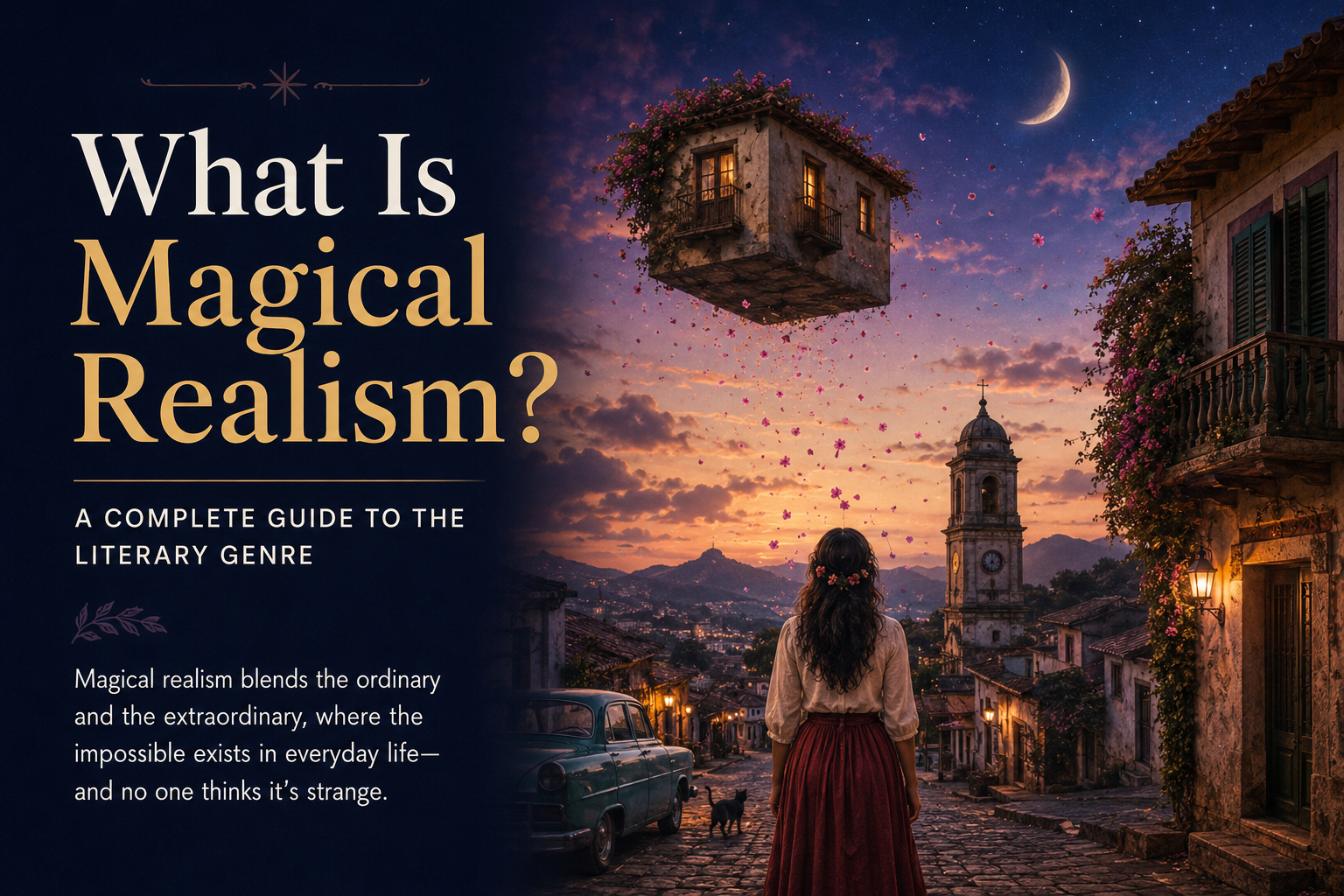
Magical realism is one of the most fascinating forms of fiction because it asks readers to accept the impossible as if it were ordinary. In a magical realism story, ghosts may sit at the dinner table, flowers may fall from the sky for days, or a woman may rise into heaven while hanging laundry. Yet nobody reacts with shock. The magical event is treated as part of everyday life.
This mixture of the ordinary and the extraordinary creates a reading experience that feels emotional, symbolic, dreamlike, and strangely believable all at once.
Magical realism appears in novels, short stories, films, and even television. It has influenced generations of writers across Latin America, Europe, Asia, Africa, and the United States. Readers often connect magical realism with writers like Gabriel García Márquez, Isabel Allende, Salman Rushdie, and Toni Morrison, though the style has grown far beyond those names.
Understanding magical realism can help readers analyze literature more deeply and help writers create stories that feel emotionally rich and imaginative without fully entering fantasy territory.
Key Takeaway
Magical realism is a literary style that blends realistic settings and believable human experiences with magical or impossible events that characters accept as normal. Unlike fantasy, magical realism does not build a separate world with special rules. Instead, it places the magical directly into ordinary life, often to explore memory, identity, history, trauma, family, culture, politics, or spirituality.
In This Guide
- What magical realism means
- The origins of magical realism
- The defining characteristics of magical realism
- How magical realism differs from fantasy
- Why writers use magical realism
- Common themes in magical realism
- Famous magical realism books and authors
- Examples of magical realism in literature
- Symbolism and meaning in magical realism
- How to identify magical realism in fiction
- Tips for writing magical realism
- Common misconceptions about magical realism
- Frequently asked questions about magical realism
What Is Magical Realism?
Magical realism is a literary genre or style in which magical events appear within an otherwise realistic world. The setting usually resembles ordinary life. Characters work jobs, raise families, attend school, cook meals, and deal with grief, poverty, love, loneliness, or political conflict. Yet within this normal reality, impossible things occur naturally.
A dead relative may continue visiting family members for years.
A child may hear the thoughts of strangers.
A town may suffer insomnia so severe that people forget the names of objects.
Rain may last for years.
The key element is not simply that magic exists. The important detail is how the story treats the magic. Characters rarely question it. The narrator presents impossible events in the same calm tone used to describe daily life.
This creates a unique emotional atmosphere. The world feels realistic and unreal at the same time.
Magical realism often reflects the way memory, emotion, spirituality, folklore, and cultural belief systems shape human experience. It suggests that reality itself may be more mysterious than strict logic allows.
Magical realism often uses ordinary settings mixed with impossible events to reveal deeper truths about memory, identity, grief, history, or culture. Because of this, understanding how literary themes and symbols work can help readers recognize why magical realism feels emotionally powerful even when events seem unrealistic. If you are new to literary interpretation, this guide to literary themes can help you build a strong foundation before exploring the genre further.














The Origins of Magical Realism
The phrase “magical realism” first appeared in art criticism before becoming connected to literature.
German art critic Franz Roh used the term in 1925 to describe paintings that presented ordinary subjects with an eerie or mysterious quality. Later, literary critics began applying the term to fiction, especially works emerging from Latin America during the twentieth century.
Magical realism became strongly associated with Latin American literature during the literary boom of the 1960s and 1970s. Writers from this period combined political history, myth, religion, folklore, colonialism, and social struggle with impossible or dreamlike events.
One of the most influential works in the genre is One Hundred Years of Solitude by Gabriel García Márquez. The novel tells the story of the Buendía family across generations in the fictional town of Macondo. The story includes ghosts, prophecies, levitation, impossible weather, and miraculous events, yet the novel remains deeply grounded in human history and political conflict.
Other writers expanded magical realism into different cultural traditions. Isabel Allende explored family history and political violence. Salman Rushdie blended mythology, colonial history, and national identity. Toni Morrison used supernatural elements to examine slavery, trauma, and memory.
Today, magical realism exists worldwide and continues influencing contemporary fiction.
The Core Characteristics of Magical Realism
Although magical realism can appear in many forms, several characteristics commonly define the genre.
Realistic Settings
Most magical realism stories begin in a believable world. The setting resembles recognizable history or ordinary life.
The town may resemble a real village.
The family may experience realistic financial problems.
Political events may reflect actual historical conflicts.
The realism grounds the reader emotionally before magical elements appear.
This realistic foundation separates magical realism from high fantasy, where entirely invented worlds often dominate the story.
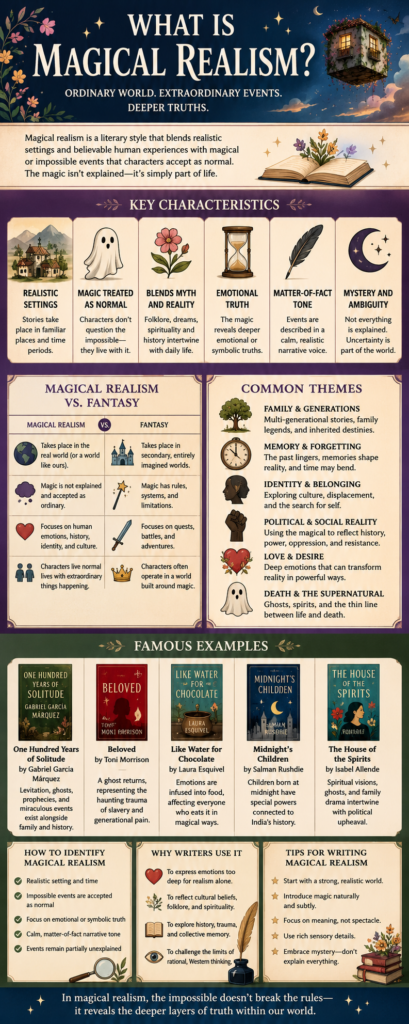
Ordinary Treatment of Magical Events
One of the clearest features of magical realism is the calm acceptance of impossible events.
Characters rarely scream in disbelief or demand scientific explanations.
Instead, the magical becomes part of everyday existence.
A grandmother may casually speak with spirits.
A child may float during emotional moments.
An entire village may accept prophetic dreams as ordinary truth.
The narrator also avoids dramatic explanation. The magical is presented with emotional seriousness and normality.
Blending Myth and Reality
Magical realism often mixes folklore, religion, superstition, oral storytelling, dreams, and mythology into daily life.
Stories may include:
- ancestral spirits
- curses
- miracles
- folk beliefs
- prophetic visions
- symbolic transformations
- supernatural weather
- impossible coincidences
These elements often reflect cultural traditions and collective memory.
Emotional or Symbolic Truth
Magical realism frequently values emotional truth more than scientific realism.
A magical event often symbolizes grief, trauma, love, guilt, memory, or social tension.
For example, a ghost may represent unresolved historical trauma rather than functioning simply as a horror element.
A magical event usually deepens emotional meaning instead of existing merely for spectacle.
One reason magical realism remains so memorable is that the magical elements usually function symbolically rather than randomly. A raining flower storm or a ghost at the dinner table often represents emotional truth rather than literal fantasy. Readers who want to study this more deeply may also find this guide to literary symbolism helpful.
A Matter-of-Fact Narrative Tone
The narration in magical realism usually sounds calm and controlled, even while describing impossible things.
This tone is essential.
If the narrator sounds shocked, frightened, or overly dramatic, the story begins moving closer to fantasy or horror.
The neutral tone encourages readers to accept the magical alongside the ordinary.
The Presence of Mystery
Magical realism rarely explains everything.
Readers may never learn why a miracle occurred or whether a supernatural event was objectively real.
The uncertainty becomes part of the reading experience.
The genre invites readers to live inside ambiguity rather than solving it.
How Magical Realism Differs from Fantasy
Many readers confuse magical realism with fantasy because both include impossible events. Yet the two genres operate very differently.
Fantasy Creates Separate Worlds
Fantasy often builds entirely new worlds with detailed systems, histories, species, or magical rules.
Examples include The Lord of the Rings by J. R. R. Tolkien or Harry Potter and the Sorcerer’s Stone by J. K. Rowling.
Magical realism usually stays inside the recognizable real world.
The town may resemble Colombia, India, the American South, or a modern city.
Magic appears inside ordinary reality instead of replacing it.
Fantasy Explains Magic
Fantasy often establishes clear magical systems.
Readers learn:
- who can use magic
- how magic works
- what powers exist
- what rules limit those powers
Magical realism rarely explains the impossible.
The magical simply exists.
Fantasy Centers Adventure
Fantasy stories often focus on quests, battles, kingdoms, prophecies, or heroic conflict.
Magical realism usually centers family life, memory, politics, identity, history, relationships, or emotional experience.
The magical supports deeper human themes rather than action-driven plots.
Characters React Differently
Fantasy characters often recognize magic as unusual or powerful.
Magical realism characters usually treat impossible events as ordinary.
This difference in reaction completely changes the atmosphere of the story.
Why Writers Use Magical Realism
Writers use magical realism because some human experiences feel larger than realism alone can express.
Grief can feel haunting.
Love can feel supernatural.
Memory can distort reality.
Political violence can feel surreal.
Trauma can make time feel broken.
Magical realism allows writers to express emotional and cultural truths that realistic fiction alone may struggle to capture.
Exploring Cultural Identity
Many magical realism writers use the genre to reflect cultures where folklore, spirituality, superstition, religion, and history remain deeply connected to daily life.
The magical elements often emerge naturally from collective cultural experience.
Addressing Historical Trauma
Magical realism frequently explores:
- colonialism
- slavery
- dictatorship
- war
- displacement
- generational trauma
The impossible may symbolize emotional wounds that history never fully resolves.
For example, haunting spirits may represent unresolved violence from the past.
Reflecting the Nature of Memory
Memory rarely behaves like strict realism.
People remember moments symbolically, emotionally, and imperfectly.
Magical realism captures this fluid quality of memory.
Time may loop.
The dead may feel present.
Objects may carry emotional power.
Reality may shift around emotional experience.
Challenging Western Rationalism
Some magical realism stories challenge the idea that only scientific or logical explanations matter.
The genre often leaves room for mystery, spirituality, intuition, dreams, and myth.
It suggests reality contains layers beyond strict rational explanation.
Common Themes in Magical Realism
Although magical realism stories vary widely, certain themes appear repeatedly.
Family and Generational History
Many magical realism stories follow families across decades or generations.
Family histories become intertwined with myth, memory, curses, or supernatural events.
Examples include:
- inherited trauma
- repeated names
- family legends
- ancestral ghosts
- cyclical history
Memory and Forgetting
Characters often struggle with memory.
A town may literally forget language.
A character may carry memories physically.
The past may refuse to disappear.
Memory itself often becomes magical.
Identity and Belonging
Magical realism frequently explores cultural identity, immigration, race, gender, or national identity.
The magical may reflect feelings of displacement or divided identity.
Political Violence and Power
Many magical realism works critique governments, colonialism, dictatorship, or social inequality.
The magical allows writers to portray political realities in emotionally powerful ways.
Death and the Supernatural
Ghosts appear frequently in magical realism.
Unlike horror fiction, these ghosts are often emotional, symbolic, or familial rather than terrifying.
The boundary between life and death may feel thin and permeable.
Love and Desire
Love in magical realism often takes exaggerated or impossible forms.
Emotion may physically alter reality.
A character’s longing may shape weather, dreams, or time itself.
Famous Magical Realism Authors
Several authors helped define or expand magical realism.
Gabriel García Márquez
Perhaps the most famous magical realism writer, García Márquez transformed world literature with One Hundred Years of Solitude.
His fiction blends political history, myth, memory, and family drama with impossible events presented as normal life.
Isabel Allende
Known for The House of the Spirits, Allende combines family history, spirituality, politics, and emotional storytelling.
Her work often focuses on women, memory, and generational trauma.
Salman Rushdie
Rushdie’s Midnight’s Children uses magical realism to explore Indian history, colonialism, identity, and national transformation.
Toni Morrison
In Beloved, Morrison uses supernatural elements to confront slavery, memory, motherhood, and trauma.
The ghost in the novel carries emotional and historical significance.
Laura Esquivel
Like Water for Chocolate blends cooking, romance, family conflict, and magical emotional effects.
Food becomes emotionally transformative in supernatural ways.
Haruki Murakami
Murakami’s fiction often combines loneliness, dreams, alternate realities, and subtle supernatural experiences within modern life.
Examples of Magical Realism in Literature
One Hundred Years of Solitude
This novel includes levitation, prophetic manuscripts, ghosts, miraculous beauty, and impossible weather patterns.
Yet the emotional center remains deeply human.
The magical reflects the cycles of history, memory, and political violence.
Beloved
The dead child returning as a ghost represents unresolved trauma from slavery.
The supernatural element becomes inseparable from emotional truth.
Like Water for Chocolate
A character’s emotions transfer into food, affecting everyone who eats it.
Cooking becomes magical, emotional, and symbolic.
Midnight’s Children
Children born at midnight during India’s independence possess supernatural abilities.
The magical reflects national identity and political transformation.
The House of the Spirits
Spiritual visions, ghosts, and supernatural awareness blend with family history and political upheaval.
Magical Realism and Symbolism
Magical realism relies heavily on symbolism.
The magical event almost always means more than its literal surface.
A storm may symbolize grief.
A haunting may symbolize historical guilt.
A miraculous transformation may symbolize emotional awakening.
The magical becomes a language for emotional and social meaning.
This symbolic depth explains why magical realism appears frequently in literary fiction and academic analysis.
Readers are invited to interpret the impossible rather than simply observe it.
How to Identify Magical Realism in Fiction
Students often struggle to determine whether a story qualifies as magical realism.
Several questions can help.
Does the Story Take Place in a Mostly Realistic World?
If the setting resembles ordinary reality, magical realism becomes more likely.
If the story occurs in a fully invented kingdom with elaborate magical systems, it is probably fantasy.
Are Magical Events Treated as Normal?
This is one of the most important clues.
If characters calmly accept impossible events, the story may belong to magical realism.
Is the Focus Emotional or Symbolic?
Magical realism usually uses the impossible to explore deeper emotional or social truths.
The magic is meaningful rather than merely entertaining.
Does the Story Resist Full Explanation?
Magical realism often leaves mysteries unresolved.
Readers may never fully understand why impossible things happen.
Is the Tone Calm and Matter-of-Fact?
The narration often sounds emotionally controlled and realistic despite describing extraordinary events.
Common Misconceptions About Magical Realism
“Magical Realism Is Just Fantasy”
This is the biggest misunderstanding.
Fantasy creates alternative worlds and structured magical systems.
Magical realism places impossible events inside ordinary life without explanation.
“Anything Weird Counts as Magical Realism”
Surrealism, horror, fantasy, science fiction, and absurdism may all contain strange events, but they operate differently.
Magical realism specifically blends realistic life with accepted supernatural elements.
“Magical Realism Must Come From Latin America”
Latin American literature strongly shaped the genre, but magical realism now appears globally.
Writers from many cultures use magical realism to explore identity, history, and emotional experience.
“The Magic Exists Only for Entertainment”
In magical realism, supernatural events usually carry symbolic, emotional, historical, or political meaning.
The magic deepens the story’s themes.
How Magical Realism Affects Readers
Magical realism changes the way readers experience reality inside fiction.
The genre creates emotional openness.
Readers begin accepting mystery, ambiguity, and symbolic logic.
The impossible starts feeling emotionally believable.
This effect can feel deeply moving because magical realism mirrors the way humans actually experience life.
People already treat memory, grief, love, spirituality, dreams, and family stories as larger than logic alone.
Magical realism gives literary form to those experiences.
Tips for Writing Magical Realism
Writers interested in magical realism should focus less on spectacle and more on emotional atmosphere.
Begin With Reality
Start with believable settings, relationships, and emotional conflicts.
The realism creates grounding.
Introduce Magic Calmly
Do not overexplain supernatural events.
Present them naturally.
Treat the impossible with emotional seriousness rather than excitement.
Focus on Emotional Meaning
The magical element should reveal something emotionally true.
Ask what the supernatural symbolizes within the story.
Use Sensory Detail
Magical realism often feels vivid and physical.
Ground impossible events in concrete sensory description.
Leave Some Mystery
Avoid explaining every detail.
Ambiguity strengthens magical realism.
Draw From Folklore and Memory
Family stories, cultural traditions, dreams, myths, and personal memories can inspire powerful magical realism.
Magical Realism in Contemporary Fiction
Magical realism continues evolving in modern literature.
Contemporary writers use the genre to explore:
- immigration
- climate anxiety
- race
- gender
- generational trauma
- technology
- displacement
- political instability
Modern magical realism often blends literary fiction with speculative elements in subtle ways.
Many readers enjoy the genre because it feels emotionally honest while remaining imaginative.
Why Magical Realism Remains Popular
Magical realism remains powerful because reality itself often feels strange.
Human beings experience:
- coincidence
- intuition
- dreams
- grief
- longing
- memory
- spiritual questions
- emotional distortion
Strict realism cannot always capture these experiences fully.
Magical realism creates space for mystery while remaining emotionally grounded.
The genre reminds readers that reality contains both the visible and the invisible.
Where to Read More About Magical Realism
For readers who want to explore the genre more deeply, here are several sources that provide helpful background on magical realism and its literary traditions.
Encyclopaedia Britannica’s overview of magical realism offers a clear explanation of the genre’s origins, major characteristics, and cultural influence across fiction and art.
Writer’s Digest’s guide to magical realism gives writers a practical look at how magical realism works in storytelling, including common techniques and examples from contemporary fiction.
For a broader literary and cultural perspective, Poetry Northwest’s discussion of magical realism and the sociology of possibility examines how magical realism reshapes the way readers think about reality, imagination, and social experience.
Frequently Asked Questions About Magical Realism
What is the difference between magical realism and fantasy?
Fantasy usually creates separate worlds with clear magical systems and rules. Magical realism places impossible events inside ordinary reality and treats them as normal parts of life.
Is magical realism a genre or a style?
Critics debate this question. Some describe magical realism as a genre, while others view it as a literary style or narrative mode that can appear across different genres.
Who invented magical realism?
The term first appeared in art criticism through Franz Roh, though many writers later shaped the literary form associated with magical realism.
Why is Gabriel García Márquez important to magical realism?
García Márquez helped popularize magical realism worldwide through works like One Hundred Years of Solitude, which became one of the most influential novels of the twentieth century.
Is magical realism always symbolic?
Most magical realism includes symbolic meaning, though interpretations vary. The magical often reflects emotional, political, cultural, or psychological truths.
Can magical realism include ghosts?
Yes. Ghosts appear frequently in magical realism, especially as symbols of memory, trauma, family history, or unresolved conflict.
Is magical realism always serious?
Not necessarily. Some magical realism includes humor, irony, romance, satire, or absurdity alongside deeper emotional themes.
What are common magical realism themes?
Common themes include family history, memory, trauma, political violence, identity, spirituality, love, death, and cultural tradition.
Is Beloved magical realism?
Yes. Many scholars consider Morrison’s novel an important example of magical realism because it blends realistic historical trauma with supernatural elements treated as emotionally real.
Can beginners write magical realism?
Yes, though the style requires emotional subtlety and restraint. Strong magical realism depends more on atmosphere, symbolism, and tone than elaborate magical systems.
Final Thoughts on Magical Realism
Magical realism continues to captivate readers because it reflects the strange emotional texture of human life. The genre allows stories to move beyond strict realism without abandoning emotional truth.
In magical realism, the impossible does not replace reality. It reveals deeper layers within it.
Ghosts become memory.
Miracles become grief.
Weather becomes emotion.
History becomes haunting.
The magical becomes another language for understanding what it means to be human.
For readers, magical realism offers stories that feel dreamlike yet deeply personal. For writers, it provides a way to explore truth through symbolism, mystery, and imagination without losing touch with ordinary life.
That balance between realism and wonder is what makes magical realism one of the most enduring and emotionally powerful forms of fiction.












