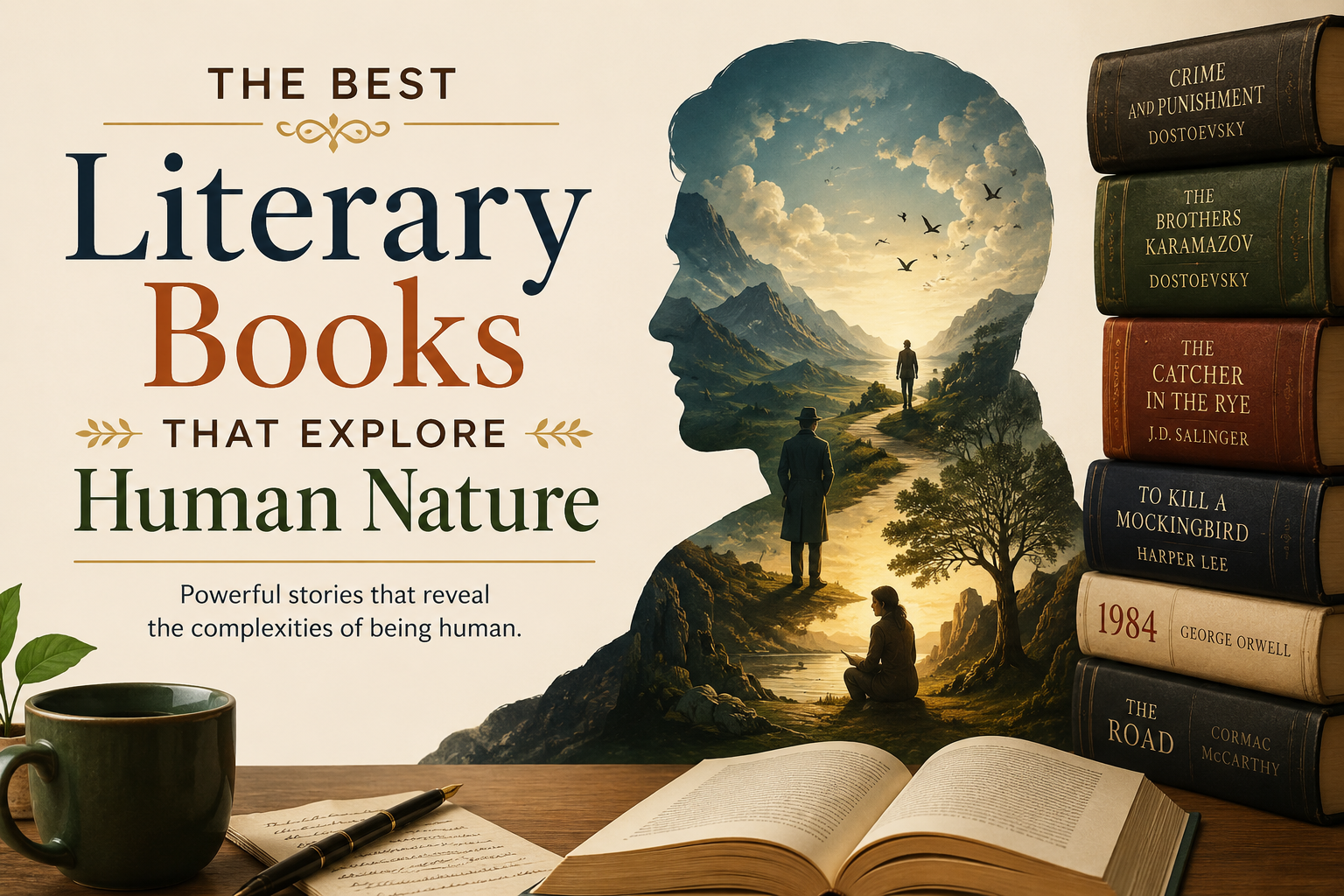
Great stories help us see the truth about people, even when that truth feels hard to face. Best Literary Human Nature looks at books that explore fear, pride, love, guilt, and moral choice.
These works matter because they ask a simple question: what do people do when life tests them?
In this Guide
What Best Literary Human Nature means
Why human nature matters in literature
Best Literary Human Nature books to read
Symbols and themes that reveal character
How students can write about human nature
FAQs
Key takeaway
What Best Literary Human Nature Means
Stories about human nature show what people want, fear, hide, and choose.
The phrase Best Literary Human Nature may sound broad, but the idea is clear. It points to books that reveal how people act under pressure.
Some characters try to do the right thing. Others choose power, comfort, or revenge. Literature lets us watch those choices from a safe distance.
That is why these books stay with us. They do not just tell us what happened. They show us why people behave the way they do.
Why Best Literary Human Nature Stories Still Matter
The best books feel alive because their characters feel real.
Best Literary Human Nature stories matter because readers can see parts of themselves in the characters. A reader may not rule a kingdom like Macbeth, but they may know what ambition feels like.
In William Shakespeare’s Macbeth, ambition grows into violence. Macbeth wants power so badly that he loses his peace, his honor, and his sense of self.
In Mary Shelley’s Frankenstein, Victor wants glory through science. His mistake is not just that he creates life. His deeper failure is that he refuses to care for what he has made.
These stories ask us to think about responsibility. They also ask if people are born flawed or shaped by the choices around them.
Best Literary Human Nature Books to Read
These books are strong choices for students because they are rich, readable, and full of moral conflict.
The Best Literary Human Nature books often focus on a character who faces a hard test. That test may come from society, family, power, or guilt.
To Kill a Mockingbird by Harper Lee
This novel explores justice, fear, and moral courage. Atticus Finch shows that doing the right thing can cost a person comfort and safety.
Scout learns that people are more complex than they first appear. The book asks readers to look past rumor and prejudice.
Lord of the Flies by William Golding
This novel places schoolboys on an island without adult rules. At first, they try to build order. Soon, fear and power begin to take over.
Golding suggests that cruelty can grow when people lose limits. The story is often used in classrooms because it raises sharp questions about civilization and human nature.
Other strong examples
Students may also study The Great Gatsby by F. Scott Fitzgerald or Hamlet by William Shakespeare. Both works show how desire can twist a person’s view of truth.
Best Literary Human Nature Themes Students Should Know
Themes help readers move from “what happened” to “what the story means.”
When students study Best Literary Human Nature, they often notice the same big ideas across different books. These ideas repeat because people face the same inner battles in many times and places.
Ambition and its cost
Ambition can help a character grow. It can also lead to ruin.
Macbeth is the classic example. His desire for power destroys his loyalty and peace of mind.
Goodness under pressure
Many novels ask if a person can stay good when the world is unfair. To Kill a Mockingbird explores this through Atticus, Scout, and the trial of Tom Robinson.
The book does not pretend goodness is easy. It shows that moral courage often feels lonely.
Fear and group behavior
Lord of the Flies shows how fear can spread through a group. The boys begin to follow the loudest voices, not the wisest ones.
This theme matters because people often act differently in a crowd. Literature helps us question that shift.
Symbols That Reveal Human Nature
Symbols give stories deeper meaning without heavy explanation.
In Best Literary Human Nature works, symbols often show what characters cannot say out loud. A symbol may reveal guilt, innocence, power, or loss.
In Lord of the Flies, the conch shell stands for order and shared rules. When the shell loses power, the boys lose their grip on peace.
In Frankenstein, light often connects to knowledge. Yet Shelley shows that knowledge without care can become dangerous.
In The Great Gatsby, the green light stands for Gatsby’s dream. It also shows how desire can trap a person in the past.
Poetry can do this too. The Poetry Foundation’s page on Robert Frost is useful for readers who want to see how poems explore choice and regret.
How to Write About Best Literary Human Nature in an Essay
A strong essay does not just name a theme. It explains how the author builds that theme through character, conflict, and symbol.
If you write about Best Literary Human Nature, start with a clear claim. Do not say, “This book shows human nature.” Say what the book argues about human nature.
For example, an essay on Macbeth could argue that unchecked ambition destroys moral judgment. An essay on Lord of the Flies could argue that fear weakens social order.
After that, choose scenes that prove your point. Focus on what characters say, what they hide, and how they change.
Recommended Books for Best Literary Human Nature Readers
These books are often easy to find and useful for class discussions.
To Kill a Mockingbird by Harper Lee is a strong choice for readers who want a story about justice and moral growth.
Lord of the Flies by William Golding is ideal for readers who want a darker look at fear, power, and group behavior.
Both books work well for essays because they offer clear conflicts and strong symbols. They also give students many ways to discuss Best Literary Human Nature without forcing one simple answer.
Common Mistakes When Reading Human Nature in Literature
It is easy to make human nature sound too simple.
One common mistake is to call a character “good” or “bad” and stop there. Most great books avoid simple labels.
Another mistake is to ignore the setting. A character’s world shapes their choices. Social pressure, fear, and unfair rules often push characters toward action.
A better approach is to ask why a character makes a choice. Then ask what the author wants readers to learn from that choice.
FAQs About Best Literary Human Nature
What does Best Literary Human Nature mean?
Best Literary Human Nature refers to books and stories that reveal how people think, choose, and change. These works often focus on moral conflict.
What is a good book about human nature for students?
To Kill a Mockingbird is a strong choice. It deals with justice, courage, and the way people judge others.
Why do teachers assign books about human nature?
Teachers assign these books because they help students think deeply about character and theme. They also connect literature to real life.
Is human nature a theme?
Human nature is a broad idea, not a theme by itself. A stronger theme would say something specific, such as “fear can make people give up their values.”
How can I find symbols related to human nature?
Look for objects, images, or repeated details that connect to a character’s inner life. Then ask how the symbol changes as the story moves forward.
Key Takeaway
Best Literary Human Nature stories matter because they show people at their most honest moments. They help readers see how fear, desire, guilt, and hope shape human choice.
The strongest literature does not give easy answers. It gives us characters who feel real, choices that matter, and questions we keep asking long after the final page. 📚
A simple step-by-step guide to understanding fictional characters and writing stronger literary analysis essays
Understanding characters is one of the most important skills in literary analysis. Stories are built around people: their decisions, their desires, and their flaws. When readers learn how to analyze characters in literature, they begin to see how authors shape meaning through personality, conflict, and change.
A strong character analysis does more than describe someone in a story. It explains why the character acts the way they do and what their actions reveal about the themes of the work. Literary scholars often look closely at a character’s motivations, relationships, and development across the narrative.
In this guide, you’ll learn simple methods you can use to analyze characters in any novel, play, or poem—from Jane Austen’s sharp social portraits to the dark psychological figures in Gothic fiction.
This article contains affiliate links.
In This Guide 📚
What character analysis means How authors create characters through characterization How to analyze a character’s motivations How to examine relationships between characters How to track character development Example character analysis from classic literature Questions you can ask while reading
What Character Analysis Means
Understanding the foundations of how to analyze characters in literature.
Character analysis is the process of examining a character’s traits, actions, motivations, and development in order to understand their role in a story. Instead of simply describing whether a character is “good” or “bad,” literary analysis asks deeper questions about why the character behaves the way they do and how those actions shape the narrative.
In literature, characters are created through a technique called characterization. This is the way authors reveal personality, beliefs, and emotional struggles through description, dialogue, and behavior.
💡 Key insight: Character analysis connects personality to meaning.
When you understand a character’s motives and choices, you begin to see how the author explores larger themes like love, ambition, morality, or social pressure.
Elizabeth Bennet often appears witty and confident, but her judgments are shaped by pride and prejudice of her own. When she rejects Mr. Darcy’s first proposal, her decision reveals both moral strength and personal bias.
Her character becomes clearer when we examine why she believes Darcy is arrogant and how those assumptions change.
Through Elizabeth’s development, Jane Austen explores themes of self-knowledge and social misunderstanding.
Examine Relationships Between Characters
Characters are often defined by their relationships.
A character rarely exists alone in literature. Instead, authors reveal personality through interactions with others.
When analyzing characters, consider:
How does the character treat friends or family? How do other characters react to them? Do their relationships change over time?
Victor Frankenstein’s relationship with his creation reveals his deepest flaws. Instead of taking responsibility for the being he brings to life, Victor abandons the creature immediately.
This decision drives the tragedy of the novel.
The creature’s loneliness and anger reflect Victor’s moral failure, turning the story into a meditation on responsibility and creation.
In Jane Austen’s Emma, the main character begins as confident and somewhat self-satisfied. She enjoys arranging relationships between others and believes she understands people perfectly.
Yet over time, Emma realizes her mistakes. She learns humility and emotional awareness.
Her transformation reveals one of the novel’s central themes: true maturity requires self-reflection.
Look for Symbolic or Thematic Meaning
Sometimes a character represents a larger idea.
In some works of literature, characters symbolize broader themes or philosophical ideas.
For example:
Dracula often represents fear of the unknown and cultural anxiety in Gothic fiction.
He is not only a villain but also a symbol of the anxieties surrounding modernity and foreign influence in Victorian England.
By examining how Dracula interacts with other characters and environments, readers see how Bram Stoker uses the character to explore fear, power, and desire.
Ask Questions While Reading
Simple questions that help you analyze characters more deeply.
When reading literature, pause occasionally and ask yourself:
What does this character want most? What are their greatest fears? How do they treat others? What mistakes do they make? How do they change?
These questions help transform passive reading into active literary analysis.
Elizabeth Bennet in Pride and Prejudice represents the struggle between perception and truth. At first she believes she understands Darcy perfectly, interpreting his reserved manner as arrogance. Her judgments seem reasonable based on the limited information she receives. Yet as new facts emerge, Elizabeth gradually recognizes her own bias. This realization reshapes her understanding of Darcy and of herself. Through Elizabeth’s journey, Jane Austen illustrates how personal pride and social expectations can distort perception. The character’s development ultimately reveals that self-knowledge is necessary for genuine love and moral growth.
This toolkit includes templates and worksheets designed to make literary analysis essays much easier to write.
Key Takeaway 💡
Learning how to analyze characters in literature means moving beyond simple description. Instead of asking whether a character is “good” or “bad,” strong literary analysis explores motivations, relationships, and change. By examining these elements closely, readers uncover the deeper themes that authors embed within their stories.
FAQ – How to analyze characters in literature
What is character analysis in literature?
Character analysis is the process of examining a character’s traits, motivations, actions, and development in order to understand their role and meaning within a literary work.
Why is character analysis important?
Characters often carry the central themes of a story. Understanding them helps readers interpret the deeper message of the work.
What are the main things to analyze in a character?
Most literary analyses focus on personality traits, motivations, relationships, and how the character changes throughout the story.
What is characterization?
Characterization is the method authors use to reveal a character’s personality through description, actions, dialogue, and interactions with others.
A clear guide to the most important literary devices students encounter when analyzing novels, poetry, and classic literature.
When readers begin studying literature more closely, they quickly encounter the term literary devices. These are the techniques writers use to shape language, structure narratives, and guide how readers interpret a story.
Authors rely on literary devices such as metaphor, symbolism, irony, and foreshadowing to communicate ideas beneath the surface of the plot. Once readers begin recognizing these techniques, patterns and meanings that once seemed hidden become easier to interpret.
Understanding literary devices is an important step for anyone who wants to learn literary analysis. Instead of only asking what happens in a story, readers begin asking how a writer’s language creates meaning.
Understanding literary devices helps readers interpret literature more thoughtfully. By recognizing patterns in language, imagery, symbolism, and narrative structure, readers move beyond simple plot summaries and begin discovering the deeper ideas within a text.
In This Guide
In this article you will learn:
• what literary devices are and why authors use them • a literary devices list with 32 important techniques • examples of literary devices from famous works of literature • how recognizing literary devices improves literary analysis
Image by Carla Paton
Quick Literary Devices List
This guide explains the following literary devices:
Below is a quick reference table summarizing some of the most common literary devices. Each device is explained in more detail later in this guide.
Metaphor: a direct comparison between two unlike things. Simile: a comparison using the words like or as. Symbolism: using an object to represent a deeper meaning. Foreshadowing: hints that suggest future events in a story. Imagery: descriptive language that appeals to the senses. Irony: a contrast between expectation and reality. Allusion: a reference to another text, event, or myth. Personification: giving human qualities to nonhuman things. Hyperbole: exaggerated language used for emphasis. Motif: a recurring image or idea in a text. Theme: the central idea explored in a literary work. Tone: the author’s attitude toward the subject. Mood: the emotional atmosphere experienced by readers. Juxtaposition: placing contrasting ideas side by side. Flashback: a narrative shift to an earlier time in the story.
What Are Literary Devices?
Literary devices are techniques writers use to communicate meaning, shape narrative structure, and influence how readers interpret a text.
Some literary devices focus on language, such as metaphor or imagery. Others affect narrative structure, such as flashback or foreshadowing. Still others influence how readers interpret themes, characters, and symbolism.
Recognizing literary devices helps readers move beyond simple summaries and begin interpreting how literature communicates deeper ideas.
If you are new to these techniques, these guides may also help:
When reading literature, look for patterns. If an image, phrase, or idea appears repeatedly, it may signal an important literary device such as symbolism or motif.
32 Literary Devices Explained With Examples
Below is a literary devices list explaining 32 common techniques used in literature.
1. Metaphor Example
A metaphor compares two unlike things directly to suggest a deeper similarity.
Example from Wuthering Heights by Emily Brontë:
“I am Heathcliff.”
This metaphor suggests that their identities and emotional lives are inseparable. Catherine’s statement is a metaphor expressing the profound emotional and psychological bond she feels with Heathcliff.
2. Simile Example
A simile compares two things using the words like or as.
Example: Descriptions in Gothic novels such as Dracula often compare darkness or fear to death itself, reinforcing the story’s atmosphere.
Example from Dracula by Bram Stoker:
“The castle is a veritable prison, and I am a prisoner.”
Although not a formal “like/as” comparison, Stoker repeatedly uses simile-like comparisons to emphasize Jonathan Harker’s sense of confinement.
3. Symbolism Example
Symbolism occurs when an object represents a deeper meaning.
Example from Frankenstein by Mary Shelley:
“Learn from me… how dangerous is the acquirement of knowledge.”
Here, the creature and Victor’s experiment symbolize the dangers of uncontrolled scientific ambition.
This printable guide summarizes 32 literary devices with simple definitions and examples from classic literature so you can keep them handy while reading or writing literary analysis essays.
9. Hyperbole Example
Hyperbole is intentional exaggeration used for emphasis.
Example from Wuthering Heights:
“I cannot live without my soul!”
Heathcliff exaggerates his emotional dependence on Catherine.
10. Motif Example
A motif is a recurring element that reinforces themes.
Example from Frankenstein:
“A flash of lightning illuminated the object.”
Light and fire repeatedly appear throughout the novel, symbolizing knowledge.
11. Theme Example
A theme is the central idea explored in a literary work.
Example from Pride and Prejudice by Jane Austen:
“Happiness in marriage is entirely a matter of chance.”
This line introduces themes of marriage, social expectations, and compatibility.
Austen’s precise word choice establishes Emma’s character immediately.
23. Narrative Voice Example
The narrative voice determines how a story is told.
Example from Frankenstein:
The novel includes multiple narrators, including Walton and Victor.
“You will rejoice to hear that no disaster has accompanied the commencement of an enterprise…”
24. Dialogue Example
Dialogue is conversation between characters.
Example from Pride and Prejudice:
“She is tolerable…”
This brief dialogue reveals Darcy’s pride and sets up Elizabeth’s later prejudice.
25. Setting Example
Setting describes the time and place of a story.
Example from Wuthering Heights:
“Wuthering Heights is the name of Mr. Heathcliff’s dwelling.”
The isolated moorland setting shapes the novel’s emotional atmosphere.
26. Satire Example
Satire criticizes social behavior.
Example from Pride and Prejudice:
“It is a truth universally acknowledged…”
Austen humorously critiques society’s obsession with marriage.
27. Climax Example
The climax is the turning point of the narrative.
Example from Frankenstein:
The confrontation between Victor and the creature marks the peak of tension.
28. Resolution Example
The resolution concludes the story’s conflicts.
Example from Frankenstein:
“He was soon borne away by the waves.”
The creature disappears after Victor’s death.
29. Characterization Example
Characterization reveals personality traits.
Example from Pride and Prejudice:
Elizabeth’s wit appears in her response to Darcy:
“I could easily forgive his pride, if he had not mortified mine.”
30. Symbol Example
A symbol represents a larger idea.
Example from Frankenstein:
“A spark of being.”
Fire symbolizes knowledge and discovery throughout the novel.
31. Oxymoron Example
Oxymoron: a figure of speech that combines two contradictory terms to create a striking expression.
Example from Romeo and Juliet by William Shakespeare:
“O brawling love! O loving hate!”
In this line, Shakespeare pairs opposite ideas—love and hate—to emphasize Romeo’s emotional confusion.
Oxymorons highlight emotional tension and can make language more dramatic or memorable.
32. Dramatic Irony Example
Dramatic irony: a literary device in which the audience knows something that the characters in the story do not.
Example from Romeo and Juliet:
“O happy dagger!”
Juliet believes Romeo is dead and takes her own life, but the audience knows that his death resulted from tragic misunderstanding. This gap in knowledge creates intense emotional tension.
Dramatic irony is especially common in tragedies and plays, where audiences are aware of information that characters lack.
How to Identify Literary Devices When Reading
Recognizing literary devices becomes easier with practice. When reading literature, look for patterns that signal deeper meaning.
Notice repeated language or imagery. Writers often repeat symbols or motifs to emphasize themes. Pay attention to unusual comparisons such as metaphors or similes. Shifts in tone or mood can also reveal important narrative moments.
If you want to practice these skills, you may find these guides helpful:
Understanding literary devices becomes much easier when you practice noticing them in real texts. As you read novels, poems, and plays, try marking passages where authors use techniques such as imagery, symbolism, metaphor, or foreshadowing. Over time, these patterns become easier to recognize.
If you would like structured practice, you can sign up below to download the free Close Reading Worksheet Pack, which includes guided exercises designed to help students identify literary devices, themes, and patterns while reading literature.
The worksheets are designed for use with classic texts and can help you apply the techniques discussed in this guide.
Download the Literary Devices Cheat Sheet
If you want a quick reference for studying or writing essays, download the free Literary Devices Cheat Sheet. It includes a printable one-page summary of the 32 literary devices explained in this guide.
A Practical Guide to Recognizing Hidden Meaning in Literature
Many stories contain objects, images, or actions that seem ordinary at first but gradually reveal deeper meaning. Learning how to find symbolism in a story helps readers recognize these subtle patterns.
Symbolism is one of the ways authors communicate ideas without stating them directly. A setting, an object, or even a repeated action may represent a larger idea about life, identity, or human relationships.
When readers learn how to find symbolism in a story, literature begins to feel richer and more layered. Instead of seeing only the plot, readers start noticing how authors use details to express deeper themes.
If you’re new to careful literary reading, you may want to begin with:
That guide explains the reading habits that help uncover symbolism.
⭐ Key Takeaway
Symbolism often appears through repetition and context. When an image, object, or action appears several times in a story, it may represent a larger idea the author wants readers to notice.
Emily Brontë’s Wuthering Heights (affiliate link) offers a strong example of how to find symbolism in a story.
Throughout the novel, the wild moorland landscape appears repeatedly.
The moors are often described as harsh, stormy, and unpredictable.
At first, these descriptions may seem like simple background setting. However, a closer reading suggests something deeper.
The turbulent landscape mirrors the intense emotions of characters such as Heathcliff and Catherine.
The stormy weather and isolated setting symbolize the novel’s themes of passion, conflict, and emotional instability.
By observing how the landscape repeatedly reflects the characters’ emotional world, readers begin to uncover the story’s symbolic meaning.
📌 A symbol often becomes visible when readers connect physical details to emotional patterns in the story.
Many of the patterns readers notice while studying literature come from techniques known as literary devices. If you’re new to these techniques, this guide explains 32 literary devices with examplesfrom classic literature.
How Symbolism Supports Literary Analysis
Recognizing symbolism is an important part of literary interpretation.
When readers identify symbols, they can begin explaining how those symbols contribute to the story’s themes.
For example, a literary essay might explore:
how weather imagery reinforces emotional conflict
how symbolic objects reflect character development
how recurring settings express thematic ideas
If you’re interested in turning observations like these into essays, see:
A classic guide to active reading and thoughtful interpretation.
Conclusion: Symbols Reward Careful Readers
Learning how to find symbolism in a story does not require guessing the author’s hidden message. Instead, it involves observing patterns and asking thoughtful questions about what those patterns suggest.
As readers pay closer attention to objects, images, and repeated details, literature begins to reveal deeper layers of meaning.
With practice, symbolism becomes one of the most rewarding aspects of reading.
FAQ — How to Find Symbolism in a Story
What is symbolism in literature?
Symbolism occurs when an object, image, or action represents a larger idea within a story.
How can I tell if something is a symbol?
Look for repetition, emotional significance, and connections to the story’s themes.
Can a symbol have more than one meaning?
Yes. Symbols often carry multiple interpretations depending on context.
Why do authors use symbolism?
Symbolism allows authors to communicate ideas indirectly and add depth to their stories.
A Practical Guide to Discovering the Deeper Meaning of Stories and Poems
Many readers enjoy novels and poems but feel unsure about how to explain what the text is really about. Teachers often ask students to identify the theme of a story, yet the idea can feel abstract at first.
Learning how to identify theme in literature becomes easier when you slow down and pay attention to patterns in the text. Themes rarely appear in a single sentence. Instead, they develop through characters, repeated images, conflicts, and the choices authors make throughout a narrative.
Once readers begin noticing these patterns, the theme gradually becomes clear. The process is closely connected to close reading and literary analysis.
If you’re new to that approach, you might begin with:
Themes emerge from patterns across a story. When readers pay attention to characters, conflicts, imagery, and repeated ideas, the deeper meaning of the text begins to appear.
Image by Carla Paton
📚 In This Guide
In this article you’ll learn:
How to identify theme in literature step by step
What themes actually are (and what they are not)
How patterns in characters and events reveal theme
A practical example from Frankenstein (affiliate link)
How theme connects to literary analysis
What Is a Theme in Literature?
Understanding how to identify theme in literature begins with a simple definition.
A theme is the central idea or insight that a work of literature explores about life, human nature, or society.
Themes often address questions such as:
responsibility
love and relationships
ambition and power
identity
isolation
morality
Unlike plot, which describes what happens, theme explains what the story suggests about those events.
Many stories explore multiple themes at the same time.
📌 Plot tells the story. Theme reveals what the story means.
Step 1: Look for Repeated Ideas
A helpful way to practice how to identify theme in literature is to look for repetition.
Authors often return to certain ideas or situations throughout a work.
For example, a novel might repeatedly show:
characters struggling with social expectations
conflicts between ambition and responsibility
tensions between freedom and duty
When these ideas appear several times, they often point toward the story’s theme.
Tracking these patterns becomes easier when readers annotate the text.
How to Read a Book — Mortimer Adler & Charles Van Doren A classic guide to thoughtful reading and interpretation.
Conclusion: Theme Emerges Through Careful Reading
Identifying theme does not require guessing what the author intended. Instead, it involves noticing patterns in the text and asking thoughtful questions about what those patterns suggest.
When readers slow down and observe details in characters, imagery, and conflicts, the story’s deeper meaning gradually becomes visible.
With practice, learning how to identify theme in literature becomes one of the most rewarding parts of reading.
FAQ — How to Identify Theme in Literature
What is the easiest way to identify theme in literature?
Look for repeated ideas across the story, especially in character decisions, conflicts, and symbols.
Is theme the same as the moral of the story?
Not exactly. A moral usually offers a clear lesson, while a theme explores broader ideas about life and human behavior.
Can a story have more than one theme?
Yes. Many works of literature explore several themes at once.
Why do teachers ask students to identify theme?
Theme analysis helps readers understand how literature explores complex ideas about society, identity, and human relationships.
A Simple Guide to Understanding Poems One Line at a Time
Poetry can feel intimidating at first. Poems often compress ideas into a few lines, use unusual imagery, and leave important meanings unstated. Many readers enjoy poetry but wonder how to analyze poetry step by step in a clear and practical way.
The good news is that poetry analysis relies on the same skills used in close reading and literary interpretation. When you slow down and pay attention to language, patterns begin to appear.
Learning how to analyze poetry step by step means noticing details such as imagery, tone, structure, and repetition. These clues help reveal the poem’s deeper meaning.
If you’re new to close reading, you might first explore this guide:
That article explains the careful reading habits that make poetry analysis possible.
⭐ Key Takeaway
Learning how to analyze poetry step by step means paying attention to small details in language. Imagery, sound, structure, and repetition often reveal the poem’s central meaning.
📚 In This Guide
In this article you’ll learn:
How to analyze poetry step by step
What details scholars look for when reading poems
How imagery and sound shape meaning
A practical example using a public-domain poem
How poetry analysis connects to literary essays
Image by Carla Paton
Step 1: Read the Poem Slowly
A good way to begin how to analyze poetry step by step is to read the poem more than once.
The first reading helps you understand the general subject of the poem. The second reading allows you to notice details.
While reading, ask simple questions:
What seems to be happening?
Who is speaking?
What emotions appear in the poem?
Many scholars recommend reading poems aloud because the sound of the language often reveals meaning.
These books provide helpful guidance for readers learning poetry analysis (affiliate links).
How to Read Poetry Like a Professor — Thomas C. Foster A widely used introduction explaining how imagery, symbolism, and poetic structure shape meaning.
A Practical Guide to Tracking Characters, Themes, and Important Details
Many readers enjoy novels but struggle to remember key details after finishing a chapter. Characters blur together, important moments slip by, and themes can be difficult to track. Learning how to take notes while reading a novel helps solve this problem.
Taking notes does not mean interrupting the pleasure of reading. Instead, it helps readers notice patterns, remember important passages, and develop deeper insights into the story. Scholars, students, and thoughtful readers often use note-taking to stay engaged with a text.
If you’ve already explored careful reading strategies, this process will feel familiar. In fact, note-taking naturally grows out of close reading in literature.
Learning how to take notes while reading a novel helps transform passive reading into active engagement. By tracking characters, themes, and meaningful passages, readers begin to notice patterns that reveal deeper meaning in the story.
Image by Carla Paton
📚 In This Guide
In this article you’ll learn:
How to take notes while reading a novel effectively
What kinds of notes scholars and students record
How to track characters, themes, and important passages
How note-taking supports literary analysis and essays
Why Take Notes While Reading a Novel?
Learning how to take notes while reading a novel helps readers notice patterns that might otherwise be easy to miss.
When reading quickly for plot, it is easy to overlook small but meaningful details. A character’s remark, a repeated image, or a subtle shift in tone might later prove important.
Taking notes helps readers:
remember key characters and relationships
track themes and recurring ideas
record memorable passages
notice patterns across chapters
Many literature students use note-taking as a bridge between reading and writing essays.
📌The best notes capture what catches your attention while reading.
What Kind of Notes Should You Take?
Effective note-taking while reading a novel focuses on patterns rather than plot summaries.
Many readers assume they should write long summaries. In reality, short observations are often more useful.
Common note categories include:
Characters Write down new characters and key traits.
Themes Notice recurring ideas such as love, reputation, identity, or power.
Important passages Record quotations that seem meaningful.
Questions Mark moments that confuse or surprise you.
These notes help you track how a novel develops its meaning over time.
Example: Taking Notes While Reading Pride and Prejudice
A simple example shows how taking notes while reading a novel can help track characters and themes.
Consider the early chapters of Jane Austen’s Pride and Prejudice (affiliate link). When Elizabeth Bennet first encounters Mr. Darcy, the narrator describes his behavior as proud and distant.
A reader taking notes might record something like:
Character note
Mr. Darcy — appears proud and reserved at the Meryton assembly.
Theme note
Reputation and first impressions may influence how characters judge each other.
Passage note
Elizabeth overhears Darcy refusing to dance with her, which shapes her opinion of him.
Later in the novel, these early impressions become important to the story’s exploration of misjudgment and social perception.
By writing down small observations like these, readers begin to notice patterns that shape the narrative.
📌Small notes made during reading often reveal the larger themes of a novel.
Simple Note-Taking Methods for Novels
There are several easy ways to practice how to take notes while reading a novel.
Different readers prefer different approaches.
Margin Notes
Write short observations directly in the book’s margins.
Sticky Notes
Use small tabs to mark important pages or passages.
Reading Journal
Keep a notebook where you track characters, themes, and quotations.
Digital Notes
Readers using e-books often highlight passages and record comments digitally.
The best method is the one that helps you stay engaged with the text.
How Note-Taking Connects to Literary Analysis
Taking notes while reading a novel often leads naturally to interpretation and analysis.
When readers collect observations across a novel, patterns begin to emerge (affiliate links).
How to Read a Book — Mortimer J. Adler & Charles Van Doren A classic guide to active reading and intellectual engagement with texts.
Conclusion: Turning Reading Into Active Thinking
Once readers learn how to take notes while reading a novel, the reading experience changes. Instead of simply following the plot, readers begin noticing how the story is constructed.
Characters, themes, and patterns gradually connect across chapters. What once seemed like small details become meaningful clues.
Over time, note-taking transforms reading into an active conversation with the text.
FAQ — Taking Notes While Reading a Novel
Should I take notes while reading fiction?
Yes. Taking notes helps readers remember characters, track themes, and notice patterns that shape the story.
How detailed should reading notes be?
Short observations are usually best. Focus on meaningful passages, character traits, and recurring ideas rather than summarizing every chapter.
Do scholars take notes while reading novels?
Yes. Literary scholars often annotate texts and record observations while reading, which later become ideas for research or interpretation.
Can note-taking improve my understanding of literature?
Absolutely. Writing down questions and observations helps readers engage more deeply with the text.
A Simple Guide to Understanding How Scholars Read Texts Carefully
When students first encounter literary analysis, they often hear the phrase close reading in literature. At first it can sound technical or mysterious. In reality, close reading simply means paying careful attention to how a text works.
Instead of reading quickly for plot, close reading slows the process down. Readers begin noticing patterns, imagery, tone shifts, repeated language, and structure. These details help reveal how an author creates meaning.
Close reading is the foundation for many other literary skills. It leads naturally to annotation, research questions, and literary analysis essays.
Close reading in literature means paying attention to the small details of a text. By noticing patterns in imagery, language, and structure, readers can uncover deeper meaning and develop thoughtful interpretations.
📚 In This Guide
In this article you’ll learn:
What close reading in literature actually means
Why close reading is important for literary analysis
What details scholars look for when reading closely
How close reading leads to annotation and research
How close reading supports writing literary essays
Image by Carla Paton
What Is Close Reading in Literature?
Close reading in literature focuses on examining the language and structure of a text rather than simply summarizing its plot.
Close reading is a method of reading that emphasizes careful attention to the text itself.
Readers ask questions such as:
Why does the author repeat certain words?
What images appear throughout the text?
Does the tone change at key moments?
How does the structure shape meaning?
Instead of reading quickly, close readers pause and examine how each detail contributes to the overall work.
When practicing close reading in literature, scholars focus on patterns that reveal how a text creates meaning.
Some of the most important features include:
Imagery Descriptions that appeal to the senses often reveal symbolic meaning.
Tone Changes in emotional tone can signal important moments in a narrative.
Repetition Repeated words or phrases may point to central themes.
Structure The arrangement of scenes, stanzas, or chapters shapes interpretation.
Symbolism Objects, settings, or actions may represent larger ideas.
When these details appear repeatedly, they often guide readers toward interpretation.
Example of Close Reading in Literature: Wuthering Heights
A short example can help illustrate how close reading in literature reveals meaning through small details in language.
To see how close reading works in practice, let’s look at a brief moment from Emily Brontë’s Wuthering Heights (affiliate link). In the novel, the narrator describes the harsh environment surrounding the house on the moors:
“Wuthering being a significant provincial adjective, descriptive of the atmospheric tumult to which its station is exposed in stormy weather.”
A quick reading might simply note that the house is located in a windy place. Close reading, however, focuses on the specific language Brontë uses.
First, the word “wuthering” itself is unusual. It suggests not just wind, but violent turbulence. The landscape is described as constantly exposed to “stormy weather,” which gives the setting a sense of instability and emotional intensity.
Second, the passage connects the physical environment with the emotional atmosphere of the novel. The chaotic weather mirrors the passionate and often destructive relationships between characters such as Heathcliff and Catherine.
Through close reading, we begin to see that the setting is not just background. Instead, the stormy landscape reflects the emotional conflicts that drive the story.
This is the essence of close reading in literature: paying attention to individual words and details until they reveal deeper patterns in the text.
📌In close reading, even a single word can reveal how a novel creates its emotional world.
A Deeper Close Reading Example: Heathcliff and Catherine in Wuthering Heights
This example shows how close reading in literature can reveal emotional and thematic meaning through specific language choices.
One of the most famous lines in Emily Brontë’s Wuthering Heights (affiliate link) occurs when Catherine explains her connection to Heathcliff:
“Whatever our souls are made of, his and mine are the same.”
At first glance, the line appears to express deep affection. A closer reading, however, shows that Brontë is doing something more complex.
The phrase “whatever our souls are made of” introduces a sense of mystery. Catherine does not define what a soul is or how it functions. Instead, she suggests something elemental and beyond ordinary explanation.
The second half of the sentence—“his and mine are the same”—removes the boundary between two individuals. Catherine does not say that Heathcliff is similar to her. She claims their identities share the same essence.
Through close reading, this moment reveals one of the novel’s central themes: a relationship that blurs the line between love, identity, and obsession. Heathcliff and Catherine are not simply romantic partners. The language suggests they see themselves as parts of the same being.
This interpretation emerges only when readers pay careful attention to individual words and phrasing, which is the core of close reading in literature.
📌Close reading shows how a single sentence can reveal the emotional core of a novel.
⭐ Close Reading Tip
When practicing close reading in literature, focus on specific words and phrases rather than large sections of plot. Ask yourself questions like:
Why does the author choose this particular word?
What emotions or ideas does the language suggest?
Does this passage connect to other moments in the text?
Often, the smallest details reveal the most important meanings.
How Close Reading Connects to Annotation
Practicing close reading in literature often leads naturally to annotating the text.
Annotation allows readers to record the observations they notice during close reading.
How to Read a Book — Mortimer J. Adler & Charles Van Doren A classic guide to active reading and careful interpretation.
These books reinforce the habits involved in close reading in literature.
Conclusion: Why Close Reading Changes the Way We Read
Once readers learn the habit of close reading, literature begins to feel different. Instead of simply following a story, readers start noticing how authors shape meaning through language.
Small details that once seemed insignificant—an image, a repeated phrase, a subtle shift in tone—begin to reveal deeper connections.
Close reading transforms reading from passive observation into active interpretation.
FAQ — Close Reading in Literature
What is close reading in literature?
Close reading in literature is a method of carefully analyzing the language, structure, and details of a text to understand its deeper meaning.
What is an example of close reading?
A reader might examine repeated imagery in a poem and analyze how those images contribute to the poem’s theme.
Why do teachers use close reading?
Teachers use close reading because it helps students develop analytical thinking and understand how literary texts create meaning.
How is close reading different from summary?
A summary explains what happens in a text. Close reading explains how the text creates meaning through language and structure.
A Practical Guide to Turning Close Reading Into Clear Interpretation
Writing about literature can feel intimidating at first. Many students understand a story or poem when they read it, yet struggle to explain their ideas in an essay. The problem is rarely a lack of insight. More often, the challenge is learning how to organize observations and turn them into a clear argument.
Learning how to write a literary analysis essay begins with careful reading. Once you notice patterns in a text—imagery, tone shifts, repeated language—you can begin to ask questions about what those patterns mean. From there, your essay becomes a way of explaining how the author builds meaning.
If you have already practiced annotating literature for close reading, you are closer to literary analysis than you might think. Annotation helps you gather the raw material that eventually becomes interpretation.
In this guide, we will walk through the steps scholars use when writing a literary analysis essay, from forming a thesis to organizing paragraphs and supporting claims with textual evidence.
⭐ Key Takeaway
Writing a literary analysis essay begins with careful reading. When you notice patterns in imagery, language, tone, or structure, those observations can develop into a thesis that explains how a text creates meaning.
Image by Carla Paton
📚 In This Guide
In this article you’ll learn:
How to write a literary analysis essay step by step
How to develop a strong thesis statement
How to use textual evidence effectively
How to structure paragraphs for literary analysis
How scholars connect close reading with interpretation
How to Write a Literary Analysis Essay
Learning how to write a literary analysis essay is less about summarizing a story and more about explaining how the text works.
Scholars ask questions like:
Why does the author repeat certain images?
What does a shift in tone reveal about the speaker?
How does the structure of the story influence meaning?
Literary analysis focuses on interpretation rather than summary. Instead of retelling what happens in a novel or poem, your goal is to explain what the text suggests about themes, ideas, or human experience.
Learning how to write a literary analysis essay starts with careful observation of the text.
Before writing anything, scholars spend time reading slowly and annotating.
Look for details such as:
imagery
tone shifts
symbolism
repeated language
structural changes
These details become the foundation of interpretation.
For example, if a poem repeatedly references winter imagery, you might ask whether winter symbolizes isolation, reflection, or emotional distance.
These early observations eventually lead to your thesis.
Understanding literary devices such as symbolism, imagery, and irony can also strengthen your interpretation when writing literary essays.
✏️ Close reading is where literary analysis begins.
Step 2: Develop a Clear Thesis
A strong thesis explains the insight you discovered while learning how to write a literary analysis essay.
Your thesis is the central argument of your essay.
It should explain:
what the text does
how it does it
why it matters
Example weak thesis:
This poem talks about loneliness.
Example stronger thesis:
Through repeated winter imagery and quiet natural scenes, the poem suggests that solitude can become a space for reflection rather than isolation.
The second thesis points to specific textual evidence and an interpretive idea.
Need more help writing literary essays?
The Literary Analysis Essay Toolkit walks you through every step of the process—from interpreting the assignment to organizing paragraphs and revising your final draft.
How to Read a Book — Mortimer J. Adler & Charles Van Doren A classic guide to active reading and annotation.
These books reinforce many of the skills involved in writing a literary analysis essay.
Conclusion: Turning Reading Into Interpretation
Learning how to write a literary analysis essay is really about learning to notice details. When you read carefully, annotate patterns, and ask thoughtful questions, your ideas naturally begin to take shape.
A literary essay simply organizes those insights into a clear explanation. Instead of summarizing the story, you guide readers through your interpretation of the text.
With practice, literary analysis becomes less about following rules and more about participating in an ongoing conversation about literature.
FAQ — Writing a Literary Analysis Essay
What is a literary analysis essay?
A literary analysis essay explains how a text creates meaning. Instead of summarizing the story, the essay interprets elements such as imagery, tone, symbolism, and structure.
How long should a literary analysis essay be?
Most academic literary essays range from 3–7 pages, depending on the assignment and level of study.
Do I need to quote from the text?
Yes. Literary analysis relies on textual evidence. Short quotations allow you to show exactly where your interpretation comes from.
What citation style is used in literary essays?
Most literature courses use MLA citation style, especially when referencing primary texts and scholarly criticism.
A practical guide for curious readers who want to go beyond summaries and surface interpretations to read literature like a scholar.
When I first began studying literature seriously, I wondered how to read literature like a scholar. I believed only graduate students knew how to do it. They sat quietly in corners of university libraries, surrounded by tall stacks of criticism, and the whole process looked technical and intimidating.
I loved books, but I didn’t understand how scholars seemed to notice patterns and meanings I had missed. Over time, I realized the difference wasn’t intelligence or access to rare materials.
It was simply learning how to read literature like a scholar—a slower, more attentive way of reading guided by curiosity and careful observation.
The good news is that this way of reading isn’t exclusive to people in degree programs. Anyone can practice it with a novel, poem, or play they care about.
You don’t need special training to ask better questions, trace ideas through a text, or connect your insights with what other readers have said.
If you’ve ever paused over a passage because it felt important, confusing, or beautiful, you’ve already taken the first step.
This post offers a practical guide for readers who want to go beyond plot summaries and initial impressions. I’ll show how literary researchers choose questions, find useful sources, evaluate them, and incorporate them into their writing without losing their own voice.
You don’t need to be in graduate school to read this way—you only need a text, a question, and patience to pay attention.
Image by Carla Paton
In This Guide
In this article, you’ll learn:
How to read literature like a scholar by starting with questions
How scholars find reliable literary research sources
How to evaluate sources in literary studies
How to write literary analysis while keeping your own voice
⭐ Key Takeaway: How to Read Literature Like a Scholar
Learning how to read literature like a scholar does not require a graduate degree or specialized training. It begins with a few simple habits: asking thoughtful questions, paying attention to patterns in a text, and learning how to join the ongoing conversation about literature.
🎥 Watch: How Scholars Read Literature If you want to see the process of close reading explained step-by-step, this short video introduces the core techniques scholars use to analyze texts more deeply.
📖✏️How to Read Literature Like a Scholar: Begin With a Question
Literary research rarely begins with certainty. It begins with curiosity.
One of the biggest surprises for new researchers is that we don’t start with a fully developed argument. Instead, we begin with something much smaller and more human: a moment of curiosity.
It might be a line that feels heavier than the rest, an image that keeps recurring, a character who seems to speak in a different tone from everyone else, or even a passage that is simply confusing. That pause — the moment when you think, Why does this matter? — is the real starting point of research.
📌“Literary research begins with a pause — the moment you ask, Why does this matter?”
When you read for plot, your goal is to find out what happens. When you read as a literary researcher, your goal is to notice what repeats, what shifts, and what doesn’t quite fit. You begin to notice patterns.
A poem repeatedly returns to images of light and shadow. A novel uses the same word at key moments. A narrator describes nature in detail but rushes through human relationships. These small observations are not random; they serve as invitations.
How Scholars Turn Observations Into Research Questions
Careful observation is only the beginning. The next step is turning what you notice into a question worth exploring.
The next step is to turn those observations into questions. For example, you might write in the margin of your book or in a notebook: “I notice that winter appears in every major scene — why?” or “Why does the speaker change from ‘I’ to ‘we’ in the final stanza?”
Questions like these give your reading direction. They also help you avoid trying to write about everything at once, which is a common challenge for beginners.
Narrowing a project does not mean making it less important. It means making it clearer. Instead of saying, “I want to write about nature in this novel,” you might ask, “How do descriptions of the natural world reflect the main character’s spiritual state?”
That shift turns a broad topic into a focused path of inquiry. You are no longer gathering random details. You are tracing a line of thought through the text.
It also helps to remember that your first question is not your final destination. As you reread and take notes, your focus will sharpen. You will see which patterns matter and which ones are only passing details. This is a normal and healthy part of the process.
Literary research is not about proving the first idea that comes into your mind. It is about allowing careful reading to reshape your question until it becomes something worth exploring in depth.
If you’re not in a classroom, you can still practice this method easily. Keep a reading journal. Jot down moments that catch your attention. Use phrases like “I notice…” and “I wonder why…”
These small habits help you slow down and focus, and that focus is the foundation of all literary exploration.
🔹TRY THIS Try this while you read: Write two simple phrases in your notebook — I notice… I wonder why… That small shift turns reading into research.
Before we speak, we first listen to the conversation already happening around a text.
Once you have a clear question, the next step is to see how other readers and scholars have approached the same work. In literary studies, research is not about finding isolated facts. It is a conversation that has been happening for years, sometimes centuries.
Your job is to listen before you try to speak. Understanding how to read literature like a scholar means learning how to enter this ongoing conversation thoughtfully.
📌“In literary studies, research is a conversation. Your job is to listen before you speak.”
Returning to the Primary Text
Everything starts with the primary text. Return to the novel, poem, or play and read it again while keeping your question in mind. Slow down and mark passages that relate to your idea. Look for an edition that includes an introduction and notes, if possible.
A good scholarly edition can provide historical context, clarify unfamiliar references, and highlight important themes without taking the work out of your hands. It helps you see what earlier readers have found meaningful while still leaving space for your own interpretation.
Once you’re familiar with the text itself, you can start looking for secondary sources. For literary research, the best places to search are academic databases instead of the open web.
The MLA International Bibliographyis a key tool in the field because it is designed specifically for language and literature. JSTORand Project MUSE are also great options for finding journal articles and book chapters. Google Scholar can be helpful too, especially if you use it to find articles and then access them through a library.
Initially, these databases may seem overwhelming. A simple way to start is by searching for the author’s name and the main idea you’re investigating. You don’t need to download everything you find. Focus on titles. Read abstracts. Ask yourself if the source addresses your specific question.
Even one strong article can lead to many more because its footnotes and works cited page reveal the path the writer took. In literary research, bibliographies are not just formalities at the end of a paper; they are maps of the ongoing discussion.
📌“Bibliographies are not formalities — they are maps of the ongoing discussion.”
It’s also helpful to search for books written about your author, your time period, or your theme. Academic and university presses are especially useful because they focus on peer-reviewed scholarship. These books often provide a broader perspective of the field and help you understand how your question fits into larger critical conversations.
If you’re working outside a university, you still have options. Many public libraries provide access to JSTOR and other databases. Open-access journals offer high-quality scholarship online. Google Scholar frequently links to free versions of articles. The process might require a little more patience, but the conversation isn’t closed to you.
The goal at this stage isn’t to gather the most sources but to find voices that clarify your thinking about your text. When you start to recognize certain critics’ names, recurring debates, or shared terms, you’ll realize you’re no longer reading alone. You’ve entered the ongoing discussion that shapes literary research.
🔎📄How to Evaluate Sources in Literary Research
Not every source that appears useful will actually help your project.
Finding articles and books is only part of the work. The more important skill is learning how to decide which ones deserve your time and attention. In literary research, a source can be entirely reputable and still not be helpful for your project.
The goal isn’t to gather a long list of titles. It’s to build a small collection of sources that help you understand your text more clearly. Developing these habits is another step in learning how to read literature like a scholar, because careful readers choose sources that sharpen their interpretation.
📌“The goal isn’t a long list of sources. It’s a small group that helps you see the text more clearly.”
Checking the Credibility of a Source
The first thing to consider is whether a source is credible. In our field, this usually means it has been published in a peer-reviewed journal or by an academic press. These publications send submissions to other scholars who evaluate the argument, evidence, and method before anything gets published.
This process doesn’t guarantee every article is brilliant, but it does ensure the work hasgone through careful review. It’s also helpful to look at who the author is. Are they a researcher working in this area? Have they written other pieces on the same author or period? A quick glance at the first page of an article or the back of a book often provides these answers.
Deciding Whether a Source Fits Your Question
Credibility, however, is only the beginning. A source can be highly respected and still not address your specific question. This is where appropriateness becomes important. When you read an abstract or skim the opening pages, ask yourself directly: Does this help me think about my particular passage, pattern, or theme?
If your project focuses on images of light in a single poem, a broad overview of the author’s entire career might provide helpful background, but it won’t do the close work you need. Conversely, an article that analyzes imagery, symbolism, or the same group of poems you’re studying will feel more immediately relevant.
Another useful habit is to watch for the moment when a source changes your perspective on the text. A good source does more than just provide information; it sharpens your focus. You revisit the primary work and notice something you hadn’t seen before. When that happens, you have found a source that fits your project.
🔹 TRY THIS When you open a new source, ask: Does this speak to my exact question? Does it change how I read the text? If not, set it aside without guilt.
It is also important to give yourself permission to set aside certain sources. New researchers often feel that when they find an article, they must use it. That is not true. Part of your growth as a reader is learning to say, “This is interesting, but it is not for this paper.” Making that choice helps keep your project focused and prevents your writing from turning into a summary of everything you’ve read.
Ultimately, the best set of sources isn’t the most famous or the largest. It’s the voices that directly address your question and assist you in forming your own understanding with more clarity and confidence.
✍️📖How to Write Literary Analysis Like a Scholar
Using research in literary writing is less about proving you have sources and more about clarifying your reading of the text.
When you start using sources in literary writing, it may feel like your main job is to prove you’ve done the research. This often results in lengthy quotations, heavy summaries, and paragraphs where your ideas get lost behind the words of other scholars. In literary studies, though, the goal is quite different.
Your close reading of the primary text stays at the center, and your sources are there to enhance, challenge, and refine your interpretation. This stage shows how readers move from close reading to writing—an essential part of how to read literature like a scholar.
Keeping the Primary Text at the Center
A good way to think about this is to remember the order of importance. The literary work comes first. Your reading of that work comes next. The critics enter the discussion after that. This means you will usually quote the poem, novel, or play more often than you quote the scholars who write about it.
The primary text is your main evidence. Secondary sources provide perspective. They show how your ideas connect to an ongoing discussion and where your interpretation offers something new or slightly different.
📌“The literary work comes first. Your reading comes next. Critics join after that.”
Because of this, long block quotations from critics are rare in literary research. It is usually better to paraphrase their ideas and then include a short quotation only when a specific phrase is especially clear or powerful.
This keeps your writing active and allows your voice to guide the reader. You are not stepping aside for the source; you are integrating the source into your line of thought.
📌“You are not stepping aside for the source; you are integrating it into your own line of thought.”
It also helps to present scholars as participants in a conversation rather than as final authorities. Instead of inserting a quotation into a paragraph, you might explain that a certain critic interprets the image in one way, then demonstrate how your reading expands on that idea or takes it in a different direction. This method makes your essay feel like a dialogue rather than a report. The reader can see how your thinking develops in relation to the existing work.
Using MLA Citation in Literary Studies
In literary studies, this conversation is usually documented using MLA style. While citation formats might seem complicated at first, they have a simple purpose. The page number in a parenthetical citation shows your reader exactly where to find the passage you’re discussing.
The Works Cited page at the end of your essay isn’t just a class requirement; it’s a record of the path you’ve taken through the field. Anyone reading your work can trace those steps and continue exploring.
The most important thing to remember is that using sources doesn’t mean sacrificing your own insight. Your careful attention to the text makes your writing worth reading.
🔹 TRY THIS Close reading is your authority. Sources support your insight — they do not replace it.
The scholars you cite are there to help you see more, test your ideas, and connect your work with a larger community of readers. When you use them this way, your writing gains depth without losing its sense of direction or its unique voice.
🧭📚Resources for Learning How to Read Literature Like a Scholar
A few well-chosen research tools can make literary work much easier.
If you want to continue growing as a literary researcher, a few carefully chosen guides can save you a lot of time and frustration. These are not books you read once and then put aside. They are tools you return to whenever you start a new project, feel uncertain about a citation, or need help engaging in a scholarly conversation.
Essential Guides for Literary Research
One of the most vital resources in the field is the MLA Handbook, published by the Modern Language Association. This guide is the standard for formatting and citation in literary studies. It explains how to cite sources, quote and paraphrase responsibly, and create a Works Cited page that allows others to follow your research. Moreover, it reflects the discipline’s values: careful attention to texts, clear attribution, and engagement in a shared body of knowledge (affiliate links).
📖Modern Language Association. MLA Handbook. 9th ed., Modern Language Association, 2021.
To learn how to express your own voice in conversations with other scholars, Gerald Graff and Cathy Birkenstein’s They Say / I Say is especially helpful. The book provides clear examples of how to introduce sources, respond to different viewpoints, and frame your own argument so that it feels connected to ongoing discussions. Although it is used across many fields, its focus on academic writing makes it particularly useful for students and independent readers new to literary research.
When you are ready to begin searching for scholarly work, the MLA International Bibliography is one of the best places to start because it is designed specifically for language and literature. It allows you to search by author, text, theme, and critical approach, and it often leads you to the most influential articles on your topic. Many libraries provide access through their websites.
JSTOR is another vital database for literary research. It provides full-text access to journal articles and book chapters from a wide range of periods and approaches. One of its most valuable features is how a strong article can lead you to many others through its footnotes and recommended sources. Even if you’re not affiliated with a university, JSTOR offers a limited number of free articles each month through its open-access program.
In writing this post, I have relied on the principles and practices outlined in these guides, as well as my own experience working with primary texts, scholarly editions, and peer-reviewed criticism in literary studies.
Together, these resources provide a solid starting point for anyone who wants to transition from reading for pleasure alone to reading as an active participant in the ongoing conversation about literature.
📖☕Anyone Can Learn How to Read Literature Like a Scholar
In the end, literary research begins with attention.
If reading like a literary researcher still feels distant or too academic, it helps to remember that learning how to read literature like a scholar begins in a very ordinary place: attention. The moment you pause at a line because it seems important, notice a pattern, or ask why a scene is written the way it is—you are already doing the work.
📌“The moment you stop at a line because it matters, you are already doing research.”
Research Begins with Attention
Research isn’t a separate activity only for classrooms and conferences. It’s a deep kind of reading that comes from curiosity and patience.
📌“Research is not a separate activity. It is a habit of attention.”
This approach to reading transforms your connection with books. A novel is no longer something you finish once and then put down. A poem is no longer a puzzle with just one hidden answer.
Each revisit to the text uncovers something new because you bring better questions, sharper awareness, and a deeper understanding of the broader conversation around it. You start to see how your insights align with those of other readers, both past and present. That realization is both humbling and motivating. It affirms that your reading has significance.
🔹 RESEARCH HABIT You are already on this path if you: pause over passages notice patterns ask why something is written the way it is
That is the beginning of literary research.
Small Habits That Build Research Skills
You don’t need perfect conditions to start. You don’t require a graduate seminar, a long list of sources, or a formal research assignment. All you need is a text that matters to you, a notebook or blank document, and the willingness to slow down.
Read once for the experience. Read again to notice details. Write down what you observe. Follow one question a little further than feels comfortable. Find one thoughtful article that helps you see the text with fresh eyes. These small practices, repeated over time, build the habits of a researcher.
🔹TRY THIS All you need to begin: A text that matters to you A question The willingness to slow down
The reward for this kind of reading isn’t just a stronger essay or better notes. It’s a deeper connection with literature itself. Characters become more nuanced. Images gain meaning throughout chapters and stanzas. Silences and tensions start to speak. You begin to see books not as finished objects but as living works that keep unfolding before you.
You’re closer to this than you realize. If you’re willing to read slowly, ask questions, and stay with a text long enough to get a response, you’ve already begun the process of literary research. Once you start, you’ll find this way of reading does more than ready you for academic writing. It teaches you how to pay attention — a skill that extends well beyond the page.
And that is how scholars learn to read literature more deeply.
Continue Learning on RapidReads
If you’re interested in learning more about literary research and close reading, you may also enjoy:
Frequently Asked Questions About How to Read Literature Like a Scholar
Do I need to be in graduate school to read like a literary researcher?
No. Reading like a literary researcher is less about formal education and more about being attentive and curious. Scholars develop habits that help them notice patterns, ask questions, and connect their ideas with the work of other readers. Anyone can practice these habits with patience and thoughtful reading.
What is the difference between reading for enjoyment and reading as a researcher?
Reading for enjoyment usually centers on following the story and feeling the emotional impact of a text. Reading as a researcher adds another layer of attention. You start to notice repeated images, unusual word choices, structural patterns, and tensions within the text. Instead of only asking “What happens?” you begin asking “Why is it written this way?”
What is the first step in a literary research project?
The first step is usually asking a question that comes from careful reading. Something in the text catches your attention: a recurring image, a surprising change in tone, or a passage that’s hard to interpret. That moment of curiosity becomes the starting point for a deeper investigation.
Do I always need scholarly sources to interpret literature?
Not always, especially when you are reading for personal growth. However, scholarly sources become useful when you want to place your ideas within a bigger conversation. They show how other readers have interpreted the text and help improve your own thinking.
Where can I find reliable sources for literary research?
Many scholars start with databases like MLA International Bibliography, JSTOR, and Project MUSE. University libraries often give access to these resources, and some public libraries do as well. Even when working on your own, tools like Google Scholar and open-access journals can offer valuable starting points.
How many sources should I use in a literary research project?
There isn’t a single number that works for every project. What matters more than quantity is relevance. A small number of carefully selected sources that directly answer your question will often be more helpful than a long list of loosely related articles.
Should I quote critics often in literary writing?
In literary studies, scholars typically cite the primary text—the poem, novel, or play—more often than critics do. Secondary sources usually appear as paraphrased ideas or brief quotations that support or challenge your interpretation.
What citation style is usually used in literary research?
Most literary scholarship adopts MLA (Modern Language Association) style. MLA citation assists readers in finding passages you discuss and following the research trail behind your work.
What is the most important habit for becoming a better literary researcher?
The most essential habit is slow, attentive reading. Taking time to notice patterns, ask questions, and revisit the text repeatedly will improve your understanding more than rushing through many sources.
Can literary research change the way I experience books?
Yes. When you read with more focus and curiosity, literature often becomes richer and more complex. Characters, images, and themes start to reveal connections that might not come out during a first read. Many readers find that research reading deepens their appreciation rather than taking away from the pleasure of reading.
What does it mean to read literature like a scholar?
Learning how to read literature like a scholar means paying close attention to patterns, asking thoughtful questions about a text, and engaging with the broader conversation of literary research.
In short, learning how to read literature like a scholar means asking better questions, noticing patterns in texts, and joining the ongoing conversation of literary research.
The RapidReads blog explores the habits, research methods, and reading practices that help readers understand literature more deeply.