How to Write an Othello Literary Analysis Essay

Othello Analysis

Writing an Othello literary analysis essay can feel hard because the play moves fast and the emotions run deep. The key is to study how Shakespeare builds meaning through language and conflict instead of just retelling the plot. If you need the basic process first, review our guide to literary analysis essays.

In this Guide

Use this quick map to find the part of the essay process you need most.

  • What a literary analysis of Othello should do
  • How to choose a strong thesis
  • Thesis statement examples
  • Topic ideas that lead to real analysis
  • Evidence suggestions by scene
  • How to structure body paragraphs
  • Helpful books and outside sources
  • FAQ
  • Key takeaway
Othello Analysis

What an Othello Literary Analysis Essay Should Do

A strong essay does more than explain what happens in the play.

Your Othello literary analysis essay should answer a clear question about Shakespeare’s choices. You might ask how Iago gains power, why Othello trusts him, or how Desdemona is trapped by the rules of her world.

Do not write a plot summary. Your teacher already knows that Iago lies, Othello becomes jealous, and Desdemona dies. Your job is to explain why those events matter.

Think of the essay as an argument about meaning. In Macbeth, students often study ambition because it shapes the hero’s choices. In Othello, jealousy and trust play a similar role, but Shakespeare ties them to honor, race, gender, and social fear.

Build an Othello Literary Analysis Essay Around a Strong Thesis

Your thesis is the backbone of the whole essay.

A strong Othello literary analysis essay needs a thesis that makes a claim someone could debate. Weak theses often sound like facts. Strong theses explain how Shakespeare creates meaning.

Weak thesis: Iago is evil and makes Othello jealous.

Stronger thesis: In Othello, Shakespeare presents jealousy as a force that grows when a person trusts public image more than private truth.

The stronger version gives you something to prove. It points to jealousy, trust, and reputation without trying to cover the whole play.

If you want a ready-made system for turning notes into strong claims, the Literary Analysis Essay Toolkit can help you plan your thesis, evidence, and body paragraphs with less stress.

Thesis Statement Examples for Othello

Use these as models, not as lines to copy.

  • Jealousy thesis: In Othello, Shakespeare shows that jealousy becomes deadly when a person values suspicion more than direct proof.
  • Iago thesis: Iago’s power comes from his skill at reading others, which lets him turn their fears into choices that serve him.
  • Reputation thesis: Shakespeare presents reputation as a fragile social mask, since characters protect their public names while ignoring moral truth.
  • Gender thesis: Through Desdemona and Emilia, Shakespeare shows how women suffer under rules that demand obedience but offer little protection.

Notice that each thesis names a main idea and explains how the play treats it. That is the main difference between a topic and an argument.

Othello Literary Analysis Essay Topics That Lead to Strong Claims

The best topics are narrow enough to prove with close reading.

The best Othello literary analysis essay topics focus on a pattern in the text. A pattern might be a repeated image, a type of language, or a shift in how one character speaks.

  • Jealousy as a learned response: How does Iago teach Othello to see Desdemona as guilty?
  • Language as control: How does Iago use careful wording to guide Othello’s thoughts?
  • Race and insecurity: How does Othello’s outsider status shape how he responds to doubt?
  • Love and possession: How does the play show the danger of treating love like ownership?
  • Emilia’s moral growth: How does Emilia move from silence to truth?

Good topics lead to evidence. If you cannot find several moments in the play that support your idea, the topic may be too broad or too thin.

Evidence to Use in an Othello Literary Analysis Essay

Your evidence should prove your idea, not decorate your paragraph.

When your Othello literary analysis essay uses quotes, explain how the words work. Do not drop a quote into the paragraph and move on. Say what the language reveals about character, power, or theme.

Here are useful moments to study:

  • Act 1: Othello explains his marriage to Desdemona and says she loved him for the dangers he had passed. This can support essays about storytelling, identity, or love.
  • Act 1: Brabantio warns Othello that Desdemona may deceive him. This line helps show how suspicion enters the marriage early.
  • Act 3, Scene 3: Iago warns Othello to beware of jealousy. The warning sounds helpful, but it plants the fear it claims to fight.
  • Act 3, Scene 3: The handkerchief becomes false proof. This can support essays about symbols, trust, or the gap between truth and appearance.
  • Act 5: Emilia exposes Iago. Her speech helps reveal the cost of silence and the courage needed to tell the truth.

For background on the play, see Britannica’s overview of Othello. For more on Shakespeare’s life and works, the Poetry Foundation profile of William Shakespeare is also useful.

How to Structure Body Paragraphs

A clear paragraph makes one main move in your argument.

Start with a topic sentence that connects to your thesis. Then give context for the quote so the reader knows where the moment occurs. After the quote, explain the words closely.

Here is a simple pattern:

  1. Make a claim about the scene.
  2. Give brief context.
  3. Use a short quote.
  4. Analyze the language.
  5. Connect back to the thesis.

For example, if your paragraph focuses on Iago, do not just say he lies. Look at how he sounds honest while he lies. His calm tone and careful pauses make Othello feel as if he has discovered the truth on his own.

This is where close reading matters. A strong paragraph might study one word, one image, or one repeated phrase. For a full walkthrough of this process, you can use our step-by-step literary analysis essay guide.

Common Mistakes to Avoid

Small essay mistakes can weaken a strong idea.

One common mistake is to make Iago the whole essay. Iago matters, but your essay should still explain what Shakespeare reveals through him.

Another mistake is to treat Othello as only jealous. His jealousy matters because it connects to trust, shame, honor, and the fear that others see him as less worthy.

Do not assume every quote explains itself. Shakespeare’s language is dense. Your analysis should slow down and show how the words create meaning.

Last, avoid a thesis that tries to cover the entire play. A focused Othello literary analysis essay often earns a stronger grade than a broad one.

Sample Mini Outline

This outline shows how a focused argument can develop across the essay.

Thesis: In Othello, Shakespeare shows that Iago destroys Othello by turning uncertainty into false certainty.

  1. Body paragraph 1: Iago first creates doubt by posing as a loyal friend.
  2. Body paragraph 2: Othello begins to treat hints as proof because Iago controls the language of the scene.
  3. Body paragraph 3: The handkerchief gives Othello a false object to trust, which makes his error feel certain.
  4. Body paragraph 4: The final act reveals the tragic cost of mistaking suspicion for truth.

This kind of outline keeps the essay organized. Each paragraph adds a new step to the argument instead of repeating the same point.

These books can help you understand the play and write with more confidence.

  • Othello by William Shakespeare, Folger Shakespeare Library edition
  • Shakespeare: The World as Stage by Bill Bryson

Use outside sources to support your thinking, not to replace it. Your teacher wants to see your own close reading of the play.

FAQ About Writing an Othello Literary Analysis Essay

Here are quick answers to common student questions.

What is the best topic for an Othello literary analysis essay?

The best topic is one you can prove with several scenes. Jealousy, reputation, Iago’s language, and the handkerchief are all strong choices.

How long should my thesis be?

Most strong thesis statements are one sentence. It should name your main idea and explain what Shakespeare shows about it.

Can I write about Iago as the main focus?

Yes, but do not only call him evil. Analyze how he uses language, trust, and social roles to gain power.

How many quotes should I use?

Use enough evidence to prove each body paragraph. Short quotes often work better than long ones because they leave more room for analysis.

Key Takeaway

A strong Othello literary analysis essay makes a focused claim, supports it with close reading, and explains how Shakespeare’s choices shape the tragedy. Start small, study the language, and let your evidence guide the argument.
Julius Caesar Character Analysis: Key People, Motivations, and Conflicts

Julius Caesar character analysis

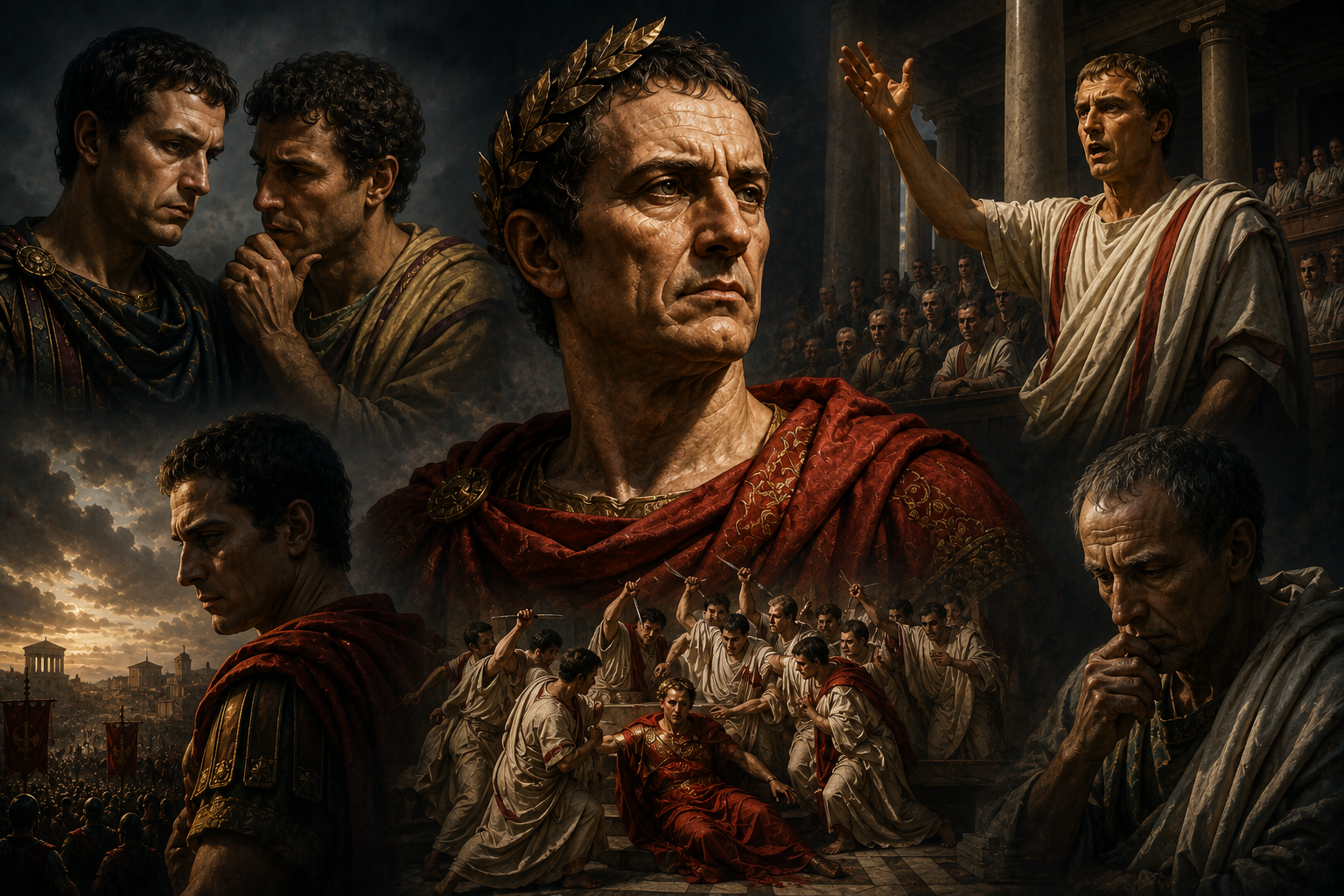
This Julius Caesar character analysis breaks down the main players in Shakespeare’s tragedy. You will see what each person wants, why conflicts grow, and how choices push Rome toward chaos.

In this Guide

Julius Caesar character analysis

Julius Caesar Character Analysis: Why Character Drives the Plot

The play is not just about one murder. It is about why people choose action over peace.

A strong Julius Caesar character analysis starts with motivation. Brutus acts from honor. Cassius acts from jealousy and fear. Antony acts from grief, loyalty, and political skill.

Shakespeare makes each choice feel personal. That is why the plot feels tense even when we know Caesar will die.

If you want a simple method for breaking down character motives, read our guide on how to analyze characters in literature.

Brutus: Honor, Fear, and the Tragic Choice

Brutus is the moral center of the play, but that does not mean he is always right.

For many students, this Julius Caesar character analysis begins with Brutus because his conflict is the clearest. He loves Caesar as a friend, but he fears Caesar may become a tyrant.

His main trait is honor. Brutus wants to protect Rome, not gain power for himself. That makes him different from Cassius.

His flaw is that he trusts ideas more than people. He believes noble reasons can make a violent act look pure. Once he joins the plot, he thinks the public will understand.

This is close to the tragic pattern we see in Hamlet. A thoughtful man faces a moral crisis, but thought does not save him from ruin.

Best quote idea: Brutus often talks about Rome, honor, and the danger of ambition. Use those moments to show how public duty fights with private loyalty.

Julius Caesar Character Analysis of Caesar: Power and Blind Spots

Caesar appears for only part of the play, yet his image controls the whole story.

Caesar is powerful, proud, and loved by many citizens. He also ignores warnings that could save his life.

His main conflict is between public strength and human weakness. He wants to seem fearless. Because of that, he treats danger as something beneath him.

Calpurnia’s dream scares him at first. Then Decius changes the meaning of the dream, and Caesar chooses pride over caution.

Caesar is not shown as a simple villain. Shakespeare leaves room for debate. Is Caesar truly dangerous, or do others fear what he might become?

For a trusted overview of the play, see the Britannica entry on Julius Caesar.

Cassius: Envy, Insight, and Control

Cassius understands people well, but he uses that skill to manipulate them.

A careful Julius Caesar character analysis must take Cassius seriously. He is not just angry. He sees Caesar’s rise as a threat to Roman freedom and to his own status.

Cassius knows Brutus has a good name. So he uses letters, praise, and pressure to pull Brutus into the conspiracy.

His main strength is insight. His main flaw is bitterness. Like Iago in Othello, he can read weakness in others and turn it into action.

Still, Cassius is not foolish. He often gives better practical advice than Brutus. For example, he wants to kill Antony too, but Brutus refuses.

Antony: Grief Turns into Strategy

Antony may seem loyal and emotional at first, but he is also one of the sharpest minds in the play.

No Julius Caesar character analysis feels complete without Antony’s funeral speech. He uses careful language to turn the crowd against the conspirators.

Antony does not attack Brutus directly at first. He repeats that Brutus is honorable, but each repeat makes the crowd doubt it more.

His strength is rhetoric, which means the art of persuasion. He understands public emotion better than Brutus does.

Antony’s conflict is also moral. He mourns Caesar, but he quickly uses Caesar’s death to gain power. Shakespeare lets us feel both his loyalty and his ambition.

You can read the full play through the Folger Shakespeare Library edition of Julius Caesar.

Portia and Calpurnia: Private Warnings in a Public World

Portia and Calpurnia show how private life suffers when public honor takes over.

Portia is Brutus’s wife. She sees that he is troubled and asks to share his burden. Her strength is loyalty, but the political world shuts her out.

Calpurnia is Caesar’s wife. She has a terrible dream and begs Caesar to stay home. Her warning is wise, but Caesar’s pride wins.

Both women sense danger before the men act with care. Their roles show a key idea in the play: Rome praises strength, but it often ignores wisdom.

Julius Caesar Character Analysis: Motivations and Conflicts

Each major character wants something different, and those wants crash into each other.

  • Brutus wants to protect Rome and keep his honor clean.
  • Caesar wants power, respect, and a strong public image.
  • Cassius wants Caesar stopped and wants influence over Brutus.
  • Antony wants revenge for Caesar and control of the crowd.
  • Portia and Calpurnia want truth, safety, and trust inside their homes.

The biggest conflict is not simply Caesar against the conspirators. It is idealism against reality. Brutus believes noble motives can guide politics, but Rome is more violent and unstable than he thinks.

This is why the play works so well for essays. You can argue about who is right, who is blind, and who changes the most.

Use This Julius Caesar Character Analysis in Essays

Good essays do more than describe a character. They explain how a character’s choices shape the play.

When you use Julius Caesar character analysis in a thesis, connect a trait to a result. For example: Brutus’s honor makes him noble, but it also makes him easy to use.

Here is a simple essay move:

  • Name the character’s main trait.
  • Show the conflict that tests that trait.
  • Explain the result of the choice.
  • Connect the result to a larger theme.

For more practice, use this character analysis strategy before you write your next paragraph.

If you want a ready-to-use study tool, try our student-friendly character analysis resource for quote-based notes and essay prep.

Suggested Books for Study

These books can help if you want more context or a stronger grasp of Shakespeare’s language.

  • Julius Caesar by William Shakespeare, Folger Shakespeare Library edition
  • Shakespeare: The World as Stage by Bill Bryson

FAQ: Julius Caesar Character Analysis

Quick answers can help you review before class or plan an essay. 💡

Who is the most important character in Julius Caesar?

Brutus is often the most important character because his choice to join the conspiracy drives the tragedy.

Is Caesar a hero or a villain?

Caesar is more complex than either label. He has pride and power, but the play never proves he would become a tyrant.

What is Brutus’s tragic flaw?

Brutus’s tragic flaw is his idealism. He believes honorable motives can control political violence.

Why is Antony’s funeral speech important?

Antony’s speech turns public opinion against the conspirators. It shows the power of language in politics.

What is the main idea of a Julius Caesar character analysis?

The main idea is that each character’s motive shapes the fall of Caesar and the collapse of Roman order.

Key Takeaway

The best Julius Caesar character analysis shows that the tragedy grows from human choices, not fate alone. Shakespeare’s characters act from honor, fear, pride, and loyalty, but none can control what their actions release.

Themes in Shakespeare’s Julius Caesar: A Student-Friendly Guide

Julius Caesar themes

This student-friendly guide explains the themes in Julius Caesar and shows why Shakespeare’s play still feels sharp today.

You will see how power, honor, fear, and words shape the choices behind Caesar’s death. If you need help with the basics first, read this guide on how to identify theme in literature.

In this Guide

Use this section to find the idea you need most.

  • What a theme means in this play
  • Power and public honor
  • Loyalty and betrayal
  • Fate and omens
  • Rhetoric and persuasion
  • Essay help
  • FAQ
Julius Caesar themes

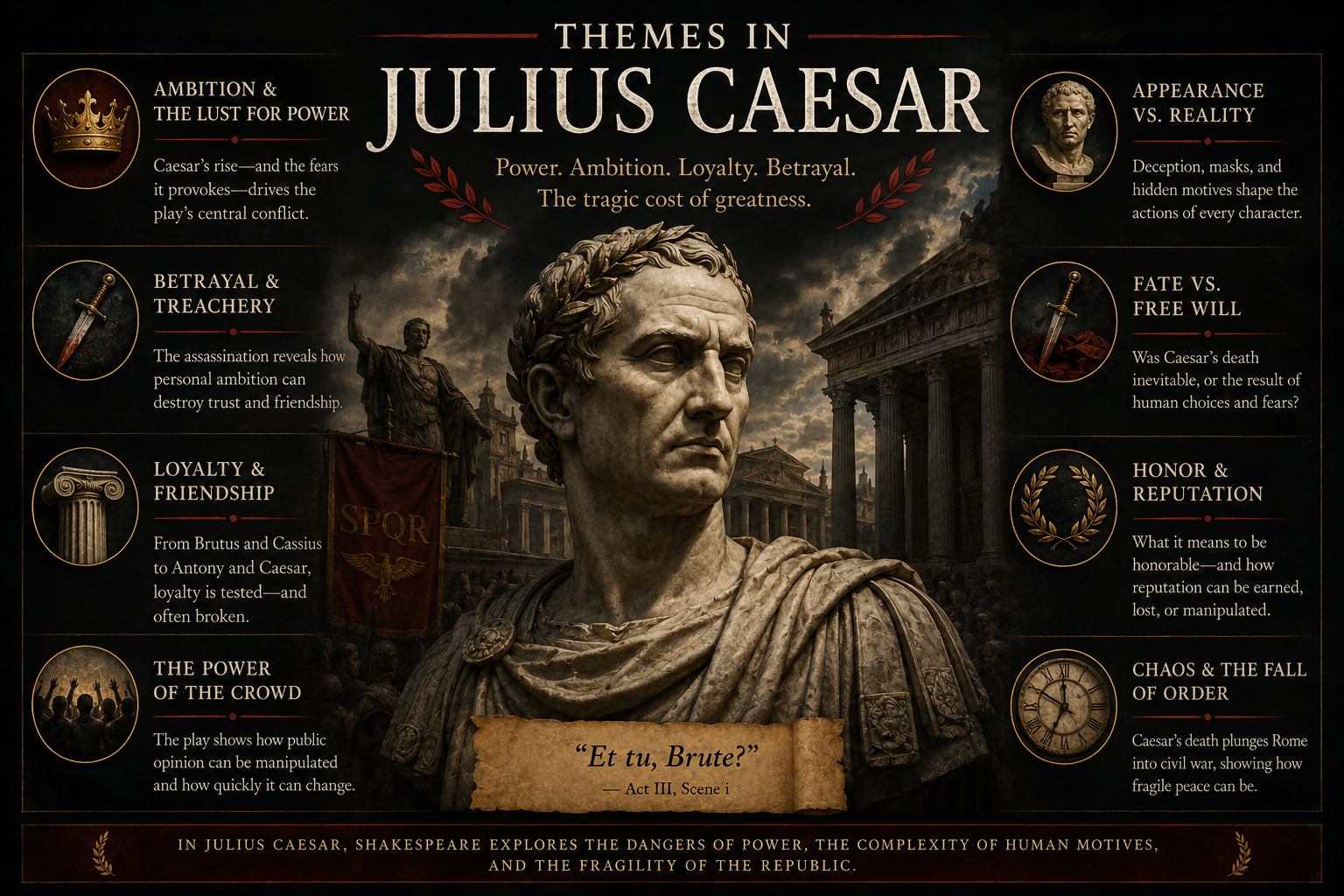
Major themes in Julius Caesar

The play asks what happens when private beliefs meet public danger.

The major themes in Julius Caesar are not just single words like power or betrayal. A true theme is a message about life, people, or society.

Shakespeare shows Rome at a tense moment. Caesar is popular, but some leaders fear he may become a tyrant. Brutus believes he can stop danger before it grows, but his choice brings new chaos.

That tension makes the play rich for students. It does not give easy answers. It asks whether a person can do a violent act for a noble reason.

Political themes in Julius Caesar: power and public honor

Rome is a public world, so reputation can be as powerful as truth.

One of the clearest themes in Julius Caesar is the danger of political power. Caesar may not call himself a king, but many Romans act as if he is close to becoming one.

Cassius uses this fear to pull Brutus into the plot. He knows Brutus cares about Rome and wants to seem honorable. This shows how politics can turn virtue into a tool.

Brutus claims he kills Caesar because he loves Rome more than Caesar. That sounds noble, but the play asks if noble language can hide personal pride.

This theme is easy to compare with Macbeth. In both plays, ambition leads to violence. Yet Brutus is not Macbeth. Brutus thinks he protects the state, which makes his fall more painful.

Personal themes in Julius Caesar: loyalty and betrayal

The most painful conflicts in the play happen between people who trust each other.

Among the themes in Julius Caesar, loyalty and betrayal may feel the most personal. Caesar trusts Brutus, and that trust makes the murder shocking.

Brutus also betrays himself in a way. He says he acts for Rome, but he ignores warnings from Portia, Caesar, and his own doubts.

Portia’s role matters here. She asks Brutus to trust her with his secrets, but he keeps her outside the political world. Their marriage shows how public duty can damage private bonds.

A similar conflict appears in Antigone by Sophocles. A character must choose between law and conscience. In Shakespeare’s play, Brutus faces that kind of choice, but his answer harms the city he hopes to save.

Fate, omens, and the themes in Julius Caesar

Warnings fill the play, but people still choose how to respond.

Fate is one of the themes in Julius Caesar that gives the play its tragic mood. The soothsayer warns Caesar to beware the Ides of March. Calpurnia dreams of danger. Strange signs appear across Rome.

Caesar hears warnings, but he refuses to seem afraid. Brutus sees danger too, but he reads it through his political fear. Both men make choices, even when the play feels haunted by fate.

This is why the play works so well as tragedy. Shakespeare suggests that human pride can make fate feel unavoidable.

How rhetoric shapes the themes in Julius Caesar

Words do not just explain action in this play. They change what people believe.

The themes in Julius Caesar become clearest in the funeral speeches. Brutus speaks in a calm way and asks the crowd to trust his reason.

Antony speaks after him and turns the crowd with emotion. He repeats the word honorable until it sounds bitter. He also uses Caesar’s wounds like proof.

This scene shows how public opinion can shift fast. It also shows that truth often loses when a speaker knows how to move a crowd.

Students may notice a link to Animal Farm by George Orwell. In both works, political language shapes how people see power.

How to write about the play in an essay

A strong essay should connect theme to character choice.

Do not write only that the play is about ambition or betrayal. Instead, explain what Shakespeare says about that idea.

A stronger claim might say: Shakespeare uses Brutus to show that people can mistake pride for moral duty.

Then use evidence from Brutus’s speeches, the conspiracy scene, and Antony’s funeral speech. For extra practice, try the RapidReads Press literature study tools as you shape a claim.

You can also review how theme works in literature before you draft your essay.

Why the play still matters

Shakespeare’s Rome feels old, but its questions are still current.

The play asks how far people should go to stop a leader they fear. It also asks how crowds decide whom to trust.

Those questions matter in school, politics, and daily life. People still use noble words to defend harsh actions. People still mistake confidence for truth.

For background on the play, Britannica has a helpful overview of Julius Caesar by Shakespeare. You can also learn more about Shakespeare through the Poetry Foundation profile of William Shakespeare.

Helpful books to look up on Amazon

These books can help you read the play with more confidence.

  • Julius Caesar by William Shakespeare, Folger Shakespeare Library edition
  • Shakespeare: The World as Stage by Bill Bryson

FAQ about the play

Use these quick answers for review before a quiz or essay.

What are the main themes in Julius Caesar?

The main ideas include power, honor, betrayal, fate, and the danger of persuasive speech.

Is ambition a theme in the play?

Yes. Caesar’s rise creates fear, and Cassius uses that fear to push the conspiracy forward.

Why is Brutus important to the theme?

Brutus shows how a person can do harm while thinking he serves a noble cause.

What does Antony’s speech show?

It shows that language can control public feeling and turn grief into violence.

Key Takeaway

The play is not only about Caesar’s death.

The key insight is this: Shakespeare shows that power becomes dangerous when fear, pride, and persuasive speech replace clear moral judgment.

Macbeth Quotes Explained: Important Passages for Students

Macbeth quotes

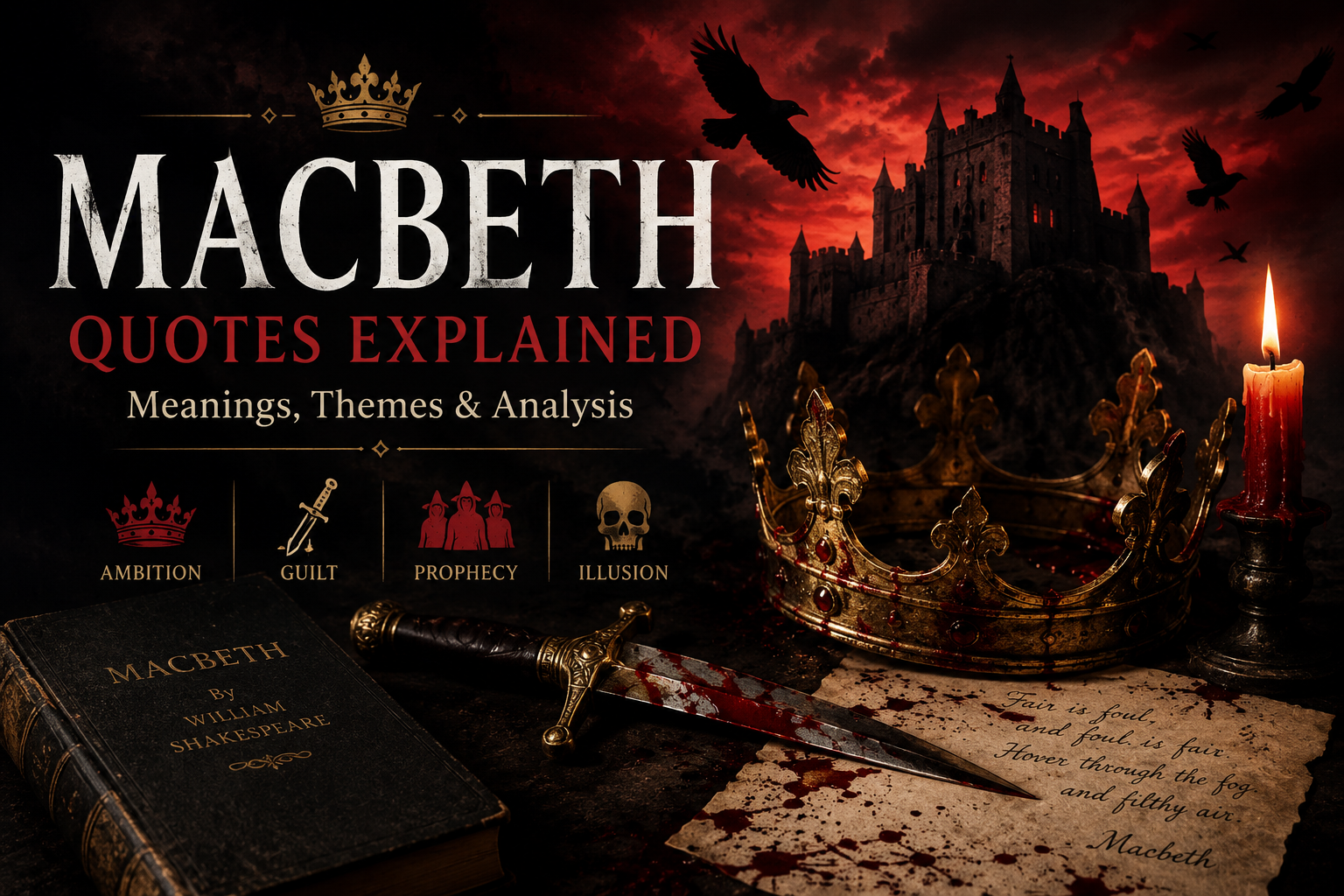
Macbeth is full of short lines that carry huge meaning. This guide offers Macbeth quotes explained in clear language so you can connect famous passages to theme and character change. Each quote below shows what the words mean and how to use them in an essay.

In this Guide

Use this quick map to find the passages that fit your class notes or essay topic.

  • How to read important quotes
  • Ambition and temptation
  • Guilt and fear
  • Appearance and reality
  • Fate and choice
  • Essay tips and study tools
Macbeth quotes

Macbeth quotes explained: how to read the play

A strong quote is not just a famous line. It is proof of how the play builds meaning.

Start with context. Ask who speaks and what has just happened. Then explain how the line reveals a conflict, fear, or desire.

Do not drop a quote into a paragraph and move on. Your job is to show why the words matter. If you need help with that skill, read our guide on how to write a literary analysis essay.

Macbeth quotes explained for ambition and temptation

Macbeth’s rise begins with a promise, but his choices turn that promise into a trap.

“Stars, hide your fires”

Macbeth says this after he starts to imagine himself as king. He wants the stars to hide their light because he knows his thoughts are dark.

This line shows **secret ambition**. Macbeth does not act yet, but his mind has already crossed a moral line.

“Vaulting ambition”

Macbeth admits that ambition is the main force pushing him toward murder. The image suggests a rider who leaps too far and falls.

This is useful for essays about self-destruction. Like Victor Frankenstein, Macbeth wants power before he has the wisdom to handle it.

These Macbeth quotes work well when your claim focuses on how desire can overpower conscience.

Macbeth quotes explained for guilt and fear

After the murder of Duncan, guilt does not fade. It grows until it shapes how Macbeth and Lady Macbeth see the world.

“Sleep no more!”

Macbeth hears this cry after he kills Duncan. Sleep usually means peace, but Macbeth has destroyed that peace for himself.

The line suggests that guilt becomes a punishment. No guard has caught Macbeth yet, but his mind is already attacking him.

“Out, damned spot!”

Lady Macbeth imagines blood on her hands. The spot is not real, but her guilt is.

Earlier, she seemed cold and strong. By this point, Shakespeare shows that denial cannot protect her forever.

For a comparison, think of Raskolnikov in Crime and Punishment. In both works, the crime happens once, but the guilt keeps returning.

Macbeth quotes explained for appearance and reality

Many characters in the play hide what they want. Shakespeare uses false faces, strange language, and broken trust to show that appearances can mislead.

“Fair is foul, and foul is fair”

The witches speak this line near the start of the play. It means that good and evil will seem mixed up.

The line prepares us for a world where truth is hard to read. Macbeth looks loyal, but he plans betrayal.

“False face must hide what the false heart doth know”

Macbeth says he must hide his plan behind a false expression. His face becomes a mask.

This quote is strong evidence for essays about deception. It shows that Macbeth understands the evil of his choice, yet he chooses to act anyway.

Macbeth quotes explained for fate and choice

The witches predict Macbeth’s future, but they do not force his hand. That tension makes the play feel tragic.

“If chance will have me king”

At first, Macbeth wonders if fate will make him king without action. This shows hesitation.

Soon, he stops waiting. His shift matters because tragedy often grows from a person’s own decisions.

“I am in blood”

Macbeth feels trapped by the violence he has caused. He thinks he has gone too far to turn back.

This line shows how one crime leads to another. Macbeth quotes explained in this way help students argue that fate may tempt him, but choice destroys him.

How to use Macbeth quotes in essays

Good quote analysis connects words on the page to a clear claim. Keep your explanation focused and direct.

When you use Macbeth quotes in an essay, follow a simple pattern:

  1. Make a claim about the character or theme.
  2. Give brief context for the quote.
  3. Use a short quotation.
  4. Explain the words that prove your point.

For example, you might write: Macbeth’s line “Stars, hide your fires” shows that he knows his ambition is morally wrong. He wants darkness to cover his thoughts, which proves that guilt begins before the murder.

For quick review before a quiz, pair this post with our Macbeth quote study notes.

Helpful books for Macbeth students

These editions and study books can help you read the play with stronger notes.

  • Macbeth by William Shakespeare, Folger Shakespeare Library edition
  • Shakespeare After All by Marjorie Garber

Choose an edition with footnotes if the language feels hard. The notes can explain old words without replacing your own thinking.

Trusted online resources

Use reliable sources when you need background on Shakespeare or the play’s history.

For a clear overview, see Britannica’s article on Macbeth. For the full public-domain text with helpful tools, visit the Folger Shakespeare Library text of Macbeth.

FAQ: Macbeth quotes explained

Here are quick answers to common student questions about choosing and analyzing quotes.

What is the best Macbeth quote for ambition?

“Vaulting ambition” is one of the clearest choices. It shows that Macbeth understands the motive behind his crime.

What quote shows Macbeth’s guilt?

“Sleep no more!” is a strong guilt quote. It shows that Macbeth loses inner peace after killing Duncan.

What quote shows Lady Macbeth’s guilt?

“Out, damned spot!” shows her guilt in a vivid way. She imagines blood that cannot be washed away.

How many quotes should I use in a Macbeth essay?

Use enough to support your claim, not to fill space. Two well-explained quotes are often stronger than many rushed ones.

Key Takeaway

Macbeth quotes explained well do more than define old words. They show how ambition, guilt, and choice push Macbeth from brave soldier to tragic tyrant.

error

Enjoy this article? Please spread the word :)

Follow by Email
BLUESKY
fb-share-icon
Reddit
LinkedIn
Share
RSS