Jane Eyre Summary and Analysis for Students

Jane Eyre Summary

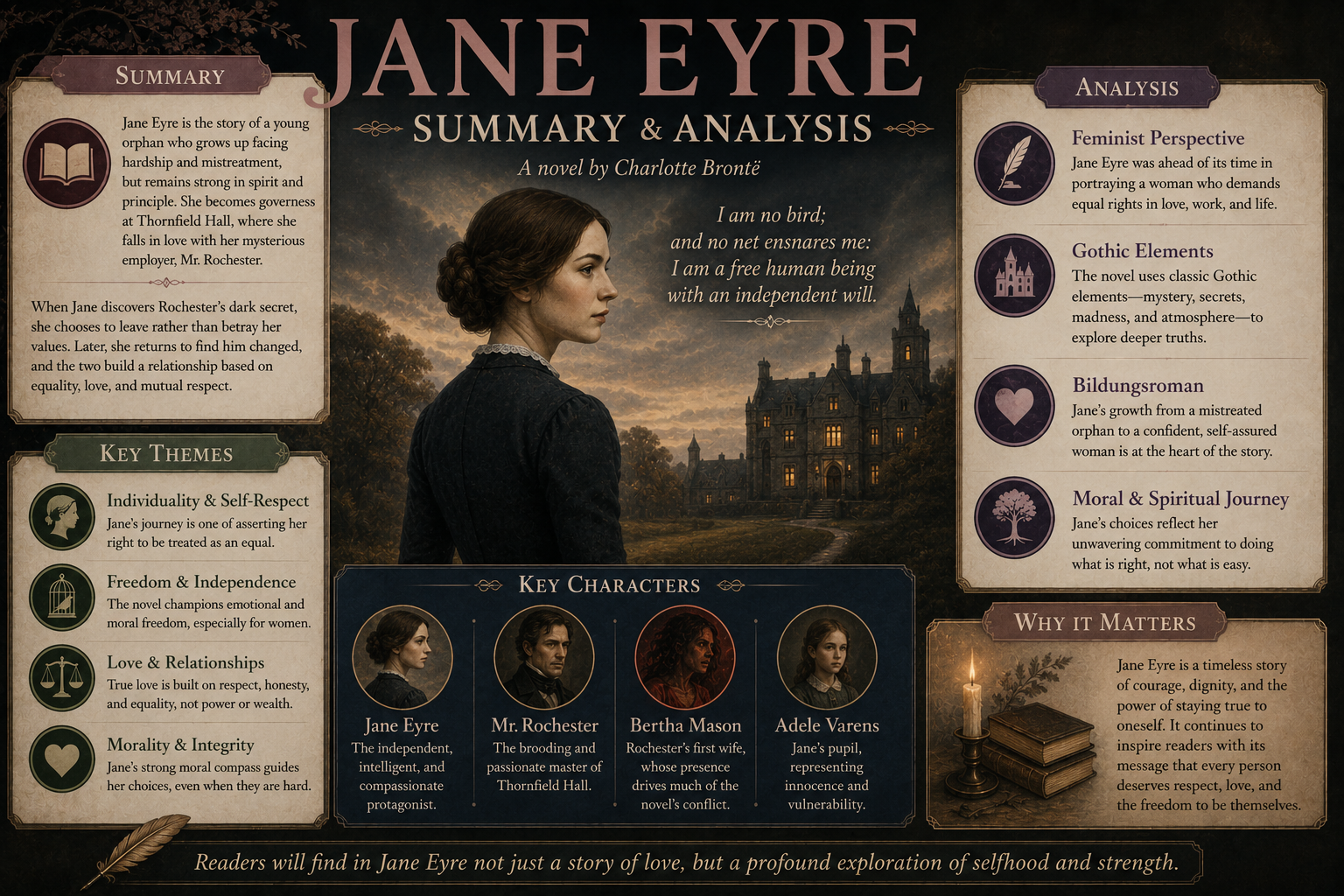
Jane Eyre is one of the most important novels of the Victorian age. This Jane Eyre summary and analysis gives students a clear path through the plot, structure, conflicts, and deeper meaning.

Charlotte Brontë tells a story about a young woman who wants love, faith, and freedom without losing herself.

In this Guide

Use this guide as a map before class, essays, or exams.

  • Quick overview
  • Plot summary by major stage
  • Structure and point of view
  • Main conflicts
  • Themes, symbols, and meaning
  • Helpful books and FAQ
Jane Eyre Summary

Jane Eyre summary and analysis: quick overview

The novel follows Jane from a harsh childhood to a hard-won adult life.

Jane is an orphan raised by cruel relatives at Gateshead. She later goes to Lowood School, becomes a governess at Thornfield Hall, and falls in love with Mr. Rochester.

This Jane Eyre summary and analysis matters because the novel is not just a romance. It is also a story about self-respect, moral choice, and the right to speak.

For a short reference overview, see Britannica on Jane Eyre.

Jane Eyre summary and analysis: plot by major stages

Brontë builds Jane’s life in clear stages, and each place tests her in a new way.

Gateshead: Jane learns she is unwanted

Jane lives with her aunt, Mrs. Reed, and her cousins. They treat her as a burden, not a child with feelings.

The red-room scene is one of the novel’s key moments. Jane is locked in the room where her uncle died, and her fear shows how trapped she feels.

Lowood: Jane learns discipline and loss

At Lowood School, Jane meets Helen Burns, a gentle girl with deep faith. Helen teaches Jane patience, but her death also shows the cruelty of neglect.

Mr. Brocklehurst uses religion to control the girls. Brontë criticizes this false form of faith.

Thornfield: Jane finds love and danger

Jane becomes a governess at Thornfield Hall. She meets Mr. Rochester, who treats her as an equal in conversation.

They fall in love, but the wedding stops when Jane learns Rochester already has a wife, Bertha Mason, hidden in the attic. Jane leaves because she will not become his mistress.

Moor House: Jane faces a different kind of trap

Jane is rescued by the Rivers family, who later turn out to be her cousins. St. John Rivers asks Jane to marry him and serve as a missionary wife.

His offer is respectable, but it has no love. Jane refuses because it would crush her spirit.

Ferndean: Jane returns by choice

Jane later returns to Rochester after a fire destroys Thornfield. Bertha dies in the fire, and Rochester loses his sight and one hand.

Jane marries him only after they can meet on more equal ground. Use this Jane Eyre summary and analysis to notice that Jane’s happy ending depends on freedom, not surrender.

How Jane Eyre is structured

The novel has a life-story shape that helps readers track Jane’s growth.

Jane Eyre is a first-person novel. Jane tells her own story as an adult, so we see both her childhood feelings and her mature judgment.

A Jane Eyre summary and analysis should also note that the book is a Bildungsroman, or coming-of-age novel. Like Great Expectations by Charles Dickens, it follows a young person through pain, mistakes, and self-knowledge.

The setting changes as Jane changes. Gateshead shows rejection, Lowood shows discipline, Thornfield shows desire, and Ferndean shows chosen love.

If you want to study Brontë’s word choices more closely, this guide to close reading in literature can help.

Main conflicts in Jane Eyre

The novel’s conflicts are personal, social, and moral.

Jane versus society is one major conflict. Jane is poor, female, and often powerless, but she refuses to accept shame as her proper place.

Jane versus herself is just as important. She wants love, but she also knows that love without respect can destroy her.

Jane versus Rochester creates the central romantic tension. Rochester loves Jane, but he tries to hide the truth about Bertha, which makes their first union morally wrong.

Jane versus St. John tests her in another way. St. John offers duty without passion, while Rochester offers passion that must be purified by honesty.

Themes in Jane Eyre summary and analysis

Brontë uses Jane’s story to ask what a person needs in order to live with dignity.

Independence and self-respect

Jane’s strongest trait is her sense of inner worth. She has little money or status, but she believes her soul is equal to anyone else’s.

For students, Jane Eyre summary and analysis often begins with this point. Jane does not reject love. She rejects love that demands the loss of self.

Love and equality

Jane and Rochester’s best moments come when they speak honestly. Their worst moments come when power is uneven.

Like Elizabeth Bennet in Pride and Prejudice, Jane must judge whether a man’s love respects her mind as well as her heart.

Religion and moral choice

The novel offers different forms of faith. Helen Burns shows patient faith, Mr. Brocklehurst shows cruel hypocrisy, and St. John shows duty without warmth.

Jane’s faith is tied to conscience. She leaves Rochester because she believes love must answer to moral truth.

Class and gender

Jane lives in a world where class shapes every chance she has. As a governess, she is educated but not rich, so she stands between social groups.

Brontë also shows how women had narrow choices. Jane wants work, love, and respect, not a life chosen for her by others.

Symbols and Gothic elements

The novel uses dark, strange, and intense images to reveal hidden fears.

The red-room stands for childhood trauma and social punishment. Jane is treated as if her anger is a crime.

Thornfield Hall stands for mystery and buried truth. The house looks grand, but it hides pain in its upper rooms.

Fire often marks passion, danger, and change. It destroys Thornfield, but it also clears the way for a more honest life.

These Gothic touches connect Jane Eyre to novels like Wuthering Heights, where setting and emotion feel closely linked.

Literary meaning and why Jane Eyre still matters

Jane’s story still feels modern because she fights for a voice.

This Jane Eyre summary and analysis also shows why the novel is more than a love story. Jane’s final happiness comes because she chooses it from a place of strength.

The famous line about Jane being no bird captures the heart of the book. She refuses to be caged by gender, class, fear, or romance.

To learn more about Charlotte Brontë as a writer, see the Poetry Foundation biography of Charlotte Brontë.

For more study support, our student literature guides can help you review major novels with clearer notes.

Helpful books for Jane Eyre study

These books are useful for students who want more context or a reliable edition.

  • Jane Eyre by Charlotte Brontë, Penguin Classics edition
  • The Madwoman in the Attic by Sandra M. Gilbert and Susan Gubar

You can look for these through a school library, local bookstore, or Amazon Books.

FAQ: Jane Eyre summary and analysis

Here are quick answers to common student questions.

What should a Jane Eyre summary and analysis include?

It should cover Jane’s life stages, her conflicts, major themes, key symbols, and the meaning of her final choice.

What is the main message of Jane Eyre?

The novel argues that love must include equality, honesty, and self-respect.

Why does Jane leave Rochester?

Jane leaves because Rochester is already married. She loves him, but she will not betray her conscience.

Is Jane Eyre a feminist novel?

Many readers see it that way because Jane demands dignity, work, and moral freedom in a world that limits women.

Key Takeaway

A strong Jane Eyre summary and analysis should show how Jane moves from isolation to self-command. The novel’s power comes from one clear idea: Jane wants love, but never at the cost of her soul.

Themes in Pride and Prejudice: A Student-Friendly Guide

Themes in Pride and Prejudice

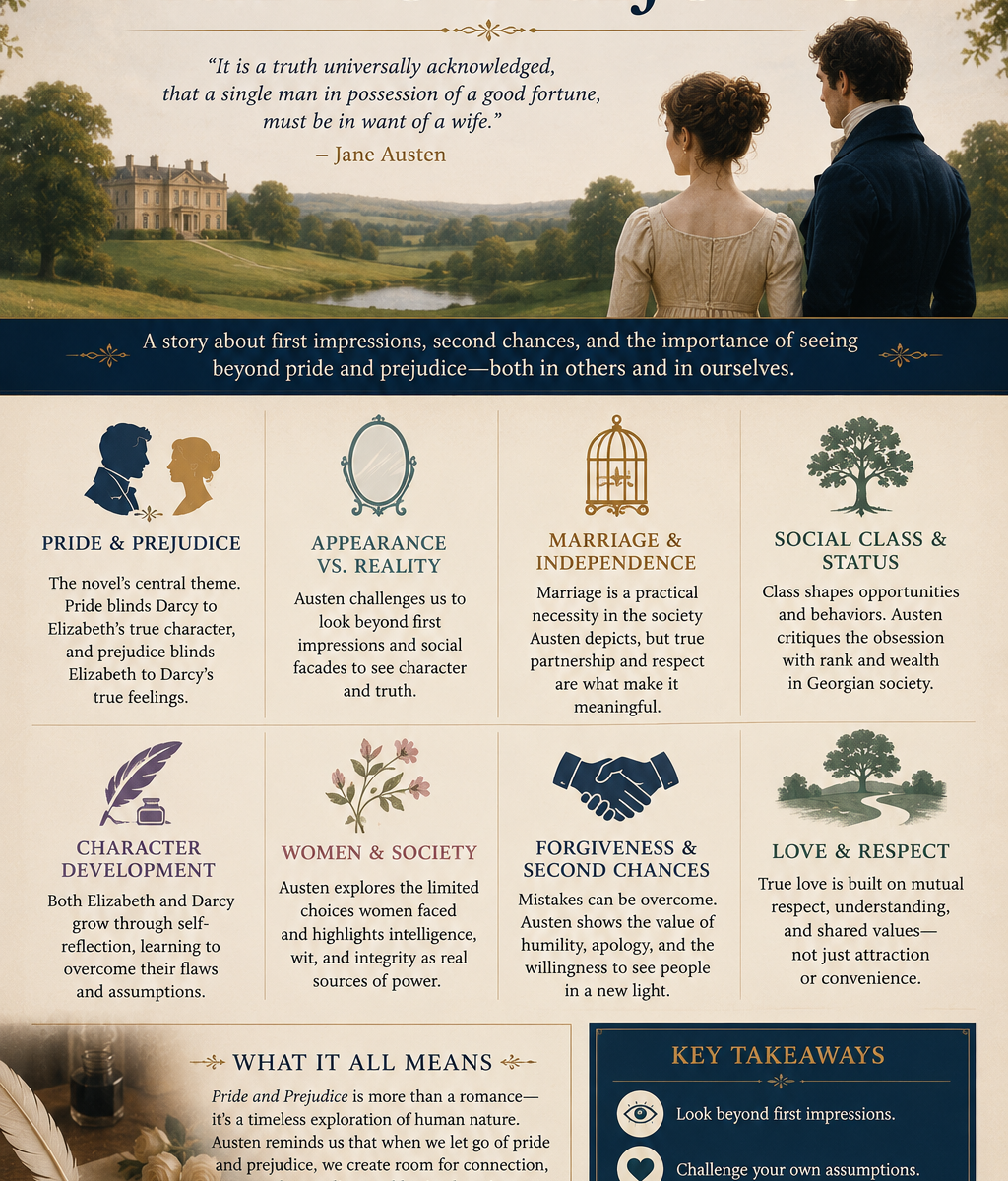
Jane Austen’s novel may look like a love story, but its ideas run much deeper. This guide explains the major themes in Pride and Prejudice so students can see how love, class, pride, and choice shape the whole book.

In this Guide

Use this quick map to find the part you need for class, notes, or an essay.

  • Why the ideas matter
  • Pride, prejudice, and self-knowledge
  • Love and marriage
  • Class and reputation
  • Money and limited choices
  • Gender and power
  • Family and education
  • Essay tips and FAQ
Themes in Pride and Prejudice

Why the themes in Pride and Prejudice matter

The novel’s themes help explain why a book from 1813 still feels fresh today.

Austen writes about people who judge too fast, protect their social rank, and search for a life with dignity. Those issues still matter in schools, friendships, and families.

The themes in Pride and Prejudice also help students see Austen’s craft. She does not preach. She uses wit, dialogue, and character change to make her ideas clear.

For helpful background on Austen’s life and era, see this overview from Britannica.

Theme 1: Pride, prejudice, and self-knowledge

Elizabeth and Darcy both have to face the truth about themselves.

Pride is not always bad in the novel. A person needs self-respect. But Darcy’s pride makes him cold, while Elizabeth’s confidence makes her judge him too quickly.

Prejudice means more than unfair dislike. It also means forming an opinion before you know the facts. Elizabeth believes Wickham because he seems charming. Darcy misreads Elizabeth’s family and social rank.

A central part of the themes in Pride and Prejudice is the need to grow. Elizabeth changes because she can admit error. Darcy changes because he can see how his behavior has hurt others.

This is similar to Pip in Great Expectations. Pip must learn that status does not equal worth. Both novels ask students to notice how a character’s wrong ideas shape the plot.

Theme 2: Love, marriage, and good judgment

Austen shows that love works best when feeling and reason stay linked.

Marriage is a major plot force in the novel. Mrs. Bennet wants her daughters married because their future is at risk. But Austen does not treat marriage as only a business deal.

Elizabeth refuses Mr. Collins because she knows a loveless match would harm her. Charlotte Lucas accepts him because she wants security. Neither choice is simple.

Another key part of the themes in Pride and Prejudice is the question of good judgment. Elizabeth and Darcy reach a strong love only after they face hard truths.

For quicker review, students can use Pride and Prejudice study resources alongside class notes.

Class and reputation as themes in Pride and Prejudice

Social rank affects how characters speak, marry, and judge one another.

Darcy has wealth and status, so others expect him to act with control. The Bennet family has less rank, so their behavior gets watched more closely.

Lady Catherine believes social class should decide marriage. She sees Elizabeth as beneath Darcy. Austen exposes how cruel that belief can be.

Reputation matters too. Lydia’s elopement threatens the whole family because society blames women more harshly than men. This shows a world where public opinion has real power.

The British Library offers useful context on Austen’s world and works at its Jane Austen page.

Theme 4: Money, security, and limited choices

Money is never just background in this novel.

The Bennet estate is entailed, which means the daughters cannot inherit it. This fact creates pressure from the first chapters.

The themes in Pride and Prejudice often connect love to economics. Characters may want romance, but they also need food, shelter, and respect.

Charlotte’s marriage to Mr. Collins can feel sad to modern readers. Yet Austen asks us to see her reason. Charlotte has few safe options, so she chooses stability.

This does not mean Austen supports every practical match. Instead, she shows how unfair systems limit personal freedom.

Theme 5: Gender and power in daily life

Austen shows how women must work within rules they did not create.

The Bennet sisters need marriage because the law and custom do not give them many paths. Their education, income, and public image all affect their futures.

Elizabeth stands out because she speaks with wit and courage. She refuses to obey Lady Catherine. She also refuses to marry without respect.

Among the themes in Pride and Prejudice, gender may be the easiest to connect to class discussion. Students can ask who has power, who lacks it, and how each character responds.

If you want help tracing those patterns, this guide on how to analyze characters in literature can help you build stronger claims.

Theme 6: Family, education, and influence

Family shapes each character’s choices, but it does not fully control them.

Mr. and Mrs. Bennet both affect their daughters. Mr. Bennet is clever, but he often avoids responsibility. Mrs. Bennet cares about security, but her panic causes trouble.

Elizabeth’s mind has been shaped by reading, talk, and sharp observation. Darcy’s values have been shaped by privilege and family pride.

This is one reason many themes in Pride and Prejudice feel personal. Austen shows that people inherit ideas, but they can still revise them.

How to write about themes in Pride and Prejudice

A strong theme paragraph needs a clear claim and proof from the story.

Do not write only that pride is a theme. Go further. Say what Austen suggests about pride, such as: pride becomes harmful when it blocks empathy and honest self-judgment.

Use a character, a choice, and a result. For example, Darcy insults Elizabeth, then later learns why his pride damaged his chance at love.

When writing about themes in Pride and Prejudice, connect the theme to Austen’s message. A theme is not just a topic. It is an idea the novel develops.

You can also review character analysis strategies to make your theme essay more focused.

Helpful books for deeper study

These books can support essays, class projects, or AP Literature prep.

  • Pride and Prejudice by Jane Austen
  • Jane Austen: A Life by Claire Tomalin

To understand the themes in Pride and Prejudice more fully, read the novel slowly and track how each major character changes.

FAQ about themes in Pride and Prejudice

These quick answers can help before a quiz, essay, or class discussion.

What are the main themes in Pride and Prejudice?

The main themes include pride, prejudice, marriage, class, money, gender roles, family influence, and self-knowledge.

What is Austen’s message about marriage?

Austen suggests that marriage should include respect and good judgment. Love matters, but so do character and security.

Why does social class matter so much in the novel?

Class affects how people judge each other and who they see as a proper match. Austen shows that this system can be unfair.

How does Elizabeth change?

Elizabeth learns that cleverness does not make her always right. Her growth comes from honest self-reflection.

Is Darcy’s pride completely bad?

No. Darcy has dignity, but his pride becomes harmful when it makes him look down on others.

Key Takeaway

The best way to read Pride and Prejudice is to watch how judgment changes. Austen shows that love and wisdom grow when people become honest about themselves.