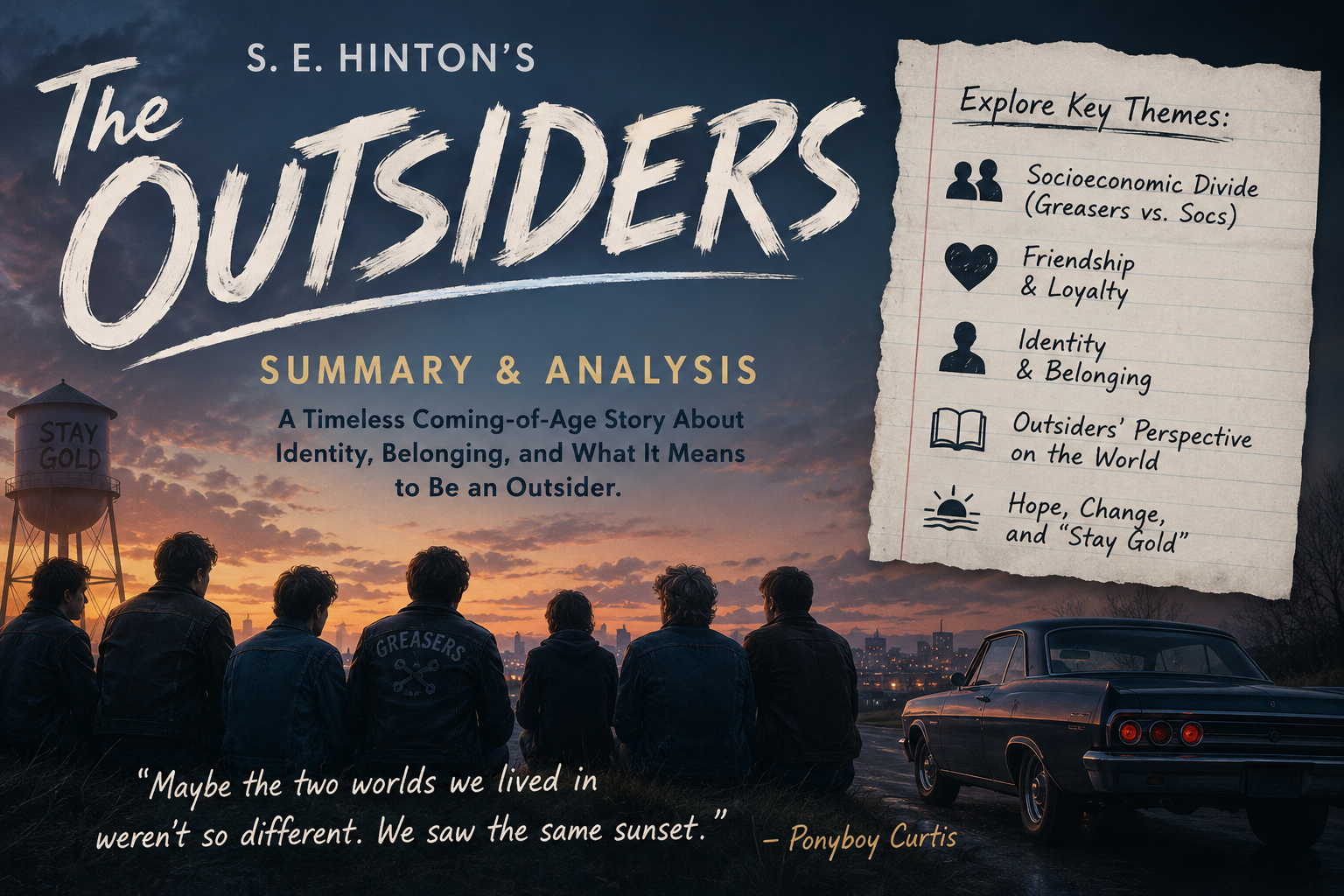
This guide gives you a clear The Outsiders summary and analysis without making the novel harder than it needs to be. You will review the plot, structure, conflicts, characters, and deeper meaning of S. E. Hinton’s famous coming-of-age story.
The Outsiders is short, but it has big ideas about class, loyalty, violence, and identity. That is why students often study it in middle school, high school, and college intro courses.
In this Guide
Use this guide as a quick map before class, homework, or essay prep.
- Plot overview
- Structure and point of view
- Main conflicts
- Characters
- Themes
- Symbols
- Ending meaning
- FAQ
The Outsiders summary and analysis: Quick Plot Overview
The novel follows Ponyboy Curtis as he learns that people are more complex than their labels.
The Outsiders takes place in Oklahoma during the 1960s. Ponyboy belongs to the Greasers, a poor group of boys who face constant judgment from richer teens called the Socs.
A strong The Outsiders summary and analysis starts with the fight between these two groups. The Greasers and Socs do not just dislike each other. They live in different worlds, even though they share the same town.
Ponyboy lives with his older brothers, Darry and Sodapop, after their parents die. Darry acts strict because he wants to keep the family together. Ponyboy often mistakes that pressure for a lack of love.
The plot turns after Ponyboy and Johnny are attacked by Socs. Johnny kills Bob, a Soc, to save Ponyboy. The boys run away and hide in an abandoned church.
At the church, Ponyboy and Johnny grow closer. They read Gone with the Wind, talk about beauty, and try to make sense of what happened. Johnny tells Ponyboy to “stay gold,” a phrase tied to innocence and goodness.
When the church catches fire, Ponyboy, Johnny, and Dally rescue children trapped inside. Johnny is badly hurt. The boys become heroes, but the world around them does not become simple.
The novel ends after Johnny dies from his injuries and Dally dies after a police chase. Ponyboy struggles with grief, then begins to write the story we have just read.
Plot Structure and Point of View
The story feels personal because Ponyboy tells it in his own voice.
The novel uses first-person narration. That means readers see events through Ponyboy’s thoughts, fears, and memories.
This choice matters. Ponyboy is smart and sensitive, but he is also young. He does not always understand Darry, the Socs, or even himself at first.
The book has a circular shape. It begins with Ponyboy leaving a movie theater, and it ends with Ponyboy writing that same opening scene for a school assignment. This structure shows that the novel is also his attempt to understand trauma.
If you want to build stronger notes on narration, try this guide to close reading in literature. It can help you slow down and study small details in key scenes.
The structure also moves from street conflict to moral reflection. Like To Kill a Mockingbird, the novel asks readers to see beyond social labels and judge people with more care.
The Outsiders summary and analysis: Main Conflicts
The main conflicts come from class division, family stress, and moral choice.
The biggest outside conflict is Greasers versus Socs. The Socs have money, status, and protection. The Greasers have each other, but they face danger and blame more often.
This part of The Outsiders summary and analysis is important because Hinton does not show either group as fully good or fully bad. Cherry Valance, a Soc, helps Ponyboy see that pain exists on both sides.
There is also a family conflict between Ponyboy and Darry. Ponyboy thinks Darry is too hard on him. Darry fears that one wrong move could send Ponyboy and Sodapop into foster care.
Johnny faces an inner conflict. He is gentle, but he has lived with fear for years. When he kills Bob, the act is violent, yet it comes from a desperate need to protect Ponyboy.
Dally has a deep conflict too. He acts tough because he believes care makes people weak. Johnny’s death breaks him because Johnny is the one person he still lets himself love.
Characters and What They Reveal
Each major character shows a different way to live with pain.
Ponyboy Curtis is the narrator. He likes books, sunsets, and movies. He feels pulled between the rough world of the Greasers and his own thoughtful nature.
Johnny Cade is quiet and scared, but he is also brave. His final message to Ponyboy tells us that goodness matters, even in a harsh world.
Dally Winston is tough and reckless. He has learned to survive by shutting down his feelings. His end shows the cost of a life without hope.
Darry Curtis is strict because he carries adult weight too soon. He gave up school and sports to care for his brothers.
Sodapop Curtis tries to keep peace at home. He is warm, but he is not free from stress. His pain reminds readers that cheerful people can still suffer.
Cherry Valance helps challenge Ponyboy’s view of the Socs. She proves that class does not erase human feeling.
Major Themes in The Outsiders summary and analysis
The novel’s themes help explain why the story still speaks to young readers.
A good The Outsiders summary and analysis should focus on class conflict. The Greasers and Socs are divided by money, clothes, cars, and public image. The novel asks whether society gives some people more chances than others.
Another key theme is identity. Ponyboy must decide who he is beyond the word Greaser. He learns that a label can describe part of a person, but it cannot explain the whole person.
The theme of loyalty shapes the group. The Greasers protect one another because they often feel ignored by the wider world. Yet loyalty can also lead to fights that cause more harm.
The theme of loss of innocence appears through Johnny and Ponyboy. The poem “Nothing Gold Can Stay” by Robert Frost helps explain this idea. Beauty and youth can fade, but Ponyboy learns that people can still choose kindness.
For more context on the author, Britannica has a helpful overview of S. E. Hinton and her place in young adult fiction.
Symbols and Motifs in the Novel
Hinton uses simple images to carry deep meaning.
In The Outsiders summary and analysis, the sunset is one of the most important symbols. Ponyboy notices that both Greasers and Socs can see the same sunset. This image shows common humanity across class lines.
The poem “Nothing Gold Can Stay” stands for innocence, beauty, and change. Johnny’s advice to “stay gold” means Ponyboy should protect the gentle part of himself.
Hair is another symbol. For the Greasers, long hair is part of their identity. When Ponyboy and Johnny cut and bleach their hair, they feel as if they have lost part of who they are.
The abandoned church works as a place of escape and change. It is away from the city’s violence, but it also becomes the place where the boys must prove who they really are.
Why the Ending Matters
The ending turns the novel from a sad story into an act of witness.
The final chapters are a key part of The Outsiders summary and analysis because they show Ponyboy in denial. He struggles to accept Johnny’s death and Dally’s collapse.
Ponyboy’s school essay becomes the novel itself. This means the act of writing helps him face what happened. He tells the story so other people can understand boys like Johnny before it is too late.
The ending does not solve poverty or violence. It gives Ponyboy a voice. That voice is his first step toward healing.
If you need help turning these ideas into an essay, pair this post with our student literature guides for more support.
How to Use This Guide for Class
This The Outsiders summary and analysis works best when you connect plot events to meaning.
Do not stop at what happens. Ask why each event matters. For example, Johnny’s death is not only sad. It shows how violence can destroy the most vulnerable people first.
For essays, choose one clear claim. You might argue that Ponyboy’s growth comes from learning to see both Greasers and Socs as human. Then use scenes, symbols, and quotes to support that claim.
You can also practice close reading skills by studying the sunset scenes or Johnny’s final letter.
Amazon Books to Read Next
These books pair well with The Outsiders because they also explore youth, class, and moral growth.
- That Was Then, This Is Now by S. E. Hinton
- To Kill a Mockingbird by Harper Lee
FAQ: The Outsiders summary and analysis
These quick answers can help with review before a quiz or essay.
What is the main point of The Outsiders?
The main point is that people are more than their social group. The novel asks readers to look past labels like Greaser and Soc.
Why does Johnny tell Ponyboy to “stay gold”?
Johnny means that Ponyboy should protect his innocence, kindness, and ability to see beauty in the world.
What is the main conflict in the novel?
The main conflict is between the Greasers and the Socs, but Ponyboy also faces inner conflict as he tries to understand himself and others.
Why is the ending important?
The ending shows Ponyboy turning pain into a story. His writing gives meaning to what he has survived.
Key Takeaway
The best The Outsiders summary and analysis shows that the novel is not just about rival groups. It is about young people who want safety, love, and a chance to be seen clearly.