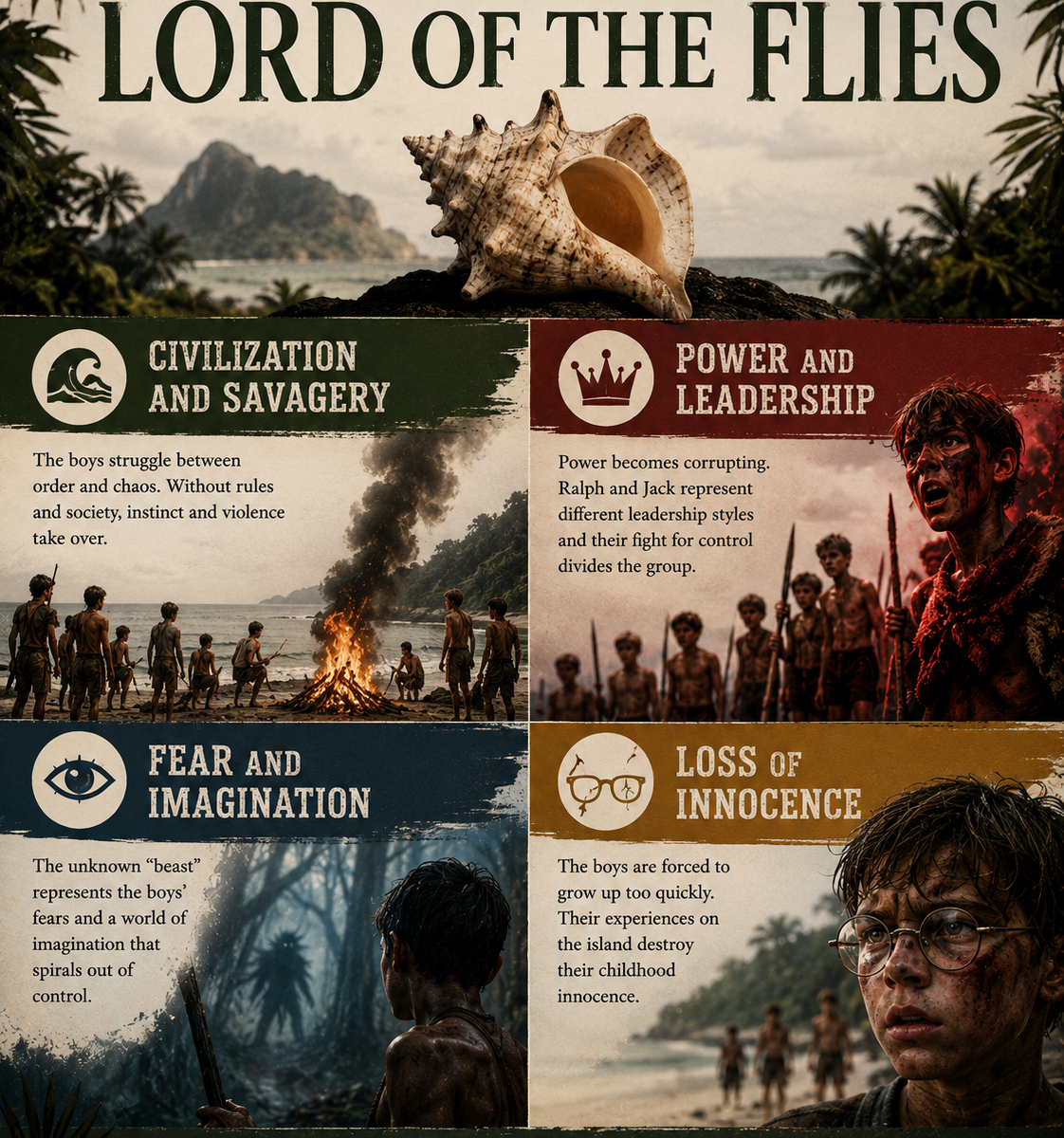
William Golding’s novel may look like a survival story, but it is really about human nature under pressure. This guide explains the major themes in Lord of the Flies so students can read the novel with more confidence.
You will see how power, fear, violence, and social order shape the boys’ choices on the island.
In this Guide
- Why the themes matter
- Civilization and savagery
- Power and leadership
- Fear and imagination
- Loss of innocence
- Symbols, essay ideas, and FAQs
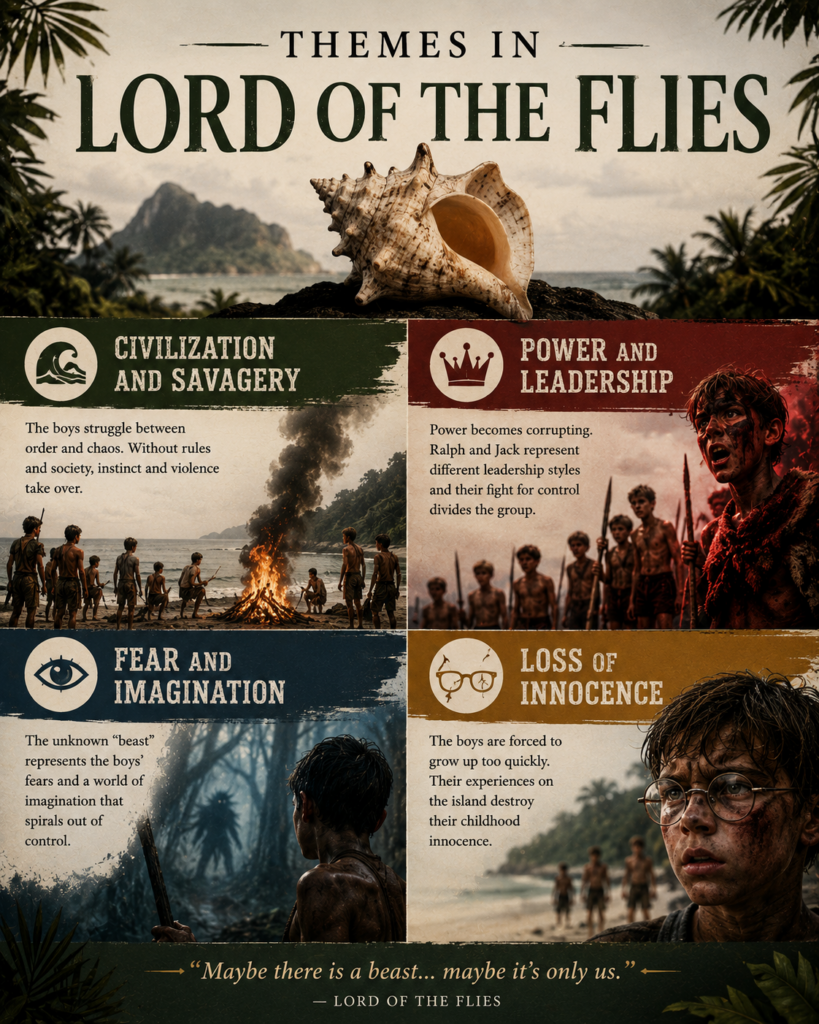
Why the Themes in Lord of the Flies Matter
The novel asks a sharp question: what happens when rules disappear?
The main themes in Lord of the Flies help readers see that the island is more than a setting. It becomes a test of society, morality, and fear.
At first, the boys try to copy the adult world. They hold meetings, choose a leader, and use the conch to give each person a turn to speak. Yet that order starts to break down when fear grows and Jack gains power.
This is why the book often appears in high school and AP Literature classes. It gives students a clear way to study conflict, symbols, and character change.
Major Themes in Lord of the Flies: Civilization vs. Savagery
This is the central conflict of the novel.
One of the most important themes in Lord of the Flies is the struggle between order and violence. Ralph stands for rules, rescue, and shared responsibility. Jack stands for force, hunting, and control.
The conch shows civilization at first. When the boys respect it, they listen to each other. When they ignore it, the group loses its moral center.
Golding does not suggest that savagery comes from the island itself. The boys bring it with them. This makes the novel darker because the danger is not only outside them. It is inside them too.
A similar idea appears in Shakespeare’s Macbeth. Macbeth does not begin as a monster, but ambition and fear pull him toward violence. In both works, pressure reveals what a person may become.
The Theme of Power and Leadership
The boys’ leaders show two very different ways to gain control.
Ralph becomes leader because other boys trust him. He wants shelters, a signal fire, and a plan for rescue. His power depends on cooperation.
Jack uses fear, excitement, and punishment. He offers meat and the thrill of the hunt. His leadership feels easier because it gives the boys quick rewards.
This theme matters because Golding shows how fragile fair leadership can be. A group may choose safety and rules, but fear can make a harsh leader seem strong.
When you write about the themes in Lord of the Flies, it helps to compare Ralph and Jack. Their conflict is not just personal. It shows two models of society.
Fear, Imagination, and the Beast
The beast is powerful because the boys believe in it.
Fear is one of the most useful themes in Lord of the Flies for essays because it affects nearly every major event. The littluns fear a beast. The older boys try to explain it, but they cannot fully control the panic.
The beast also becomes a tool. Jack uses fear of the beast to gain loyalty. If the boys feel unsafe, they look to him for protection.
Simon understands the truth before the others do. The beast is not a real monster hiding in the jungle. It is the darkness within people.
This idea connects to Arthur Miller’s The Crucible. In that play, fear spreads through a community and makes people act against reason. Golding shows a similar pattern on the island.
Loss of Innocence in Lord of the Flies
The island changes the boys, but it also reveals them.
At the start, the boys act like schoolchildren on an adventure. They swim, explore, and treat the island like a game. That innocent mood does not last.
The deaths of Simon and Piggy mark a painful shift. After these moments, the reader can no longer see the island as a simple place of play.
Ralph’s final tears matter because he now understands what people can do. He cries for Piggy, for Simon, and for the end of his own innocence.
Among the major themes in Lord of the Flies, this one often feels the most personal. Students can trace how childhood trust gives way to guilt and grief.
The Theme of Human Nature
Golding presents a dark view of what people may become without moral limits.
The novel does not claim that every person is evil all the time. Ralph, Piggy, and Simon all show care or reason. Yet the book suggests that goodness needs support from rules, empathy, and courage.
Simon is the clearest moral figure. He helps the littluns, seeks truth, and sees beyond the group’s fear. His death shows how a crowd can destroy a person who stands apart.
This is one reason the themes in Lord of the Flies still matter. The novel asks readers to think about school groups, politics, teams, and any place where people follow a crowd.
Symbols That Support the Themes in Lord of the Flies
Golding uses simple objects to carry big ideas.
The conch stands for order and shared speech. When it breaks, the boys have lost more than a shell. They have lost the system that kept them human.
Piggy’s glasses stand for reason and practical knowledge. They help start the fire, which means they also connect to rescue and hope. When the glasses are stolen, reason is pushed aside.
The signal fire stands for connection to the outside world. When the boys care for it, they still want rescue. When they forget it, they drift further from civilized life.
The Lord of the Flies, the pig’s head on a stick, stands for corruption and inner evil. It gives shape to the fear that has haunted the group.
For a reliable background on the author and novel, students can visit Britannica’s page on William Golding.
How to Write About Themes in Lord of the Flies
A strong theme essay should make a claim, not just name a topic.
Do not write only that the novel is about power. Instead, explain what Golding says about power. For example: Golding shows that fear can make violent leadership seem attractive.
Then support your claim with scenes. You might use the election, Jack’s tribe, the killing of Simon, or the breaking of the conch.
If you need help shaping a thesis and using evidence, see our guide on how to write a literary analysis essay.
You can also build a paragraph around a symbol. For example, Piggy’s glasses show how reason can be useful, but also easy to steal when violence takes over.
For extra practice, you can use our student literature study resources to plan theme notes and essay ideas.
Helpful Books to Read Next
These books can help you understand the novel and its larger literary context.
- Lord of the Flies by William Golding
- How to Read Literature Like a Professor by Thomas C. Foster
For more context on major literary terms, the Poetry Foundation glossary is a helpful reference.
FAQ: Themes in Lord of the Flies
What is the main theme of Lord of the Flies?
The main theme is the conflict between civilization and savagery. Golding shows how quickly order can break down when fear and violence take control.
What does the beast symbolize?
The beast symbolizes the darkness within human beings. It is not just a creature the boys fear. It reflects their own capacity for violence.
How does Golding show loss of innocence?
Golding shows it through the boys’ shift from play to cruelty. Simon’s and Piggy’s deaths make the loss clear.
Why is the conch important?
The conch stands for rules, speech, and democracy. When it is destroyed, civilized order has fully collapsed.
How can I write a thesis about this novel?
Choose one theme, make a clear claim about Golding’s message, and connect it to key scenes. For more help, use this literary analysis essay guide.
Key Takeaway
The major themes in Lord of the Flies show that civilization is fragile. Golding’s novel warns that fear, power, and group pressure can reveal the darkest parts of human nature.