

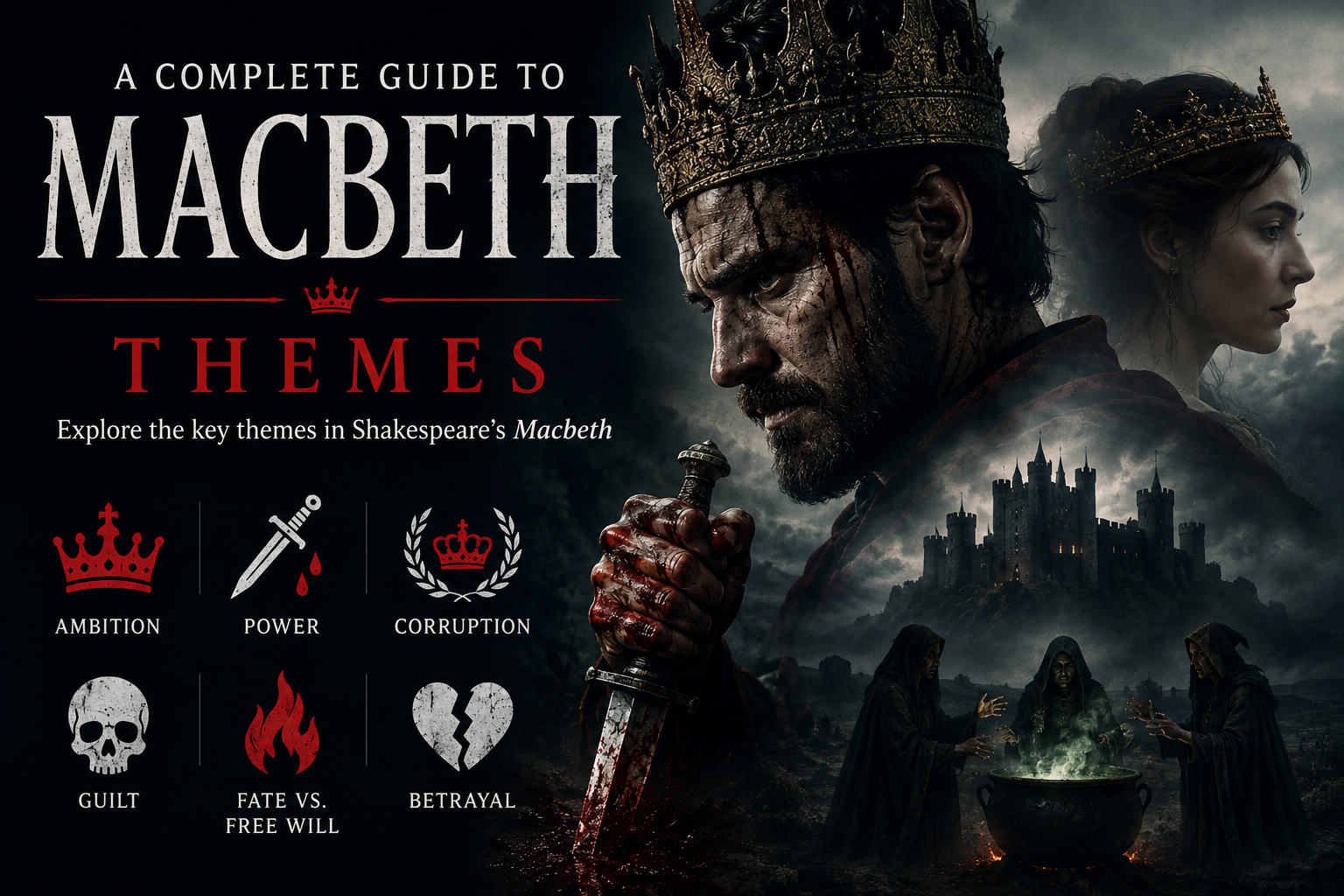
The themes in Macbeth help explain why Shakespeare’s tragedy still feels intense and easy to debate. This guide breaks down ambition, guilt, fate, power, and false appearances in a way students can use for class essays.
In this Guide
- Why the play’s themes matter
- Ambition and moral collapse
- Guilt and the mind
- Fate and free will
- Appearance versus reality
- Power, disorder, and kingship
- Books, links, and FAQ
Why the themes in Macbeth matter
Shakespeare uses themes to turn a murder story into a study of human weakness.
Macbeth is not only about a man who wants to be king. It is about what happens when desire outruns conscience.
Theme helps you move beyond plot summary. Instead of saying, “Macbeth kills Duncan,” you can ask why he does it, what it costs him, and what Shakespeare may be saying about power.
If you want help connecting theme to a character’s choices, this guide on how to analyze characters in literature can help you build stronger paragraphs.
Themes in Macbeth: Ambition and its dangers
Ambition drives Macbeth forward, but it also destroys his judgment.
Of all the themes in Macbeth, ambition is the one most students notice first. Macbeth begins as a brave soldier, but the witches’ prophecy wakes a desire he cannot control.
Lady Macbeth also links ambition to action. She pushes Macbeth to prove himself by taking the crown. Yet both characters learn that getting power does not bring peace.
Shakespeare does not say ambition is always evil. The problem is ambition without moral limits. Macbeth wants greatness, but he cuts himself off from loyalty, mercy, and truth.
This idea appears in other classics too. In Mary Shelley’s Frankenstein, Victor wants to master life itself, and his unchecked desire leads to ruin.
Themes in Macbeth: Guilt and the divided mind
Guilt becomes a punishment that no crown can erase.
One of the strongest themes in Macbeth is guilt. After Duncan’s murder, Macbeth hears voices and fears he will never sleep again.
Sleep becomes a key symbol. To Macbeth, sleep means innocence and calm. Once he murders Duncan, he loses both.
Lady Macbeth tries to reject guilt at first. She tells Macbeth that a little water will clear them. Later, she sleepwalks and imagines blood on her hands.
The famous “Out, damned spot!” scene shows that guilt lives inside the mind. No public victory can silence private shame.
This theme is similar to Dostoevsky’s Crime and Punishment, where a murderer’s inner life becomes part of the punishment.
Themes in Macbeth: Fate, prophecy, and free will
The witches predict the future, but Macbeth chooses how to act.
The witches create one of the play’s biggest questions. Is Macbeth trapped by fate, or does he freely choose evil?
The prophecy says Macbeth will become king. It does not say he must murder Duncan. That gap matters.
Macbeth treats the prophecy like permission. He lets the idea of kingship shape his choices until he becomes dependent on more predictions.
Shakespeare keeps the answer uneasy. Fate may tempt Macbeth, but it does not force the dagger into his hand.
Themes in Macbeth: Appearance versus reality
Many characters hide truth behind a false face.
Appearance versus reality is one of the key themes in Macbeth because the play is full of masks. Characters speak with loyalty while they plan betrayal.
Lady Macbeth tells her husband to “look like the innocent flower” while hiding a deadly purpose. This image makes deception seem beautiful on the surface, but rotten underneath.
Duncan also misreads people. He trusts Macbeth just as he once trusted the old Thane of Cawdor. His kindness makes the betrayal feel more painful.
The witches add to this confusion with lines like “Fair is foul, and foul is fair.” In their world, moral signs cannot be trusted.
Other important themes in Macbeth
The play also explores power, disorder, and what makes a ruler legitimate.
These themes in Macbeth matter because Duncan’s murder breaks more than a family line. It damages the natural and political order of Scotland.
After Duncan dies, strange events follow. Darkness covers the day, animals act against nature, and Scotland becomes filled with fear.
Macbeth holds the title of king, but he lacks true authority. He rules through violence, not justice.
Malcolm’s return suggests that good kingship depends on self-control and care for the people. Shakespeare contrasts tyranny with lawful rule.
For more background on Shakespeare’s life and world, see Britannica’s William Shakespeare biography. You can also read the full play at the Folger Shakespeare Library.
How to write about the themes in a Macbeth essay
A strong theme paragraph connects a big idea to a specific choice or image.
Start with a clear claim. For example, Shakespeare shows that ambition becomes destructive when it breaks away from conscience.
Then use a short quote or scene. The dagger vision, the sleepwalking scene, or the witches’ prophecies can all support a strong point.
After the evidence, explain how the moment reveals meaning. Do not stop at what happened. Show why it matters.
Helpful books for studying Macbeth
A good edition can make the play much easier to understand.
- Macbeth by William Shakespeare, Folger Shakespeare Library edition
- Shakespeare: The World as Stage by Bill Bryson
FAQ about themes in Macbeth
Here are short answers to common student questions.
What are the main themes in Macbeth?
The main themes are ambition, guilt, fate versus free will, appearance versus reality, and the abuse of power.
What is the most important theme in Macbeth?
Ambition is often seen as the central theme because it causes Macbeth’s rise and fall.
How does guilt affect Macbeth?
Guilt makes Macbeth fearful, restless, and violent. Instead of stopping him, it pushes him deeper into crime.
Do the witches control Macbeth?
No. They tempt him with prophecy, but Macbeth still makes his own choices.
Key Takeaway
The themes in Macbeth show how quickly power can corrupt a person who ignores conscience. Shakespeare’s play lasts because its questions about desire, fear, and moral choice still feel real today.












