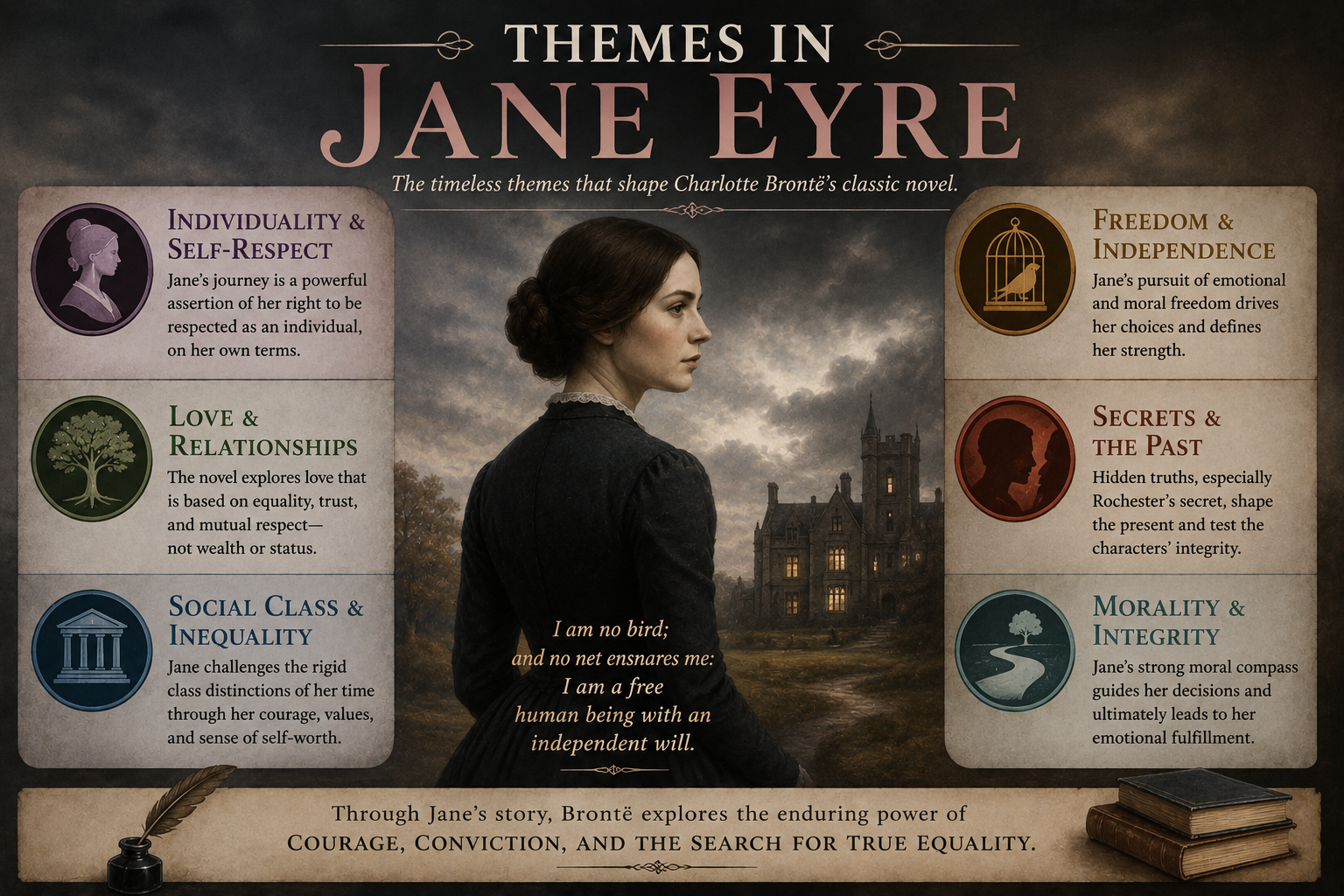
A clear guide to the major ideas, conflicts, and meanings students should notice in Jane Eyre.
The themes in Jane Eyre help explain why Charlotte Brontë’s novel still matters in English classes today. The book is not just a love story. It is also about self-respect, power, faith, and the search for a true home.
In this Guide
- Why the themes matter
- Independence and self-respect
- Love and equality
- Class and gender limits
- Religion and moral choice
- Identity and inner worth
- Home and belonging
- Symbols and motifs
- Helpful books
- FAQ
Why the themes in Jane Eyre matter
Brontë uses Jane’s life to ask what a person needs in order to live with dignity.
The main themes in Jane Eyre grow from Jane’s biggest conflicts. She wants love, but she will not give up her values to get it. She wants safety, but she also wants freedom.
That balance makes the novel useful for high school, AP Literature, and college essays. You can connect almost every major scene to one question: How does Jane protect her inner self in a world that tries to control her?
One reason students remember the themes in Jane Eyre is that Jane changes without losing her core beliefs. Like Elizabeth Bennet in Pride and Prejudice, she learns about love while also learning what she will not accept.
Themes in Jane Eyre: Independence and Self-Respect
Jane’s strongest desire is not wealth or romance. It is the right to live as her own person.
From the start, Jane knows what it feels like to have no power. At Gateshead, Mrs. Reed and John Reed treat her as less than family. At Lowood, harsh rules and public shame teach Jane how cruel authority can be.
Yet Jane does not become passive. She speaks the truth when she can, even when the cost is high. Her famous moral strength starts in childhood.
This is one of the most important themes in Jane Eyre because Jane’s independence shapes every major choice. She leaves Thornfield after Rochester asks her to live against her conscience. She refuses St. John Rivers because his plan would make her useful but unhappy.
Jane’s self-respect is not loud pride. It is moral independence. She would rather be alone than live as someone else’s possession.
Love and Equality
Brontë presents love as powerful, but never enough by itself.
Jane loves Rochester, and their bond is one of the novel’s central forces. Still, the novel tests that love through secrets, power, and social rank.
Among the major themes in Jane Eyre, love and equality are closely linked. Jane cannot accept a relationship where Rochester has all the control. His wealth, age, and social position place him above her at first.
Jane’s choice to leave Thornfield proves that she values equal love over emotional comfort. She does not stop loving Rochester. She chooses to protect her soul.
By the end, their relationship changes. Jane has family, money, and freedom. Rochester has lost some of his power and must depend on her. This shift matters because Brontë suggests that true love needs mutual respect.
Social Class and Gender Limits
Jane lives in a world where birth and money decide how people are treated.
As a poor orphan, Jane has few options. She becomes a governess, which places her in a strange middle position. She is educated, but not wealthy. She works in a rich home, but she is not fully part of its class.
This makes Thornfield tense. Jane can speak with Rochester as an intellectual equal, but society sees her as beneath him. Blanche Ingram shows the opposite problem. She has status, but little real feeling.
Gender also limits Jane. Victorian women were often expected to depend on men. Jane resists that role. She wants work, thought, movement, and choice.
For more background on Charlotte Brontë and the world that shaped the novel, see Britannica’s overview of Charlotte Brontë.
Religion and Moral Choice
Religion in the novel is not simple. Brontë shows both harmful faith and healing faith.
Mr. Brocklehurst uses religion to control children and shame the poor. His faith looks holy, but his actions are cruel and selfish.
Helen Burns offers a different model. She teaches patience, forgiveness, and spiritual peace. Jane admires Helen, but she does not fully copy her. Jane still believes injustice should be named.
St. John Rivers gives another version of faith. He is disciplined and brave, but he is cold. He wants Jane to marry him for duty, not love.
These themes in Jane Eyre show that Brontë values spiritual integrity over empty rule-following. Jane’s faith helps her choose what is right, but it does not erase her need for human love.
Appearance, Identity, and Inner Worth
Many characters judge by appearance, but the novel asks readers to look deeper.
Jane is often described as plain. Rochester is not shown as a perfect romantic hero either. Brontë avoids the idea that beauty equals goodness.
Blanche Ingram looks like the ideal match for Rochester, but her values are shallow. Jane has less social shine, yet she has honesty, intelligence, and courage.
This theme works well in essays because it connects to point of view. Since Jane tells her own story, readers see her inner world. We learn that identity is not just what others see. It is what a person knows to be true inside.
Home, Belonging, and Freedom
Jane spends much of the novel searching for a place where she can belong without losing herself.
Gateshead is a house, but it is not a home. Lowood gives Jane education and friendship, but it also brings suffering. Thornfield offers love, but it hides a secret that makes it unsafe.
Moor House gives Jane family and stability. Still, St. John’s control threatens her freedom. Ferndean, near the end, becomes the closest thing to a true home because Jane can love Rochester as an equal.
This theme matters because home in the novel is not just a building. It is a place where Jane’s body, mind, and conscience can rest.
Symbols that support themes in Jane Eyre
Brontë uses setting, weather, and repeated images to deepen the novel’s meaning.
Symbols make the themes in Jane Eyre easier to see. The red-room at Gateshead shows fear, punishment, and isolation. Fire often connects to passion, anger, or life. Ice and cold often mark emotional distance.
Thornfield itself becomes a symbol of hidden truth. Its beauty covers a locked secret, much like Rochester’s charm covers his past.
If you want help spotting patterns like these, read our guide on how to find symbolism in a story. It can help you turn symbols into stronger essay points.
You can also use the British Library’s article on Jane Eyre and 19th-century women for context on gender and society.
How to write about the themes in Jane Eyre
A strong essay should not just name a theme. It should explain how Brontë builds that idea through conflict and character choice.
For example, do not only say that independence is important. Show how Jane’s choices at Gateshead, Thornfield, and Moor House prove that she values self-respect over comfort.
Try this sentence frame:
Brontë develops the theme of [idea] by showing how Jane [choice or conflict], which reveals [larger meaning].
You can also connect theme to symbol. The red-room shows Jane’s early powerlessness, while Ferndean shows a quieter form of freedom. This kind of pattern helps an essay feel focused.
For more support, you can explore our Jane Eyre study resources as you plan your notes.
Helpful books for students
If you want a print copy or a study-friendly edition, look for these titles through Amazon, a local bookstore, or your school library:
- Jane Eyre by Charlotte Brontë
- The Madwoman in the Attic by Sandra M. Gilbert and Susan Gubar
The first gives you the full novel. The second is more advanced, but it is useful for college-level study of gender and power.
FAQ: Themes in Jane Eyre
What are the main themes in Jane Eyre?
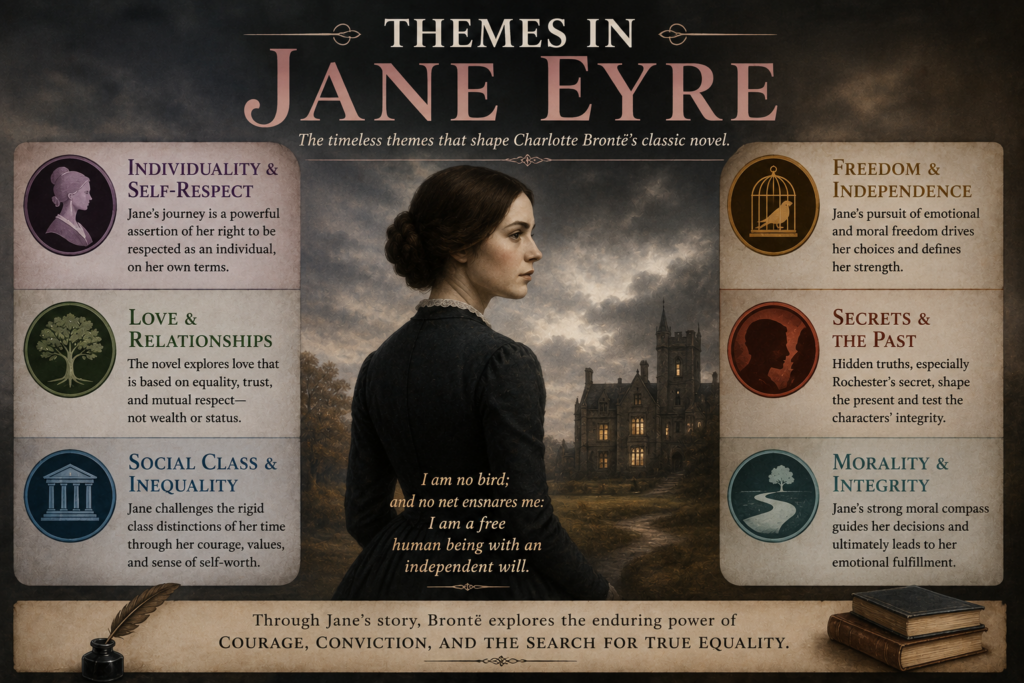
The main themes in Jane Eyre include independence, love, class, gender, religion, identity, and belonging.
What is the most important theme in the novel?
Independence may be the most important theme because nearly every major choice Jane makes protects her self-respect.
How does Jane Eyre show feminism?
The novel shows feminism through Jane’s demand for equality, work, thought, and moral choice in a society that limits women.
Why does Jane leave Rochester?
Jane leaves because staying would break her conscience. She loves Rochester, but she will not give up her moral freedom.
How do symbols connect to theme?
Symbols like the red-room, fire, and Thornfield turn abstract ideas into concrete images. They help readers see fear, passion, and hidden truth.
Key Takeaway
The themes in Jane Eyre all point to one clear idea: real love and real faith must respect the self. Jane’s journey matters because she gains belonging without surrendering her freedom.