

Of Mice and Men Literary Analysis Essay: How to Write a Strong One

Mice and Men

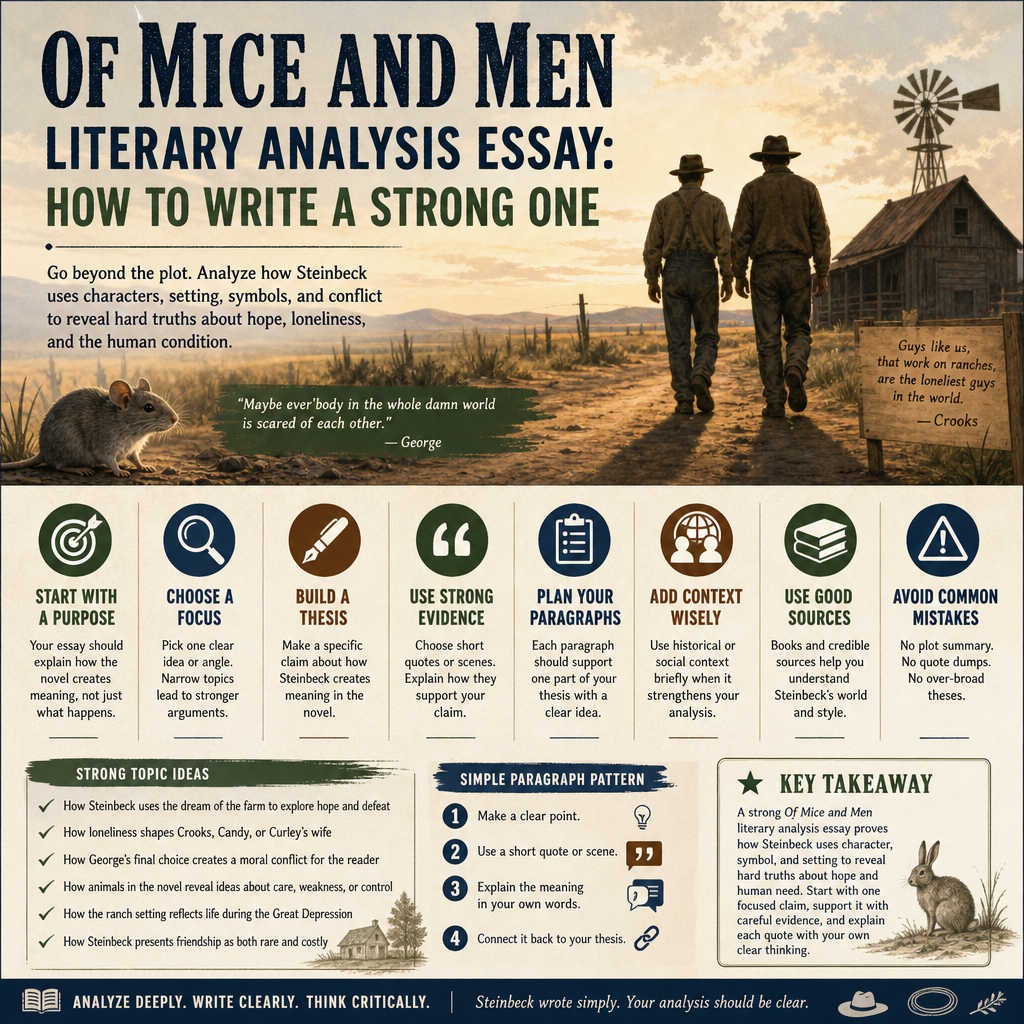
Writing an Of Mice and Men literary analysis essay can feel tough because the book is short but full of meaning. This guide will help you move from topic idea to thesis, then from evidence to a clear final draft.

You will learn how to build an argument about Steinbeck’s novel without just retelling the plot.
Mice and Men

In this Guide

Use this guide as a quick map before you write.

  • What a literary analysis essay should do
  • How to choose a strong focus
  • Thesis statement examples
  • Topic ideas for Of Mice and Men
  • Evidence suggestions from the novel
  • Helpful books and sources
  • FAQ and final takeaway

Start Your Of Mice and Men Literary Analysis Essay with a Clear Purpose

A strong essay should explain how a text creates meaning, not just what happens in the story.

In Of Mice and Men, John Steinbeck tells a simple story about George and Lennie, two workers who hope for a better life. Your job is to look deeper. Ask how Steinbeck uses character, setting, symbols, conflict, or tone to shape the reader’s view.

A plot summary says, ‘George and Lennie want a farm.’ A literary analysis says, ‘Steinbeck uses the dream of the farm to show how hope can both comfort and mislead people who live with little power.’

If you need a wider overview of essay structure, read our guide to writing a literary analysis essay. It pairs well with this Of Mice and Men literary analysis essay plan.

Choose a Focus for Your Of Mice and Men Literary Analysis Essay

Your essay becomes stronger when it studies one clear idea instead of many broad themes.

Many students start with a theme like loneliness or the American Dream. That is a good start, but it is not enough yet. You need an angle that shows what Steinbeck says about that theme.

For example, ‘loneliness’ is too broad. A sharper focus would be: ‘Steinbeck shows that loneliness can make people both cruel and desperate for connection.’

This focus keeps your Of Mice and Men literary analysis essay from drift. It also helps each body paragraph serve one main claim.

Think of how this works in other well-known books. In The Great Gatsby, a student should not just write about wealth. A stronger essay asks how wealth changes how people treat others.

Build a Thesis for an Of Mice and Men Literary Analysis Essay

Your thesis is the main argument your whole essay must prove.

A good thesis names the text, gives a clear claim, and points to how the author creates meaning. It should not sound like a fact from the plot.

Weak thesis: In Of Mice and Men, George and Lennie have a dream.

Stronger thesis: In Of Mice and Men, Steinbeck uses George and Lennie’s dream of owning land to show how hope can help people survive hardship, even when that hope is fragile.

Here are more thesis statement examples you can adapt:

  • Theme thesis: Steinbeck presents loneliness as a force that damages people’s sense of worth and pushes them to seek control over others.
  • Character thesis: Through George’s care for Lennie, Steinbeck shows that love can become a heavy moral burden in an unfair world.
  • Symbol thesis: The rabbits in Of Mice and Men symbolize Lennie’s dream of safety, but they also reveal how far that dream is from reality.
  • Setting thesis: Steinbeck uses the ranch as a harsh social world where workers compete for status because they lack real security.

Your Of Mice and Men literary analysis essay will feel much more focused if every paragraph connects back to one of these kinds of claims.

If thesis writing slows you down, the Literary Analysis Essay Toolkit gives you thesis frames, paragraph planners, and revision checklists made for student essays.

Use Evidence in Your Of Mice and Men Literary Analysis Essay

Good evidence does not speak for itself, so you must explain how it supports your claim.

Choose short quotes or moments that reveal a pattern. You do not need the longest quote. You need the most useful one.

For a theme essay on loneliness, you might study Crooks’s room and his talk with Lennie. Crooks lives apart from the other men, and his bitterness grows from that forced isolation.

For an essay on dreams, you might use the repeated description of the farm. The dream returns at key moments, which shows how much George and Lennie need it.

For an essay on power, you might study Curley’s behavior or the way the ranch workers treat Candy after his dog grows old. These scenes reveal a world where weakness can make a person unsafe.

Use this simple pattern in each body paragraph:

  • Make a clear point.
  • Use a short quote or scene.
  • Explain the meaning in your own words.
  • Connect it back to the thesis.

This pattern works for an Of Mice and Men literary analysis essay, but it also works for novels like To Kill a Mockingbird or Lord of the Flies.

Of Mice and Men Literary Analysis Essay Topic Ideas

The best topic gives you room to argue, not just describe.

Here are strong topic angles for your essay:

  • How Steinbeck uses the dream of the farm to explore hope and defeat
  • How loneliness shapes Crooks, Candy, or Curley’s wife
  • How George’s final choice creates a moral conflict for the reader
  • How animals in the novel reveal ideas about care, weakness, or control
  • How the ranch setting reflects life during the Great Depression
  • How Steinbeck presents friendship as both rare and costly

Once you pick a topic, turn it into a question. For example: ‘How does Steinbeck use Candy’s dog to prepare the reader for the ending?’ Your answer can become your thesis.

This step will help your Of Mice and Men literary analysis essay sound more original and less like a report.

Plan Body Paragraphs Before You Draft

A simple plan can save you from a messy essay.

Each body paragraph should cover one part of your thesis. If your thesis is about hope, loneliness, or moral choice, each paragraph should show a different piece of that idea.

Here is a sample plan for a thesis about the dream of the farm:

  • Body paragraph 1: The farm gives George and Lennie comfort in a hard world.
  • Body paragraph 2: The dream attracts others because many characters feel trapped.
  • Body paragraph 3: The collapse of the dream shows the limits of hope in an unfair society.

Be careful with your topic sentences. Do not start every paragraph with plot. Start with an idea.

Plot-based: Lennie talks about rabbits again.

Analysis-based: Lennie’s repeated focus on rabbits shows his need for a safe future he can understand.

For more help with paragraph shape, our literary analysis essay guide breaks down claims, evidence, and commentary in a clear way.

Add Context Without Letting It Take Over

Context can help, but the novel must stay at the center of your essay.

Of Mice and Men connects to the Great Depression, migrant labor, and the struggle for economic security. These facts can support your analysis, but they should not replace close reading.

A useful sentence might say: ‘The ranch reflects the unstable lives of workers during the Great Depression, which makes George and Lennie’s dream feel urgent.’

For quick background, you can use Britannica’s biography of John Steinbeck. You can also read the Nobel Prize profile on Steinbeck for a short view of his literary importance.

Helpful Books to Consider

These books can help you understand Steinbeck’s world and style.

If you shop on Amazon or use your school library, look for these titles:

  • Of Mice and Men by John Steinbeck
  • The Grapes of Wrath by John Steinbeck
  • Steinbeck: A Life in Letters edited by Elaine Steinbeck and Robert Wallsten

The first title is the main text. The other books can help you see Steinbeck’s wider concerns with work, poverty, and human dignity.

Common Mistakes to Avoid in an Of Mice and Men Literary Analysis Essay

Small choices can weaken your essay even when your idea is strong.

Do not write a full plot summary. Your teacher already knows the story. Focus on what Steinbeck does and why it matters.

Do not use quotes without commentary. After each quote, explain the word choice, symbol, contrast, or character action that supports your claim.

Do not make your thesis too broad. A claim like ‘Steinbeck shows life is hard’ is true, but it is not specific enough for a strong essay.

Do not ignore the ending. Even if your essay is not only about the final scene, the ending often changes how readers understand earlier dreams and choices.

FAQ: Of Mice and Men Literary Analysis Essay

Here are quick answers to common student questions.

What is a good thesis for an Of Mice and Men literary analysis essay?

A good thesis makes a clear claim about how Steinbeck creates meaning. For example: ‘Steinbeck uses George and Lennie’s dream to show how hope can comfort people who live with fear and uncertainty.’

What themes can I write about?

You can write about loneliness, dreams, friendship, power, mercy, or social inequality. Pick one theme and make a specific claim about it.

How many quotes should I use?

Use enough quotes to prove your points, but do not overload the essay. One strong quote or scene per body paragraph often works well.

Should I include historical context?

Yes, but keep it brief. Use context only when it helps explain the novel’s setting, conflict, or characters.

Can I write about George’s final choice?

Yes. That topic works well because it lets you analyze love, responsibility, and moral conflict in one focused argument.

Key Takeaway

A strong ending should remind you what matters most.

A strong Of Mice and Men literary analysis essay does not just explain the story. It proves how Steinbeck uses character, symbol, and setting to reveal hard truths about hope and human need.

Start with one focused claim, support it with careful evidence, and explain each quote with your own clear thinking. That is the heart of literary analysis. ✍️
The Crucible Literary Analysis Essay: How to Write One

The Crucible literary analysis essay

Writing The Crucible literary analysis essay can feel hard because the play is both a courtroom drama and a warning about fear. This guide will help you build a clear thesis, choose strong evidence, and turn your ideas into a smart essay.

A focused The Crucible literary analysis essay should do more than retell the Salem witch trials. It should explain how Arthur Miller uses character, conflict, and language to reveal a deeper meaning.

The Crucible literary analysis essay

In this Guide

  • Why The Crucible works so well for analysis
  • The Crucible literary analysis essay: start with a real argument
  • Topic ideas that give you something to prove
  • Thesis statement examples
  • How to use evidence without plot summary
  • Helpful books and links
  • FAQ

Why The Crucible Still Works for Literary Analysis

Miller’s play gives students a rich way to study fear, power, guilt, and reputation.

The Crucible is set during the Salem witch trials, but it also speaks to Miller’s own time. He wrote it during the Red Scare, when many Americans feared communism and public accusation could destroy a life.

That double meaning gives you a lot to analyze. You can write about the events in Salem, but you can also explore why Miller wrote the play for a modern audience.

For helpful background, read Britannica’s overview of Arthur Miller. You can also review the real Salem witch trials to understand the history behind the drama.

The Crucible literary analysis essay: Start with a Real Argument

Your essay needs a claim that someone could debate.

A weak thesis says that fear is important in the play. That is true, but it is too broad. A stronger thesis explains what fear does and why it matters.

Your The Crucible literary analysis essay should answer a question like this: How does Miller show that fear can damage truth, justice, or personal identity?

Think of it like Macbeth. A weak essay might say Macbeth wants power. A stronger essay would argue that Shakespeare shows ambition as a force that destroys moral judgment.

The same rule applies here. Do not just name a theme. Make a claim about how that theme works.

If you need a full refresher on essay basics, this guide to how to write a literary analysis essay can help you review the core steps.

The Crucible Literary Analysis Essay Topic Ideas That Actually Work

The best topics give you a pattern to track across the play.

Here are useful directions for your essay:

  • Reputation and fear: Argue that characters protect their names even when truth is at risk.
  • Power and accusation: Explore how Abigail and the court use public fear to control others.
  • John Proctor’s moral growth: Show how Proctor moves from private guilt to public courage.
  • Religion and authority: Analyze how spiritual language becomes a tool of control.
  • Hysteria as a social force: Explain how fear spreads when people stop using reason.

Try to avoid topics that only describe the plot. For example, do not write only about what Abigail does. Write about how Miller uses Abigail to show the danger of unchecked power.

Sample Thesis Statements for The Crucible literary analysis essay

A strong thesis gives your essay direction before the first body paragraph begins.

A The Crucible literary analysis essay works best when the thesis names the theme and explains Miller’s message. Use these examples as models, not copy-and-paste answers.

In The Crucible, Arthur Miller shows that fear can destroy justice because a frightened society rewards accusation more than truth.

Through John Proctor’s conflict between guilt and honor, Miller argues that integrity becomes most meaningful when it costs something.

Miller presents Abigail Williams as more than a villain; he uses her rise to power to show how weak systems can reward lies.

In The Crucible, public reputation becomes a trap because characters fear shame more than moral failure.

Notice how each thesis makes a point. None of them simply says that the play has themes. Each one explains what Miller suggests about human behavior.

How to Structure Your The Crucible Literary Analysis Essay

A clear structure helps your reader follow your thinking.

Start with a short introduction. Give brief context, name the play and author, then end with your thesis.

Each body paragraph should focus on one idea. Begin with a topic sentence, then bring in one quoted detail or scene. Explain how that evidence proves your claim.

Your conclusion should not just repeat the thesis. Instead, show why your argument matters. By the end, The Crucible literary analysis essay should leave the reader with a sharper view of Miller’s warning.

If you want a faster way to plan your outline, thesis, quote notes, and commentary, check out The Literary Analysis Essay Toolkit. It is built to help students move from a blank page to a polished draft.

Use Evidence Without Retelling the Plot

Your teacher already knows what happens in the play.

Plot summary tells the reader that Proctor refuses to sign his confession. Analysis explains why that moment matters. It shows how the scene connects to identity, truth, and moral courage.

A helpful pattern is simple: make a claim, use evidence, and explain the meaning.

For example, you might discuss Proctor’s final choice. The evidence is his refusal to give the court a signed lie. The analysis should explain how Miller turns his name into a symbol of personal honor.

This is like writing about Hester Prynne in The Scarlet Letter. You would not only say she wears the scarlet letter. You would explain how the symbol changes meaning as the story develops.

Strong Evidence to Consider

Good evidence comes from major choices, repeated ideas, and key conflicts.

You may want to look closely at these parts of the play:

  • Proctor’s private guilt after his affair with Abigail
  • Abigail’s control over the other girls
  • Hale’s change from confidence to doubt
  • Elizabeth’s struggle with honesty and forgiveness
  • The court’s refusal to question its own power
  • Proctor’s final choice about his name

Do not use a quote just because it sounds famous. Pick evidence that helps prove your thesis.

When you write your commentary, ask: What does this moment reveal about the character? What does it suggest about society? How does it support Miller’s message?

Common Mistakes to Avoid

Most weak essays fail because they stay too general.

One common mistake is writing about the whole play at once. Choose a focused path. A paper about fear will be stronger if it studies one effect of fear, such as false confession or public shame.

Another mistake is treating characters like real people only. They do have emotions, but they are also literary tools. Ask why Miller shapes them this way.

Do not use modern slang or casual judgment. Instead of saying Abigail is just evil, explain how Miller uses her to expose fear, desire, and weak authority.

Books That Can Help

These books can support your reading and help you understand the play’s background.

  • The Crucible by Arthur Miller
  • Why I Wrote The Crucible by Arthur Miller
  • The Salem Witch Trials Reader edited by Frances Hill

You do not need to read every source before you write. Even a short background source can help you avoid shallow claims.

FAQ About The Crucible Literary Analysis Essay

These quick answers can help you plan with less stress.

What is the best topic for a The Crucible literary analysis essay?

A strong topic focuses on a theme with a clear argument. Reputation, fear, power, and integrity all work well.

Can I write about John Proctor?

Yes. Proctor is a strong choice if you focus on his moral conflict, not just his actions.

How many quotes should I use?

Use enough evidence to prove your point. For most school essays, one or two strong quotes per body paragraph is better than many weak ones.

Should I mention McCarthyism?

You can, if it supports your thesis. Keep the focus on the play unless your assignment asks for historical context.

Key Takeaway

A strong The Crucible literary analysis essay makes a clear claim about Miller’s message and proves it with focused evidence. Do not retell the play. Show how it works and why it still matters.

How to Write a Thesis Statement for a Literary Analysis Essay

thesis statement for a literary analysis essay

A simple guide to crafting clear, focused arguments about literature

Many students understand the plot of a novel or poem but struggle to explain what the text means. When it comes time to write a literary essay, the most difficult part is often the thesis statement.

A thesis statement is the sentence that explains the main argument of your essay. It tells readers what interpretation you will defend and guides the structure of the entire paper.

Learning how to write a thesis statement for a literary analysis essay can transform the writing process. Instead of feeling lost, you gain a clear direction for your argument and a framework for organizing your ideas.

In this guide, we will explore how thesis statements work, examine examples from classic literature, and practice building strong claims that support thoughtful literary analysis.

This article contains affiliate links.

thesis statement for a literary analysis essay
Image by Carla Paton

In This Guide

In this article, you’ll learn:

• what a thesis statement does in literary analysis
• the difference between weak and strong thesis statements
• examples from classic novels
• a simple formula for writing a thesis
• common mistakes students make
• a practice exercise to strengthen your skills

What a Thesis Statement Does in Literary Analysis

A thesis statement explains what interpretation your essay will argue about a literary text.

Instead of summarizing the plot, a thesis identifies how the author creates meaning through elements such as:

  • theme
  • symbolism
  • characterization
  • imagery
  • narrative structure

Your thesis becomes the central claim that every paragraph in your essay will support.

For example, in Mary Shelley’s Frankenstein, the novel explores the dangers of ambition and scientific curiosity. A literary analysis essay might examine how Victor Frankenstein’s obsession with knowledge leads to tragic consequences.

A thesis for that essay might argue that Shelley uses Victor’s ambition to critique the pursuit of knowledge without moral responsibility.

This statement gives the essay a clear focus and prepares the reader for the argument that follows.

For more strategies on interpreting literature, see:

How to Read Literature Like a Scholar
https://rapidreadspress.com/how-to-read-literature-like-a-scholar/

Weak vs. Strong Thesis Statements

Not all thesis statements are equally effective. Many students begin with statements that describe the topic but fail to make a clear argument.

Weak thesis statements often summarize the story or present an obvious observation.

Example from Pride and Prejudice:

Weak thesis:

Elizabeth Bennet learns important lessons during the novel.

This statement is true, but it does not explain what those lessons are or why they matter.

A stronger thesis presents a specific interpretation.

Strong thesis:

In Pride and Prejudice, Jane Austen uses Elizabeth Bennet’s changing perception of Darcy to show how pride and prejudice distort judgment.

This version makes a clear claim and suggests how the author develops the theme.

The difference is simple:

Weak thesis → describes the story
Strong thesis → interprets the story

Thesis Statement Examples from Classic Literature

Looking at examples from well-known works can help illustrate how literary thesis statements function.

Consider Emily Brontë’s Wuthering Heights.

A weak thesis might say:

The novel shows the intense relationship between Catherine and Heathcliff.

A stronger thesis could be:

In Wuthering Heights, Emily Brontë uses the wild moorland landscape to reflect the destructive passion between Catherine and Heathcliff.

This statement connects setting and theme, giving the essay a clear analytical direction.

Another example can be found in Jane Austen’s Emma.

Weak thesis:

Emma learns about her mistakes.

Stronger thesis:

In Emma, Jane Austen portrays Emma Woodhouse’s misguided attempts to control the lives of others as a critique of social arrogance and misplaced confidence.

This thesis identifies the character arc while explaining the novel’s larger idea.

📘 Need more help writing literary essays?

The Literary Analysis Essay Toolkit walks you through every step of the process—from interpreting the assignment to organizing paragraphs and revising your final draft.

Get the Literary Analysis Essay Toolkit

A Simple Formula for Writing a Literary Thesis

Students often find thesis statements easier when they follow a simple structure.

A useful formula is:

Author + literary device or element + interpretation of meaning

Example structure:

In [Title], [Author] uses [literary element] to reveal [interpretation].

Example from Frankenstein (affiliate link):

In Frankenstein, Mary Shelley uses Victor Frankenstein’s relentless ambition to warn about the dangers of pursuing knowledge without responsibility.

Example from Dracula (affiliate link):

In Dracula, Bram Stoker uses imagery of darkness and decay to create a sense of moral and supernatural danger.

This structure works well because it identifies:

• the text
• the literary technique
• the interpretation

If you want help recognizing literary techniques, see:

Literary Devices List: 32 Literary Devices Explained
https://rapidreadspress.com/literary-devices-list/

Common Thesis Statement Mistakes

Even strong essays can suffer from weak thesis statements if writers fall into a few common traps.

One common mistake is writing a thesis that is too vague.

Example:

The novel explores important themes.

This statement does not explain which themes or how the author develops them.

Another mistake is writing a thesis that simply summarizes the story.

Example:

Victor Frankenstein creates a monster and regrets it.

This is a plot summary rather than an interpretation.

A good thesis should always answer the question:

What idea does the text reveal?

Finally, avoid thesis statements that attempt to cover too many ideas at once. A focused claim leads to a clearer essay.

Practice Exercise

Try creating a thesis statement using the following example.

Consider this prompt based on Sense and Sensibility:

Analyze how Jane Austen contrasts the characters of Elinor and Marianne Dashwood.

Start by identifying the literary focus.

Character contrast.

Next consider what idea the contrast reveals.

Perhaps Austen explores the tension between emotional expression and social restraint.

A thesis might look like this:

In Sense and Sensibility, Jane Austen contrasts Elinor’s restraint with Marianne’s emotional openness to explore the balance between reason and feeling.

Practicing with different works helps strengthen your ability to develop clear literary arguments.

Key Takeaway

A thesis statement is the foundation of every literary analysis essay.

When you learn how to write a thesis statement for a literary analysis essay, you move beyond summarizing a story and begin interpreting how literature communicates deeper meaning.

A strong thesis presents a clear claim, identifies the literary elements involved, and guides the structure of the entire essay.

Recommended Books

These books provide helpful insights into literary analysis and writing about literature.

📚 How to Read Literature Like a Professor – Thomas C. Foster

📚 Reading Like a Writer – Francine Prose

📚 How to Read and Why – Harold Bloom

These resources expand on the critical reading skills discussed in this guide.

FAQ Thesis Statements Frequently Asked Questions

What is a thesis statement in literary analysis?

A thesis statement is the main argument of a literary essay. It explains the interpretation the writer will defend about the text.

How long should a literary thesis statement be?

Most thesis statements are one or two sentences that clearly present the essay’s argument.

Should a thesis include literary devices?

Often yes. Many strong literary theses identify elements such as symbolism, imagery, characterization, or theme.

Can a thesis statement be a question?

Generally no. A thesis should make a clear claim, not ask a question.







