

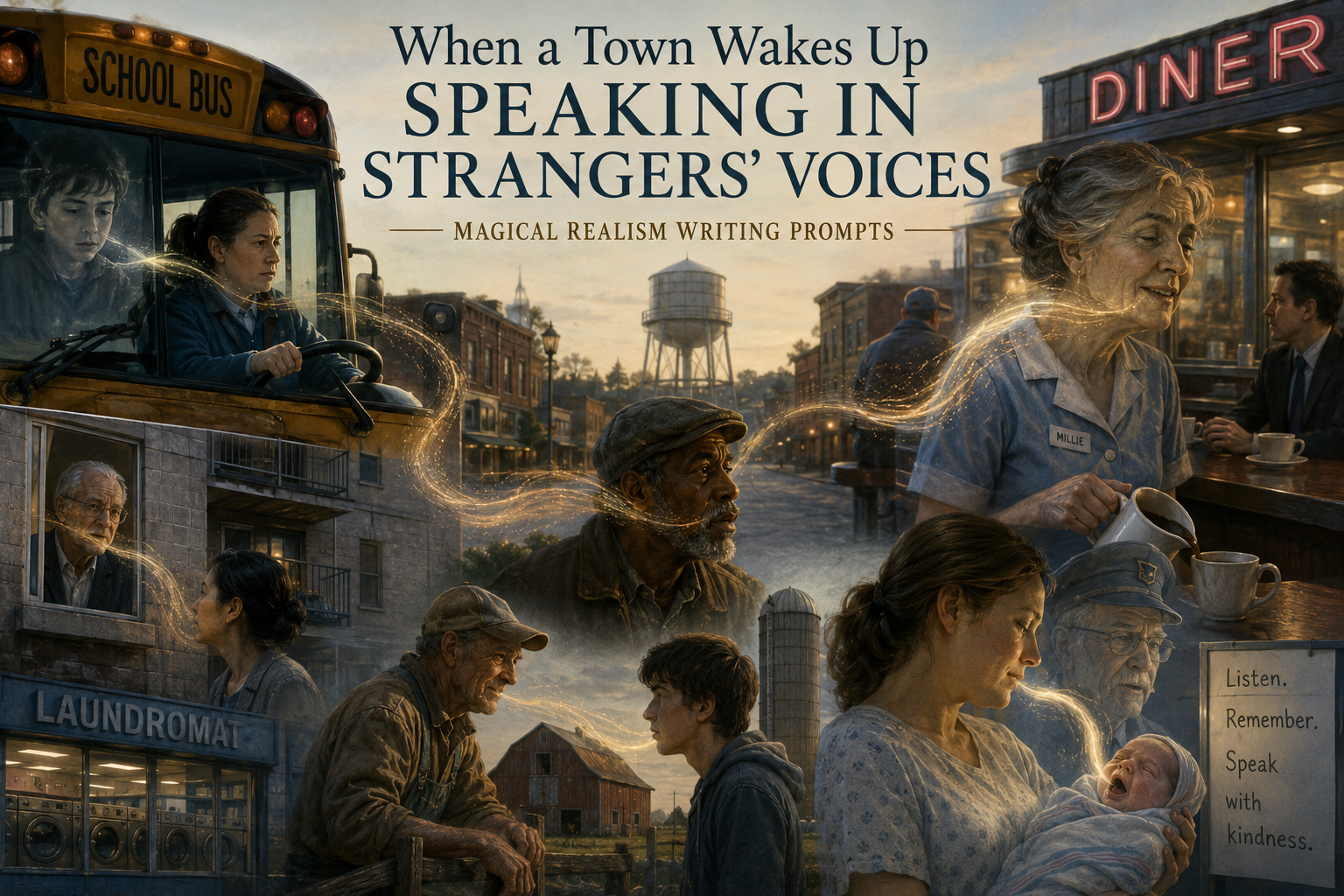
What happens when the impossible arrives quietly?
Not with explosions. Not with portals opening in the sky. Not with monsters or prophecies.
Instead, imagine waking up one ordinary morning and discovering that your voice no longer belongs to you.
That is the strange emotional territory magical realism loves to explore.
In magical realism, impossible things enter everyday life without fully breaking it. People still go to work. Coffee still brews. School buses still arrive. The world continues almost normally, except for one impossible detail that reveals something hidden underneath ordinary life.
The following magical realism prompts explore a town where every person wakes up speaking in someone else’s voice.
Rather than focusing on spectacle or explanation, these prompts use magical realism to uncover grief, memory, resentment, tenderness, guilt, and longing. The magic itself is never fully explained because the emotional truth matters more than the mechanics.
In This Guide
- What makes a writing prompt magical realism
- Why borrowed voices work as magical realism
- How to write emotional magical realism stories
- Five magical realism prompt ideas
- Tips for writing magical realism fiction
- FAQ about magical realism prompts
What Makes a Prompt Magical Realism?
Magical realism blends the ordinary world with one impossible element that characters accept as part of reality.
A magical realism story does not usually pause to explain the magic. The impossible simply exists beside everyday life.
A woman may float while hanging laundry. A town may forget insomnia exists. A child may hear ghosts during dinner. Nobody reacts as though they have entered a fantasy novel. Instead, the strange becomes woven into ordinary routines.
That emotional contrast is what gives magical realism its power.
In these prompts, the magical element is simple: everyone wakes up speaking in someone else’s voice.
But the emotional consequences become enormous.
Why the “Borrowed Voices” Idea Works So Well
The idea of borrowed voices creates instant emotional tension because voices carry identity.
A voice contains memory, history, pain, affection, fear, and social power. Hearing the wrong voice come from your own mouth would immediately force you to think differently about yourself and other people.
These prompts capture this beautifully by placing the impossible inside ordinary spaces like school buses, apartment buildings, diners, farms, and hospitals.
That contrast is deeply connected to magical realism.
The world itself remains recognizable. Breakfast still happens. Laundry still spins. Nurses still check monitors. The magic does not stop life. It exposes hidden emotional truths already buried inside it.
Magical Realism Prompt #1: The School Bus Route
One morning, a school bus driver begins her route exactly as she has for twenty-two years. But when she calls out the children’s stops, she speaks in the voice of a boy who drowned in the quarry the previous summer. Soon every child discovers they are speaking in someone else’s voice too. Some hear dead relatives. Others hear estranged parents, former friends, or complete strangers.
This magical realism prompt works because the impossible enters a completely normal setting.
The children still ride to school.
The driver still keeps both hands on the wheel.
Nobody fully understands what is happening, but the routine of the morning continues anyway.
A strong story could focus on one child who suddenly speaks in the voice of an absent father. Does the child use that borrowed voice to comfort their grieving mother? Or to finally say the painful things nobody in the family has admitted aloud?
The magic becomes a way of exploring emotional inheritance and unfinished conversations.
Magical Realism Prompt #2: The Apartment Building Above the Laundromat
In a worn apartment building above a laundromat, residents wake up speaking in the voices of people they have avoided for years. A landlord suddenly hears himself speaking with the stutter he had as a child. A nurse answers her phone in the voice of a patient she could not save. A retired man speaks with the voice of an immigrant neighbor whose name he never bothered to learn.
This prompt captures one of the strongest qualities of magical realism: emotional confrontation through quiet impossibility.
Nobody runs from monsters.
Nobody tries to save the world.
Instead, people are forced into uncomfortable intimacy.
The laundromat still hums downstairs. People still fry onions for dinner. Someone still complains about parking. Yet every conversation becomes emotionally charged because each borrowed voice carries history with it.
A story built from this prompt could focus on loneliness, prejudice, guilt, or the fear of truly seeing another person.
Magical Realism Prompt #3: The Diner Breakfast Crowd
At the local diner, the breakfast crowd notices the voice exchange over coffee and pancakes. The mayor now speaks with the voice of the woman who cleans city offices at night. A football coach orders breakfast in the delicate voice of his estranged daughter. A widower hears his late wife’s laughter coming from the waitress pouring coffee.
This prompt feels especially suited to magical realism because diners already function as emotional crossroads.
Everybody passes through.
Everybody overhears things.
Everybody carries private grief into public space.
The impossible event does not destroy the diner’s routine. Orders continue. Bacon still hisses on the grill. The waitress still refills cups.
That restraint matters.
Magical realism often becomes more powerful when characters react with uneasy acceptance rather than dramatic panic.
A story here could center on the waitress, who suddenly becomes the accidental witness to the town’s hidden emotional life.
Magical Realism Prompt #4: The Dairy Farm
On a small dairy farm outside town, a father and son wake up speaking in each other’s voices after months of emotional distance. The father’s words come out wounded and impatient. The son’s sound exhausted and weathered beyond his years.
This prompt works beautifully because magical realism often reveals emotional truths that realistic dialogue alone cannot reach.
The pair still completes morning chores.
They mend fences.
They feed calves.
They listen to radio reports describing the strange phenomenon spreading across town.
But now every sentence carries emotional weight neither person can avoid.
The magical element forces both characters to hear themselves through someone else’s experience.
That emotional reversal creates powerful opportunities for stories about family conflict, masculinity, regret, and forgiveness.
Magical Realism Prompt #5: The Maternity Ward
In the maternity ward, newborn babies begin crying in the voices of elderly townspeople. One infant cries with the rasp of a retired mailman. Another sighs with the voice of a woman who has sat in the same church pew for fifty years. A premature baby speaks with the exact voice of a man who disappeared decades earlier.
This may be the most haunting magical realism prompt in the collection because it blends birth with memory.
The story suddenly asks difficult questions.
Can a community ever escape its past?
Do families inherit emotional wounds before language itself?
Can forgiveness survive across generations?
The hospital remains ordinary. Nurses still check monitors and change sheets. Yet the impossible transforms every newborn cry into a reminder that memory never fully disappears.
A deeply emotional story could follow a mother who hears her child cry in the voice of someone she has spent years trying to forgive.
How to Write Better Magical Realism Stories
Many writers make the mistake of treating magical realism like fantasy with less worldbuilding.
But magical realism usually depends more on emotional realism than magical systems.
When writing from these prompts, focus less on explaining why the voices changed and more on what the change reveals.
Pay attention to ordinary details.
The smell of coffee.
The sound of tires on wet pavement.
The awkward silence after someone speaks with the wrong voice.
Magical realism becomes convincing when the emotional world feels authentic enough that readers accept the impossible detail beside it.
It also helps to resist overexplaining the magic itself.
Avoid giving a scientific or supernatural explanation for the voice exchange.
That ambiguity allows the emotional meaning to stay at the center of the story.
Key Takeaway
The best magical realism prompts do not use magic for spectacle.
They use impossible moments to reveal ordinary emotional truths.
A town waking up with borrowed voices becomes a way of exploring grief, loneliness, resentment, memory, forgiveness, and connection. The magic matters less than the emotional honesty it uncovers.
That is what magical realism does best.
It makes invisible feelings briefly visible.
Or in this case, audible.
FAQ About Magical Realism Prompts
What is a magical realism prompt?
A magical realism prompt combines ordinary reality with one impossible element that characters mostly accept as normal. The goal is usually emotional or symbolic exploration rather than fantasy adventure.
How is magical realism different from fantasy?
Fantasy often builds entirely separate worlds with detailed magical systems. Magical realism usually takes place in recognizable everyday settings where one strange event quietly exists beside normal life.
Do magical realism stories need explanations for the magic?
Usually not. In many magical realism stories, the mystery remains unresolved because the emotional meaning matters more than the mechanics.
What themes work well in magical realism?
Grief, memory, identity, family conflict, love, guilt, loneliness, cultural inheritance, and social tension often work especially well because magical realism reveals hidden emotional truths.
Why are ordinary settings important in magical realism?
Ordinary settings create contrast. The impossible feels more emotionally powerful when it appears beside everyday routines like cooking breakfast, riding a bus, or working a normal shift.


Get the Free Close Reading Worksheet Pack
Join my email list and receive the printable worksheet pack you can use with any novel or poem.
No spam. Just helpful guides for reading literature well.












