Oliver Twist Quotes Explained: Important Passages for Students

Rapid Reads Press

Oliver Twist quotes explained can help you understand how Charles Dickens builds a powerful story about poverty, cruelty, and mercy. This guide gives you short, useful passages and shows how to use them in essays without overloading your paper.

In this Guide

  • Why the quotes matter
  • Workhouse and hunger quotes
  • Law and power quotes
  • Innocence and feeling quotes
  • Nancy and moral choice
  • How to use quotes in essays
  • Book suggestions
  • FAQ

Oliver Twist quotes explained: why these lines matter

Dickens uses sharp lines to expose a cruel society.

Oliver Twist is not just a story about one orphan. It is a social novel that asks readers to look at how poor children were treated in 19th-century England.

Use this set of Oliver Twist quotes explained as a study tool. Each quote can support a claim about character, setting, or theme.

If you need help building a full paragraph around a quote, this guide on how to write a literary analysis essay can help you turn notes into a clear argument.

Oliver Twist quotes explained: hunger and the workhouse

The most famous line in the novel shows how hunger becomes a moral test.

Quote: “Please, sir, I want some more.”

This short sentence is one of the most famous lines in English fiction. Oliver is not greedy. He is hungry.

The power of the line comes from its politeness. Oliver says “please” and “sir,” yet the adults act as if he has committed a crime.

Among all Oliver Twist quotes explained in class, this one is often the easiest to connect to Dickens’s main point. A society that punishes a starving child has lost its sense of justice.

Essay use: This quote works well in a paragraph about social criticism. You can argue that Dickens uses Oliver’s simple request to reveal the cruelty of the workhouse system.

A useful comparison is Dickens’s A Christmas Carol. In that novel, Scrooge also learns that poverty is not a personal failure. Dickens often pushes readers to see the poor as human beings, not as problems.

Quote: “a parish child”

This phrase labels Oliver before he has a chance to choose anything for himself. He becomes part of a system before he becomes a person in the eyes of adults.

Dickens wants readers to notice how language can reduce a child to a category. Oliver is treated like a case file, not a son or student.

Essay use: Use this quote to discuss identity. Oliver’s name and status are shaped by institutions, but his kindness resists those labels.

Oliver Twist quotes explained: law, power, and hypocrisy

Dickens often turns legal language into satire.

Quote: “The law is a ass, a idiot.”

Mr. Bumble says this line when the law does not serve his own interests. The grammar is funny, but the point is serious.

This is one of the best Oliver Twist quotes explained for satire. Dickens shows that people in power respect the law only when it protects them.

The line also attacks blind faith in systems. A law can look official and still be cruel, foolish, or unfair.

Essay use: This quote fits a paper about hypocrisy. You can argue that Dickens uses Mr. Bumble to expose the selfishness behind public authority.

Quote: “questions of coat and waistcoat”

Dickens suggests that people often mistake clothing for virtue. A person in fine dress may seem wise or holy, even if his actions prove otherwise.

The quote attacks class prejudice. In the world of the novel, appearance often decides who gets trust.

Essay use: Use this line in an essay about social status. It can support a claim that Dickens mocks a society that confuses wealth with moral worth.

For brief background on Dickens’s life and career, see Britannica’s Charles Dickens biography.

Oliver Twist quotes explained: innocence and feeling

Oliver survives because his kindness does not disappear.

Quote: “possessing rather too much” feeling

The narrator says Oliver has more feeling than others expect. This matters because many adults treat him as if poor children are rough or empty inside.

For Oliver Twist quotes explained in essays, this line is useful because it points to Dickens’s view of nature and nurture. Oliver lives in harsh places, yet he does not become cruel.

That idea links Oliver Twist to Jane Eyre. Both novels show children who face neglect but keep a strong inner life.

Essay use: This quote can support an argument about innocence. Oliver’s goodness is not weakness. It is Dickens’s way of challenging a brutal world.

Quote: “There are books of which the backs and covers are by far the best parts.”

This line shows Dickens’s comic voice. He can pause the plot to make a sharp joke about books, taste, and false value.

The quote also reminds us that Oliver Twist is not only dark. Dickens uses humor to make his social criticism easier to read and harder to ignore.

Essay use: Use this quote if your teacher asks about tone. It shows how satire can mix laughter with judgment.

Oliver Twist quotes explained: Nancy and moral choice

Nancy’s story shows that Dickens does not divide people into simple groups.

Quote: “I will not turn upon him.”

Nancy says this about Bill Sikes. Her loyalty is painful because it helps show how trapped she feels.

This quote matters because Nancy knows right from wrong, yet fear and attachment pull her back. Dickens presents her as a complex person, not a flat symbol.

In many Oliver Twist quotes explained guides, Nancy is treated only as a victim. That is too simple. She also makes brave choices, even when those choices cost her safety.

Essay use: This quote works in a paragraph about moral conflict. You can argue that Nancy reveals Dickens’s belief that goodness can exist in damaged lives.

How to use Oliver Twist quotes explained in essays

A good quote is only useful when you explain its meaning.

Do not drop a quote into a paragraph and move on. Give context first, quote only the words you need, then explain how the language supports your claim.

A strong pattern is simple: make a claim, give a short quote, explain the effect. If you want more help with that structure, read this literary analysis essay guide.

Example claim: Dickens uses Oliver’s hunger to expose the cruelty of public charity.

Example evidence: Oliver’s request, “Please, sir, I want some more,” is polite and desperate.

Example explanation: The adults respond with fear and anger, which makes the workhouse look morally backward.

If you want a printable organizer for quote notes, pair these tips with our student quote study pack.

Common themes connected to Oliver Twist quotes explained

Many key passages connect to the same core ideas.

Poverty and injustice: Oliver’s hunger shows how the poor are blamed for pain caused by social systems.

Innocence: Oliver’s kindness makes him a moral contrast to adults who should protect him.

Appearance and class: Dickens often shows that clothing and status can hide selfish behavior.

Crime and survival: Characters like Nancy show how hard it can be to escape a life shaped by fear.

Recommended books for more context

Search for these titles on Amazon, at your school library, or through a local bookstore.

  • Oliver Twist by Charles Dickens
  • Charles Dickens: A Life by Claire Tomalin
  • What Jane Austen Ate and Charles Dickens Knew by Daniel Pool

For more primary context on Dickens and his world, the British Library’s Charles Dickens overview is a helpful place to start.

FAQ: Oliver Twist quotes explained

What is the most famous quote from Oliver Twist?

The most famous quote is “Please, sir, I want some more.” It shows Oliver’s hunger and exposes the cruelty of the workhouse.

What do Oliver Twist quotes explained usually focus on?

They often focus on poverty, innocence, class, and social hypocrisy. These are major concerns in Dickens’s novel.

Can I use short quotes in an essay?

Yes. Short quotes are often stronger because they are easier to explain in detail.

How many quotes should I use in one paragraph?

One well-chosen quote is usually enough. Spend more time explaining it than copying long passages.

Key Takeaway

The best Oliver Twist quotes explained do more than identify famous lines. They show how Dickens uses a child’s story to criticize a society that often forgets mercy.
Themes in Oliver Twist: A Student-Friendly Guide

Rapid Reads Press

Studying the themes in Oliver Twist helps students see why Charles Dickens’s novel still feels urgent. This guide breaks down the novel’s major ideas in clear language you can use for class discussion and essays.

Dickens builds a world where poor children face hunger, fear, and strict social rules. Oliver’s story asks readers to notice both personal choices and unfair systems.

In this Guide

  • Why Dickens’s themes matter
  • Poverty and the workhouse
  • Crime and justice
  • Childhood and innocence
  • Morality and choice
  • Social class and identity
  • Charity and hypocrisy
  • How to write about the novel
  • FAQ and key takeaway

Why the Themes in Oliver Twist Matter

Dickens uses Oliver’s story to ask what a fair society owes to a child.

Oliver Twist is more than a story about one orphan. It is a sharp look at poverty, crime, public charity, and social class in Victorian England.

Dickens wrote during a time when poor people often faced harsh treatment from the law and from public aid systems. You can learn more about his life and career through Britannica’s biography of Charles Dickens.

The themes in Oliver Twist matter because they connect private pain to public problems. Oliver suffers as one child, but his suffering points to a larger world that has failed many children like him.

Poverty as One of the Central Themes in Oliver Twist

Poverty in the novel is not shown as a personal flaw.

Oliver is born poor, and that fact shapes how others treat him. The workhouse officials see him as a burden before they see him as a child.

The famous scene where Oliver asks for more food shows how cruel the system can be. His simple hunger becomes a crime in the eyes of the adults who control him.

Dickens wants readers to see that poverty is not just about a lack of money. It can mean a lack of safety, respect, and power.

Like Victor Hugo’s Les Misérables, the novel asks whether the law and justice are always the same. Both books show poor people trapped by rules made by those who do not share their pain.

Crime, Justice, and the Themes in Oliver Twist

The novel shows crime as both a danger and a symptom of social failure.

Oliver enters the criminal world through Fagin’s group. He does not choose that life, but he is pulled toward it because he has no stable home.

Characters like the Artful Dodger show how children can be trained into crime. Dickens does not excuse theft, but he asks why children end up in that world at all.

Bill Sikes represents violence without remorse. Nancy, on the other hand, feels guilt and takes a moral risk to help Oliver.

This contrast matters. Dickens shows that justice should look beyond punishment and ask what formed each person.

Childhood and Innocence in Oliver Twist

Oliver’s innocence makes the cruelty around him feel even worse.

One of the most moving themes in Oliver Twist is the idea that children should not be treated as guilty by nature. Oliver is judged, blamed, and pushed around before he can defend himself.

He often seems almost too good to be real. This is not an accident. Dickens uses Oliver’s purity to expose the ugliness of the adults and systems around him.

In To Kill a Mockingbird, Scout’s young point of view reveals adult injustice. Oliver serves a similar role. His innocence helps readers see how harsh the world has become.

Morality and Choice in the Themes in Oliver Twist

Dickens cares deeply about the choices people make under pressure.

Oliver remains kind even when others mistreat him. His goodness gives the novel a clear moral center.

Nancy is one of the most complex figures in the book. She lives inside a criminal world, but she still chooses to protect Oliver when it matters most.

When students study the themes in Oliver Twist, Nancy is worth close attention. She shows that moral worth is not always tied to social status.

Dickens sometimes draws clear lines between good and evil. Yet Nancy makes the novel less simple because her courage grows out of a painful life.

Social Class, Identity, and Reputation

The novel asks whether a person’s worth should depend on birth or status.

Oliver is treated badly when people think he is only a poor orphan. Later, his hidden family background changes how others understand him.

This creates a useful tension for students. Dickens attacks class prejudice, but the plot also rewards Oliver with a more respectable identity.

That tension can lead to a strong essay claim. You might argue that Dickens criticizes class judgment while still relying on some class-based ideas.

This is one reason the themes in Oliver Twist work well for AP Literature and college essays. The novel has clear moral points, but it also has contradictions worth exploring.

Charity, Religion, and Hypocrisy

Dickens separates real compassion from public displays of goodness.

Many adults in the novel claim to act with duty or virtue. Yet they often treat Oliver with coldness.

Mr. Bumble is a key example. He works within a system that is supposed to help the poor, but he uses his role to control and shame them.

True charity in the novel looks different. It appears when characters offer protection, kindness, or personal risk without seeking praise.

Dickens’s point is simple but strong. A society can talk about morality and still fail the people who need care most.

Setting as a Theme: The Workhouse and London Streets

Places in the novel shape how readers understand power.

The workhouse feels cold and controlled. It turns hunger into a rule problem and treats children like numbers.

London’s streets feel dangerous, crowded, and uncertain. They offer Oliver motion, but not real freedom.

Dickens often uses setting to show moral danger. A room, street, or institution can reveal who has power and who has none.

For more context on the world Dickens wrote about, the British Library has helpful material on poverty and the workhouse in Victorian Britain.

How to Write About the Themes in Oliver Twist

A strong theme essay should make a clear claim, not just name a topic.

Do not write only that the novel is about poverty. Say what Dickens argues about poverty.

For example, you might claim that Dickens shows poverty as a social failure rather than a sign of weak character. Then use Oliver’s workhouse scenes to prove it.

As you write about the themes in Oliver Twist, connect each example to the novel’s larger message. If you need help shaping claims and evidence, use our guide on how to write a literary analysis essay.

If your class needs a quick review tool, this Oliver Twist study resource can help you organize theme notes before an essay or exam.

Suggested Books to Search on Amazon

These books can help you understand Dickens and his world more fully.

  • Oliver Twist by Charles Dickens
  • Charles Dickens: A Life by Claire Tomalin

FAQ: Themes in Oliver Twist

Use these quick answers to review before class or a test.

What are the main themes in Oliver Twist?

The main themes in Oliver Twist include poverty, crime, childhood innocence, social class, moral choice, and hypocrisy.

What is the most important theme in the novel?

Poverty may be the most important theme because it shapes Oliver’s life from the start. It also connects to crime, justice, and public charity.

How does Dickens show that society fails children?

He shows adults and institutions that neglect Oliver when he most needs care. The workhouse is the clearest example.

Is Oliver Twist only social criticism?

No. It is also a story about identity, goodness, fear, and hope. Its social criticism comes through character and plot.

How can I write a strong thesis about the novel?

Focus on what Dickens says about a theme. A strong thesis makes an argument, then proves it with scenes from the text.

Key Takeaway

Oliver Twist shows that a society reveals its values by how it treats its poorest children.

Dickens uses Oliver’s life to challenge cruelty, false charity, and unfair judgment. That is why the novel still gives students so much to discuss today.

David Copperfield Summary and Analysis for Students

David Copperfield Summary

David Copperfield is one of Charles Dickens’s most personal novels, but it can feel long at first. This David Copperfield summary and analysis gives you a clear path through the plot, conflicts, structure, and meaning so you can read with more confidence.

In this Guide

Use this guide as a quick map before, during, or after you read the novel.

  • Quick background on Dickens and the novel
  • Plot overview from David’s childhood to adulthood
  • Structure, point of view, and style
  • Main conflicts and character growth
  • Themes, symbols, and literary meaning
  • FAQ for students
David Copperfield Summary

David Copperfield Summary and Analysis: Quick Background

The novel makes more sense when you know how close it was to Dickens’s own life.

David Copperfield was published in monthly parts from 1849 to 1850. Dickens had also worked in a factory as a child, so David’s pain in the warehouse scenes comes from a real emotional place.

The novel is a bildungsroman, which means it follows a young person as he grows into adult life. Like Jane Eyre, it shows how childhood pain can shape a person’s values.

You can learn more about Dickens’s life through Britannica’s overview of Charles Dickens.

David Copperfield Summary and Analysis: Plot Overview

A strong plot summary should track David’s growth, not just the events around him.

David is born after his father’s death. His mother, Clara, loves him, and the loyal servant Peggotty gives him warmth and safety.

That peace ends when Clara marries Edward Murdstone. Murdstone and his sister bring fear into the house. They treat David as a problem to control, not as a child to love.

After David bites Murdstone during a harsh lesson, he is sent away to school. There he meets James Steerforth, a charming older student, and Tommy Traddles, a kind friend who later becomes a steady adult.

David’s mother dies, and Murdstone sends him to work in a London warehouse. This part of the novel shows child labor and shame. David feels abandoned, poor, and almost invisible.

David runs away to Dover to find his great-aunt, Betsey Trotwood. She takes him in, protects him, and helpfully changes the direction of his life.

David then studies, works, and tries to build a future. He meets Agnes Wickfield, whose calm goodness becomes one of the novel’s moral anchors.

A good David Copperfield summary and analysis should also follow the darker side plots. Steerforth seduces Little Em’ly and destroys her hopes. Uriah Heep uses false humility to gain power over the Wickfield family.

David marries Dora Spenlow, but their marriage stays childish and fragile. After Dora dies, David slowly understands that love needs more than sweetness.

At the end, Mr. Micawber exposes Uriah Heep’s fraud. David becomes a successful writer and marries Agnes, who has loved him with patience and wisdom.

Structure and Point of View in David Copperfield

The novel may look loose, but it has a careful life-story shape.

David tells the story as an adult looking back on his younger self. This creates two Davids: the child who suffers and the adult who tries to understand that suffering.

This point of view matters because memory can be selective. David often notices what he felt before he fully understands what happened.

You can compare this to To Kill a Mockingbird, where Scout tells childhood events with adult insight. Both novels ask readers to think about how memory shapes meaning.

Dickens also wrote the novel in parts for magazine readers. That is why it has cliffhangers, side stories, and dramatic turns. Each section had to keep readers ready for the next issue.

David Copperfield Summary and Analysis: Major Conflicts

The main conflicts push David from fear toward self-knowledge.

The first conflict is David against cruelty. Murdstone represents harsh control, and his home becomes a place of fear. Dickens shows that discipline without love can damage a child.

David also faces class pressure and poverty. The warehouse scenes show how fast a child can fall when adults fail him.

Another conflict is David’s poor judgment. He admires Steerforth because Steerforth is confident and exciting. He later learns that charm is not the same as goodness.

Uriah Heep creates a moral conflict. He pretends to be humble, but his words hide greed and ambition. Dickens uses him to show how false virtue can become a weapon.

Character Analysis in David Copperfield

Dickens builds characters through speech, habits, and moral choices.

David Copperfield is kind, sensitive, and often mistaken. His growth comes from learning how to judge people more clearly.

Betsey Trotwood begins as sharp and strange, but she becomes one of David’s strongest protectors. She shows that love does not always look soft.

Agnes Wickfield is the novel’s steady moral guide. She helps David see what is lasting and true.

Dora Spenlow is gentle and sweet, but her marriage to David shows the limits of romantic fantasy.

Mr. Micawber is comic, hopeful, and often foolish with money. Still, he plays a key role when he helps expose Uriah Heep.

Steerforth is rich, charming, and careless. His betrayal of Little Em’ly shows the damage caused by selfish privilege.

Uriah Heep is one of Dickens’s best-known villains. His repeated claims of being humble make him even more disturbing.

David Copperfield Summary and Analysis: Themes and Meaning

This novel asks how a person becomes good after pain and failure.

One major theme is the search for home. David loses safe homes early, then spends much of the novel trying to build one that lasts.

Another key theme is moral education. School teaches David facts, but life teaches him judgment, patience, and responsibility.

The novel also studies class and power. Wealth protects Steerforth until his choices hurt others. Poverty makes David and Little Em’ly more exposed to danger.

For many students, this summary and analysis of David Copperfield should make one point clear: Dickens cares about personal growth, but he also attacks social systems that harm children and low-income people.

For more context on Dickens and Victorian childhood, see this article from the British Library.

Symbols and Literary Devices

Dickens uses pattern and contrast to make the novel easier to remember.

The sea is an important symbol. It connects to danger, change, and fate, especially in the storm near the end of the novel.

Names also carry meaning. Murdstone sounds hard and cold. Uriah Heep’s name feels slippery and uneasy, which matches his behavior.

Dickens often uses foils, or characters who contrast with each other. Agnes and Dora show two different kinds of love. Steerforth and Traddles show two different paths into adulthood.

Humor matters too. Mr. Micawber’s comic speeches lighten the novel, but they also reveal real anxiety about debt and survival.

How to Use This David Copperfield Summary and Analysis

This book gets easier when you read for patterns instead of every small detail.

Use this David Copperfield summary and analysis as a guide, not as a replacement for the novel. While you read, mark scenes where David changes his mind about another person.

Pay close attention to repeated images, names, and settings. If you need help with that skill, read our guide to close reading in literature.

For extra practice, you can pair the novel with this student reading companion as you review chapters and key passages.

Books and Helpful Resources

These books can help if you want more context or a stronger study routine.

  • David Copperfield by Charles Dickens
  • Charles Dickens: A Life by Claire Tomalin

If you want a broader reading skill book, How to Read Literature Like a Professor by Thomas C. Foster is also useful for students.

FAQ

These quick answers cover common student questions about the novel.

What is the main idea of this David Copperfield summary and analysis?

It explains how David grows from a hurt child into a wiser adult. The novel links personal growth with social criticism.

Is David Copperfield based on Charles Dickens’s life?

Partly, yes. The novel is fiction, but David’s work in the warehouse reflects Dickens’s own painful childhood experience.

Who is the main villain in David Copperfield?

Uriah Heep is the clearest villain because he uses false humility to control others. Murdstone is also cruel and damaging early in David’s life.

Does David Copperfield have a happy ending?

Mostly, yes. David finds love, work, and peace, but the ending still remembers the losses that shaped him.

Key Takeaway

The novel is long, but its central idea is simple.

A David Copperfield summary and analysis should show that Dickens is not just telling a life story. He is asking how kindness, memory, and hard lessons can shape a person’s character.

Themes in David Copperfield: A Student-Friendly Guide

David Copperfield Themes

David Copperfield is a long novel, but its ideas are clear once you know what to watch for. This guide explains the themes in David Copperfield in a student-friendly way, with examples you can use for essays, class notes, and AP Literature review.

In this Guide

Use this list to jump to the ideas that matter most.

  • Why the themes matter
  • Major themes in David Copperfield
  • Childhood, memory, and identity
  • Power, cruelty, and control
  • Class, money, and ambition
  • Women, marriage, and choice
  • Symbols and repeated patterns
  • Essay ideas and FAQ
David Copperfield Themes

Why the themes in David Copperfield matter

The novel is not just about David’s life. It is about how people become who they are.

Charles Dickens tells the story as David looks back on his past. Because of that, memory shapes almost every event. David is both the main character and the storyteller, so readers see how he understands his pain, mistakes, and growth.

The themes in David Copperfield help students see the novel as more than a plot summary. They show how Dickens thinks about family, work, class, love, and moral strength.

This matters for essays because Dickens often links private life to social problems. David’s personal struggles reveal larger issues in Victorian England, much like Jane Eyre links one young woman’s life to questions about class and gender.

Major themes in David Copperfield students should know

The biggest ideas in the novel all connect to growth.

The major themes in David Copperfield include childhood hardship, moral education, social class, gender roles, and the search for a stable home. Dickens shows that growing up is not simple. It takes pain, help, work, and self-knowledge.

David faces loss very early. He also meets adults who either protect him or harm him. The contrast between kind guides and cruel figures helps Dickens ask a key question: what kind of world helps a child become good?

These themes in David Copperfield also show why the novel is often called a bildungsroman. That term means a coming-of-age story. Like Great Expectations, the novel follows a young person from childhood toward mature self-understanding.

Childhood, memory, and identity

David’s childhood shapes the adult he becomes.

Dickens begins with David’s birth and early home life. This makes childhood feel like the root of the whole story. David’s first memories are full of love, fear, confusion, and longing.

When Mr. Murdstone enters the home, David’s childhood changes fast. The house becomes strict and cold. David learns that adults can use rules as weapons.

Childhood and memory form one of the key themes in David Copperfield because David tells the story from the future. He does not just remember events. He tries to understand what they meant.

This is useful for AP Literature. Ask how David’s adult voice changes the way readers see his younger self. A narrator who looks back can judge events in ways a child could not.

You can compare this to To Kill a Mockingbird, where Scout’s adult memory shapes the story of her childhood. In both books, memory turns personal experience into moral meaning.

Cruelty, neglect, and abuse of power

Dickens often shows power through the way adults treat the weak.

Mr. Murdstone is one of the clearest examples of cruel power. He claims to value discipline, but his control damages David and his mother. Dickens does not present him as a strong moral guide. He shows him as harsh, proud, and cold.

At Salem House, David meets another form of abuse. School should help children grow, but it can also shame and harm them. Dickens uses these scenes to attack systems that punish children without care.

Abuse of power is one of the darker themes in David Copperfield. It appears in homes, schools, workplaces, and marriages. Dickens asks readers to notice who has control and who suffers because of it.

Uriah Heep is different from Mr. Murdstone, but he also seeks power. He hides ambition behind false humility. His behavior shows that cruelty can appear as open force or as quiet manipulation.

Education, work, and moral growth

David learns from books, labor, failure, and friendship.

Education in the novel is not only about school. David’s formal education matters, but his moral education matters more. He must learn how to judge people, how to work, and how to act with discipline.

His time at the factory is painful. It shows how close a child can come to being trapped by poverty. Dickens knew this kind of shame from his own life, which gives these scenes strong emotional force.

David’s career as a writer also matters. Work gives him purpose. It helps him move from helplessness toward independence.

Moral growth is one of the most important themes in David Copperfield because David does not become wise all at once. He misreads people. He makes poor choices. And he learns slowly.

This makes him feel human. Dickens suggests that maturity comes from honest reflection, not from perfect behavior.

Class, money, and social mobility

The novel shows how money can protect people, trap them, or tempt them.

David’s life changes based on his class position. At times, he has family support. At other times, he feels poor and powerless. Dickens uses these shifts to show how unstable social life can be.

Class and money shape many relationships in the novel. Some characters gain respect because they have wealth. Others have good hearts but little status.

Mr. Micawber is a comic figure, but his money problems are serious. He dreams big and speaks with hope, yet debt follows him. Dickens makes him funny without ignoring the stress of poverty.

Uriah Heep wants to rise in society, but Dickens shows his ambition as corrupt. David also rises, but the novel presents his success as tied to work and moral growth. That contrast is important.

The themes in David Copperfield do not say that ambition is always bad. Instead, Dickens asks what kind of ambition a person has. Does it build a life, or does it harm others?

Women, marriage, and limited choices

Dickens shows women with sympathy, but the novel also reflects Victorian limits.

David’s mother, Clara, is gentle and loving, but she has little power once Mr. Murdstone takes control. Her weakness is not treated as a joke. It becomes a source of tragedy.

Dora is often seen as childlike. David loves her, but their marriage shows the limits of romantic fantasy. He must learn that love based only on charm may not create a strong partnership.

Agnes offers another model. She is steady, wise, and morally clear. Some modern readers find her too ideal, but she still plays a key role in David’s growth.

Gender is one of the themes in David Copperfield that students should handle with care. Dickens criticizes cruelty toward women, but he also often places women in narrow roles.

For essays, you might ask how the novel views the “ideal woman.” Does Dickens challenge Victorian gender roles, or does he repeat them? A strong answer can do both.

Names, masks, and hidden selves

Characters often reveal themselves through the gap between appearance and truth.

Dickens gives many characters names that feel symbolic. Mr. Murdstone sounds hard and heavy. Uriah Heep’s name feels unpleasant before readers even know him well.

Names and masks help Dickens show moral identity. Some people pretend to be humble, kind, or respectable. Their actions tell the truth.

This pattern connects to the themes in David Copperfield because David must learn to read people better. He starts as a trusting child. Over time, he becomes more aware of false appearances.

If you want help with this skill, review how to find symbolism in a story. It can help you move from noticing details to explaining their meaning.

How to study themes in David Copperfield for essays

A strong theme essay should connect an idea to character change.

Do not just write, “The theme is childhood.” That is a topic, not a full theme. A stronger claim would say that Dickens shows childhood as a fragile stage that depends on adult kindness and protection.

When you write about the themes in David Copperfield, choose one main idea and track it through several scenes. Look for changes. Ask how David sees the issue early in life and how he sees it later.

Useful evidence can come from major turning points. David’s home life with the Murdstones, his factory work, his friendship with the Micawbers, and his marriages all reveal key ideas.

You can also link theme to form. Since David tells his own story, his voice matters. The act of narration becomes part of the meaning.

For quick review support, pair your notes with student-friendly literature study resources from RapidReads Press.

Helpful context and sources

Good background can make the novel easier to understand.

For a clear overview of the novel, see the Britannica entry on David Copperfield. It gives useful facts about publication, plot, and major characters.

For broader context on Dickens and Victorian life, the British Library page on Charles Dickens is a strong place to start.

These books can help if you want more depth.

  • David Copperfield by Charles Dickens
  • Charles Dickens: A Life by Claire Tomalin

FAQ: Themes in David Copperfield

Here are short answers to common student questions.

What are the main themes in David Copperfield?

The main themes in David Copperfield include childhood, memory, class, power, love, and moral growth. Most of them connect to David’s movement from pain toward maturity.

What is the most important theme in the novel?

One of the most important themes is personal growth. David must learn from suffering, work, friendship, and failure before he can understand himself.

How does Dickens show social class?

Dickens shows class through money problems, work, manners, and social respect. Characters rise or fall based on both wealth and moral choices.

Why is memory important in David Copperfield?

Memory matters because David tells the story as an adult. He looks back on childhood and gives past events deeper meaning.

How can I write about theme without summarizing the plot?

Start with a claim about the message of the novel. Then use short plot moments only as proof for that claim.

Key Takeaway

The themes in David Copperfield show that growing up means learning how to read the world, judge character, and build a moral life.

Dickens turns David’s personal story into a larger study of childhood, class, love, and resilience. That is why the novel still gives students so much to discuss. 📚

How to Write a Great Expectations Literary Analysis Essay

Great Expectations Essay

A Great Expectations literary analysis essay asks you to look past the plot and explain how Charles Dickens builds meaning. This guide will help you choose a sharp topic, write a clear thesis, and use evidence with confidence.

In this Guide

Use this quick map to find the part of the essay process you need most.

  • What your essay should do
  • How to choose a focus
  • Thesis statement examples
  • Evidence ideas
  • Essay outline
  • Revision checklist
  • FAQ
Great Expectations Essay

What a Great Expectations Literary Analysis Essay Should Do

Your essay should make an argument about how the novel works, not just what happens in it.

Before you draft your Great Expectations literary analysis essay, remember the main goal: prove an idea about the text. You are not retelling Pip’s life. You are explaining how Dickens uses character, setting, conflict, or symbols to shape a theme.

A weak Great Expectations literary analysis essay might say that Pip changes over time. A stronger one argues why that change matters. For example, Pip’s shame about Joe shows how class ambition can damage love and self-respect.

If you need a full refresher on the basics, start with our step-by-step literary analysis essay guide.

Choose a Focus for Your Great Expectations Literary Analysis Essay

A strong focus keeps your essay from becoming a plot summary.

The best Great Expectations literary analysis essay topics start with a question. Why does Pip feel ashamed of Joe? How does Miss Havisham’s house reflect emotional decay? What does Dickens suggest about money and moral worth?

Good topics often come from patterns. Look for repeated images, repeated conflicts, or repeated choices. In Great Expectations, you might notice hands, chains, fire, food, social class, or guilt.

This is much like writing about the green light in The Great Gatsby. You do not just say the light appears. You explain what it reveals about desire and false hope.

Build a Thesis That Makes a Clear Claim

Your thesis should answer a literary question with a claim that can be proven through the novel.

A thesis is not a fact. It is also not your personal reaction. It is a focused argument about Dickens’s choices.

Weak thesis: Pip changes a lot in the novel.

Stronger thesis: Dickens uses Pip’s shame, ambition, and regret to show that social success means little without loyalty and humility.

Here are more thesis statement examples you can adapt:

  • Class thesis: Dickens presents Pip’s rise in status as a moral test that exposes the cruelty of class judgment.
  • Setting thesis: Satis House reflects Miss Havisham’s frozen grief and warns readers about the danger of living in the past.
  • Character thesis: Magwitch helps Dickens challenge the idea that wealth proves virtue.
  • Coming-of-age thesis: Pip’s maturity begins when he stops chasing status and accepts responsibility for his actions.

If thesis writing feels hard, the Literary Analysis Essay Toolkit gives you plug-in thesis frames, outline templates, and quote analysis prompts made for student essays.

Use Evidence That Does More Than Fill Space

The best evidence helps your reader see how Dickens creates meaning.

Choose quotes that reveal a pattern. A famous quote can work, but only if you explain it well. A short quote with strong analysis is often better than a long quote with weak commentary.

Essay FocusEvidence to Look For
Class ambitionPip’s embarrassment about Joe and his wish to become a gentleman
GuiltPip’s fear after helping Magwitch and his later moral discomfort
SettingThe decay of Satis House and the marshes near Pip’s home
IdentityPip’s changing view of Magwitch, Joe, and himself

After each quote, ask: What word choice matters? What does this scene reveal? How does it connect to your thesis?

For background on the author, you can read the Charles Dickens overview from Britannica. The British Library also has helpful context on Great Expectations.

Great Expectations Literary Analysis Essay Topic Ideas

A useful topic gives you room to argue, not just describe.

Here are strong directions for a Great Expectations literary analysis essay:

  • How Dickens criticizes the link between money and worth
  • How Pip’s shame changes his relationships
  • How Satis House acts as a symbol of emotional damage
  • How Magwitch changes the reader’s idea of goodness
  • How Estella becomes a victim of Miss Havisham’s revenge
  • How the marshes create a mood of fear and moral confusion

Pick one angle and narrow it. For example, do not write about class in the whole novel. Write about how Pip’s treatment of Joe reveals the cost of class ambition.

Great Expectations Literary Analysis Essay Outline

A clear outline helps you build an argument that feels planned and easy to follow.

Use this structure for a Great Expectations literary analysis essay if your teacher has not given you a format.

Introduction

Start with the novel title, author, and your main topic. End with your thesis. Keep the summary brief.

Body Paragraph 1

Begin with a topic sentence that supports your thesis. Use a quote or scene from the early novel. Explain how Dickens’s choices reveal your point.

Body Paragraph 2

Move to a later moment that develops the same idea. Show change, contrast, or deeper conflict.

Body Paragraph 3

Use your strongest evidence here. Connect it back to the larger theme of the novel.

Conclusion

Do not repeat your thesis word for word. Explain what Dickens helps readers understand about ambition, loyalty, or moral growth.

For more essay structure help, review our guide to writing a literary analysis essay.

Revision Checklist for Your Great Expectations Literary Analysis Essay

Revision turns a decent draft into a clear argument.

  • Does your thesis make a claim about Dickens’s meaning?
  • Does each body paragraph support that claim?
  • Do you explain quotes instead of dropping them in?
  • Do your topic sentences guide the reader?
  • Do you avoid plot summary?
  • Does the conclusion answer why the argument matters?

Read your essay out loud if you can. If a sentence sounds vague, make it more direct. If a paragraph only retells events, add analysis.

Books to Pair with Your Essay Prep

These books can help you understand Dickens and sharpen your analysis.

  • Great Expectations by Charles Dickens
  • Charles Dickens by Michael Slater

Use the novel first. Critical books can help, but your essay should still center on your own close reading.

FAQ About a Great Expectations Literary Analysis Essay

These quick answers address common student problems.

What is a good thesis for a Great Expectations literary analysis essay?

A good thesis makes a clear claim about how Dickens builds meaning. For example, you might argue that Pip’s shame shows the moral danger of class ambition.

Can I write about Pip as a coming-of-age character?

Yes. Pip is a strong choice because his growth connects to regret, guilt, and self-knowledge.

How many quotes should I use?

Use the number your teacher asks for. If no number is given, aim for one or two strong pieces of evidence per body paragraph.

Should I summarize the plot?

Use only brief summary. Most of your essay should explain how the text supports your claim.

Key Takeaway

A strong final insight helps your essay feel complete.

A strong Great Expectations literary analysis essay does not try to cover the whole novel. It makes one focused claim, supports it with careful evidence, and shows how Dickens turns Pip’s story into a lesson about character and value.

Themes in Great Expectations: A Student-Friendly Guide

Themes in Great Expectations

Themes in Great Expectations help readers see why Dickens’s novel still matters. This guide breaks down the major ideas in clear language, with examples you can use for class notes, essays, and test prep.

Great Expectations is not just a story about Pip’s rise in society. It is also a sharp look at pride, shame, love, wealth, and what it means to become a better person.

In this Guide

  • Why the themes in Great Expectations matter
  • Ambition and self-improvement
  • Social class and wealth
  • Love, home, and chosen family
  • Guilt, crime, and conscience
  • Moral growth and identity
  • Symbols that support the themes
  • How to write about the novel
  • Book suggestions
  • FAQ
Themes in Great Expectations

Why the Themes in Great Expectations Matter

Dickens uses Pip’s life to ask what makes a person truly honorable.

The themes in Great Expectations matter because Pip often chases the wrong things. He thinks money and status will make him worthy, but the novel slowly shows that kindness matters more.

This makes the book useful for students because many conflicts feel familiar. Pip wants approval. He wants to escape shame. He wants to become someone others respect.

For a deeper look at how Pip changes, you may find this guide on how to analyze characters in literature helpful.

Themes in Great Expectations: Ambition and Self-Improvement

Pip’s ambition pushes the plot, but it also blinds him.

One of the most important themes in Great Expectations is ambition. Pip wants to become a gentleman after he meets Estella and Miss Havisham. He starts to feel ashamed of Joe, the forge, and his old life.

At first, ambition seems positive. Pip wants education and a better future. The problem is that he links success with class, wealth, and Estella’s approval.

Dickens shows that self-improvement is not wrong by itself. The danger appears when Pip forgets loyalty and gratitude.

This is similar to The Great Gatsby by F. Scott Fitzgerald. Gatsby also chases a dream tied to wealth and love. In both novels, the dream looks bright but causes pain.

Themes in Great Expectations: Social Class and Wealth

The novel questions the idea that rich people are better people.

The themes in Great Expectations often focus on class. Pip learns to judge people by social rank, even when those judgments are unfair.

Joe is kind, honest, and loyal, yet Pip feels embarrassed by him. Miss Havisham is rich, but her wealth does not make her happy or good. Estella has status, but she has been taught to hurt others.

Magwitch is one of the clearest examples. Society calls him a criminal, yet he shows deep loyalty to Pip. Dickens asks readers to look past labels and judge people by their actions.

For reliable context on Dickens’s life and era, see the Britannica overview of Charles Dickens.

Love, Home, and Chosen Family

Dickens contrasts selfish love with steady care.

The themes in Great Expectations about love are not simple. Pip loves Estella, but that love brings shame and pain. Miss Havisham uses Estella as a tool for revenge, which twists love into control.

Joe and Biddy offer a different kind of love. They are patient, honest, and humble. Their care does not depend on money or rank.

The novel suggests that home is not always about a grand house. Satis House is rich but cold. Joe’s forge is plain, yet it offers real warmth.

This contrast helps students see Dickens’s message: love should help people grow, not trap them in pride or bitterness.

Guilt, Crime, and Conscience

Pip’s guilt starts early and follows him into adulthood.

As a child, Pip helps Magwitch in the marshes and feels afraid. That fear becomes part of his moral life. He learns that choices have weight.

Crime in the novel is not only legal crime. Dickens also shows emotional harm. Miss Havisham harms Estella. Pip harms Joe by acting ashamed of him.

The themes in Great Expectations connect guilt with conscience. Pip must learn to face what he has done. His growth starts when he can admit his mistakes.

You can compare this to Macbeth by William Shakespeare. Macbeth’s guilt leads to fear and ruin, while Pip’s guilt gives him a chance to change.

Moral Growth and Identity

Pip becomes wiser when he learns that status is not the same as worth.

At the start, Pip defines himself by what he lacks. He is poor. He has no polished manners. And he believes he needs wealth to become valuable.

By the end, he has a clearer view of himself. He learns that being a gentleman is not about clothes, money, or speech. It is about humility and care for others.

This is one of the most student-friendly themes in Great Expectations because it links to a common coming-of-age pattern. Pip grows by losing false ideas about success.

Symbols That Support the Themes in Great Expectations

Dickens uses places and objects to make the novel’s ideas easier to see.

The themes in Great Expectations often appear through symbols. The marshes feel dark and uncertain, which matches Pip’s fear and confusion as a child.

Satis House shows decay. Miss Havisham’s stopped clocks and old wedding dress reveal a life frozen by pain. Her home may look impressive, but it is full of ruin.

The forge stands for honest work and simple goodness. Joe’s world may seem rough to Pip, but it has moral strength.

These symbols help readers track Pip’s inner conflict. He moves between places that reflect shame, desire, and truth.

How to Write About Themes in Great Expectations

A strong theme paragraph connects an idea to character, plot, and evidence.

When you write about themes in Great Expectations, avoid broad claims like “the book is about money.” Make your claim more precise.

For example: Dickens shows that wealth can raise a person’s status without improving that person’s character.

Then use evidence. Pip’s treatment of Joe, Magwitch’s loyalty, and Miss Havisham’s misery all support that idea.

If you need help with Pip, Estella, or Magwitch, review character analysis strategies before you draft your essay.

If you want a classroom-ready aid, you can also use our Great Expectations theme study resource for guided notes and essay prep.

Helpful Background for Students

Context can make Dickens’s message clearer.

Dickens wrote during the Victorian period, a time of strict class lines and fast social change. Many readers cared deeply about respectability, manners, and social rank.

Great Expectations challenges those values. It asks whether society rewards the right people and whether money can fix shame.

For more historical context, the British Library page on Charles Dickens is a useful source.

These books can support your study of Dickens and the novel.

  • Great Expectations by Charles Dickens
  • Charles Dickens: A Very Short Introduction by Jenny Hartley

FAQ: Themes in Great Expectations

What are the main themes in Great Expectations?

The main themes include ambition, class, guilt, love, identity, and moral growth. The novel asks what makes someone truly good.

What is the most important theme in the novel?

Many students focus on moral growth. Pip must learn that wealth and status do not decide a person’s worth.

How does Dickens show social class?

He shows class through Pip’s shame, Joe’s honesty, Miss Havisham’s wealth, and Magwitch’s life as an outcast.

Is Great Expectations a coming-of-age novel?

Yes. Pip grows from a fearful child into an adult who understands guilt, love, and responsibility.

How can I write a thesis about the themes?

Choose one theme and make a clear claim. Then connect it to Pip’s choices and at least one major relationship.

Key Takeaway

The best way to understand themes in Great Expectations is to watch how Pip changes. Dickens shows that true growth comes when a person chooses humility, kindness, and honesty over status.

Symbols in A Tale of Two Cities: What They Mean and Why They Matter

Symbols in A Tale of Two Cities

Charles Dickens fills his novel with images that point to larger ideas. The symbols in A Tale of Two Cities help readers see anger, sacrifice, injustice, and hope more clearly.

This guide explains the most important symbols and shows how each one connects to theme. It is built for students who want clear examples they can use in class or essays.

In this Guide

  • Why symbolism matters in the novel
  • The broken wine cask
  • Light and darkness
  • Knitting and the revolution
  • La Guillotine
  • Imprisonment
  • Resurrection
  • How to write about the symbols
  • FAQ
Symbols in A Tale of Two Cities

Why symbols in A Tale of Two Cities matter

Symbols help Dickens turn big social problems into clear images.

The French Revolution can feel huge and complex. Dickens makes it easier to understand by using objects, colors, and repeated images.

Many symbols in A Tale of Two Cities show how private pain connects to public violence. A broken wine cask is not just a spill. It becomes a warning about hunger and rage.

If you need a simple method for spotting deeper meaning, read our guide on how to find symbolism in a story.

The broken wine cask as one of the key symbols in A Tale of Two Cities

The spilled wine shows how hunger can turn into violence.

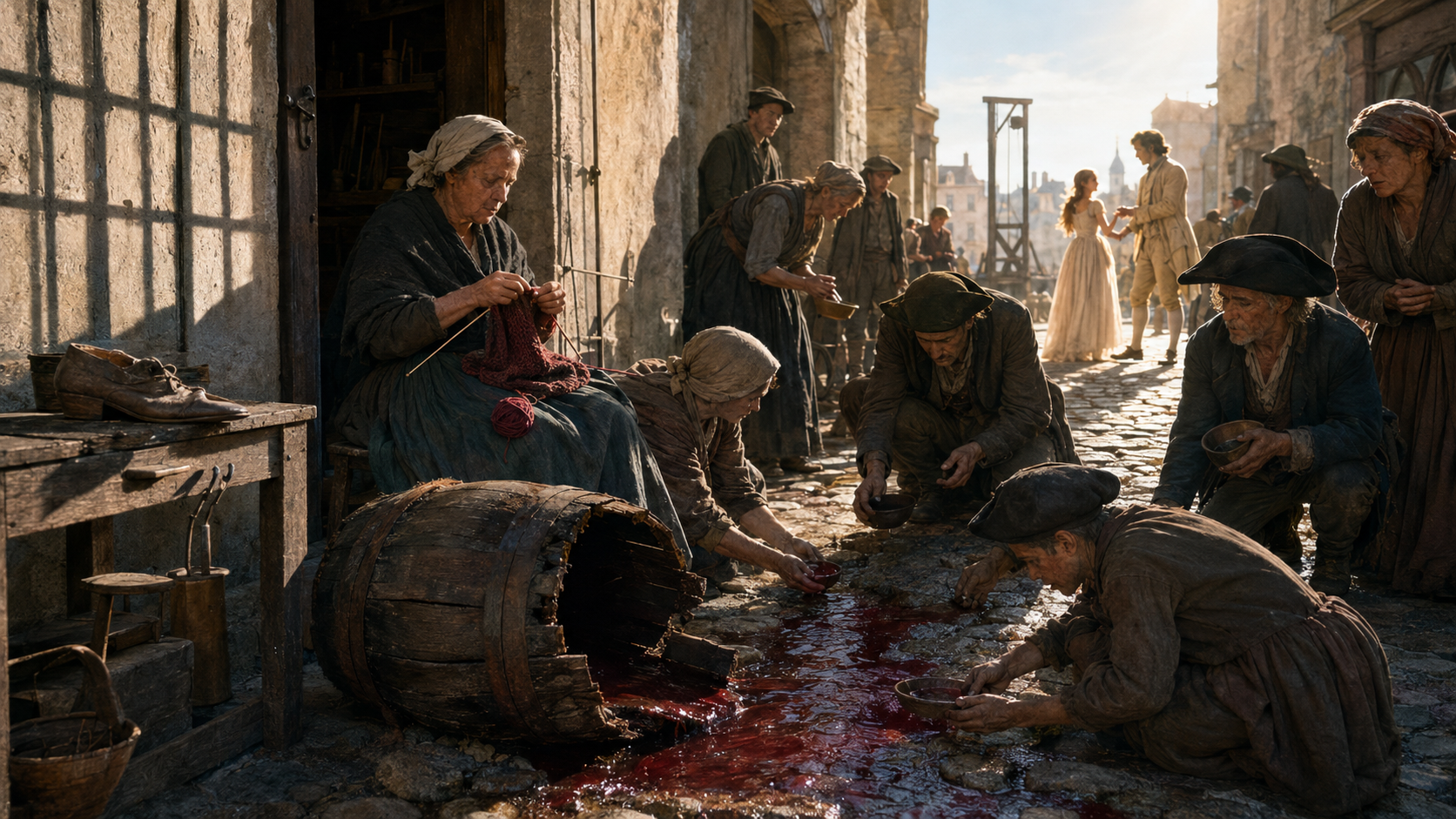
Early in the novel, a wine cask breaks in the street of Saint Antoine. Poor people rush to drink from the muddy ground. The scene is sad, messy, and tense.

The wine looks like blood. Dickens even shows someone writing the word blood on a wall. This moment points ahead to the bloodshed of the French Revolution.

The symbol matters because it links poverty with revenge. The people are not violent for no reason. They are starving, ignored, and pushed too far.

Like the green light in The Great Gatsby, the wine means more than it first seems to mean. It turns a simple object into a sign of desire and danger.

Light and darkness in the symbols in A Tale of Two Cities

Light often points to love, truth, and moral hope.

Dickens uses darkness to show fear, secrecy, and despair. Dr. Manette’s prison past is tied to dark rooms and hidden memories.

Lucie Manette is often linked with light. Her love helps bring her father back into the world after years in prison. She does not fix history, but she gives him a reason to live.

This symbol connects to the theme of **resurrection**. Light suggests that broken people can return to life, even after deep suffering.

The contrast also helps Dickens build mood. A dark street or prison cell makes the reader feel the danger before it reaches the characters.

Knitting as a symbol of revenge

Madame Defarge’s knitting turns a quiet act into a threat.

Knitting may seem harmless at first. In the novel, it becomes a record of names marked for death.

Madame Defarge uses her knitting to hide plans for revenge. This makes the symbol cold and frightening. It shows how hate can become patient and exact.

The symbol also connects to fate. Once a name enters her work, that person seems trapped. The image reminds readers of the Fates in Greek myth, who were tied to the thread of human life.

Here, Dickens shows a dark truth about justice. When justice becomes revenge, it can lose mercy.

La Guillotine and the symbol of public violence

The guillotine shows how a revolution can turn into a machine.

In the novel, La Guillotine is treated almost like a living force. Crowds gather around it. People watch death as if it were a show.

This symbol connects to the theme of mob power. The revolution begins with real anger against cruelty. Yet the guillotine shows how quickly a fight for justice can become cruel too.

Dickens does not excuse the old French nobility. He shows their pride and abuse. But he also warns that violence can spread until no one controls it.

For brief historical background on Dickens and his world, see Britannica’s biography of Charles Dickens.

Prison and chains as symbols in A Tale of Two Cities

Prison stands for both physical pain and mental trauma.

Dr. Manette spends years in the Bastille. Even after he is free, part of him remains trapped by fear and memory.

His shoemaking is a key sign of that trauma. When stress returns, he falls back into the habit he learned in prison. The past still has power over him.

This is one of the most human symbols in A Tale of Two Cities. It shows that freedom is not just about leaving a cell. A person also needs healing.

The Bastille itself becomes a symbol of unfair power. Its fall marks a political change, but Dickens asks whether people can escape cruelty without repeating it.

Resurrection as the central image of the novel

Resurrection means return, renewal, and moral rebirth.

The novel opens with the idea of being recalled to life. Dr. Manette is brought back from mental ruin. Charles Darnay is saved from death more than once.

Sydney Carton gives the deepest form of resurrection. He begins as a wasted man who sees little value in himself. By the end, he chooses a sacrifice that gives his life meaning.

This image connects to Christian ideas of selfless love. It also connects to a broader human hope: people can change.

The best symbols in A Tale of Two Cities work this way. They are not just clues. They help readers feel the novel’s moral struggle.

How to study symbols in A Tale of Two Cities for essays

A strong essay links each symbol to a theme and a scene.

Do not just say that wine stands for blood. Explain how the wine scene reveals hunger, anger, and the coming violence.

Try this simple pattern: name the symbol, describe where it appears, then explain what it shows about the novel’s message. Keep the focus on meaning.

For more help, review this step-by-step guide to finding symbolism. If you want extra practice, our literature study resources can help you build stronger notes.

Suggested books for deeper study

These books can help you understand Dickens, revolution, and literary symbols.

  • A Tale of Two Cities by Charles Dickens
  • Charles Dickens by Claire Tomalin

You can also explore the British Library’s Charles Dickens resources for helpful context.

FAQ about symbols in A Tale of Two Cities

Here are short answers to common student questions.

What are the main symbols in A Tale of Two Cities?

The main symbols include the broken wine cask, light and darkness, knitting, La Guillotine, prisons, and resurrection.

What does the wine symbolize in the novel?

The wine symbolizes hunger, blood, and the violence that will come with the French Revolution.

Why is knitting important in A Tale of Two Cities?

Knitting shows Madame Defarge’s revenge. It also suggests fate, since the names she records seem marked for death.

What does resurrection mean in the novel?

Resurrection means a return to life or purpose. Dr. Manette, Darnay, and Carton all connect to this idea.

How should I write about symbolism in an essay?

Choose one symbol, connect it to a clear theme, and use a specific scene as proof.

Key takeaway

The symbols in A Tale of Two Cities matter because they turn history into feeling. Dickens uses objects and images to show how suffering can lead to revenge, but also how love can lead to renewal.

Themes in A Tale of Two Cities: A Student-Friendly Guide

A Tale of Two Cities Themes

The themes in A Tale of Two Cities help students see why Dickens’s novel still matters. This guide explains the major ideas, conflicts, and meanings behind the story in clear language.

Charles Dickens writes about a world split by anger, fear, love, and hope. If you can track those ideas, the novel becomes much easier to understand.

In this Guide

  • Why theme matters in the novel
  • Sacrifice
  • Revolution
  • Justice and revenge
  • Resurrection
  • Class conflict
  • Family and loyalty
  • How to study the themes
  • FAQ
A Tale of Two Cities Themes

Why the themes in A Tale of Two Cities matter

Dickens uses theme to connect private lives with public violence.

A Tale of Two Cities is set in London and Paris during the time of the French Revolution. The story moves between homes, courts, prisons, and streets full of fear.

The themes in A Tale of Two Cities show how history affects real people. Dickens does not treat revolution as a simple event. He shows both the need for change and the danger of hatred.

Students often find the plot complex at first. Theme gives you a path through it. Once you notice repeated ideas like sacrifice, resurrection, and revenge, the novel becomes clearer.

Sacrifice and the themes in A Tale of Two Cities

Sacrifice is one of the novel’s most powerful ideas.

Sydney Carton is the clearest example. At first, he seems wasted and careless. He believes his life has little value.

By the end, Carton gives his life so Charles Darnay can live. His choice is not just brave. It gives meaning to a life he thought was ruined.

This theme links to a common idea in literature: a broken person can still act with grace. In Les Misérables, Jean Valjean also changes through mercy and self-giving love.

One of the key themes in A Tale of Two Cities is that sacrifice can restore hope. Dickens does not say sacrifice erases pain. He shows that it can create a future for others.

Revolution and the themes in A Tale of Two Cities

The novel asks when revolution becomes justice, and when it becomes cruelty.

Dickens does not ignore the suffering of the people with low income in France. The aristocracy has abused its power for years. The people have real reasons to be angry.

Yet the Revolution soon turns violent. The oppressed become willing to destroy anyone linked to the old system. The guillotine becomes a symbol of fear, not freedom.

This is why the themes in A Tale of Two Cities are not simple. Dickens supports justice, but he warns against mob rage. When people lose mercy, even a noble cause can become brutal.

For more historical background, Britannica’s overview of the French Revolution gives helpful context for the world of the novel.

Justice, revenge, and moral blindness

Dickens draws a sharp line between justice and revenge.

Justice seeks what is right. Revenge seeks payback no matter the cost. In the novel, that difference matters.

Madame Defarge has suffered deeply. Her anger comes from real trauma. But her desire for revenge grows so strong that she no longer sees people as individuals.

Charles Darnay becomes a target because of his family name. He rejects his family’s cruelty, but the Revolution still judges him by blood. That is moral blindness.

Among the themes in A Tale of Two Cities, this one is especially useful for essays. Dickens shows that pain can explain revenge, but it does not make revenge right.

From Idea to Novel Blueprint

Resurrection and new life

Resurrection means a return from death, despair, or spiritual loss.

Dr. Manette is “recalled to life” after years in prison. He is alive, but he has lost much of himself. Love helps him return to the world.

Sydney Carton also connects to resurrection. His final act gives him moral rebirth. He does not escape death, but he gains purpose.

The novel’s first book is even called “Recalled to Life.” That phrase prepares readers for one of the deepest themes in A Tale of Two Cities. People can be damaged, but they are not always beyond repair.

This idea also appears in A Christmas Carol, another Dickens work. Scrooge is not physically dead, but he needs a new moral life.

Class conflict and social inequality

The novel shows what can happen when a society treats the poor as disposable.

The French aristocrats live with comfort while common people starve. The Marquis St. Evrémonde is cold and cruel. He sees the poor as beneath him.

Dickens uses this conflict to show why revolution becomes possible. A society built on arrogance cannot stay stable forever.

Still, Dickens does not praise violence as the answer. He shows that class abuse creates rage, and rage can destroy the innocent with the guilty.

That balance makes the themes in A Tale of Two Cities rich for AP Literature and college essays. The book can criticize oppression while also warning against hatred.

Family, loyalty, and love

Love gives many characters the strength to survive.

Lucie Manette is often seen as gentle, but her role matters. Her love helps restore her father after prison. She becomes a source of peace in a violent world.

Charles Darnay shows loyalty by rejecting his family’s corrupt past. He tries to live by a better moral code, even when history catches up with him.

Carton’s love for Lucie also changes him. He does not win her in a romantic sense. Instead, his love leads him toward selfless action.

In this way, the themes in A Tale of Two Cities connect personal love to social hope. Dickens suggests that history may be cruel, but human love can still matter.

Fate, history, and personal choice

The novel asks whether people are trapped by history or free to choose.

Many characters seem caught in forces larger than themselves. The Revolution, family guilt, prison, and public anger shape their lives.

Yet Dickens also shows the power of choice. Darnay chooses to reject his family’s values. Carton chooses sacrifice. Lucie chooses care and loyalty.

This makes the novel more hopeful than it first appears. People cannot control history, but they can control their moral response to it.

For author background, see Britannica’s entry on Charles Dickens.

How to study the themes in A Tale of Two Cities

The best way to study theme is to connect ideas to characters, scenes, and symbols.

Start with a repeated idea. Then ask where it appears and how it changes. For example, resurrection appears with Dr. Manette early in the novel and with Carton near the end.

If you need a simple method, read our guide on how to identify theme in literature. It can help you turn notes into a clear thesis.

When you write about the themes in A Tale of Two Cities, avoid vague claims like “the theme is love.” Try a fuller claim: “Dickens shows that love can restore people who have been damaged by violence and loss.”

Books that pair well with A Tale of Two Cities

These books can help students compare similar ideas across literature.

  • Les Misérables by Victor Hugo
  • Great Expectations by Charles Dickens
  • Animal Farm by George Orwell

Each book explores power, justice, and moral choice in a different way. They are useful for comparison essays and class discussion.

FAQ about themes in A Tale of Two Cities

What is the main theme of A Tale of Two Cities?

The main theme is sacrifice. Sydney Carton’s final choice shows how love and selflessness can give life meaning.

What does resurrection mean in the novel?

Resurrection means return or renewal. Dr. Manette returns from prison, while Carton finds moral renewal through sacrifice.

How does Dickens show the danger of revenge?

He shows revenge through Madame Defarge and the Revolution’s violence. Revenge turns justice into cruelty when mercy disappears.

Why is class conflict important?

Class conflict explains why the Revolution begins. Dickens shows that a society with deep injustice can create deep anger.

Is A Tale of Two Cities against revolution?

Not exactly. Dickens understands why people revolt, but he warns that revolution without mercy can become another form of tyranny.

Key takeaway

The themes in A Tale of Two Cities show a world shaped by injustice, but not defeated by it. Dickens argues that sacrifice, mercy, and love can still create hope in violent times.

error

Enjoy this article? Please spread the word :)

Follow by Email
BLUESKY
fb-share-icon
Reddit
LinkedIn
Share
RSS