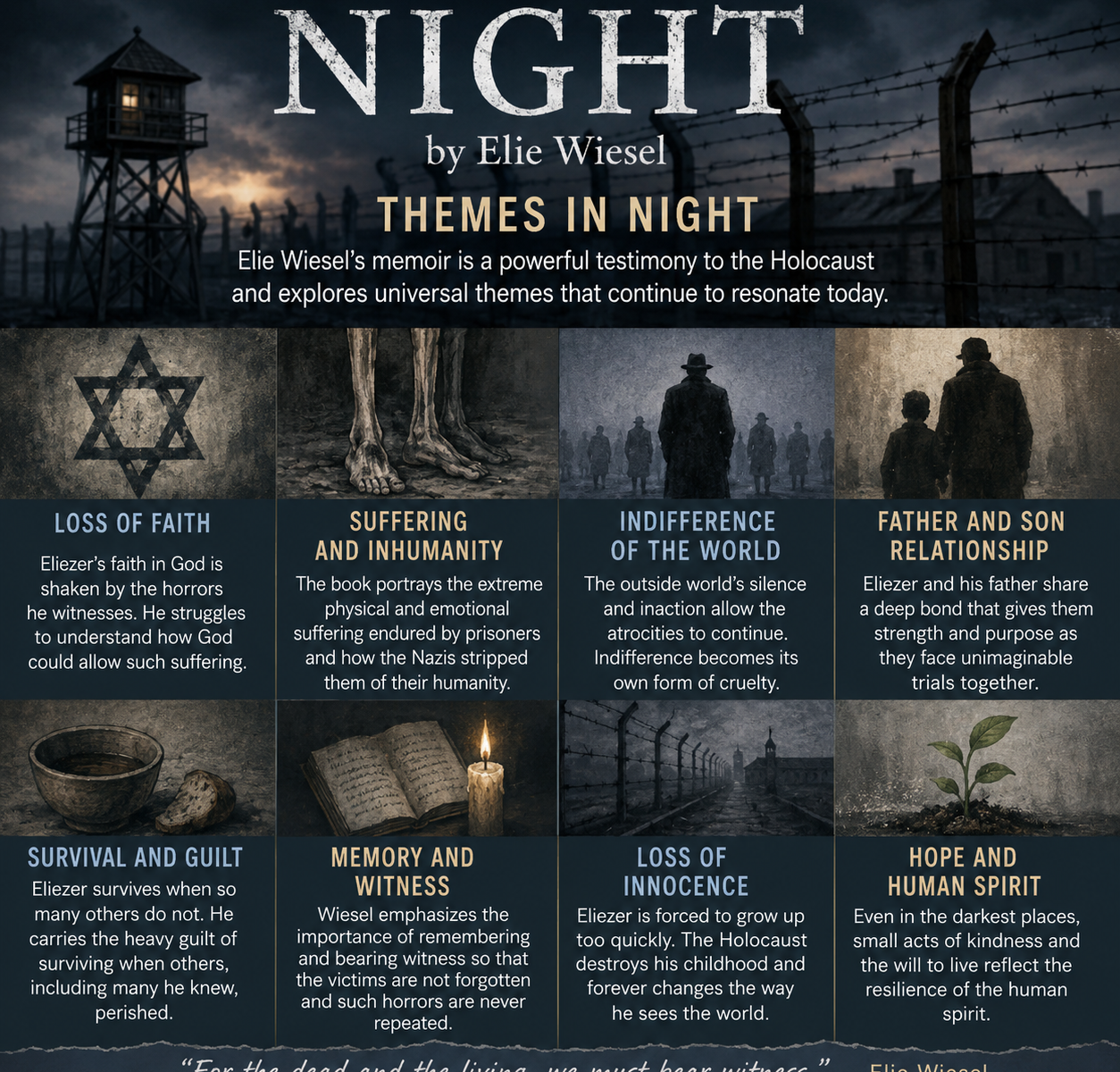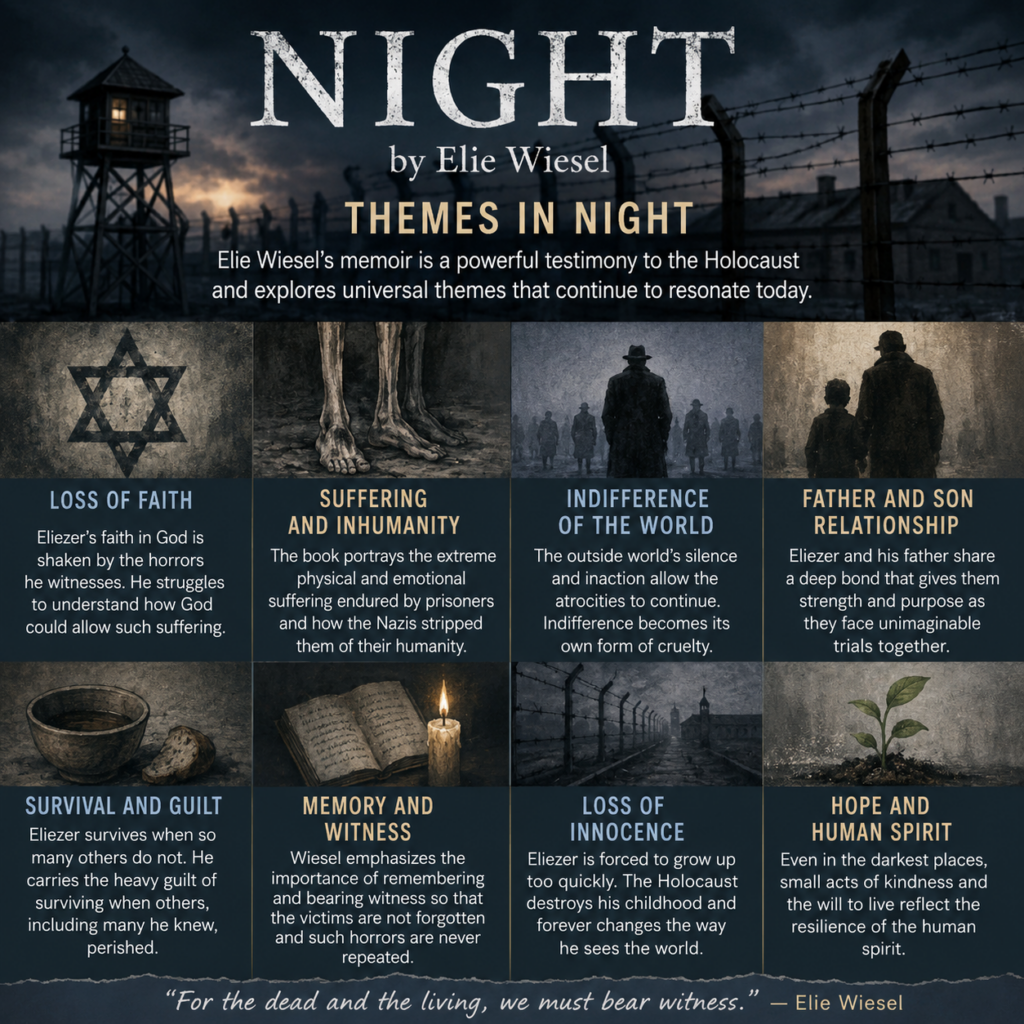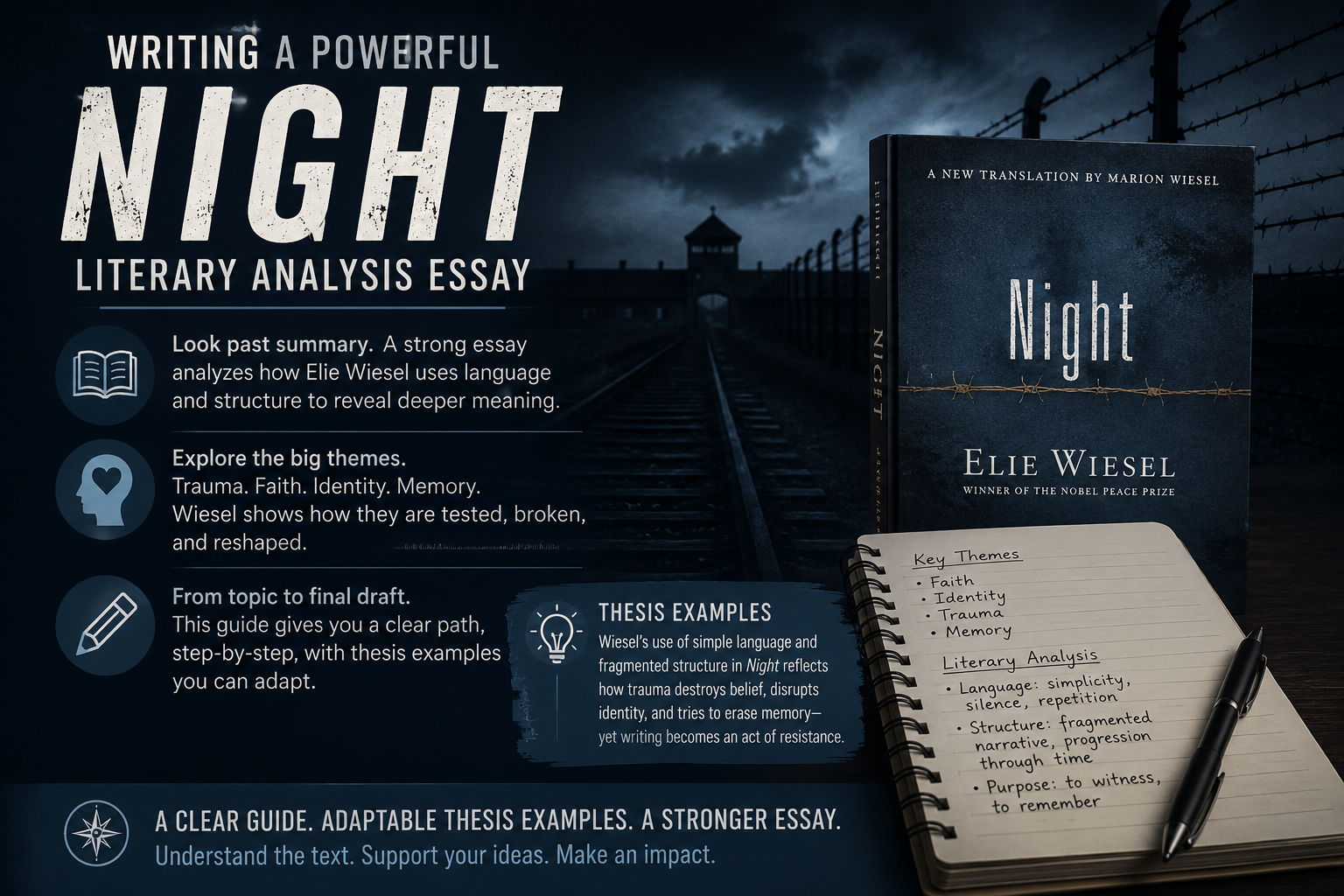
Writing about Elie Wiesel’s Night can feel hard because the book is brief but emotionally heavy. A strong Night literary analysis essay looks past summary and asks how Wiesel uses language and structure to show what trauma does to faith, identity, and memory.
This guide gives you a clear path from topic choice to final draft, with thesis examples you can adapt for your own essay.
In this Guide
- What a literary analysis essay on Night should do
- How to choose a focused topic
- Strong thesis statement examples
- Essay structure that works
- Evidence ideas from the text
- Common mistakes to avoid
- Helpful books and research links
- Quick FAQ for students
What a Night literary analysis essay should do
Your essay should explain how the book works, not just what happens in it.
A Night literary analysis essay should make an argument about Wiesel’s choices as a writer. You might study his spare style, his use of silence, his changing view of faith, or his focus on father-son bonds.
Summary can help for a sentence or two, but it should never take over. Your reader likely knows that Elie is taken to Auschwitz, loses his sense of safety, and faces deep spiritual pain. Your job is to explain why those events matter and how Wiesel makes the reader feel their weight.
Think of it like writing about Macbeth. You would not only say that Macbeth becomes king. You would explain how Shakespeare uses guilt, prophecy, and darkness to show moral collapse. With Night, you do the same kind of close reading.
If you need a broader refresher, start with our guide on how to write a literary analysis essay, then return to this book-specific plan.
How to choose a Night literary analysis essay topic
A good topic should be narrow enough to prove in a few pages.
Many students choose topics that are too large, such as suffering in Night. That idea matters, but it is too broad. A better topic asks how one part of the book reveals that suffering.
For a Night literary analysis essay, try a topic that centers on one pattern. A pattern might be repeated images of night, moments of silence, changes in prayer, or scenes between Elie and his father.
Here are focused topic ideas:
- How Wiesel uses night as a symbol of lost faith
- How silence shows trauma and fear
- How Elie’s bond with his father shapes his will to survive
- How short sentences reflect shock
- How Wiesel presents memory as a form of witness
Each topic gives you room to analyze. Each one also points you toward specific passages, which makes the essay easier to build.
Thesis statement examples for a Night literary analysis essay
Your thesis should make a claim that someone could discuss, question, or prove with evidence.
Your Night literary analysis essay needs more than a true statement. The sentence Elie suffers in the camps is true, but it is not a strong thesis. It tells what happens, not what the book means.
A stronger thesis explains how Wiesel creates meaning. Notice how each example below names a literary choice and connects it to a larger idea.
- In Night, Wiesel uses repeated images of darkness to show how the Holocaust destroys Elie’s sense of God’s presence.
- Wiesel’s plain, direct style makes the violence in Night feel more painful because the narrator refuses to soften what he remembers.
- Through Elie’s changing relationship with his father, Night shows that love can survive in brutal conditions, but it also becomes marked by guilt.
- Wiesel uses silence as a symbol of spiritual crisis, showing that unanswered prayer can feel like abandonment.
- By framing memory as testimony, Wiesel turns personal trauma into a warning for later generations.
You can use these as models, but do not copy them word for word if your teacher expects original work. Change the focus to match the passages you plan to discuss.
How to structure your Night literary analysis essay
A simple structure helps your ideas stay clear.
A clear Night literary analysis essay usually starts with a brief introduction. Name the author and book, give a little context, and end with your thesis. Keep the plot summary short.
Your body paragraphs should each prove one part of the thesis. Start with a topic sentence, use a short piece of evidence, then explain how that evidence supports your claim.
Here is a strong body paragraph pattern:
- Make one clear point.
- Introduce the scene or passage.
- Use a brief quote or detail.
- Analyze the language.
- Connect back to the thesis.
The analysis step matters most. Do not drop in a quote and move on. Explain word choice, tone, symbol, or contrast. Show your reader how the passage works.
If you want help turning notes into a full draft, the Literary Analysis Essay Toolkit gives you thesis frames, paragraph builders, and revision checklists made for students.
Evidence to use in a Night literary analysis essay
Strong evidence comes from moments where Wiesel’s style and meaning meet.
When you choose evidence for a Night literary analysis essay, look for short passages that reveal change. Elie’s loss of faith, his fear for his father, and his shock at human cruelty all offer rich material.
Good evidence choices may include:
- The first description of night and darkness
- Scenes where prayer changes or stops
- Moments when silence replaces comfort
- Images of fire, smoke, or ash
- Scenes that show Elie’s guilt about his father
- The final image of Elie’s reflection
You do not need long quotes. A few words can be enough if you explain them well. In fact, short quotes often lead to better analysis because you can focus on exact language.
For historical background, use trusted sources. The Britannica biography of Elie Wiesel gives helpful context about his life. The United States Holocaust Memorial Museum page on Auschwitz can help you understand the setting with care.
Common mistakes in a Night literary analysis essay
Most weak essays have good ideas, but they lose focus.
The first mistake is writing a plot summary. If most of your paragraph retells events, pause and ask what the passage reveals about theme or style.
The second mistake is treating Night only as history. The history is real and vital, but your assignment asks for literary analysis. Study how Wiesel shapes memory through symbols, tone, and structure.
Another mistake is making claims that feel too broad. A sentence like Night shows that life is hard is not specific enough. A stronger claim would connect life under extreme violence to faith, family, or identity.
Be careful with tone. This book deals with genocide and trauma. Avoid casual language, jokes, or dramatic claims that overstate what the text says.
Suggested books for deeper study
These books can help you understand Night and Wiesel’s role as a witness.
- Night by Elie Wiesel
- All Rivers Run to the Sea by Elie Wiesel
If your teacher allows outside sources, use them to build context. Your main evidence should still come from Night itself.
FAQ about writing a Night literary analysis essay
These quick answers solve the questions students ask most.
What is a good thesis for a Night literary analysis essay?
A good thesis connects a literary device to a theme. For example, you could argue that Wiesel uses darkness to show Elie’s loss of faith.
Can I write about historical context?
Yes, but keep the essay focused on literature. Use history to support your reading, not to replace close analysis.
How many quotes should I use?
Use enough evidence to prove your point. Most body paragraphs need one short quote or one clear textual detail.
Should I write in first person?
Most teachers prefer formal academic style. Unless your teacher says yes, avoid phrases like I think or I believe.
Key Takeaway
Before you turn in your Night literary analysis essay, check that every paragraph proves your thesis through Wiesel’s language and choices. The best essays honor the book’s seriousness while making a clear, focused argument.