

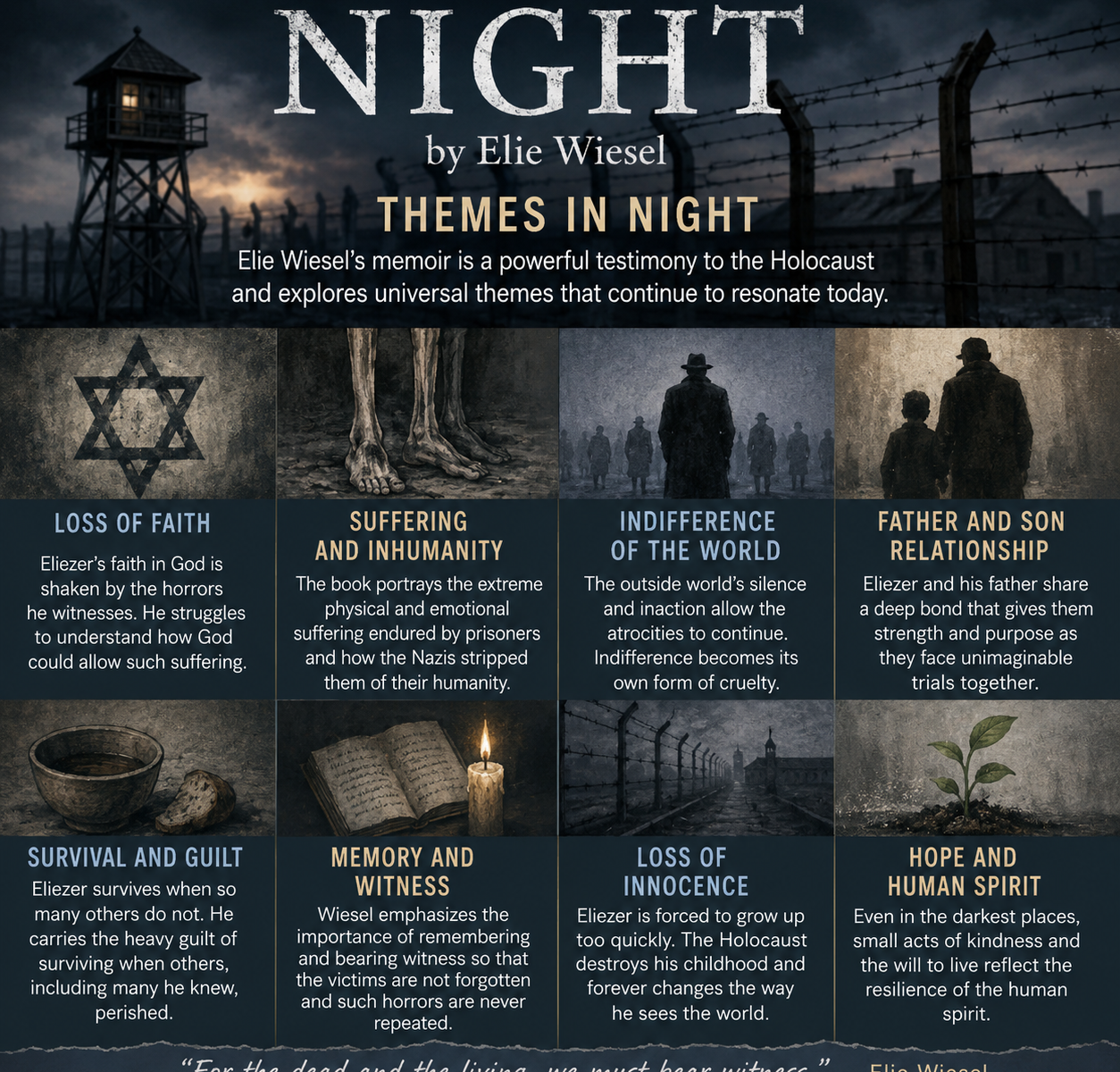
Elie Wiesel’s Night is a short memoir, but its ideas are deep and hard to forget. The themes in Night help students understand how the book explores faith, cruelty, silence, memory, and survival during the Holocaust.
This guide explains the major ideas in clear terms so you can use them in class talks, essays, and exams.
In this Guide
- Why the themes in Night matter
- Faith and doubt
- Dehumanization and identity
- Silence and responsibility
- Memory and witness
- How to write about theme
- FAQ
Why the themes in Night matter
The memoir is not just about what happened to Elie Wiesel. It asks what happens to a person’s beliefs, family bonds, and sense of self under extreme evil.
The themes in Night matter because they show how history affects real human lives. Wiesel does not let readers stay distant from the suffering he describes.
Before you write about theme, remember this key point: the book is a memoir, not a made-up story. Its themes come from lived experience.
If you need a quick review of the basic idea of theme, this guide to how to identify theme in literature can help.
Themes in Night: Faith and Doubt
Wiesel shows faith as something that can be tested, wounded, and changed.
At the start, Elie has a deep interest in religion. He studies Jewish texts and wants to understand God in a serious way.
After he enters the camps, his faith faces horror that seems impossible to explain. He sees children suffer. He sees people pray while death surrounds them.
This is one of the most painful themes in Night because Wiesel does not give an easy answer. He shows how suffering can make someone question the beliefs that once gave life meaning.
A useful comparison is Job from the Bible. Job also suffers and questions God, but Wiesel’s world feels even more broken because the evil is made by humans.
For essays, avoid saying Elie simply loses faith. A stronger claim is that his faith changes into anger, doubt, and silence.
Themes in Night: Dehumanization and Identity
The camps try to strip people of names, dignity, and personal worth.
One of the clearest themes in Night is dehumanization. Prisoners are shaved, numbered, starved, beaten, and forced to live in fear.
This matters because Wiesel shows that genocide does not begin with murder alone. It begins when people are treated as less than human.
Elie’s identity changes as the camps take away parts of his former life. He is no longer just a son, student, or believer. He becomes a prisoner who must fight to stay alive.
This theme connects to other Holocaust texts, such as The Diary of a Young Girl by Anne Frank. Both works show how hatred targets identity, but Wiesel shows the inside of the camp system with direct force.
When you write about this theme, focus on how language and treatment change the prisoners. A number replaces a name. Hunger replaces normal thought. Fear replaces daily life.
Family, Survival, and Moral Conflict
Wiesel shows how extreme suffering can strain even the strongest family bond.
Elie and his father depend on each other. Their relationship helps both of them survive for much of the memoir.
Yet the camps create terrible moral pressure. Elie sometimes feels fear, guilt, and frustration as he tries to care for his father while he is also weak.
This theme is hard because it does not judge Elie in a simple way. Instead, it shows how evil systems can force people into choices no one should have to face.
A similar idea appears in King Lear, where family love is tested by power and suffering. In Night, the test is not pride or politics. It is hunger, terror, and death.
Themes in Night: Silence and Responsibility
Silence in the memoir can mean fear, failure, or unanswered pain.
Among the themes in Night, silence is one of the most important. Many people outside the camps do not act in time. Some witnesses turn away. God also seems silent to Elie during the worst moments.
Wiesel uses this silence to ask a serious question: what do people owe each other when evil becomes visible?
The memoir suggests that silence can protect the guilty when innocent people need help. This is why Wiesel later became known as a voice for human rights and memory.
For historical background, students can read the United States Holocaust Memorial Museum page on Elie Wiesel.
Themes in Night: Memory and Witness
Wiesel writes so the dead are not erased by time.
Memory is one of the central themes in Night because the memoir itself is an act of witness. Wiesel tells what he saw so readers cannot claim ignorance.
This does not mean the book only records facts. It also shows how memory carries pain. The past remains alive in the mind of the survivor.
Many works of literature use memory to fight loss. In Beloved by Toni Morrison, memory also forces readers to face violence that society may want to forget.
In Night, memory has a moral purpose. To remember is to honor victims and warn the living.
Loss of Innocence in Night
Elie’s view of the world changes because he sees what humans can do to each other.
At first, Elie is young, curious, and devoted to study. He trusts religious learning and family life.
By the end, his childhood has been destroyed. The famous mirror scene shows a person who has survived but has been deeply changed.
Loss of innocence is not only about growing older. In this memoir, it means being forced to see cruelty before the mind is ready.
How to write about themes in Night
A strong theme statement should say more than one word.
Do not write, “The theme is faith.” That is a topic. Write a full idea, such as, “Wiesel shows that extreme suffering can turn faith into doubt, anger, and silence.”
Use short evidence. Then explain how the evidence proves your point.
Here is a simple pattern: name the theme, connect it to a key moment, and explain what Wiesel wants readers to understand.
Helpful books to read with Night
These books can help students build context and compare ideas:
- The Diary of a Young Girl by Anne Frank
- Man’s Search for Meaning by Viktor E. Frankl
These works are different from Night, but they also deal with suffering, memory, and the human search for meaning.
FAQ about themes in Night
What are the main themes in Night?
The main themes in Night include faith and doubt, dehumanization, family bonds, silence, memory, and loss of innocence.
Is Night a novel or a memoir?
Night is a memoir. It is based on Elie Wiesel’s own experience during the Holocaust.
What is the most important theme in Night?
Many students choose faith and doubt because Elie’s relationship with God changes so much. Dehumanization is also central to the book.
How do I find evidence for a theme?
Look for repeated moments, changes in Elie’s thoughts, and scenes that show conflict. Then explain what those moments reveal.
Key Takeaway
The themes in Night show how cruelty attacks faith, identity, family, and memory. Wiesel’s memoir asks readers not only to understand the past, but to carry its warning forward.


Get the Free Close Reading Worksheet Pack
Join my email list and receive the printable worksheet pack you can use with any novel or poem.
No spam. Just helpful guides for reading literature well.












