

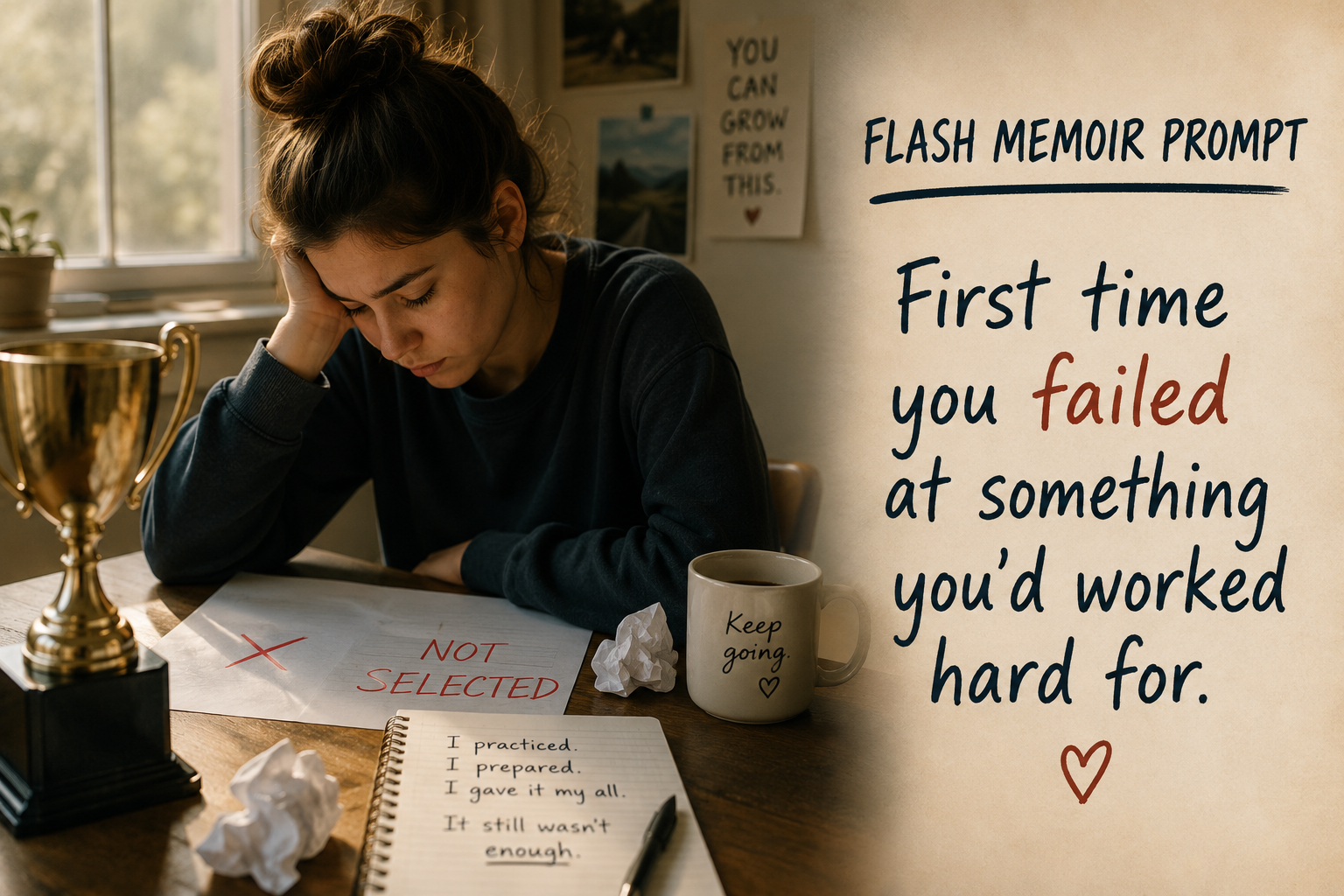
A focused flash memoir prompt first time failed at something can help you return to the exact moment when effort met disappointment, and when a younger version of you had to decide what to do next.
Maybe you still remember the room before you remember the failure. The squeak of a gym floor. The smell of pencil shavings during an exam. The heavy silence after an audition, a game, a race, a contest, or a project you wanted badly.
Failure can feel too large to write about, especially when you worked hard for the thing you did not get. But a flash memoir does not need the whole history. It only needs one clear moment when hope shifted into something else.

The Prompt
Write about the first time you failed at something you’d worked hard for.
This prompt works because it asks you to remember effort, not just outcome. The story is not only about losing, missing, falling short, or being told no. It is about the hours before that moment. It is about the version of you who believed effort would protect you from disappointment.
A flash memoir prompt first time failed at something can uncover a memory that still has energy in it. You may remember who was there, what you expected, and how your body reacted when you realized things had gone wrong.
Why This Memory Matters
The first serious failure often changes how we understand fairness. Before it happens, we may believe hard work always leads to the result we want. After it happens, we learn something more complicated.
That does not mean the story has to end with a big lesson. In fact, it may be stronger if it stays close to the scene. Maybe you remember stuffing a rejected application into your backpack. Maybe you remember smiling so no one would ask if you were upset. Maybe you remember your parent saying the wrong thing in the car because neither of you knew what else to say.
These small details carry the emotional truth. They show the reader what the moment felt like without forcing a moral onto it.
If you are trying to understand the deeper meaning of this memory, you might find it helpful to think about theme. This guide on how to identify theme in literature can also help memoir writers notice the ideas hiding inside a personal story.
Your memory may be about shame, pride, pressure, family expectation, resilience, or the pain of wanting something in public. Let the scene show you which one matters most.
How to Approach This Prompt
Begin with one physical detail from the moment you knew you had failed. Do not start with your whole life story. Start with the trophy table you did not reach, the computer screen with the score, the teacher’s red pen, or the phone call that ended too fast.
Then narrow the memory to one scene. You might choose the minute before the result, the moment you found out, or the ride home afterward. A flash memoir works best when it holds the camera steady.
Try to write what you noticed before you explain what it meant. If your hands shook, write that. If the room felt too bright, write that. If someone near you celebrated while you stood still, write that too.
You do not have to make yourself look wise. You can let yourself be young, hurt, angry, embarrassed, or confused. That honesty is often what makes the piece feel alive.
If you like marking up memories the way students mark up texts, you can borrow a few ideas from how to annotate literature. Circle the strongest image in your draft. Underline the sentence that feels most true. Build the rest of the piece around those clues.
For this flash memoir prompt first time failed at something, avoid covering every practice, every hope, and every later success. Stay with the first crack in the plan. That is where the story lives.
A Quick Example
The envelope was thinner than I expected. I knew that before I opened it. All week, I had imagined a thick packet with forms to sign and a letter that began with “Congratulations.” I had practiced my audition song until my throat felt raw. I had even stopped drinking soda because I thought serious singers probably made serious choices. In the kitchen, my mother watched me slide one finger under the flap. The paper inside made a soft scraping sound. “Thank you for auditioning,” it said. I read the first line three times. My mother asked if I was okay, and I nodded because crying felt like one more thing I might do badly. Outside, the neighbor’s dog barked and barked, as if it had already heard the news.
Try It Yourself
Set a timer for ten minutes and write about the first time you failed at something you had worked hard for. Choose one scene and stay there. Let the memory be awkward if it was awkward. Let it be unfair if it felt unfair.
You can begin with this sentence: “I knew I had failed when…” Then follow the memory into the room, the field, the hallway, the stage, or the kitchen where it happened.
When you finish, read your draft once and look for the most honest sentence. That sentence may be quiet. It may not explain everything. Keep it anyway. It might be the center of the piece.
This flash memoir prompt first time failed at something is not asking you to prove that failure made you stronger. It is asking you to remember what it cost to care that much.
Want More Flash Memoir Prompts?
If this prompt opened a memory you did not expect, keep writing. Short prompts can help you build a steady memoir practice one small scene at a time. Explore all 365 prompts in The Memory Trigger: 365 Flash Memoir Writing Prompts.


Get the Free Close Reading Worksheet Pack
Join my email list and receive the printable worksheet pack you can use with any novel or poem.
No spam. Just helpful guides for reading literature well.












