Flash Memoir Prompt: First Time You Were in a Place Where You Didn’t Speak the Language

Rapid Reads Press

A warm, specific flash memoir prompt for remembering the first time you stood in a place where every word around you felt locked, and one small moment told the truth. If you came looking for a flash memoir prompt first time place where didn’t speak the language, begin with the instant your face got hot and your hands had to do the talking.

The Prompt

Write about the first time you were in a place where you didn’t speak the language.

This prompt works because it drops you into a clear scene right away. You may remember an airport, a train station, a classroom, a market, or a family dinner where everyone laughed and you were still trying to catch up.

Language is more than words. It is tone, gesture, speed, facial expression, and the strange little pause before you admit you do not understand. That pause can carry a whole story.

This flash memoir prompt asks you to find the moment when you felt outside the circle. Maybe you felt brave. Maybe you felt foolish. Maybe you felt lonely for five minutes, then helped by a stranger who pointed, smiled, or wrote a number on the back of a receipt.

Why This Memory Matters

The first time you are surrounded by a language you do not know, you notice things you might ignore at home. You watch mouths. You study signs. You guess from body language. A simple question, like asking where the bathroom is, can become an adventure.

That kind of memory can reveal how you handle uncertainty. Do you freeze? Do you laugh? Do you pretend to understand? Do you become very polite, very quiet, or very determined?

It can also uncover a story about dependence. Many of us like to feel capable. Then suddenly we need help ordering soup, buying a bus ticket, or finding a gate number. That shift can be humbling, and it can make a small kindness feel huge.

This is also a prompt about sound. The language around you may have felt musical, sharp, fast, soft, or impossible to separate into words. The signs may have looked like art at first. If you enjoy thinking about how unfamiliar words affect meaning, you might like this guide on how to understand Shakespearean language, since it explores how we make sense of language that first feels distant.

In a memoir piece, the event does not have to be dramatic. You do not need to write about getting lost for hours. The best memory might be the minute you pointed at a pastry in a glass case and hoped you had not chosen something filled with fish.

How to Approach This Prompt

Start with a physical detail. Do not begin by explaining the whole trip or naming every reason you were there. Begin with the menu you could not read, the ticket machine that blinked at you, the clerk who repeated the same sentence twice, or your own nervous smile reflected in a window.

Keep the memory to one scene. A strong flash memoir piece often happens in a small space. Pick the counter, the bus stop, the hotel desk, the kitchen table, or the street corner. Let the reader stand there with you.

Write what you noticed before you explain what it meant. For example, instead of starting with, “I felt helpless,” show us the blue sign, the crowded platform, and the way everyone else seemed to know where to go. Let the feeling rise from the details.

Then ask yourself one quiet question: What did I learn about myself in that moment? You might have learned that you were more stubborn than you thought. You might have learned that embarrassment fades when someone is kind. You might have learned that being silent can make you pay closer attention.

Try to avoid turning the piece into a travel report. You are not writing about every city, meal, or landmark. You are writing about one moment when language failed and something else had to take over.

Objects can help, too. A phrasebook, a phone screen, a paper map, or a handwritten note can hold meaning inside the scene. If you want to practice reading deeper meaning in ordinary details, this post on how to find symbolism in a story can help you see how small objects carry emotional weight.

A Quick Example

The first time I couldn’t speak the language, I was standing in a bakery in Lisbon with six people behind me and no idea how to ask for coffee. The woman at the counter waited with one hand on the register. I pointed at a round pastry because it was the only brave thing I could think to do. She said something I didn’t understand, and my face went hot. Then she held up one finger, raised her eyebrows, and I nodded like she had saved me from drowning. When she slid the plate across the counter, she added a tiny cup of coffee anyway. I sat near the window, embarrassed and grateful, eating slowly because every bite felt like a small apology.

Try It Yourself

Set a timer for ten minutes and write one scene from this memory. Begin with the place, then move straight to the problem. What did you need? Who was nearby? What sound or sign made you realize you were no longer in familiar territory?

Do not worry about perfect sentences at first. Let the memory arrive in pieces. You can clean it up later.

If you get stuck, write this sentence and keep going: “I realized I didn’t know how to say…” That line can open the door fast. It puts you back inside the body of the memory, where the best details often wait.

This flash memoir prompt first time place where didn’t speak the language is really an invitation to remember a moment of being human. We all reach points where we need help, patience, or a little courage. Write the scene honestly, and let it stay small enough to feel true.

Want More Flash Memoir Prompts?

If this prompt helped you find a vivid memory, keep going with short daily practice. Explore all 365 prompts in The Memory Trigger: 365 Flash Memoir Writing Prompts.
Flash Memoir Prompt: First Time You Made a Decision that You Knew Your Family Wouldn’t Understand

flash memoir prompt decision

A quiet flash memoir prompt for the first time you made a decision you knew your family would not understand, told through one brave moment, one clear scene, and the truth you could not explain yet.

Maybe you remember the room before you remember the words. The kitchen light felt too bright. Your phone sat heavy in your hand. Someone in your family was asking what you had decided, and you already knew your answer would sound wrong to them.

This flash memoir prompt first time made decision knew you would be misunderstood is about that tense little space between loyalty and self-trust. It asks you to write about the moment when you chose something that made sense to you, even if it made no sense to the people who loved you.

flash memoir prompt decision

The Prompt

Write about the first time you made a decision that you knew your family wouldn’t understand.

This prompt can open a powerful memory because it holds conflict right away. There is a choice. There is a family. There is a gap between what others expect and what you know you need.

You do not have to write about a dramatic fight or a life-changing announcement. The most honest version may live in a small scene. Maybe you chose a college far from home. Maybe you quit something everyone praised you for. Maybe you kept a relationship private, changed your plans, refused a tradition, or said no when everyone expected yes.

The heart of this prompt is not whether your family was right or wrong. The heart is the first time you felt the cost of having your own mind.

Why This Memory Matters

Family can shape our first ideas about safety, success, duty, and love. When you make a decision your family will not understand, you may feel guilt before anyone even says a word.

That feeling is worth writing about. It shows the reader who you were at the moment you began to separate your own voice from the voices around you.

This kind of memory may uncover a story about independence. It may also reveal fear, tenderness, or regret. You might find that your family’s reaction was less harsh than you expected. You might find that their silence hurt more than shouting.

In flash memoir, the power often comes from staying close to one moment. Instead of explaining your whole family history, you can show your father clearing his throat, your sister staring at the table, or your mother folding the same dish towel twice.

Those small actions can carry the weight of the scene. If you enjoy studying how people reveal themselves through action, you may also like this guide on how to analyze characters in literature. The same skill can help memoir writers notice what people say without saying it directly.

How to Approach This Prompt

For this flash memoir prompt first time made decision knew others would question, begin with a physical detail. Do not start by explaining the entire decision. Start with the thing your body remembers.

What did your hands do? Where were you sitting? Was there food on the table? Was the room quiet, messy, hot, cold, crowded, or strange?

Then narrow the memory to one scene. Choose the moment before you told them, the moment after, or the moment when you decided not to explain yourself anymore.

Try this opening move: “I knew they would not understand when…” Then finish the sentence with a concrete image instead of an abstract feeling.

For example:

“I knew they would not understand when I saw my mother place the nursing school brochure beside my untouched plate.”

That kind of sentence gives the reader a scene. It also gives you a doorway into the memory.

Write what you noticed before you explain what it meant. Let the scene breathe a little. If you jump too quickly to the lesson, you may miss the emotional texture of the moment.

Also, avoid trying to tell the whole story at once. You do not need to explain every family argument, every expectation, or every reason behind your choice. Flash memoir works best when one moment stands in for something larger.

If you want a simple structure, try this:

Start with the scene. Show the decision. End with what you could not say out loud at the time.

That is enough for a strong first draft.

A Quick Example

I knew they would not understand when my uncle laughed and said, “Art school?” like I had told him I planned to live on the moon. We were in my grandmother’s dining room, and the plastic cover on the table stuck to my wrist. Everyone had been talking about my cousin’s new job at the hospital. Then my mother asked if I had sent in my scholarship forms. I said yes, but not for nursing. The room went quiet in a way that felt practiced. My father looked down at his plate. I wanted to explain that drawing was the only place I felt awake, but the words sounded childish in my head. So I just said, “I already mailed it.” My voice shook, but I did not take it back.

Try It Yourself

Set a timer for ten minutes and write the scene as if you are back inside it. Do not worry about making the decision look wise. Do not try to defend yourself on the page.

Focus on what happened in the room, car, hallway, or phone call. Let the reader feel the pressure before you name it.

If the memory still feels charged, write around the edges first. Describe the weather that day. Describe what you wore. Describe the object closest to you. Often, the truth enters through the side door.

When you revise, look for one sentence that feels especially honest. It may be quiet. It may be uncomfortable. Keep that sentence and build the piece around it.

This flash memoir prompt first time made decision knew your family would not understand is not asking you to judge your family or prove you were right. It is asking you to remember the first time you heard your own inner voice and chose to follow it anyway.

Want More Flash Memoir Prompts?

If this prompt helped you find a memory with tension and heart, keep going. A daily prompt can give you a small, steady way to build scenes from your life without having to tell everything at once.

Explore all 365 prompts in The Memory Trigger: 365 Flash Memoir Writing Prompts.

Flash Memoir Prompt: First Time You Wore Something that Made You Feel Like a Different Version of Yourself

Flash memoir prompt clothes

A warm writing invitation about the first time clothing changed how you stood, moved, or saw yourself in the mirror.

You may still remember the weight of it: a borrowed jacket, a stiff uniform, a dress that felt too grown-up, a pair of shoes that made noise on the floor. Maybe you caught your reflection and paused. For one second, you were still yourself, but also someone new.

This flash memoir prompt first time wore something made you feel different is about more than fashion. It is about identity, courage, disguise, belonging, and the strange power of fabric to tell us who we are allowed to become.

Flash memoir prompt clothes

The Prompt

Write about the first time you wore something that made you feel like a different version of yourself.

This prompt can unlock a clear and powerful memory because clothing is physical. You can describe how it felt on your skin, how it fit, how others looked at you, and what changed inside you when you put it on.

You do not have to write about a dramatic outfit. The memory might be small: a hand-me-down coat, a sports jersey, a graduation robe, makeup for the first time, a tie for a funeral, or a uniform for your first job. The meaning often lives in the small details.

Why This Memory Matters

Clothes can make us feel visible, hidden, older, braver, awkward, proud, or trapped. A simple shirt can carry a whole story.

Maybe the outfit helped you act like the person you wanted to become. Maybe it made you feel like you were pretending. Maybe someone else chose it for you, and the memory still holds anger or shame. Maybe you wore it because you needed to fit in, even if it did not feel like you.

This flash memoir prompt first time wore something made you feel like a different person can reveal a turning point. It asks: Who were you before you put it on? Who did you become after? Even if the change lasted only one afternoon, that moment may still matter.

For student writers, this is also a useful way to practice finding a theme in a personal story. If you want help thinking about deeper meaning, you might enjoy this guide on how to identify theme in literature. The same skill can help when you read your own memories closely.

How to Approach This Prompt

Begin with one physical detail. Do not start by explaining your whole life or telling the reader what the outfit meant. Start with the zipper that stuck, the tag scratching your neck, the sleeves hanging past your wrists, or the click of heels on tile.

Then narrow the memory to one scene. Where were you? A bedroom, school hallway, church bathroom, locker room, store dressing room, or front porch? Keep the camera close.

Write what you noticed before you explain what it meant. If people stared, describe that. If no one noticed, describe that too. Sometimes the private change matters more than the public reaction.

You might ask yourself these questions before you draft:

  • Who chose the clothing?
  • Did you want to wear it?
  • What did you think when you saw yourself?
  • How did your body move differently?
  • What did the outfit make possible?

If you are using this as classroom writing practice, you can also annotate your own draft the way you would annotate a story. Mark the sensory details, emotional shift, and strongest sentence. This simple guide to how to annotate literature can help you practice noticing what a piece of writing is doing.

Avoid trying to tell every clothing memory you have. Choose the one moment where something changed. Flash memoir works best when it feels small on the outside and large on the inside.

A Quick Example

The first time I wore my dad’s old leather jacket, I was sixteen and trying to look like I had somewhere to go. The jacket smelled like cold air, motor oil, and the peppermint gum he kept in his truck. It was too wide in the shoulders, so I pulled my hands into the sleeves and pretended that was the style. When I walked into school, nobody said anything. That disappointed me more than I wanted to admit. But in the bathroom mirror, under the buzzing light, I saw a version of myself who looked less afraid. I stood up straighter. I fixed my hair. For the rest of the day, I kept one hand in the pocket, holding onto the torn lining like proof.

Try It Yourself

Set a timer for ten minutes. Write the scene as if you are back in the room where you first put the item on. Let the mirror, the fabric, and your body lead the memory.

Do not worry about making the piece perfect. Your first draft only needs to find the moment. You can shape the meaning later.

If you get stuck, write one sentence that begins with, “When I saw myself, I thought…” Then keep going. This flash memoir prompt first time wore something made you see yourself differently is really an invitation to explore change, even if that change began with a button, a hem, or a pair of shoes.

Want More Flash Memoir Prompts?

If this memory opened a door, keep writing. Explore all 365 prompts in The Memory Trigger: 365 Flash Memoir Writing Prompts.

Flash Memoir Prompt: First Time You Kept a Secret that Felt Too Big to Keep

Flash memoir prompt secret

A brief writing invitation for returning to the first secret that felt bigger than your hands, and finding the small scene where silence began to weigh something.

You might remember the moment by its temperature. A hot face. Cold fingers. A stomach that seemed to drop before anyone even asked a question.

If you need a flash memoir prompt, first time kept secret felt too big for your own chest, begin with the moment you knew you would stay quiet. That moment may have lasted only a few seconds, but it can hold a whole story.

Secrets are strange in childhood and young adulthood. Sometimes they make you feel chosen. Sometimes they make you feel trapped. Sometimes you do not even know whether the secret belongs to you, but there you are, carrying it anyway.

Flash memoir prompt secret

The Prompt

Write about the first time you kept a secret that felt too big to keep.

This prompt can unlock a meaningful memory because it asks you to write about pressure. The secret itself matters, but the real story may be in what it did to your body, your voice, and your sense of right and wrong.

You do not need to reveal every detail if the memory still feels private. A flash memoir can work around the edges. You can write about the hallway, the dinner table, the unanswered phone call, or the way someone looked at you as if they knew.

For this flash memoir prompt first time kept secret felt heavy, try to focus on one clear scene instead of the whole history around it. The smaller the moment, the stronger the memory often becomes.

Why This Memory Matters

The first secret that felt too big often marks a change. Before it, you may have believed adults knew everything, friends always told the truth, or families said what needed to be said. After it, the world may have felt more complicated.

This kind of memory may uncover a story about loyalty. Maybe you kept a friend’s secret because you did not want to betray them. Maybe you held in something you had seen because speaking would have changed the room forever.

It may also uncover a story about fear. You might have worried someone would be angry, hurt, disappointed, or blamed. A secret can make a child feel powerful for a moment, then powerless for much longer.

In literature, secrets often push a story forward because they affect how people act when no one says the truth out loud. If you want to see how hidden truth and public judgment can shape a character, the Scarlet Letter study guide offers a clear example of secrecy at the center of a story.

In memoir, though, the point is not to turn your life into a lesson. The point is to notice what the secret changed. Did you become more careful? Did you start listening at doors? Did you learn that silence can feel loud?

How to Approach This Prompt

Start with a physical detail. Do not begin by explaining the whole situation. Begin with a hand on a doorknob, a folded note in a pocket, the smell of cafeteria pizza, or the sound of your own breathing while someone waited for your answer.

Then narrow the memory to one scene. Ask yourself: Where was I standing or sitting when I first understood this secret was mine to carry? Who else was there? What did I do with my face?

For this flash memoir prompt first time kept secret felt too big, try writing what you noticed before you write what it meant. Maybe you noticed your mother’s keys on the counter, your best friend’s red eyes, or the way your notebook paper tore when you erased too hard.

Let the meaning arrive later. Memory often works that way. First comes the small object. Then comes the feeling.

You may also want to think about the mood of the scene. Was it tense, quiet, weirdly normal, or almost funny because everyone was acting like nothing had happened? If you need help naming the feeling of a scene, this guide to tone vs. mood in literature can help you separate the narrator’s voice from the atmosphere around the memory.

Avoid trying to tell the entire secret from beginning to end. Flash memoir works best when it trusts one image. You can leave some things unsaid. In fact, a story about a secret may feel more honest when it does not explain everything.

A Quick Example

I was nine when I found the birthday present hidden behind the water heater. It was a blue bike with silver streamers curled like ribbon candy from the handlebars. My father saw me see it. For one second, we both froze in the basement light. Then he put one finger to his mouth and smiled, but his smile looked nervous, as if I had caught him doing something worse than being kind. At dinner, my mother asked why I was so quiet. I stared at my peas and said I was tired. The secret buzzed in me all week. By Saturday, when she rolled the bike into the yard, I had practiced surprise so many times that my real joy came out wrong.

Try It Yourself

Set a timer for ten minutes and write this sentence at the top of the page: “The first secret I remember keeping was…” Then move straight into a scene.

Do not worry yet about whether the secret was serious enough. If it felt big to you then, it belongs on the page. Childhood size and adult size are not the same, and memoir often lives in that difference.

If the memory feels tender, give yourself permission to write around it. Describe the room. Describe the weather. Describe what your hands did. You can decide later what to keep, change, or leave private.

This flash memoir prompt first time kept secret felt too big to keep is really an invitation to study the weight of silence. What did you carry? Why did you carry it? What did that younger version of you understand before they had the words?

Want More Flash Memoir Prompts?

Explore all 365 prompts in The Memory Trigger: 365 Flash Memoir Writing Prompts. Use them one at a time, and let each small memory become a doorway into a fuller story.

Flash Memoir Prompt: First Time You Read Something that Made You Feel Less Alone

flash memoir prompt alone

A brief writing invitation about the first time a book, poem, essay, or line on a page made you feel seen instead of separate.

Maybe you remember sitting alone at a kitchen table, a school desk, a bus stop, or the edge of your bed, holding a book that suddenly seemed to know something about you. The room may have stayed the same, but something inside you shifted. A sentence named a feeling you had never said out loud.

This flash memoir prompt first time read something made you feel less alone is about that quiet shock of recognition. It is not really about proving that a text changed your whole life. It is about finding one small moment when words reached across the distance and said, “You too?”

flash memoir prompt alone

The Prompt

Write about the first time you read something that made you feel less alone.

This prompt can unlock a meaningful memory because reading is often private. No one else may have known what was happening inside you. You might have been reading a novel for class, a library book you picked at random, a poem online, a comic, a memoir, or even a paragraph in a magazine.

The power of this memory may come from contrast. Before the reading, you felt strange, embarrassed, left out, confused, or quiet. After the reading, you still had the same life, but you had a new kind of company.

Why This Memory Matters

Stories about reading can reveal who we were before we had the words for ourselves. You may remember the first character who had your fear, your family problem, your secret hope, or your sense of being different. You may remember a writer who made sadness feel less like a flaw.

This kind of flash memoir does not need a dramatic plot. The drama can be internal. A page turns. A line lands. Your shoulders loosen. You underline a sentence so hard the paper almost tears.

For students, this prompt can also connect personal writing to literary study. When a text makes you feel seen, you are already doing a form of close attention. If you want to explore that skill more deeply, you might enjoy this guide to what close reading means in literature.

The memory may also show how reading helped you survive a season of life. Maybe you were the new kid, the grieving kid, the quiet kid, the angry kid, or the kid who laughed at the wrong time because laughing felt safer than crying.

A strong response to this flash memoir prompt first time read something made you feel less alone should stay close to the moment. Let the reader feel the room, the book in your hands, and the strange comfort of being understood by someone you had never met.

How to Approach This Prompt

Begin with one physical detail. Do not start by explaining the entire backstory. Start with the book’s cracked spine, the fluorescent classroom light, the smell of a used paperback, or the way your thumb rested under one sentence.

Then narrow the memory to one scene. Where were you? How old were you? What did you read? What sentence, character, or idea caught you off guard?

Write what you noticed before you explain what it meant. For example, you might write, “I read the same paragraph three times,” before you write, “It was the first time I knew other people felt that kind of loneliness.” This lets the reader discover the meaning with you.

If you saved the book, remember what it looked like. If you do not remember the title, that is okay. You can write around the missing detail. Sometimes the emotional truth matters more than the exact citation.

If the text was assigned in school, you might also write about the gap between the classroom discussion and your private reaction. Maybe everyone else talked about themes while you sat there thinking, “This is me.” If you like marking those private reactions as you read, this guide on how to annotate literature can help you turn small notes into stronger reflections.

Try to avoid telling the whole story of your life. This is a flash memoir prompt. Let one reading moment carry the weight. Trust the small scene.

A Quick Example

I was twelve, hiding in the school library during lunch because the cafeteria felt too loud. I pulled a thin paperback off the shelf because the cover was blue, my favorite color that year. I do not remember the title now, but I remember a girl in the story counting ceiling tiles while her parents argued downstairs. I stopped reading and looked up at the library ceiling. Square tiles. Water stain near the vent. Someone else knew that trick. Someone else had made a game out of waiting for noise to pass. I kept my finger on the sentence so I would not lose it. When the bell rang, I checked out the book and carried it against my chest like proof.

Try It Yourself

Set a timer for ten minutes and write the scene as clearly as you can. Begin with where you were, then move toward the line, page, or character that found you.

You do not have to explain why the reading mattered right away. Let the memory unfold. Let the younger version of you react honestly, even if the feeling seems small now.

If you get stuck, use this sentence starter: “I did not know anyone else felt that way until I read…” Then follow the memory wherever it leads.

This flash memoir prompt first time read something made you feel less alone can become a tender piece about books, school, family, identity, or grief. It can also become a funny piece about the strange comfort of meeting yourself in an unexpected place.

Want More Flash Memoir Prompts?

Explore all 365 prompts in The Memory Trigger: 365 Flash Memoir Writing Prompts.

Flash Memoir Prompt: First Time You Cooked Something for Yourself

flash memoir prompt

That first meal you made alone may have tasted strange, smoky, or better than expected, but it probably carried a small charge of independence. This flash memoir prompt about the first time you cooked something invites you to return to one simple kitchen moment and notice what changed inside you.

flash memoir prompt

The Prompt

Write about the first time you cooked something for yourself.

At first, this may seem like a small memory. Maybe you made scrambled eggs before school. Maybe you heated soup in a dented pot. Maybe you burned toast and called it dinner anyway.

But food memories often hold more than food. They hold hunger, need, pride, loneliness, freedom, and the quiet shock of realizing you can take care of yourself in some small way. A flash memoir prompt first time cooked something gives you a clear scene to enter, which helps you avoid trying to explain your whole life at once.

Stay with the moment. The pan. The smell. The mistake. The bite you took when nobody else was watching.

Why This Memory Matters

The first time you cooked for yourself may have marked a shift you did not understand at the time. You may have been a child trying to prove you were grown. You may have been a college student with an empty fridge and a cheap saucepan. You may have been newly alone, feeding yourself because no one else was there to do it.

This memory can reveal how you learned independence. It can also reveal what you believed about care. Did cooking feel like freedom? Did it feel like proof that you had been left to figure things out too soon? Did it feel funny, clumsy, or proud?

You do not need a dramatic scene for this prompt to work. A burned grilled cheese can carry a whole story. So can a bowl of instant noodles eaten at a quiet table. The meaning often hides in the ordinary detail.

If you are a student, this kind of writing can also help you practice finding meaning in a scene. The same skill appears when you identify theme in literature: you notice what happens, then ask what deeper truth it points toward.

How to Approach This Prompt

Begin with one physical detail. Do not start by explaining your age, your family, or the whole situation. Start with the thing you remember most clearly.

Maybe it was the sound of oil popping in the pan. Maybe it was the sticky handle of a wooden spoon. Maybe it was the way the microwave light made the kitchen look yellow at night.

Once you have that detail, narrow the memory to one scene. Keep yourself in the kitchen or wherever you cooked. Let the reader see what you did with your hands. Let them hear the cupboard door, the timer, the scrape of a fork on a plate.

Try to write what you noticed before you explain what it meant. For example, instead of starting with “That was the day I became independent,” you might write, “I stood on a chair to reach the skillet and hoped my mother would not hear it hit the stove.” That sentence gives the reader a scene. The meaning can arrive later.

If you like marking up stories for important details, you can use a similar habit in your own draft. After you write, reread and underline the strongest images. This guide on how to annotate literature can help you think about what to notice on the page, even when the page is your own memory.

For this flash memoir prompt first time cooked something, avoid trying to tell every meal that came after. You are not writing your full history with food. You are writing one moment when you met yourself in a new way.

A Quick Example

I was eleven when I made my first egg. My father was asleep on the couch, one arm over his eyes, and the house had that late-afternoon heat that made everyone quiet. I pulled the small pan from the lower cabinet and cracked the egg too hard. Half the shell fell in. I picked it out with my fingers, proud and disgusted at the same time. The butter browned before I knew what to do, so the egg came out with crisp edges and a soft middle. I ate it standing at the counter with too much salt. Nobody clapped. Nobody asked if I was hungry. But when I washed the plate, I remember thinking, I did that. It was a small thought, but it stayed.

Try It Yourself

Set a timer for ten minutes and write the scene without stopping. Begin with the kitchen, the tool, or the first thing that went wrong. Let the memory stay small.

If you get stuck, write this sentence and keep going: “The first thing I remember is…” Then name the object in your hand or the smell in the room.

You do not have to make the memory neat. You do not have to turn it into a lesson. Just tell the truth of what it felt like to feed yourself that first time, whether it felt happy, lonely, awkward, or brave.

When you finish, read your piece once and look for the sentence that feels most alive. That sentence may be the heart of the memoir.

Want More Flash Memoir Prompts?

If this flash memoir prompt first time cooked something helped you find a clear memory, keep going with short, focused writing sessions. Explore all 365 prompts in The Memory Trigger: 365 Flash Memoir Writing Prompts.

Flash Memoir Prompt: First Time You Were Responsible for Someone Younger Than You

Rapid Reads Press

A focused flash memoir prompt about the first time someone younger depended on you, and what that moment revealed about care, pressure, and growing up fast.

Maybe you remember the weight of a smaller hand in yours, or the sound of a baby crying while every adult seemed too far away. Maybe you were only a kid yourself, but for one afternoon, one bus ride, or one long evening, you were the person in charge.

This flash memoir prompt first time responsible someone younger invites you to write about that shift. It may have lasted ten minutes. It may have felt like an entire year. Either way, the moment mattered because someone looked to you, and you had to decide what kind of older person you would be.

The Prompt

Write about the first time you were responsible for someone younger than you.

This prompt can unlock a meaningful memory because responsibility often arrives before we feel ready. You might remember babysitting a sibling, walking a cousin home from school, watching a younger neighbor at the pool, or helping a child stay calm during a confusing moment.

The story does not need to be dramatic. In fact, a small scene may work better. A spilled cup of juice, a missed bus stop, a scraped knee, or a bedtime you were supposed to enforce can carry more truth than a long summary of your childhood.

Why This Memory Matters

The first time you were responsible for someone younger often reveals a quiet turning point. You may have felt proud, annoyed, nervous, or oddly powerful. You may have copied the adults around you, then realized you did not fully understand what they carried every day.

This kind of memory can show how you learned care. It can also show how responsibility can feel unfair when it lands too early. Some people remember feeling trusted. Others remember feeling trapped. Both are honest places to begin.

As you write, pay attention to what the younger person needed from you. Did they need food, comfort, directions, entertainment, protection, patience? Their need helps shape the scene. It also helps reveal your younger self as a character on the page.

If you enjoy thinking about people on the page in that way, you might find it useful to read about how to analyze characters in literature. Memoir works differently from fiction, but the same careful attention to choices, motives, and reactions can help you understand your own memory.

How to Approach This Flash Memoir Prompt: First Time Responsible Someone Younger

Begin with one physical detail. Do not start by explaining your whole family history. Start with the backpack you carried, the sticky hand you held, the baby bottle you warmed, or the television volume you kept turning down because you were afraid the noise meant you were doing something wrong.

Then narrow the memory to one scene. Choose a clear moment when the responsibility became real. Maybe an adult handed you a list. Maybe your little brother started to cry after acting brave. Maybe you realized you had to cross a busy street with someone who trusted you completely.

Write what you noticed before you explain what it meant. Let the reader see the room, hear the younger child’s voice, and feel your worry in your body. Meaning can come later. Often, the strongest flash memoirs let the moment speak first.

Try asking yourself one simple question: When did I realize I was the oldest person available? That answer may lead you straight into the memory.

You can also mark up your draft the way you might mark a story for school. Circle the sensory details. Underline the moment when the feeling changes. If that habit helps, this guide on how to annotate literature can give you a simple way to notice what matters in a text, including your own.

For this flash memoir prompt first time responsible someone younger, avoid trying to cover every time you babysat or every way you helped at home. Stay with the first time the role surprised you. The smaller the scene, the stronger the memory may become.

A Quick Example

My mother left us in the cereal aisle while she ran back for milk. “Watch your sister,” she said, like it was the easiest thing in the world. My sister was three and wearing one red mitten because she had dropped the other somewhere near the apples. I was nine. I remember standing between her and the cart, trying to look serious. She reached for a box with a cartoon tiger on it, and the whole row shifted forward. I grabbed the boxes before they fell, my heart banging like I had saved her from traffic. When Mom came back, my sister was smiling, chewing on the mitten string. Nobody praised me. But I felt taller walking out of the store.

Try It Yourself

Set a timer for ten minutes and write the scene as you remember it. Do not worry about making it polished. Focus on the moment when you first felt responsible and what your body did in response.

If you get stuck, begin with this sentence: “I was supposed to watch them for just a little while.” Then follow the memory wherever it goes. Let it be funny if it was funny. Let it be tense if it was tense. Let your younger self be imperfect.

This flash memoir prompt first time responsible someone younger is really about a small transfer of trust. Someone younger depended on you, even briefly, and you learned something about care that may have stayed with you longer than anyone knew.

Want More Flash Memoir Prompts?

If you want to keep building a daily writing habit, choose one memory at a time and give it a clear scene. Explore all 365 prompts in The Memory Trigger: 365 Flash Memoir Writing Prompts.

Flash Memoir Prompt: First Time You Realized Your Hometown Was Smaller Than You’d Thought

Rapid Reads Press

A brief writing invitation for capturing the moment your familiar town suddenly felt smaller, tighter, or more knowable than it had before.

The Prompt

Maybe it happened in a grocery store aisle, when your teacher knew your uncle’s bad leg and the checker remembered your mother’s brand of coffee. Maybe it happened after you left for a bigger place and came home to find the same three cars parked outside the diner. The flash memoir prompt first time realized hometown smaller asks you to return to one of those moments when the map in your mind changed size.

Write about the first time you realized your hometown was smaller than you’d thought.

This prompt works because it begins with a shift in perception. As children, we often think our hometown is the whole world. The streets feel endless. The school feels huge. The grown-ups seem separate from one another. Then one day, we notice the threads. Everyone knows everyone. News travels faster than we expected. A place that once felt wide starts to feel close, maybe even too close.

That change can carry humor, comfort, embarrassment, grief, or pride. You do not need a dramatic event. A small moment of recognition is enough.

Why This Memory Matters

The first time you realized your hometown was smaller than you’d thought may have been the first time you understood community. It may also have been the first time you understood limits.

Maybe you saw your principal at the pharmacy and felt shocked that he existed outside school. Maybe you learned that two families you thought were strangers had been arguing for twenty years. Perhaps your first job taught you that every customer already knew your last name, your parents, and what street you lived on.

These memories matter because they show how a place can hold you and hem you in at the same time. A small town can feel safe because someone always notices. It can also feel heavy because someone always notices.

Your story might uncover a quiet loss of innocence. It might show the moment you stopped seeing your hometown as a magical, endless place and started seeing it as a network of real people with histories, habits, and secrets.

It can also reveal who you were at that age. Were you proud to be known? Did you want to disappear? Did the smallness make you laugh? Or, did it make you want to leave?

For a flash memoir, the goal is not to explain your whole relationship with your hometown. The goal is to let one scene do the work. A parking lot, a church basement, a football game, or a waiting room can say more than a full biography if you choose the right detail. If you want to think more about how places and objects carry meaning, this guide on how to find symbolism in a story can help you notice what your memory is really holding.

How to Approach This Prompt

Begin with one physical detail from the moment. Do not start by explaining your town’s history. Start with the bell over the diner door, the smell of cut grass near the ball field, or the bulletin board at the post office with the same curled flyers from last month.

Then narrow the memory to one scene. The flash memoir prompt first time realized hometown smaller works best when you avoid trying to tell every hometown story at once. Choose the moment when the feeling arrived.

Ask yourself: Where was I standing? Who was there? What did someone say that made the town feel smaller? What did I notice before I understood what it meant?

That last question is important. In memoir, meaning often comes after the image. Let the reader see what you saw first. Maybe you noticed your father lower his voice when a certain man walked in. Perhaps you noticed your babysitter’s picture on the wall of the old high school. Maybe you noticed that the cashier knew your report card grade before you had told anyone.

Try writing the scene in real time. Hold off on the lesson for a few lines. Let the moment feel slightly awkward, funny, or strange before you explain it.

You can also pay attention to the edge of town. Many writers discover this memory through boundaries: the last streetlight, the county road, the water tower, the field behind the school. If landscape shaped your sense of home, you may enjoy this reflection on nature, isolation, and western writing, especially if your hometown felt both open and closed.

Keep the piece short. Aim for one page or less. A strong flash memoir often ends when the realization lands. You do not have to solve your feelings about the place. You only have to show the moment it changed size.

A Quick Example

I was twelve the first time I understood that Maple Ridge was not as big as I thought. I was in the hardware store with my dad, waiting by a wall of paint chips, when the owner asked if my math test had gone better on Friday. Wait, I had not told my dad about the first test, much less the second one. My ears burned. Dad looked down at me, half amused, half curious. The owner just kept sorting keys like he had asked about the weather. Outside, Main Street looked the same: two stoplights, the bank clock, the bakery window fogged with heat. But something had shifted. The town was no longer a place full of strangers. It was one big room, and somehow everybody had heard me drop my pencil.

Try It Yourself

Set a timer for ten minutes and write about the first time your hometown felt smaller than you had imagined. Use the flash memoir prompt first time realized hometown smaller as a doorway into one clear scene.

Do not worry about making the piece neat at first. Write the sound of a familiar name spoken by the wrong person. Write the face you recognized when you did not expect to. Or, write the moment you felt seen, trapped, loved, exposed, or amused.

When you revise, cut anything that explains too much too soon. Look for the detail that carries the emotion. It might be a street sign, a school hallway, a church potluck table, or a cashier who knew more than you wanted them to know.

If the memory feels tender, stay gentle with it. If it feels funny, let it be funny. Small-town stories often hold mixed feelings. That is what makes them worth writing.

Want More Flash Memoir Prompts?

If you enjoyed this flash memoir prompt first time realized hometown smaller, keep collecting these small but revealing moments. Explore all 365 prompts in The Memory Trigger: 365 Flash Memoir Writing Prompts.
Flash Memoir Prompt: First Time You Felt Genuinely Proud of Yourself

Rapid Reads Press

Maybe it happened in an empty kitchen, after everyone else had gone to bed: this flash memoir prompt first time felt genuinely proud asks you to return to the private moment when your own approval finally felt like enough.

The Prompt

Write about the first time you felt genuinely proud of yourself, with no one else around to see it.

This prompt works because pride is often tied to an audience. We remember the award, the applause, the grade, the compliment, or the person who finally noticed. But private pride is different. It does not need proof. It arrives quietly, sometimes in a bedroom, a bathroom mirror, a parked car, a school hallway, or at a desk covered in crumbs and paper.

A flash memoir prompt, the first time felt genuinely proud, can help you find a small scene with a large emotional center. The key is to look for the moment when you knew something had changed inside you, even if the rest of the world kept moving like nothing had happened.

Why This Memory Matters

The first time you felt proud of yourself may not look dramatic from the outside. Maybe you finished a hard assignment without help. Maybe you walked away from someone who kept hurting you. Maybe you saved money, fixed something, passed a test, apologized first, told the truth, or stayed calm when you wanted to fall apart.

What matters is the private nature of the moment. Since no one else was there to praise you, the pride had to come from somewhere deeper. That makes the memory powerful. It shows what you value when no one is watching.

This kind of memory can also reveal a theme in your life. You may notice a pattern around independence, courage, discipline, forgiveness, or survival. If you want help thinking about larger meaning in a personal story, this guide on how to identify theme in literature can also help you spot the theme inside your own writing.

Private pride can feel tender because it may be connected to a time when you wanted someone else to notice. Maybe no one did. Maybe that hurt. But the memory is still yours. In fact, the quietness may be what gives it its shape.

How to Approach This Prompt

Begin with one physical detail. Do not start by explaining your whole life or why the moment mattered. Start with what your body knew first.

Maybe your hands were shaking. Maybe your shirt was damp with sweat. Maybe there was a red pen mark on the page, a sink full of dishes, a bus ticket in your pocket, or a glow from a computer screen in a dark room.

Once you have that detail, narrow the memory to one scene. A flash memoir does not need the full backstory. You can hint at what came before, but try to stay close to the moment when pride arrived.

Ask yourself: Where was I? What had I just done? What did I notice in the room? Did I smile, cry, exhale, laugh, or sit very still?

Write what you noticed before you explain what it meant. This helps the reader feel the scene instead of being told how important it was. For example, “I folded the test and put it under my pillow” may say more than “I was proud because I had worked hard.”

After you draft, read your piece like a careful reader. Circle the strongest image. Underline the sentence where the emotion changes. If you enjoy close reading, the same habits used to annotate literature can help you revise your memoir with more care.

Above all, avoid trying to tell every related story at once. Stay with the first real moment. Let it breathe.

A Quick Example

I was sitting on the bathroom floor with my laptop balanced on a towel because the apartment was too loud everywhere else. The tile was cold through my pajama pants. I clicked submit on my college application at 12:17 a.m., then stared at the screen as if it might take the words back. No one knew I had finished it. My mother was asleep. My brother was playing music behind his door. I had written the essay in pieces before school, after work, and once in the laundry room while the dryer thumped beside me. When the confirmation email arrived, I pressed my hand over my mouth. I did not scream. I just sat there, smiling at the sink cabinet, feeling taller than I had all week.

Try It Yourself

Set a timer for ten minutes and write from the prompt without trying to make the memory sound impressive. The moment does not have to be noble or life-changing. It only has to be true.

If you get stuck, begin with this sentence: “No one saw me when I…” Then keep going. Let the sentence lead you into the room, the object, the sound, or the small action that held the feeling.

As you write, remember that pride does not always shout. Sometimes it shows up as relief. Sometimes it feels like a steady breath. Sometimes it is simply the moment you realize, “I did that.” That is enough for this flash memoir prompt first time felt genuinely proud.

Want More Flash Memoir Prompts?

If this prompt helped you uncover a quiet memory, keep gathering those small scenes. They often become the strongest pieces of memoir because they carry real emotional weight without needing to explain too much. Explore all 365 prompts in The Memory Trigger: 365 Flash Memoir Writing Prompts.
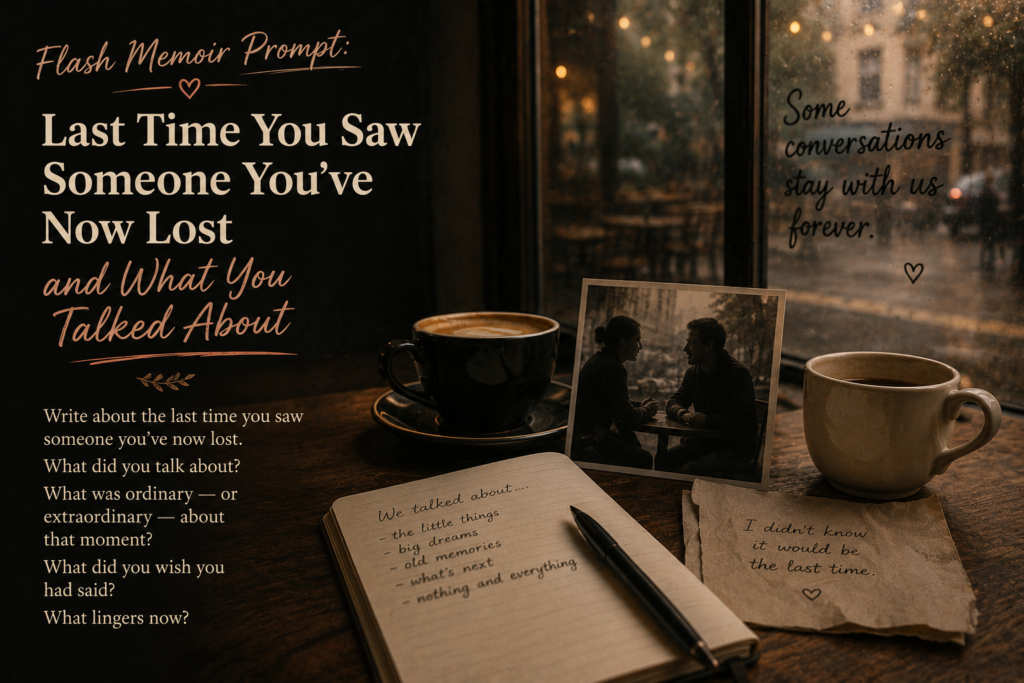
Flash Memoir Prompt: First Time You Were Given a Compliment that You Actually Believed

flash memoir prompt first time given compliment actually believed

A warm flash memoir prompt for remembering the first compliment that felt true, and the small moment when someone else’s words finally reached you.

There is a strange little pause that happens when a compliment lands. Maybe you were used to brushing praise away. Maybe you laughed, changed the subject, or said, “No, I’m not,” before the other person even finished speaking. Then one day, someone said something simple, and for once, you did not argue with it.

This flash memoir prompt, the first time you were given a compliment you actually believed, invites you to return to that exact moment. Not the long history of why compliments were hard to accept. Just the first time one slipped past your defenses and settled somewhere honest.

flash memoir prompt first time given compliment actually believed

The Prompt

Write about the first time you were given a compliment that you actually believed.

This prompt can unlock a meaningful memory because it is rarely just about the compliment. It is about who said it, how they said it, where you were standing, and why those words felt different from all the others.

Maybe the compliment came from a teacher who noticed your writing. Maybe it came from a coach, a grandparent, a friend, or someone you barely knew. Maybe it was not dramatic at all. Sometimes the words we believe are quiet ones, said in a hallway, at a kitchen table, or after a hard day when we had almost given up.

Why This Memory Matters

A believable compliment can mark a shift in how you see yourself. It might be the first time you felt talented, kind, brave, funny, capable, or worth noticing. That kind of memory has power because it shows a moment when your inner story changed.

This prompt may uncover a story about self-doubt. It may bring up a time when you wanted approval but did not know how to receive it. It may also reveal how much one thoughtful sentence can matter when it comes from the right person at the right time.

For student writers, this is a useful prompt because it keeps the memory focused. You do not have to explain your entire childhood or every reason you lacked confidence. You can build the scene around one compliment and let the reader understand the rest through detail.

If you are exploring broader meaning in your writing, you might find it helpful to think about the larger idea behind the scene. This is similar to how readers learn to identify theme in literature. A small moment can point toward a bigger truth without needing to announce it.

How to Approach This Prompt

Begin with the place where the compliment happened. Put yourself back in the room, the car, the classroom, the parking lot, or the store aisle. What were you holding? What could you hear? What did the light look like?

Then narrow the memory to one scene. Avoid trying to tell the whole story of your confidence or insecurity. Stay close to the moment when the words were said.

Write what you noticed before explaining what it meant. Maybe you noticed the person did not smile in a joking way. Maybe they looked you straight in the eye. Maybe their voice was ordinary, which made the compliment feel more real.

You might start with a physical detail, such as your hands under the desk, your shoes on the floor, or the heat in your face. A physical detail can make the emotion easier to write because it gives the memory something solid to stand on.

If you like to mark up memories before drafting, try borrowing a reading habit. Circle the words that carry feeling, underline the turning point, or make a note beside the moment that changed you. These simple moves are close to the skills used when you annotate literature, and they can help you notice what matters in your own story.

As you write, resist the urge to make the compliment sound perfect. Real compliments are often plain. “You’re good at this.” “That was brave.” “I trust you.” “You made the room feel lighter.” The truth of the memory does not need fancy language.

A Quick Example

I was sixteen, wiping down tables at the diner after the lunch rush. My shirt smelled like fryer oil, and my shoes stuck to the floor near the soda machine. Mrs. Alvarez, the owner, stood behind the counter counting change. I had just calmed down a customer who was angry about his order, though my hands shook the whole time. She looked up and said, “You keep your head when people lose theirs.” I waited for the joke or the correction. It did not come. She went back to counting quarters. I stood there with the wet rag in my hand, feeling taller than I had five minutes before. No one had ever called me calm. But that day, I believed her.

Try It Yourself

Set a timer for ten minutes and write the scene as clearly as you can. Do not worry about making it polished. Focus on the moment the compliment was spoken and what happened inside you right after.

If you get stuck, use this sentence starter: “I did not believe compliments back then, but when they said…” Let the memory continue from there.

This flash memoir prompt first time given compliment actually believed works best when you keep it small. One voice. One sentence. One shift. That is enough for a strong flash memoir piece.

Want More Flash Memoir Prompts?

If this prompt helped you remember a moment you had nearly forgotten, keep going. Explore all 365 prompts in The Memory Trigger: 365 Flash Memoir Writing Prompts.