Some images feel like they already contain a story before a single word arrives. A flickering motel sign in the rain. A suitcase left beside a vending machine. An empty highway with no headlights coming. The image does not explain itself, which is exactly why it can unlock strong poetry.
This ekphrasis poetry prompt asks you to enter the emotional atmosphere of an image instead of simply describing it. You are not writing a summary of what you see. You are writing toward the feeling underneath it.
Ekphrasis Poetry Prompt: The Motel Sign Still Buzzing
Write a poem inspired by an empty roadside motel at midnight during a storm.
Somewhere nearby, a neon sign still buzzes. A suitcase sits abandoned beside a vending machine. Rain keeps falling. No one arrives.
Your speaker may be someone who stayed there years ago, someone passing through, someone waiting for a person who never came back, or even someone who cannot leave. The poem can stay realistic or drift toward the surreal.
Try to focus on sensory detail instead of explanation. Let the image create emotional pressure on its own.
Questions to Explore
Why was the suitcase left behind?
What does the storm seem to remember?
What feeling hangs in the silence?
Or, what happened just before this moment?
What does the speaker refuse to admit?
You do not need to answer every question directly. Sometimes the strongest poems leave part of the image unresolved.
Why This Ekphrasis Poetry Prompt Works
Ekphrasis poetry becomes powerful when the image feels emotionally alive. An empty motel can suggest escape, regret, loneliness, freedom, disappearance, memory, or reinvention without stating any of those ideas outright.
Images like this give poets something concrete to return to while writing. The glowing sign, the rainwater, the cracked pavement, and the abandoned suitcase can act as emotional anchors throughout the poem.
If the poem feels stuck, narrow your focus. Write only about the sound of the rain hitting the sign. Write only about the suitcase handle. Or, write only about the color of the reflected neon on the wet asphalt.
Small details often carry the emotional weight.
Try Different Angles
You could write this poem as:
A narrative free verse poem
A fragmented prose poem
A noir-inspired monologue
A memory poem about leaving home
A surreal dream poem
A poem spoken by the motel itself
The image does not need to stay literal. Let it shift as the poem develops.
A Final Thought
Good ekphrasis poetry does not just describe an image. It enters it. The goal is not accuracy. The goal is emotional resonance.
Somewhere in the storm, the motel sign is still buzzing. Let the poem begin there.
Sometimes an image feels less like a picture and more like a memory waiting for language. That is part of what makes ekphrasis poetry so powerful. A poet looks closely at a visual image and begins to speak back to it. The poem becomes a conversation between silence and observation.
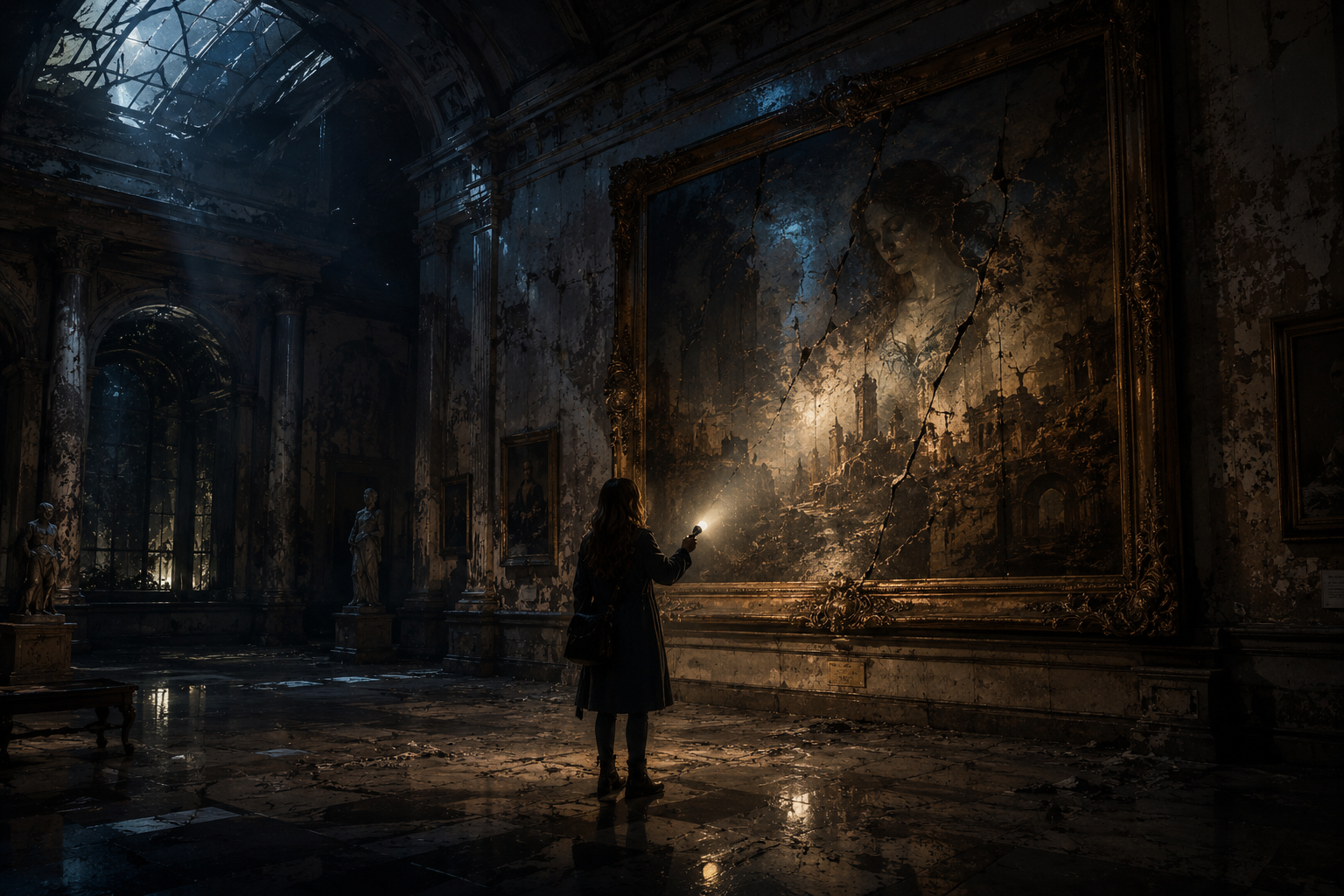
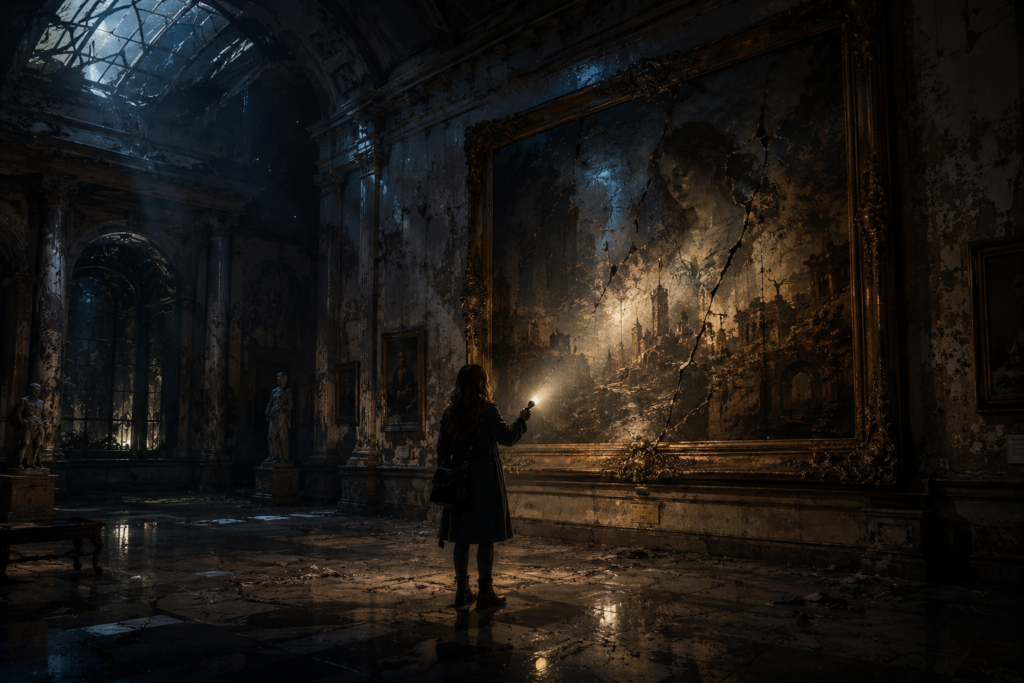
This ekphrasis poetry prompt invites you to write from the emotional atmosphere of an abandoned museum and a damaged painting that seems to hold a secret inside it.
In this Prompt
What ekphrasis poetry is
How to approach the image emotionally
A creative poetry prompt
Questions to deepen the poem
Tips for strong sensory writing
What Is Ekphrasis Poetry?
Ekphrasis poetry is poetry inspired by visual art.
The art can be real or imagined. A poet might respond to a painting, sculpture, photograph, film still, or even a mural seen on the side of a building. Sometimes the poem describes the image directly. Sometimes it explores the emotions, memories, or hidden story behind it.
John Keats’ “Ode on a Grecian Urn” remains one of the most famous examples. Modern poets often use ekphrasis to explore grief, identity, memory, fear, beauty, or history through visual details.
The goal is not to explain the image perfectly. The goal is to let the image open a door inside the poem.
The Prompt
Look at the image of the abandoned museum and the cracked painting.
Write a poem about the moment someone realizes the painting is trying to tell them something.
The message may be literal or emotional. The painting might remind the speaker of a forgotten memory, a lost relationship, a fear they buried, or a version of themselves they no longer recognize.
You can write in first person, second person, or third person.
You might focus on:
The silence of the museum
The flashlight beam moving across the damaged canvas
The feeling that the painting is watching back
What the cracks in the artwork reveal
Why the speaker came to the museum in the first place
Whether the painting offers comfort or warning
You do not need to explain everything. Mystery often gives ekphrasis poetry its emotional force.
Questions That Can Deepen the Poem
What emotion appears first when the speaker sees the painting?
What detail feels impossible to ignore?
Ask, what does the broken artwork reveal about the speaker’s own life?
What sounds fill the empty museum?
Does the speaker leave changed?
Tips for Writing the Poem
Focus on sensory detail before explanation. Let readers hear the echo of footsteps, smell dust in the air, or notice the cold light on marble floors.
Avoid summarizing the image too quickly. Stay inside one moment long enough for tension to build.
Strong ekphrasis poetry often moves from observation into reflection. The image becomes a mirror for something human.
You can also let the painting remain partly unknowable. Some of the strongest poems leave space for uncertainty.
Final Thought
A powerful image can hold emotion before language ever arrives. Ekphrasis poetry gives writers a way to step inside that silence and answer it.
The abandoned museum in this prompt is not just a setting. It is a place where memory, art, loneliness, and imagination begin speaking at the same time.
A clear, step-by-step way to understand Dickinson’s poems—even if they feel confusing at first
Emily Dickinson can feel strange the first time you read her. The short lines, the dashes, the capital letters, and the deep ideas can make even simple poems feel hard to follow. But once you learn how to read Emily Dickinson, her poems become surprisingly clear, powerful, and even personal. This guide will walk you through a simple method you can use right away, with real examples from her most famous poems.
This article contains affilate links.
In this Guide
Why Emily Dickinson feels difficult
Step 1: Read the poem slowly
Step 2: Look at punctuation and dashes
Step 3: Identify the speaker and situation
Step 4: Find the central idea or theme
Step 5: Notice imagery and symbolism
Step 6: Paraphrase the poem
Step 7: Connect it to a bigger meaning
FAQs about reading Emily Dickinson
Key takeaway
Why Learning How to Read Emily Dickinson Matters
Emily Dickinson’s poetry looks simple, but it carries deep meaning in very small spaces.
When you learn how to read Emily Dickinson, you are learning how to slow down and notice details. Her poems often deal with death, hope, faith, and the inner life, which makes them widely taught in schools. For example, in “Hope is the thing with feathers,” she turns hope into a bird. That sounds simple, but the meaning grows as you read more closely.
When learning how to read Emily Dickinson, the biggest mistake is rushing. Her poems are short, so each word matters.
For example, in “Because I could not stop for Death,” the opening line seems calm: “Because I could not stop for Death – He kindly stopped for me –”
At first, it sounds polite. But if you slow down, you notice something strange: Death is personified as a polite driver. That small detail changes the tone completely.
Her poems are compressed and leave out context. She expects readers to fill in the gaps.
What do the dashes mean?
They create pauses, emphasize ideas, and show shifts in thought or emotion.
Do Dickinson’s poems have one correct meaning?
No. Many poems allow for multiple interpretations, as long as they are supported by the text.
Where should beginners start?
Start with well-known poems like “Hope is the thing with feathers” and “Because I could not stop for Death.”
Key Takeaway
Learning how to read Emily Dickinson is about slowing down and noticing details. Her poems may look simple, but they reward careful reading. When you pay attention to punctuation, imagery, and theme, her work becomes clear and deeply meaningful.
How Close Reading, Paradox, and Imagery Reveal Meaning in Dickinson’s Poetry
Literary theory gives us different lenses for interpreting literature. Each theory asks us to look at a text in a different way. Some theories focus on history. Some focus on the author. Others focus on culture or politics. New Criticism (also known as Formalism) is different because it tells us to focus only on the text itself.
When we read Emily Dickinson through New Criticism, we begin to notice how much meaning is hidden in her word choice, punctuation, rhyme, and imagery. Her poems are short, but they are very dense.
What New Criticism Is Key Ideas of New Criticism New Criticism Emily Dickinson Analysis Example Passages and Analysis How to Write a New Criticism Essay Final Thoughts FAQ
Image by Carla Paton
What Is New Criticism?
New Criticism Emily Dickinson begins with a simple idea: the meaning of a poem is inside the poem itself. We do not need the author’s biography. We do not need historical background. And, we do not need to know what the author intended.
Instead, we look closely at the words on the page. We pay attention to imagery, rhyme, paradox, irony, tone, and structure. New Critics believed that a poem is like a machine. Each part works together to create meaning.
New Criticism Emily Dickinson analysis usually focuses on a few important ideas. The first is close reading, which means reading slowly and paying attention to every word.
The second is paradox, which is when a poem contains ideas that seem to contradict each other but are both true.
The third is irony, where the meaning is different from what we expect.
The fourth is tension, which is the conflict between different ideas in the poem.
The fifth is unity, which means that all parts of the poem work together to create a single meaning.
Dickinson’s poetry is full of paradox and tension, which is why New Criticism works so well with her poems.
New Criticism Emily Dickinson analysis works well because Dickinson’s poems are very compact. She uses dashes, slant rhyme, and unusual capitalization. These are not random choices. New Critics would say that every punctuation mark matters. Every word matters. Every sound matters.
For example, in the poem “Because I could not stop for Death,” Death is described as kind and polite. This creates tension because death is normally frightening. The poem creates meaning through this contrast.
The slow rhythm of the poem also mirrors the slow carriage ride toward death. A New Critic would focus on how the rhythm, imagery, and tone all work together to create meaning.
Not on Dickinson’s life. Not on history. Only on the poem.
Let’s look at a short example from Emily Dickinson:
“Hope is the thing with feathers That perches in the soul”
A New Criticism Emily Dickinson reading would focus on the metaphor of the bird. Hope is not described as an idea. It is described as a living creature. The word “perches” suggests that hope stays and does not leave easily. The image of feathers suggests something light and gentle.
The poem never clearly defines hope, but the metaphor helps us understand it emotionally. The poem also creates tension because hope sings during storms. This creates a contrast between suffering and comfort.
A New Critic would argue that the meaning of the poem comes from this contrast and from the extended metaphor.
If you are writing a New Criticism Emily Dickinson essay, focus only on the poem. Do not write about Dickinson’s biography. Do not write about history unless it appears in the poem itself.
Start with a thesis about how the poem creates meaning through literary devices. Then write body paragraphs about imagery, paradox, tone, and structure.
Always include short quotations from the poem as evidence. Then explain how the words create meaning.
New Criticism Emily Dickinson analysis teaches us an important lesson. Great poems are carefully constructed. Every word matters. Every image matters. When we slow down and read carefully, we begin to see patterns, contrasts, and symbols that we did not notice at first.
Emily Dickinson’s poetry is perfect for this kind of reading because her poems are short but full of meaning. New Criticism helps us see how much meaning can fit into just a few lines of poetry. Once you learn this method, you will start to see poetry differently. You will start to see that poems are not just written. They are built.
Key Takeaway
New Criticism teaches us to focus on the text itself, and Emily Dickinson’s poetry shows us why this method works so well. Her poems create meaning through imagery, paradox, irony, and structure, and close reading helps us see how all the parts work together.
FAQ – New Criticism Emily Dickinson
What is New Criticism in simple terms?
New Criticism is a way of reading literature that focuses only on the text itself, not the author’s life or historical background.
Why is Emily Dickinson good for New Criticism?
Her poems are short, dense, and full of literary devices like paradox, symbolism, and irony, which makes them perfect for close reading.
What literary devices do New Critics look for?
They often look for paradox, irony, symbolism, imagery, tone, and structure.
Do New Critics care about the author’s life?
No. New Criticism focuses only on the text itself.
How do you write a New Criticism essay?
Focus on literary devices, include quotations, and explain how the words create meaning.
How to recognize the tools poets use to create meaning, emotion, and beauty
Poetry can sometimes feel confusing when you first read it. The language may seem strange, the lines may be short, and the meaning may not be obvious at first. Many students feel lost because poems do not always tell a clear story the way a novel does. But once you understand literary devices in poetry, poems become much easier to understand and much more enjoyable to read.
Poets use literary devices as tools. These tools help them create images, express emotions, and communicate ideas in powerful ways. When you learn to recognize these tools, you begin to see how a poem works instead of just guessing what it means.
Key idea: Literary devices are the tools poets use to create meaning.
In this guide, we will look at the most important literary devices in poetry, how to recognize them, and how they help you understand a poem more deeply.
In this Guide 📚
What are literary devices in poetry Why poets use literary devices Imagery Metaphor Simile Symbolism Personification Sound devices How literary devices create theme How to analyze literary devices in poetry
Image by Carla Paton
What Are Literary Devices in Poetry?
Literary devices in poetry are techniques that poets use to create meaning, emotion, and imagery. These devices include metaphor, simile, symbolism, imagery, personification, alliteration, and many others.
When poets write, they do not usually explain everything directly. Instead, they show ideas through language. Literary devices help them do this.
For example, instead of saying “I feel sad,” a poet might describe a dark sky, a cold wind, or a dying flower. These images help the reader feel the emotion rather than just read about it.
Poets use literary devices because poetry is meant to be felt as well as understood. Literary devices help poets compress meaning into a small number of words.
A poem is usually short, so every word matters. Literary devices allow poets to say more with fewer words.
For example, in Emily Dickinson’s poem: “Hope is the thing with feathers That perches in the soul”
Dickinson does not define hope in a dictionary way. Instead, she uses a metaphor. She compares hope to a bird. This image helps the reader understand that hope is alive, gentle, and always present.
This is why literary devices in poetry are not decorations. They are the meaning.
Imagery is one of the most important literary devices in poetry. Imagery is language that appeals to the senses. It helps the reader see, hear, feel, smell, or taste what is happening in the poem.
Consider these lines from William Wordsworth: “I wandered lonely as a cloud That floats on high o’er vales and hills”
This image helps us see the speaker floating above the landscape. The image also creates a feeling of calm and quiet.
When you look for imagery, ask yourself: What do I see? What do I hear? What do I feel?
Metaphor and simile are comparisons. They show how two different things are similar.
A simile uses the words “like” or “as.” A metaphor does not.
Example of simile from Robert Burns: “O my Luve’s like a red, red rose”
Example of metaphor from Langston Hughes: “Life is a broken-winged bird That cannot fly”
These comparisons help readers understand ideas through images. Instead of explaining life in abstract terms, Hughes compares life to a bird that cannot fly. This creates a strong emotional image.
When you find a metaphor or simile, ask what the comparison is trying to show you.
Symbolism in Poetry
Symbolism is when an object represents a larger idea.
In Robert Frost’s poem “The Road Not Taken,” the road is not just a road. It represents life choices.
Symbols often represent ideas like: Life Death Hope Freedom Time Innocence
Personification is when human qualities are given to animals, objects, or ideas.
Example from Emily Dickinson: “Because I could not stop for Death – He kindly stopped for me”
Death is described as a polite person. This changes how we think about death. Instead of something frightening, it becomes something calm and inevitable.
Personification helps poets turn abstract ideas into characters.
Sound Devices in Poetry
Poetry is meant to be heard as well as read. Sound devices are very important literary devices in poetry.
Common sound devices include: Alliteration – repetition of beginning sounds Assonance – repetition of vowel sounds Consonance – repetition of consonant sounds Rhyme – repetition of end sounds
Example of alliteration from Edgar Allan Poe: “While I nodded, nearly napping”
The repetition of the “n” sound creates rhythm and mood.
Sound devices help create music in poetry, which affects how the poem feels.
Image by Carla Paton
How Literary Devices Create Theme
Literary devices are not just small techniques. They help create the theme of the poem.
Theme is the main idea or message of a poem. Poets develop theme through imagery, symbolism, metaphor, and other literary devices.
For example, in many poems, night may symbolize death or loneliness, while morning may symbolize hope or new beginnings.
When analyzing literary devices in poetry, follow this simple process:
First, read the poem slowly. Second, look for imagery and comparisons. Third, look for symbols. Fourth, think about how these devices connect to the theme.
AffiliateThese are excellent resources for understanding literary devices in poetry and learning how to analyze poems more confidently. (Affilate links)
Literary devices in poetry are the tools poets use to create meaning, emotion, and theme. When you learn to recognize imagery, metaphor, symbolism, personification, and sound devices, poetry becomes clearer and more meaningful. Instead of feeling confusing, poems begin to feel like puzzles that you know how to solve.
FAQ – Literary Devices in Poetry
What are literary devices in poetry?
Literary devices in poetry are techniques such as metaphor, simile, imagery, symbolism, and sound devices that poets use to create meaning and emotion.
What are the most common literary devices in poetry?
The most common literary devices in poetry include imagery, metaphor, simile, symbolism, personification, alliteration, and rhyme.
Why are literary devices important in poetry?
Literary devices are important because they help poets express complex ideas and emotions in a small number of words.
How do you identify literary devices in poetry?
Look for descriptive language, comparisons, repeated sounds, and objects that may represent larger ideas.
A Simple Guide to Understanding Poems One Line at a Time
Poetry can feel intimidating at first. Poems often compress ideas into a few lines, use unusual imagery, and leave important meanings unstated. Many readers enjoy poetry but wonder how to analyze poetry step by step in a clear and practical way.
The good news is that poetry analysis relies on the same skills used in close reading and literary interpretation. When you slow down and pay attention to language, patterns begin to appear.
Learning how to analyze poetry step by step means noticing details such as imagery, tone, structure, and repetition. These clues help reveal the poem’s deeper meaning.
If you’re new to close reading, you might first explore this guide:
That article explains the careful reading habits that make poetry analysis possible.
⭐ Key Takeaway
Learning how to analyze poetry step by step means paying attention to small details in language. Imagery, sound, structure, and repetition often reveal the poem’s central meaning.
📚 In This Guide
In this article you’ll learn:
How to analyze poetry step by step
What details scholars look for when reading poems
How imagery and sound shape meaning
A practical example using a public-domain poem
How poetry analysis connects to literary essays
Image by Carla Paton
Step 1: Read the Poem Slowly
A good way to begin how to analyze poetry step by step is to read the poem more than once.
The first reading helps you understand the general subject of the poem. The second reading allows you to notice details.
While reading, ask simple questions:
What seems to be happening?
Who is speaking?
What emotions appear in the poem?
Many scholars recommend reading poems aloud because the sound of the language often reveals meaning.
These books provide helpful guidance for readers learning poetry analysis (affiliate links).
How to Read Poetry Like a Professor — Thomas C. Foster A widely used introduction explaining how imagery, symbolism, and poetic structure shape meaning.