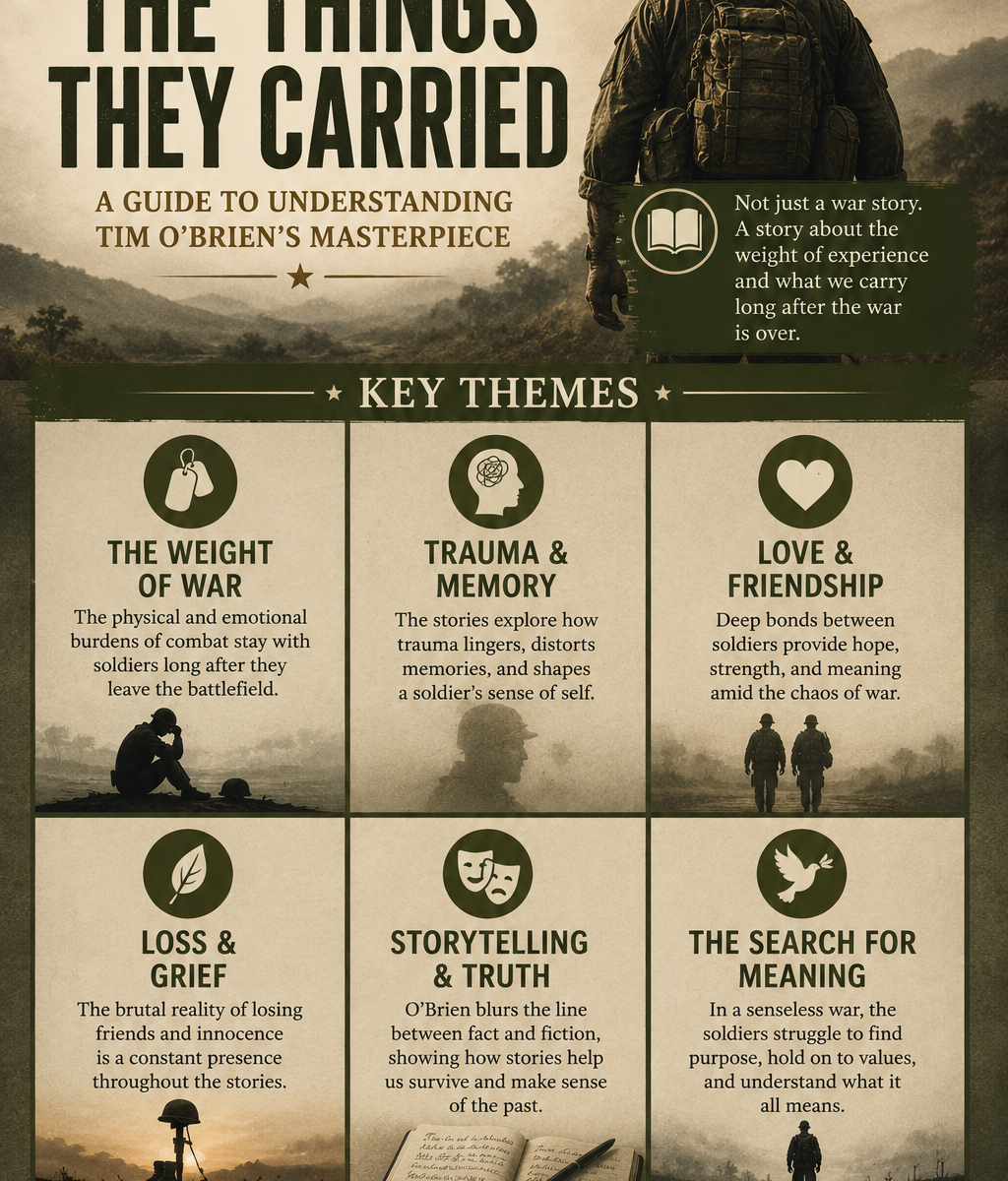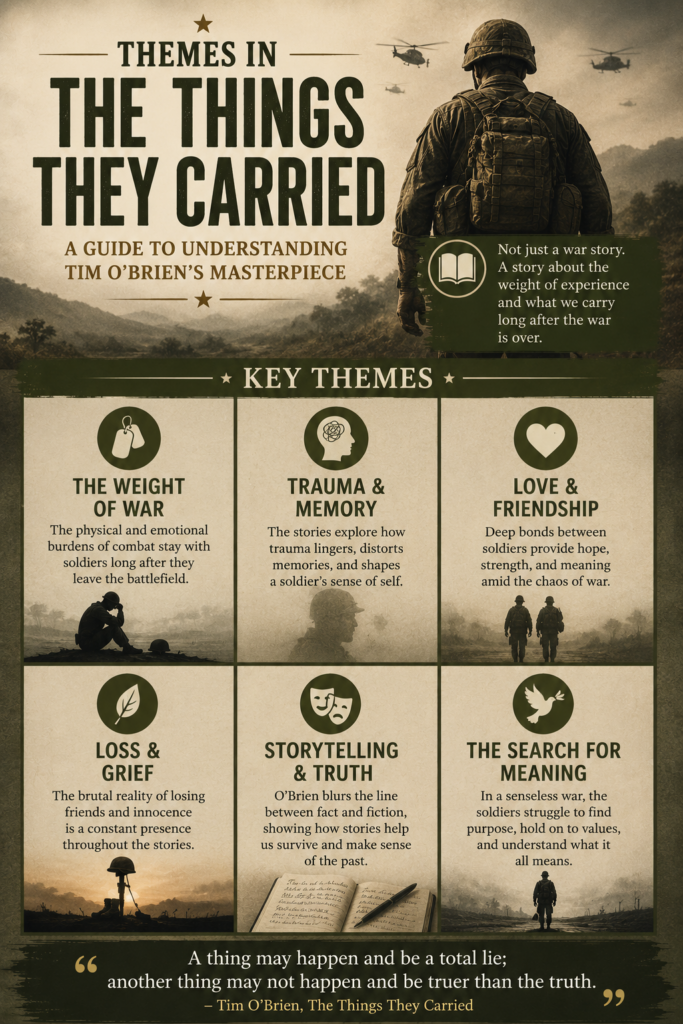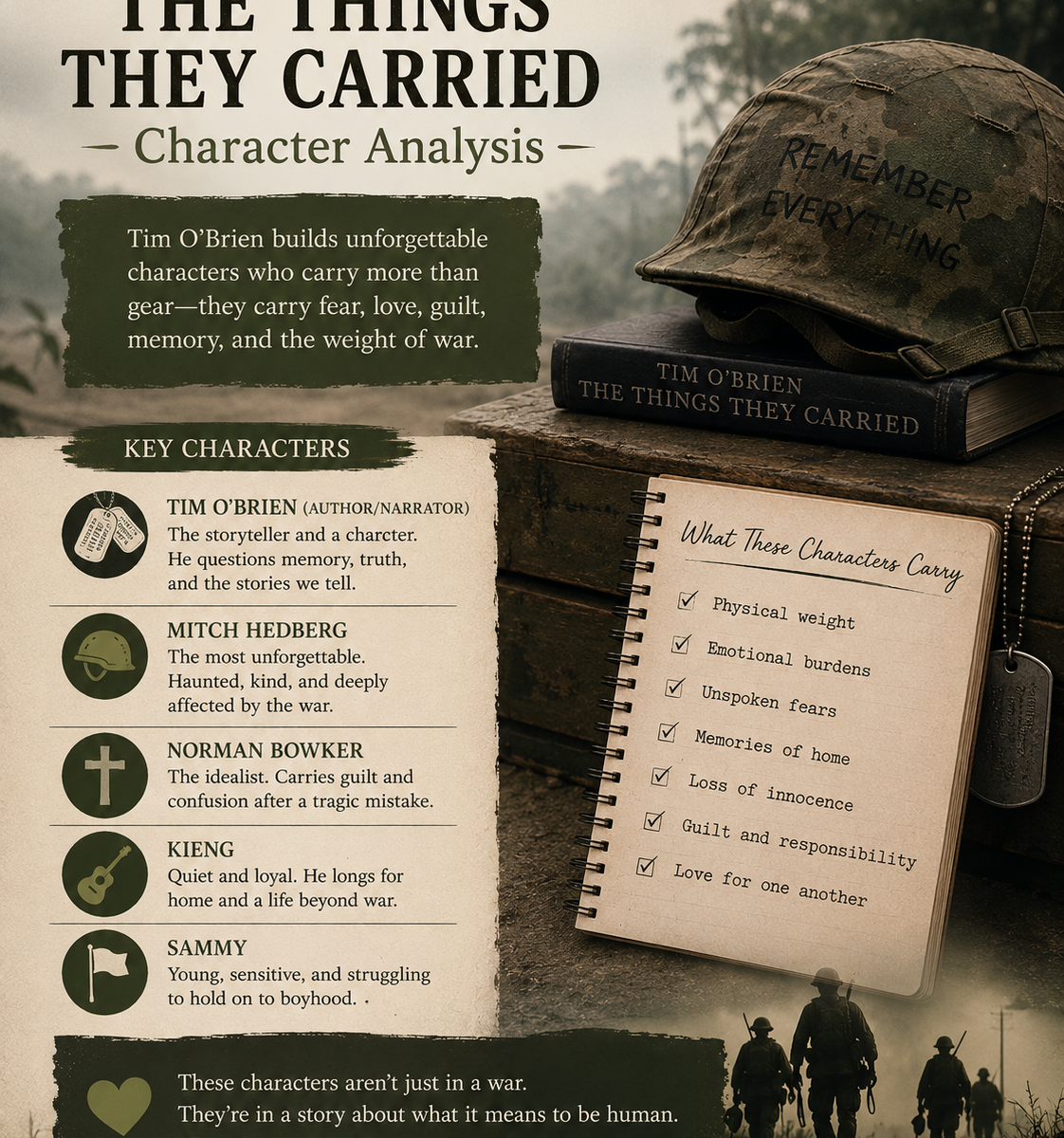
A strong The Things They Carried character analysis helps you see why war in Tim O’Brien’s book feels so personal. The soldiers carry weapons and gear, but they also carry fear, shame, love, and memory.
This guide breaks down the main characters, their motives, and the conflicts that shape each story.
In this Guide
Use these sections to move from quick review to essay-ready ideas.
The Things They Carried Character Analysis: Quick Overview
- Quick overview of the characters
- Tim O’Brien as narrator
- Jimmy Cross and guilt
- The soldiers as a group
- Mary Anne Bell and change
- Major conflicts
- How to use this in essays
- Related books
- FAQ
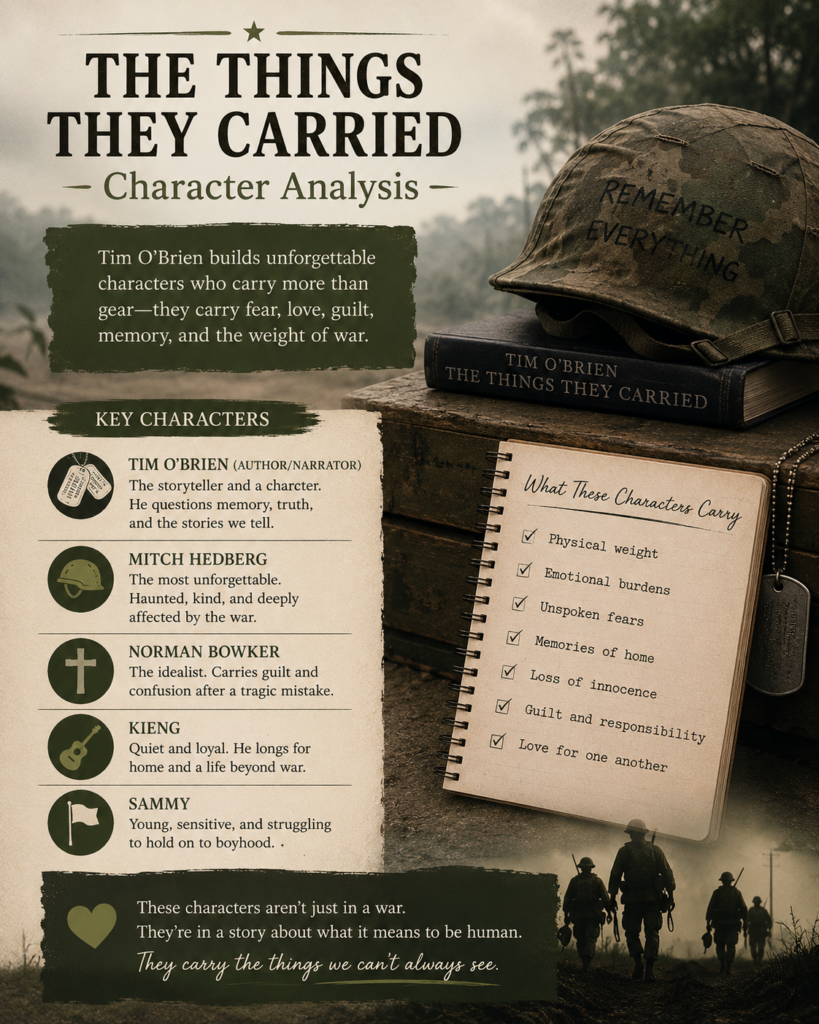
The characters matter because each one shows a different cost of war.
O’Brien does not present the platoon as a simple group of heroes. He shows them as young men under pressure, often scared, often ashamed, and often unsure of what courage even means.
In a The Things They Carried character analysis, it helps to separate what each person carries on the outside from what each person carries inside. The outside items are easy to name. The inner burdens are harder, and that is where the best analysis begins.
Tim O’Brien carries memory and guilt. Jimmy Cross carries love and blame. Kiowa carries faith and calm. Norman Bowker carries silence after the war.
These people do not stay in neat roles. A brave man may panic. A funny man may hide pain. That mix makes the book feel honest.
The Things They Carried character analysis of Tim O’Brien
Tim O’Brien is both a character and the voice that shapes the book.
O’Brien, the narrator, looks back on Vietnam years later. He tells stories because memory will not leave him alone. He also tells stories because plain facts do not seem large enough to hold the truth of war.
This makes him a complex narrator. He does not always ask readers to trust every detail. Instead, he asks them to feel the emotional truth behind the story.
A good The Things They Carried character analysis should note that O’Brien often fights himself. He hates the war, but he goes anyway. He fears shame more than danger. That fear pushes him toward a choice he does not fully believe in.
His inner conflict is clear in “On the Rainy River.” He wants to flee to Canada, yet he cannot bear what his town may think of him. Like Hamlet, he spends much of his time caught between action and doubt.
O’Brien’s motive is not glory. He wants to make sense of trauma. He wants to give shape to memory before it fades or turns false.
For background on the author, see the Britannica profile of Tim O’Brien.
Jimmy Cross: love, guilt, and failed leadership
Jimmy Cross shows how private dreams can clash with public duty.
Lieutenant Jimmy Cross is the platoon’s leader, but he often feels more like a lonely young man than a strong commander. He loves Martha, a college student back home, and he reads her letters as if they can protect him.
His love is not really based on a shared life. It is based on hope. Martha becomes a symbol of the world he wants to return to.
After Ted Lavender dies, Cross blames himself. He thinks his thoughts of Martha made him weak. He burns her letters and photos, but that act does not free him from guilt.
In The Things They Carried character analysis, Cross is useful because he shows one of the book’s central questions: What does responsibility mean when death can happen at random?
Cross wants control, but Vietnam gives him no clear rules. His conflict is not only with the enemy. It is with his own mind.
Key soldiers and what they reveal
The platoon works like a group portrait, with each soldier adding a new angle on fear.
Kiowa
Kiowa is thoughtful, steady, and deeply human. He carries a Bible and often acts as a moral center for the group.
His death in the sewage field is one of the book’s most painful moments. It feels wrong because Kiowa represents kindness in a world that does not reward it.
Kiowa’s conflict is quiet. He tries to hold onto decency while war pushes everyone toward numbness.
Norman Bowker
Norman Bowker survives the war, but survival does not bring peace. At home, he circles a lake and cannot find a way to speak about what happened.
His pain shows that war does not end when soldiers return. His conflict is with silence, memory, and a town that cannot understand him.
Bowker is one of the strongest examples for The Things They Carried character analysis because his story links war trauma to isolation.
Rat Kiley
Rat Kiley is the medic. He tells wild stories, jokes, and tries to keep fear at a distance.
Yet he is not careless. His job forces him close to pain. When the pressure becomes too much, he wounds himself to leave the war.
Rat’s conflict shows how even trained helpers can break under constant fear.
Curt Lemon
Curt Lemon wants to seem brave. He takes risks because he fears looking weak.
His death is sudden and almost unreal. O’Brien describes it in a way that mixes beauty with horror, which makes the moment hard to forget.
Lemon’s motive is pride. His conflict is the gap between real courage and the performance of courage.
Ted Lavender
Ted Lavender carries tranquilizers because he is scared. O’Brien does not mock him for this.
Lavender’s death sets much of the book in motion, especially Jimmy Cross’s guilt. He reminds readers that fear is not a flaw in war. It is a normal response to danger.
Henry Dobbins
Henry Dobbins is large, gentle, and superstitious. He wears his girlfriend’s pantyhose as a charm.
That detail may seem strange, but it shows how soldiers reach for comfort. Dobbins needs belief, even if the belief looks odd from the outside.
Mitchell Sanders and Azar
Mitchell Sanders often tells stories and comments on what happens around him. He helps build the book’s focus on storytelling.
Azar, by contrast, can be cruel. His jokes show how war can twist humor into something harsh.
Together, they show two ways men respond to fear: one tries to explain it, while the other tries to laugh at pain.
Mary Anne Bell: innocence changed by war
She shows that Vietnam changes anyone who enters its world.
Mary Anne arrives as Mark Fossie’s girlfriend. At first, she seems innocent and out of place. Soon, she becomes drawn to the land, the danger, and the freedom she feels there.
Her change disturbs the men because it breaks their idea of what women should be. She does not stay a symbol of home. She becomes part of the war’s strange power.
In The Things They Carried character analysis, Mary Anne is important because she proves that war is not only a setting. It is a force that transforms identity.
Her story also asks a hard question: Did Vietnam reveal something hidden in her, or did it create something new?
The Things They Carried character analysis: major conflicts
The main conflicts are often internal, even when the war seems like the obvious battle.
Man vs. self appears again and again. O’Brien fights shame. Cross fights guilt. Bowker fights silence.
Man vs. society also matters. The soldiers feel trapped by ideas about courage, masculinity, and patriotism. They fear judgment from people who are not even in Vietnam.
Man vs. war shapes the whole book. The soldiers face danger, but they also face confusion. The war has no clear moral path for them.
This is why a The Things They Carried character analysis should not only ask, “What happens to this person?” It should also ask, “What pressure changes this person?”
In Macbeth, guilt grows after a violent act. In O’Brien’s book, guilt often comes from living through violence and not knowing how to explain it.
Using The Things They Carried character analysis in essays
Strong essays connect character choices to larger themes.
Start with a clear claim about one character. Do not just say that Jimmy Cross feels guilty. Say that his guilt shows how war makes leadership feel impossible.
Then use a quote or moment from the text. Explain how the detail works. A strong The Things They Carried character analysis links evidence to meaning, not just plot.
You can also compare characters. For example, Cross and Bowker both carry guilt, but Cross still has a duty to lead, while Bowker feels lost after his duty ends.
If you want a step-by-step method, use our guide on how to analyze characters in literature. It can help you turn notes into a focused paragraph.
You can also pair this post with our character analysis study tool for quote work and class prep.
Books that pair well with this analysis
These books can help you build context for class discussion or a longer essay.
- The Things They Carried by Tim O’Brien
- Going After Cacciato by Tim O’Brien
- All Quiet on the Western Front by Erich Maria Remarque
Remarque’s novel is a useful comparison because it also shows young soldiers changed by fear, duty, and loss.
FAQ: The Things They Carried character analysis
These quick answers can help you review before a discussion post or essay.
Who is the main character in The Things They Carried?
Tim O’Brien is the main voice and central character, but the book also works as a group portrait of the platoon.
What is Jimmy Cross’s main conflict?
Jimmy Cross struggles with guilt. He believes his love for Martha distracted him from his duty as a leader.
Why is Norman Bowker important?
Norman Bowker shows the pain of life after war. His story reveals how trauma can survive long after combat ends.
What does Kiowa represent?
Kiowa often represents faith, kindness, and moral balance. His death shows how war can destroy what is most humane.
How do I write a The Things They Carried character analysis paragraph?
Make a claim, choose a strong detail, and explain how that detail reveals motive or conflict. Keep the focus on meaning, not plot summary.
Key takeaway
The best The Things They Carried character analysis shows that each person carries more than physical weight. O’Brien’s characters carry guilt, fear, love, and memory, which makes the book a lasting study of war’s human cost.